Page 113 of 397
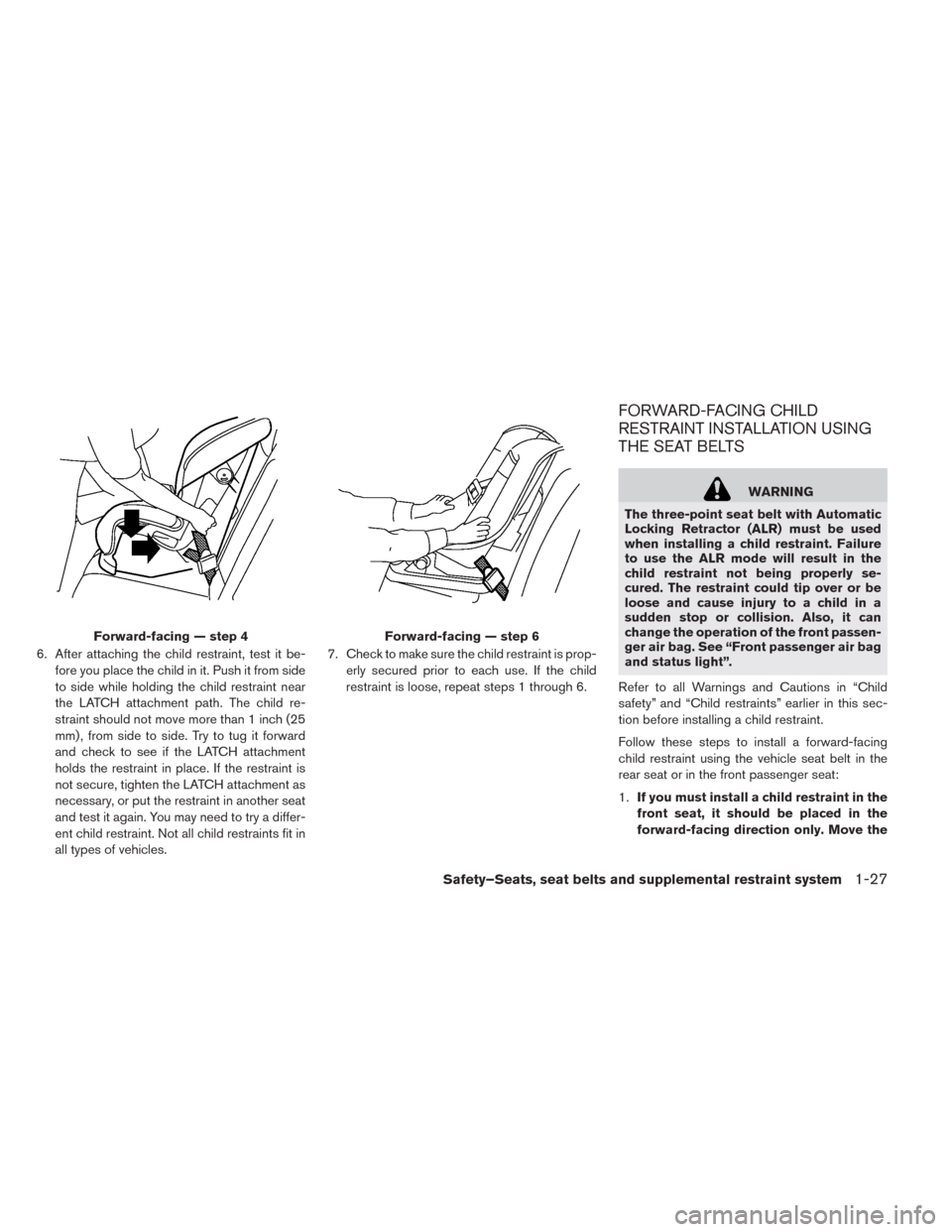
6. After attaching the child restraint, test it be-
fore you place the child in it. Push it from side
to side while holding the child restraint near
the LATCH attachment path. The child re-
straint should not move more than 1 inch (25
mm) , from side to side. Try to tug it forward
and check to see if the LATCH attachment
holds the restraint in place. If the restraint is
not secure, tighten the LATCH attachment as
necessary, or put the restraint in another seat
and test it again. You may need to try a differ-
ent child restraint. Not all child restraints fit in
all types of vehicles.7. Check to make sure the child restraint is prop-
erly secured prior to each use. If the child
restraint is loose, repeat steps 1 through 6.
FORWARD-FACING CHILD
RESTRAINT INSTALLATION USING
THE SEAT BELTS
WARNING
The three-point seat belt with Automatic
Locking Retractor (ALR) must be used
when installing a child restraint. Failure
to use the ALR mode will result in the
child restraint not being properly se-
cured. The restraint could tip over or be
loose and cause injury to a child in a
sudden stop or collision. Also, it can
change the operation of the front passen-
ger air bag. See “Front passenger air bag
and status light”.
Refer to all Warnings and Cautions in “Child
safety” and “Child restraints” earlier in this sec-
tion before installing a child restraint.
Follow these steps to install a forward-facing
child restraint using the vehicle seat belt in the
rear seat or in the front passenger seat:
1.If you must install a child restraint in the
front seat, it should be placed in the
forward-facing direction only. Move the
Forward-facing — step 4Forward-facing — step 6
Safety–Seats, seat belts and supplemental restraint system1-27
Page 114 of 397
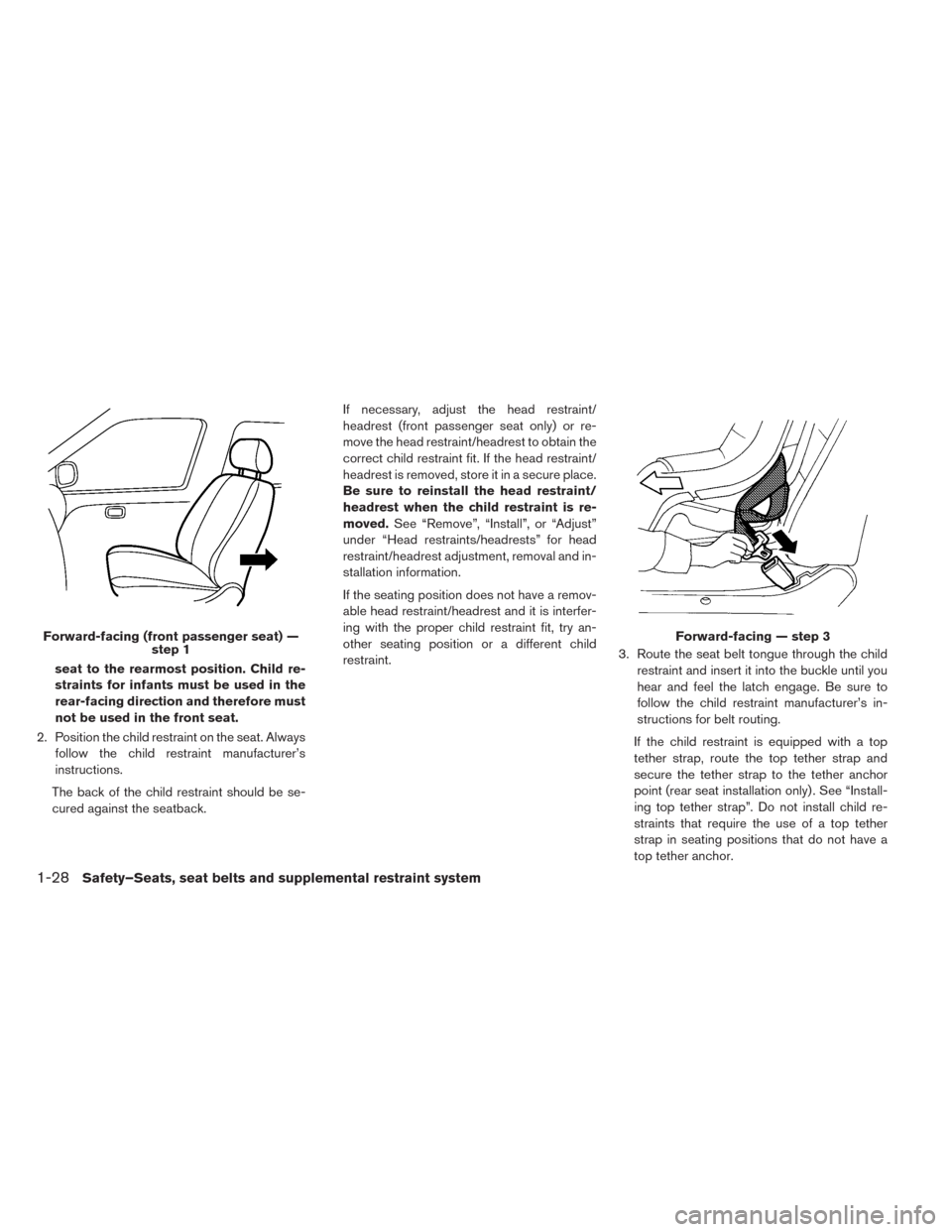
seat to the rearmost position. Child re-
straints for infants must be used in the
rear-facing direction and therefore must
not be used in the front seat.
2. Position the child restraint on the seat. Always
follow the child restraint manufacturer’s
instructions.
The back of the child restraint should be se-
cured against the seatback.If necessary, adjust the head restraint/
headrest (front passenger seat only) or re-
move the head restraint/headrest to obtain the
correct child restraint fit. If the head restraint/
headrest is removed, store it in a secure place.
Be sure to reinstall the head restraint/
headrest when the child restraint is re-
moved.See “Remove”, “Install”, or “Adjust”
under “Head restraints/headrests” for head
restraint/headrest adjustment, removal and in-
stallation information.
If the seating position does not have a remov-
able head restraint/headrest and it is interfer-
ing with the proper child restraint fit, try an-
other seating position or a different child
restraint.3. Route the seat belt tongue through the child
restraint and insert it into the buckle until you
hear and feel the latch engage. Be sure to
follow the child restraint manufacturer’s in-
structions for belt routing.
If the child restraint is equipped with a top
tether strap, route the top tether strap and
secure the tether strap to the tether anchor
point (rear seat installation only) . See “Install-
ing top tether strap”. Do not install child re-
straints that require the use of a top tether
strap in seating positions that do not have a
top tether anchor.
Forward-facing (front passenger seat) —
step 1Forward-facing — step 3
1-28Safety–Seats, seat belts and supplemental restraint system
Page 115 of 397
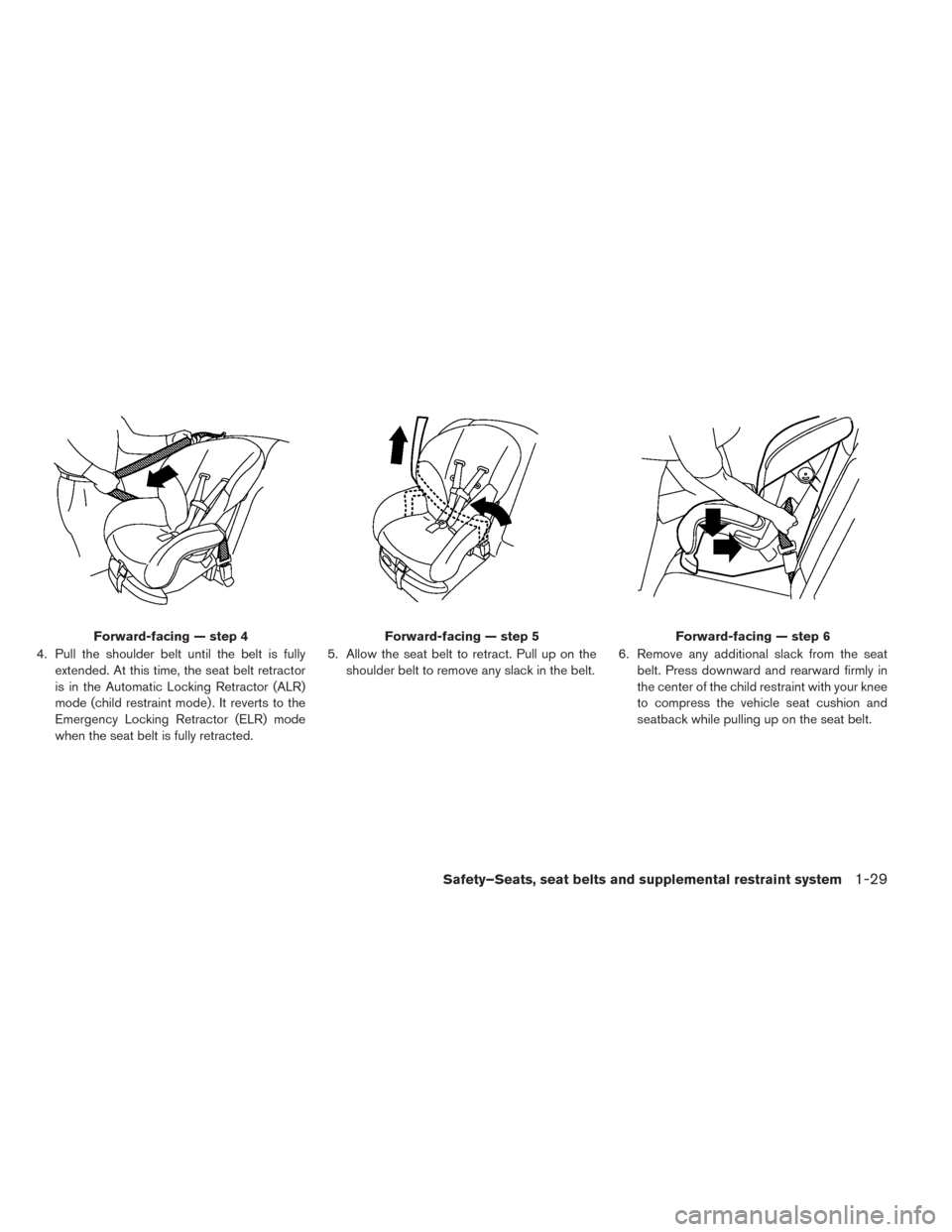
4. Pull the shoulder belt until the belt is fully
extended. At this time, the seat belt retractor
is in the Automatic Locking Retractor (ALR)
mode (child restraint mode) . It reverts to the
Emergency Locking Retractor (ELR) mode
when the seat belt is fully retracted.5. Allow the seat belt to retract. Pull up on the
shoulder belt to remove any slack in the belt.6. Remove any additional slack from the seat
belt. Press downward and rearward firmly in
the center of the child restraint with your knee
to compress the vehicle seat cushion and
seatback while pulling up on the seat belt.
Forward-facing — step 4Forward-facing — step 5Forward-facing — step 6
Safety–Seats, seat belts and supplemental restraint system1-29
Page 120 of 397
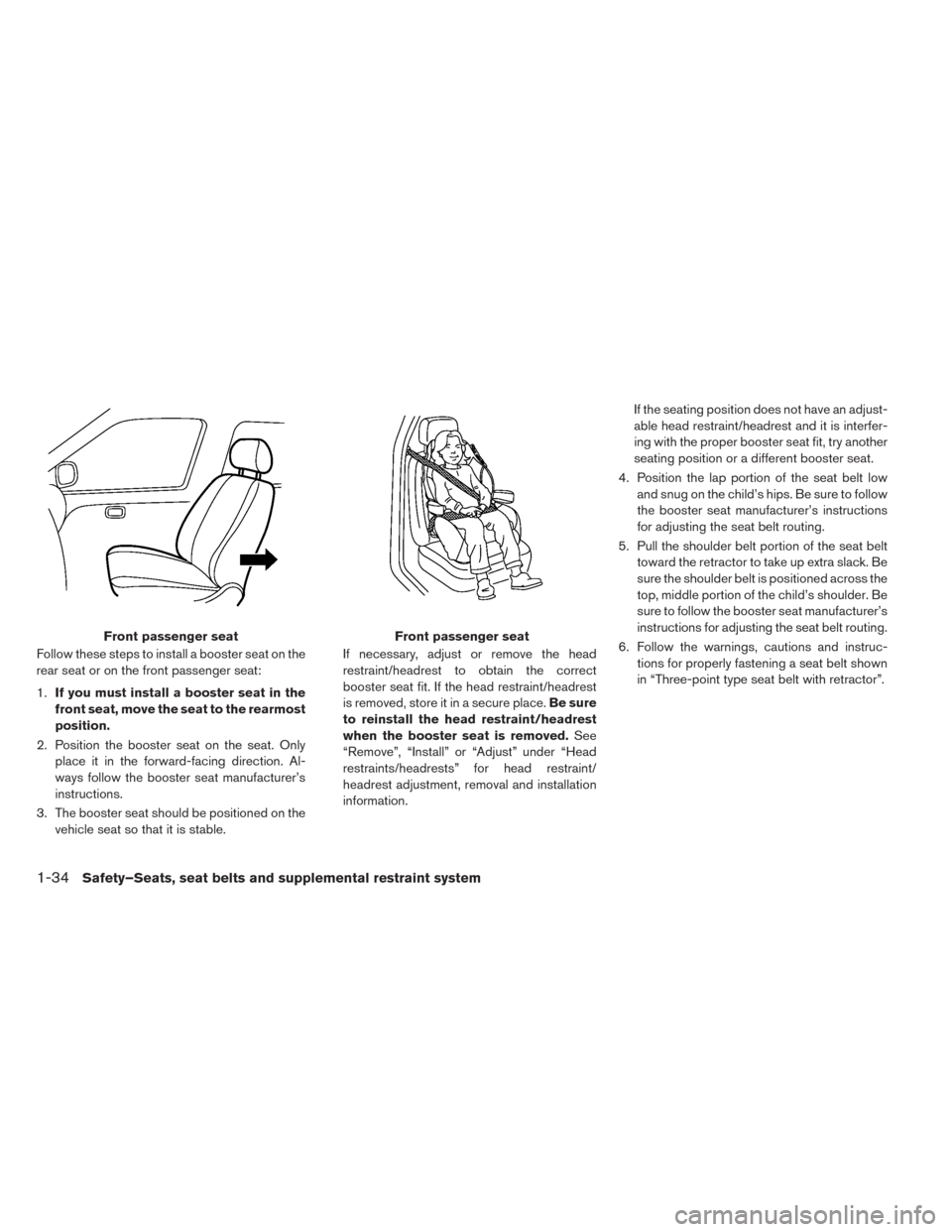
Follow these steps to install a booster seat on the
rear seat or on the front passenger seat:
1.If you must install a booster seat in the
front seat, move the seat to the rearmost
position.
2. Position the booster seat on the seat. Only
place it in the forward-facing direction. Al-
ways follow the booster seat manufacturer’s
instructions.
3. The booster seat should be positioned on the
vehicle seat so that it is stable.If necessary, adjust or remove the head
restraint/headrest to obtain the correct
booster seat fit. If the head restraint/headrest
is removed, store it in a secure place.Be sure
to reinstall the head restraint/headrest
when the booster seat is removed.See
“Remove”, “Install” or “Adjust” under “Head
restraints/headrests” for head restraint/
headrest adjustment, removal and installation
information.If the seating position does not have an adjust-
able head restraint/headrest and it is interfer-
ing with the proper booster seat fit, try another
seating position or a different booster seat.
4. Position the lap portion of the seat belt low
and snug on the child’s hips. Be sure to follow
the booster seat manufacturer’s instructions
for adjusting the seat belt routing.
5. Pull the shoulder belt portion of the seat belt
toward the retractor to take up extra slack. Be
sure the shoulder belt is positioned across the
top, middle portion of the child’s shoulder. Be
sure to follow the booster seat manufacturer’s
instructions for adjusting the seat belt routing.
6. Follow the warnings, cautions and instruc-
tions for properly fastening a seat belt shown
in “Three-point type seat belt with retractor”.
Front passenger seatFront passenger seat
1-34Safety–Seats, seat belts and supplemental restraint system
Page 124 of 397
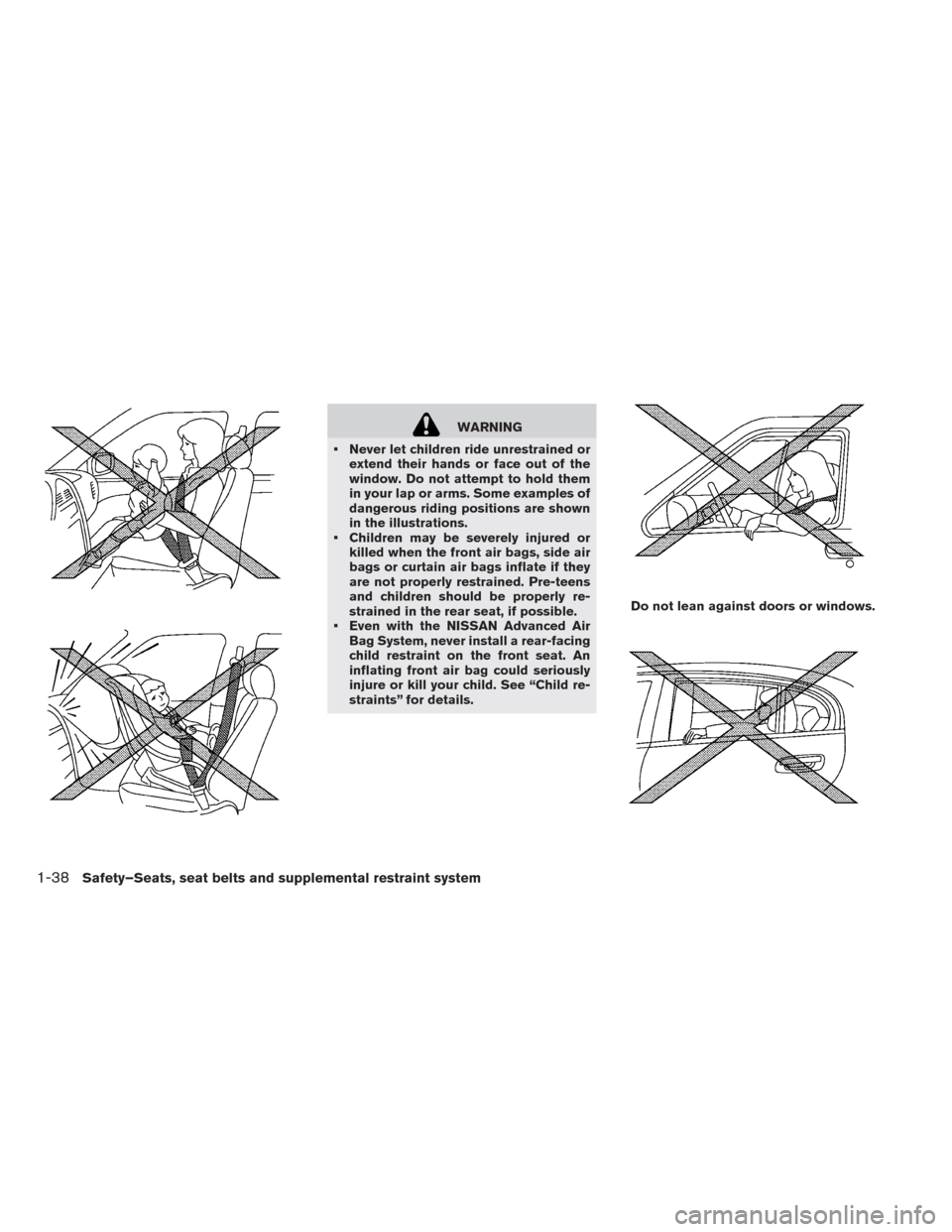
WARNING
• Never let children ride unrestrained or
extend their hands or face out of the
window. Do not attempt to hold them
in your lap or arms. Some examples of
dangerous riding positions are shown
in the illustrations.
• Children may be severely injured or
killed when the front air bags, side air
bags or curtain air bags inflate if they
are not properly restrained. Pre-teens
and children should be properly re-
strained in the rear seat, if possible.
• Even with the NISSAN Advanced Air
Bag System, never install a rear-facing
child restraint on the front seat. An
inflating front air bag could seriously
injure or kill your child. See “Child re-
straints” for details.
Do not lean against doors or windows.
1-38Safety–Seats, seat belts and supplemental restraint system