2014 NISSAN JUKE tow
[x] Cancel search: towPage 310 of 402
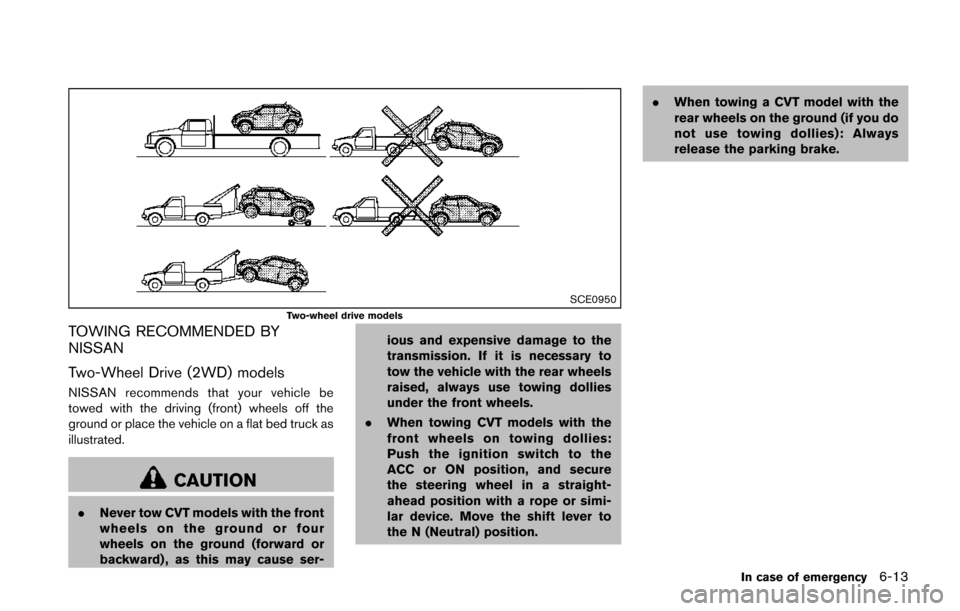
SCE0950Two-wheel drive models
TOWING RECOMMENDED BY
NISSAN
Two-Wheel Drive (2WD) models
NISSAN recommends that your vehicle be
towed with the driving (front) wheels off the
ground or place the vehicle on a flat bed truck as
illustrated.
CAUTION
.Never tow CVT models with the front
wheels on the ground or four
wheels on the ground (forward or
backward) , as this may cause ser- ious and expensive damage to the
transmission. If it is necessary to
tow the vehicle with the rear wheels
raised, always use towing dollies
under the front wheels.
. When towing CVT models with the
front wheels on towing dollies:
Push the ignition switch to the
ACC or ON position, and secure
the steering wheel in a straight-
ahead position with a rope or simi-
lar device. Move the shift lever to
the N (Neutral) position. .
When towing a CVT model with the
rear wheels on the ground (if you do
not use towing dollies): Always
release the parking brake.
In case of emergency6-13
Page 311 of 402
6-14In case of emergency
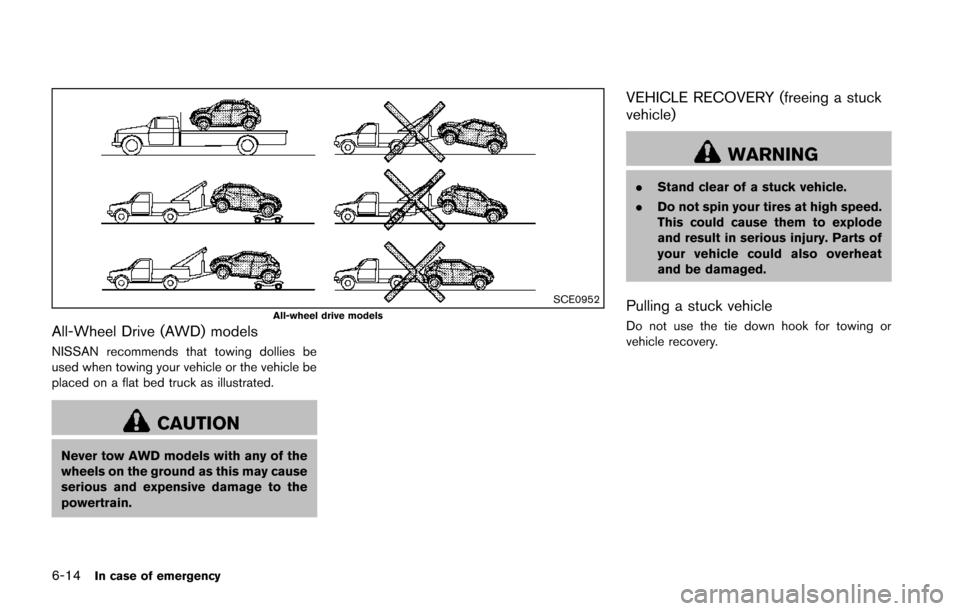
SCE0952All-wheel drive models
All-Wheel Drive (AWD) models
NISSAN recommends that towing dollies be
used when towing your vehicle or the vehicle be
placed on a flat bed truck as illustrated.
CAUTION
Never tow AWD models with any of the
wheels on the ground as this may cause
serious and expensive damage to the
powertrain.
VEHICLE RECOVERY (freeing a stuck
vehicle)
WARNING
.Stand clear of a stuck vehicle.
. Do not spin your tires at high speed.
This could cause them to explode
and result in serious injury. Parts of
your vehicle could also overheat
and be damaged.
Pulling a stuck vehicle
Do not use the tie down hook for towing or
vehicle recovery.
Page 312 of 402
SCE0951Front (except for NISMO models)
JVE0109XFront (NISMO models)
SCE0833
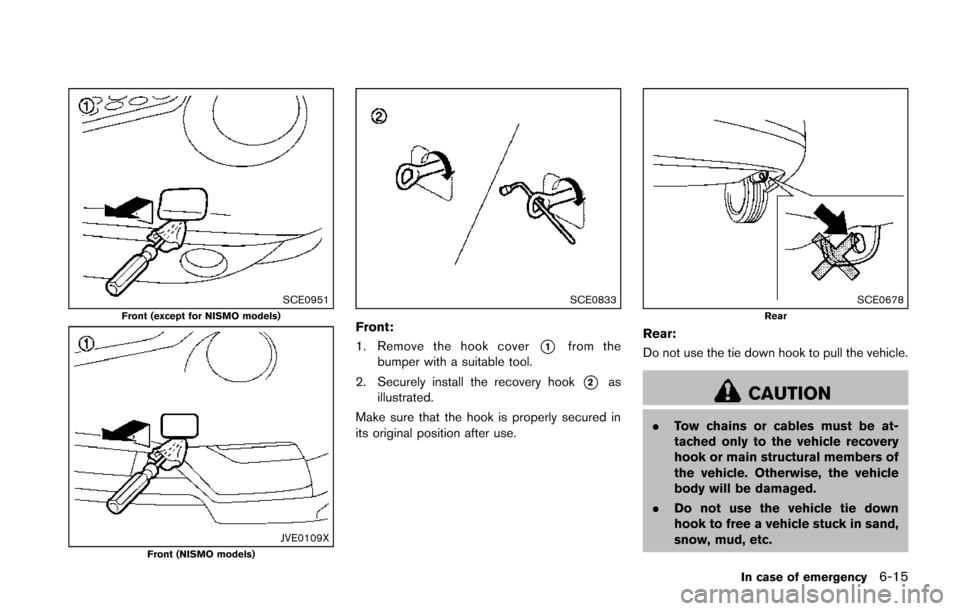
Front:
1. Remove the hook cover
*1from the
bumper with a suitable tool.
2. Securely install the recovery hook
*2as
illustrated.
Make sure that the hook is properly secured in
its original position after use.
SCE0678Rear
Rear:
Do not use the tie down hook to pull the vehicle.
CAUTION
. Tow chains or cables must be at-
tached only to the vehicle recovery
hook or main structural members of
the vehicle. Otherwise, the vehicle
body will be damaged.
. Do not use the vehicle tie down
hook to free a vehicle stuck in sand,
snow, mud, etc.
In case of emergency6-15
Page 313 of 402
6-16In case of emergency
.Never tow a vehicle using the vehi-
cle tie down hook or recovery hook.
. Always pull the cable straight out
from the front of the vehicle. Never
pull on the vehicle at an angle.
. Pulling devices should be routed so
they do not touch any part of the
suspension, steering, brake or cool-
ing systems.
. Pulling devices such as ropes or
canvas straps are not recommended
for use in vehicle towing or recov-
ery.
Rocking a stuck vehicle
If your vehicle is stuck in sand, snow, mud, etc.,
use the following procedure:
1. Turn off the Vehicle Dynamic Control (VDC)
system.
2. Make sure the area in front and behind the vehicle is clear of obstructions.
3. Turn the steering wheel right and left to clear an area around the front tires.
4. Slowly rock the vehicle forward and back- ward.
.Shift back and forth between R (Reverse)and D (Drive) (Continuously Variable Transmission models) or 1st and R
(Reverse) (Manual Transmission models) .
.Apply the accelerator as little as possible
to maintain the rocking motion.
.Release the accelerator pedal beforeshifting between R and D (Continuously
Variable Transmission models) or 1st and
R (Manual Transmission models).
.Do not spin the tires above 35 MPH (55
km/h).
5. If the vehicle cannot be freed after a few tries, contact a professional towing service
to remove the vehicle.
Page 317 of 402
7-4Appearance and care
WHEELS
Wash the wheels when washing the vehicle to
maintain their appearance.
.Clean the inner side of the wheels when the
wheel is changed or the underside of the
vehicle is washed.
. Inspect wheel rims regularly for dents or
corrosion. Such damage may cause loss of
pressure or poor seal at the tire bead.
. NISSAN recommends that the road wheels
be waxed to protect against road salt in
areas where it is used during winter.
CAUTION
Do not use abrasive cleaners when
washing the wheels.
ALUMINUM ALLOY WHEELS
Wash regularly with a sponge dampened in a
mild soap solution, especially during winter
months in areas where road salt is used. Salt
could discolor the wheels if not removed.
CAUTION
Follow the directions below to avoid
staining or discoloring the wheels:
.Do not use a cleaner that uses
strong acid or alkali contents to
clean the wheels.
. Do not apply wheel cleaners to the
wheels when they are hot. The
wheel temperature should be the
same as ambient temperature.
. Rinse the wheel to completely re-
move the cleaner within 15 minutes
after the cleaner is applied.
CHROME PARTS
Clean chrome parts regularly with a non-
abrasive chrome polish to maintain the finish.
TIRE DRESSING
NISSAN does not recommend the use of tire
dressings. Tire manufacturers apply a coating to
the tires to help reduce discoloration of the
rubber. If a tire dressing is applied to the tires, it
may react with the coating and form a com-
pound. This compound may come off the tire
while driving and stain the vehicle paint.
If you choose to use a tire dressing, take the following precautions:
.
Use a water-based tire dressing. The coat-
ing on the tire dissolves more easily with an
oil-based tire dressing.
. Apply a light coat of tire dressing to help
prevent it from entering the tire tread/
grooves (where it would be difficult to
remove) .
. Wipe off excess tire dressing using a dry
towel. Make sure the tire dressing is
completely removed from the tire tread/
grooves.
. Allow the tire dressing to dry as recom-
mended by tire dressing manufacturer.
Page 318 of 402
Occasionally remove loose dust from the interior
trim, plastic parts and seats using a vacuum
cleaner or soft bristled brush. Wipe the vinyl and
leather surfaces with a clean, soft cloth dam-
pened in mild soap solution, then wipe clean
with a dry soft cloth.
Regular care and cleaning is required in order to
maintain the appearance of the leather.
Before using any fabric protector, read the
manufacturer’s recommendations. Some fabric
protectors contain chemicals that may stain or
bleach the seat material.
Use a cloth dampened only with water, to clean
the meter and gauge lens.
WARNING
Do not use water or acidic cleaners (hot
steam cleaners) on the seat. This can
damage the seat or occupant classifica-
tion sensors. This can also affect the
operation of the air bag system and
result in serious personal injury.
CAUTION
.Never use benzine, thinner, or any
similar material.
. For cleaning, use a soft cloth, dam-
pened with water. Never use a rough
cloth, alcohol, benzine, thinner or
any kind of solvent or paper towel
with a chemical cleaning agent.
They will scratch or cause discolora-
tion to the lens.
. Do not spray any liquid such as
water on the meter lens. Spraying
liquid may cause the system to
malfunction.
. Small dirt particles can be abrasive
and damaging to the leather sur-
faces and should be removed
promptly. Do not use saddle soap,
car waxes, polishes, oils, cleaning
fluids, solvents, detergents or am-
monia-based cleaners as they may
damage the leather’s natural finish.
. Never use fabric protectors unless
recommended by the manufacturer.
. Do not use glass or plastic cleaner
on meter or gauge lens covers. It may damage the lens cover.AIR FRESHENERS
Most air fresheners use a solvent that could
affect the vehicle interior. If you use an air
freshener, take the following precautions:
.
Hanging-type air fresheners can cause
permanent discoloration when they contact
vehicle interior surfaces. Place the air
freshener in a location that allows it to hang
free and not contact an interior surface.
. Liquid-type air fresheners typically clip on
the vents. These products can cause
immediate damage and discoloration when
spilled on interior surfaces.
Carefully read and follow the manufacturer’s
instructions before using air fresheners.
Appearance and care7-5
CLEANING INTERIOR
Page 366 of 402
9 Technical and consumer information
Capacities and recommended fuel/lubricants ................... 9-2Fuel information ................................................................... 9-4
Engine oil and oil filter recommendation ....................... 9-6
Air conditioning system refrigerant and
lubricant recommendations ............................................... 9-7
Specifications ........................................................................\
..... 9-8
Engine ........................................................................\
............ 9-8
Wheels and tires ................................................................. 9-8
Dimensions and weights ................................................... 9-9
When traveling or registering your vehicle in
another country ........................................................................\
.. 9-9
Vehicle identification .............................................................. 9-10 Vehicle Identification Number (VIN) plate .................. 9-10
Vehicle identification number (chassis number) ....... 9-10
Engine serial number ....................................................... 9-10
F.M.V.S.S./C.M.V.S.S. certification label .................... 9-11
Emission control information label ............................... 9-11
Tire and Loading Information label .............................. 9-11
Air conditioner specification label ................................ 9-12 Installing front license plate ................................................ 9-13
Vehicle loading information ................................................. 9-14
Terms ........................................................................\
......... 9-14
Vehicle load capacity .................................................... 9-15
Loading tips ..................................................................... 9-16
Measurement of weights .............................................. 9-16
Towing a trailer ....................................................................... 9-17
Flat towing ........................................................................\
....... 9-17 Continuously Variable Transmission (CVT) ............. 9-17
Manual Transmission ..................................................... 9-17
Uniform tire quality grading ................................................. 9-18 Treadwear ........................................................................\
9-18
Traction AA, A, B and C .............................................. 9-18
Temperature A, B and C .............................................. 9-18
Emission control system warranty ..................................... 9-19
Reporting safety defects ..................................................... 9-19
Readiness for Inspection/Maintenance (I/M) test ......... 9-20
Event Data Recorders (EDR) ............................................. 9-21
Owner’s manual/service manual order information ...... 9-21
Page 369 of 402
9-4Technical and consumer information
FUEL INFORMATION
Except for NISMO RS models:
NISSAN recommends the use of unleaded
premium gasoline with an octane rating of at
least 91 AKI (Anti-Knock Index) number (Re-
search octane number 96).
If unleaded premium gasoline is not available,
you may use unleaded regular gasoline with an
octane rating of at least 87 AKI number
(Research octane number 91), but you may
notice a decrease in performance.
For NISMO RS models:
Use unleaded premium gasoline with an octane
rating of at least 91 AKI (Anti-Knock Index)
number (Research octane number 96).
If unleaded premium gasoline is not available,
unleaded regular gasoline with an octane rating
of at least 87 AKI number (Research octane
number 91) may be temporarily used, but only
under the following precautions:
.Have the fuel tank filled only partially with
unleaded regular gasoline, and fill up with
unleaded premium gasoline as soon as
possible.
. Avoid full throttle driving and abrupt accel-
eration.
Use unleaded premium gasoline for max-
imum vehicle performance.CAUTION
. Using a fuel other than that speci-
fied could adversely affect the emis-
sion control system, and may also
affect warranty coverage.
. Under no circumstances should a
leaded gasoline be used, because
this will damage the three-way cat-
alyst.
. Do not use E-15 or E-85 fuel in your
vehicle. Your vehicle is not designed
to run on E-15 or E-85 fuel. Using E-
15 or E-85 fuel in a vehicle not
specifically designed for E-15 or E-
85 fuel can adversely affect the
emission control devices and sys-
tems of the vehicle. Damage caused
by such fuel is not covered by the
NISSAN new vehicle limited war-
ranty.
. U.S. government regulations require
ethanol dispensing pumps to be
identified by a small, square, orange
and black label with the common
abbreviation or the appropriate per-
centage for that region.
Gasoline specifications
NISSAN recommends using gasoline that meets
the World-Wide Fuel Charter (WWFC) speci-
fications where it is available. Many of the
automobile manufacturers developed this spe-
cification to improve emission control system
and vehicle performance. Ask your service
station manager if the gasoline meets the
WWFC specifications.
Reformulated gasoline
Some fuel suppliers are now producing refor-
mulated gasolines. These gasolines are specially
designed to reduce vehicle emissions. NISSAN
supports efforts towards cleaner air and sug-
gests that you use reformulated gasoline when
available.
Gasoline containing oxygenates
Some fuel suppliers sell gasoline containing
oxygenates such as ethanol, MTBE and metha-
nol with or without advertising their presence.
NISSAN does not recommend the use of fuels
of which the oxygenate content and the fuel
compatibility for your NISSAN cannot be readily
determined. If in doubt, ask your service station
manager.
If you use oxygenate-blend gasoline, please take
the following precautions as the usage of such
fuels may cause vehicle performance problems