2014 NISSAN JUKE warning
[x] Cancel search: warningPage 39 of 402
1-18Safety — Seats, seat belts and supplemental restraint system
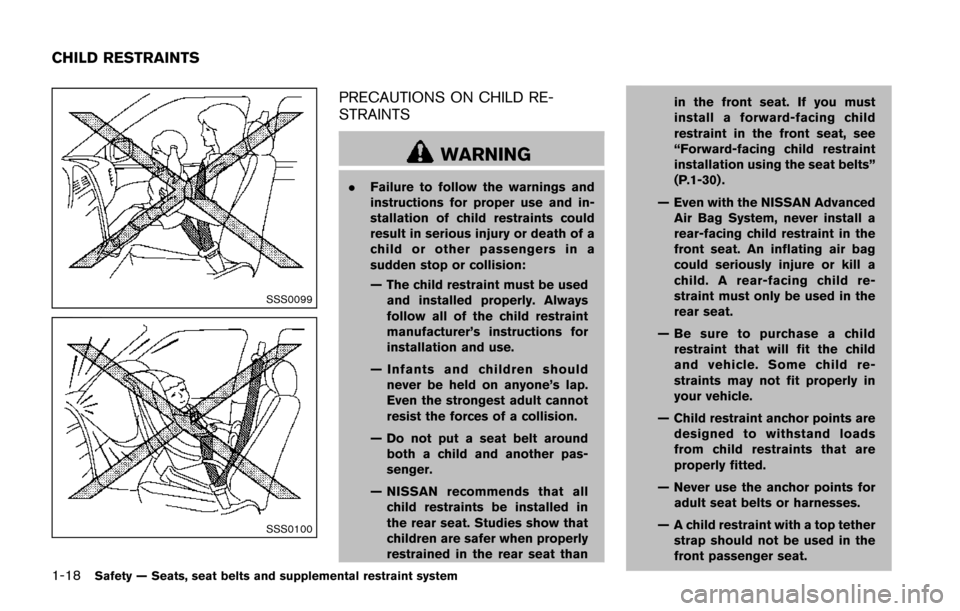
SSS0099
SSS0100
PRECAUTIONS ON CHILD RE-
STRAINTS
WARNING
.Failure to follow the warnings and
instructions for proper use and in-
stallation of child restraints could
result in serious injury or death of a
child or other passengers in a
sudden stop or collision:
— The child restraint must be used
and installed properly. Always
follow all of the child restraint
manufacturer’s instructions for
installation and use.
— Infants and children should never be held on anyone’s lap.
Even the strongest adult cannot
resist the forces of a collision.
— Do not put a seat belt around both a child and another pas-
senger.
— NISSAN recommends that all child restraints be installed in
the rear seat. Studies show that
children are safer when properly
restrained in the rear seat than in the front seat. If you must
install a forward-facing child
restraint in the front seat, see
“Forward-facing child restraint
installation using the seat belts”
(P.1-30) .
— Even with the NISSAN Advanced Air Bag System, never install a
rear-facing child restraint in the
front seat. An inflating air bag
could seriously injure or kill a
child. A rear-facing child re-
straint must only be used in the
rear seat.
— Be sure to purchase a child restraint that will fit the child
and vehicle. Some child re-
straints may not fit properly in
your vehicle.
— Child restraint anchor points are designed to withstand loads
from child restraints that are
properly fitted.
— Never use the anchor points for adult seat belts or harnesses.
— A child restraint with a top tether strap should not be used in the
front passenger seat.
CHILD RESTRAINTS
Page 41 of 402
1-20Safety — Seats, seat belts and supplemental restraint system
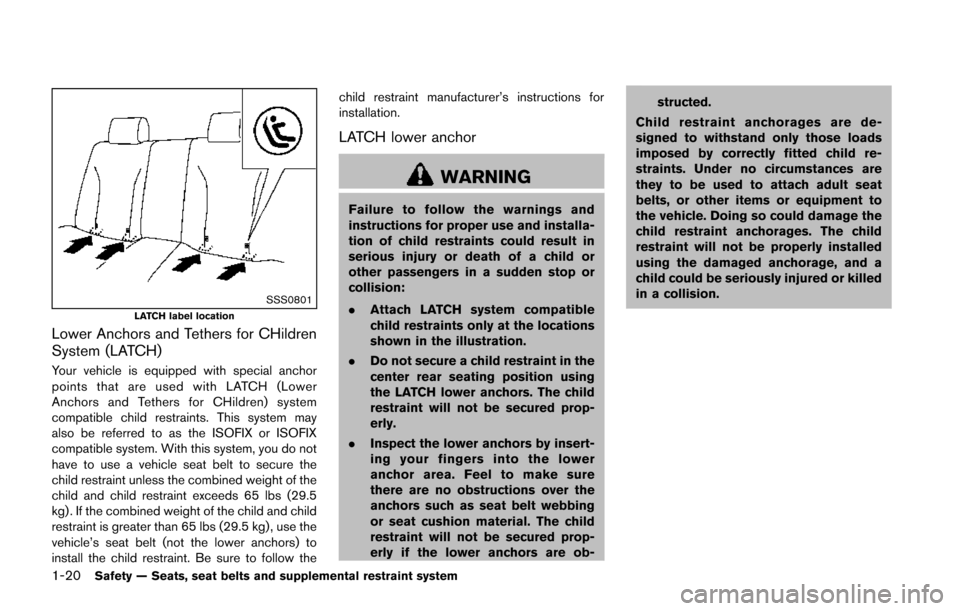
SSS0801LATCH label location
Lower Anchors and Tethers for CHildren
System (LATCH)
Your vehicle is equipped with special anchor
points that are used with LATCH (Lower
Anchors and Tethers for CHildren) system
compatible child restraints. This system may
also be referred to as the ISOFIX or ISOFIX
compatible system. With this system, you do not
have to use a vehicle seat belt to secure the
child restraint unless the combined weight of the
child and child restraint exceeds 65 lbs (29.5
kg) . If the combined weight of the child and child
restraint is greater than 65 lbs (29.5 kg) , use the
vehicle’s seat belt (not the lower anchors) to
install the child restraint. Be sure to follow thechild restraint manufacturer’s instructions for
installation.
LATCH lower anchor
WARNING
Failure to follow the warnings and
instructions for proper use and installa-
tion of child restraints could result in
serious injury or death of a child or
other passengers in a sudden stop or
collision:
.
Attach LATCH system compatible
child restraints only at the locations
shown in the illustration.
. Do not secure a child restraint in the
center rear seating position using
the LATCH lower anchors. The child
restraint will not be secured prop-
erly.
. Inspect the lower anchors by insert-
ing your fingers into the lower
anchor area. Feel to make sure
there are no obstructions over the
anchors such as seat belt webbing
or seat cushion material. The child
restraint will not be secured prop-
erly if the lower anchors are ob- structed.
Child restraint anchorages are de-
signed to withstand only those loads
imposed by correctly fitted child re-
straints. Under no circumstances are
they to be used to attach adult seat
belts, or other items or equipment to
the vehicle. Doing so could damage the
child restraint anchorages. The child
restraint will not be properly installed
using the damaged anchorage, and a
child could be seriously injured or killed
in a collision.
Page 42 of 402
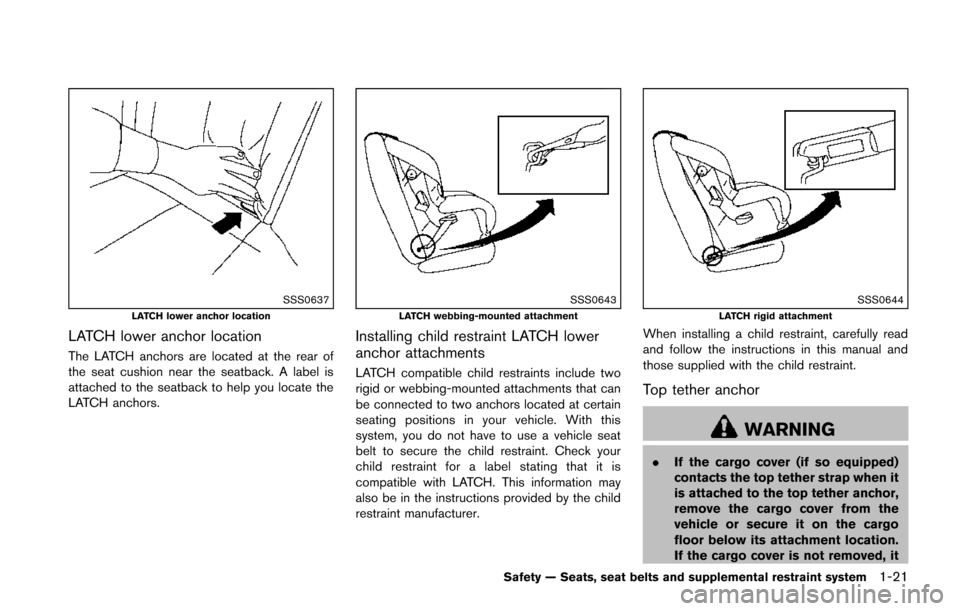
SSS0637LATCH lower anchor location
LATCH lower anchor location
The LATCH anchors are located at the rear of
the seat cushion near the seatback. A label is
attached to the seatback to help you locate the
LATCH anchors.
SSS0643LATCH webbing-mounted attachment
Installing child restraint LATCH lower
anchor attachments
LATCH compatible child restraints include two
rigid or webbing-mounted attachments that can
be connected to two anchors located at certain
seating positions in your vehicle. With this
system, you do not have to use a vehicle seat
belt to secure the child restraint. Check your
child restraint for a label stating that it is
compatible with LATCH. This information may
also be in the instructions provided by the child
restraint manufacturer.
SSS0644LATCH rigid attachment
When installing a child restraint, carefully read
and follow the instructions in this manual and
those supplied with the child restraint.
Top tether anchor
WARNING
.If the cargo cover (if so equipped)
contacts the top tether strap when it
is attached to the top tether anchor,
remove the cargo cover from the
vehicle or secure it on the cargo
floor below its attachment location.
If the cargo cover is not removed, it
Safety — Seats, seat belts and supplemental restraint system1-21
Page 43 of 402
1-22Safety — Seats, seat belts and supplemental restraint system
may damage the top tether strap
during a collision. Your child could
be seriously injured or killed in a
collision if the child restraint top
tether strap is damaged.
. Do not allow cargo to contact the
top tether strap when it is attached
to the top tether anchor. Properly
secure the cargo so it does not
contact the top tether strap. Cargo
that is not properly secured or cargo
that contacts the top tether strap
may damage the top tether strap
during a collision. Your child could
be seriously injured or killed in a
collision if the child restraint top
tether strap is damaged.
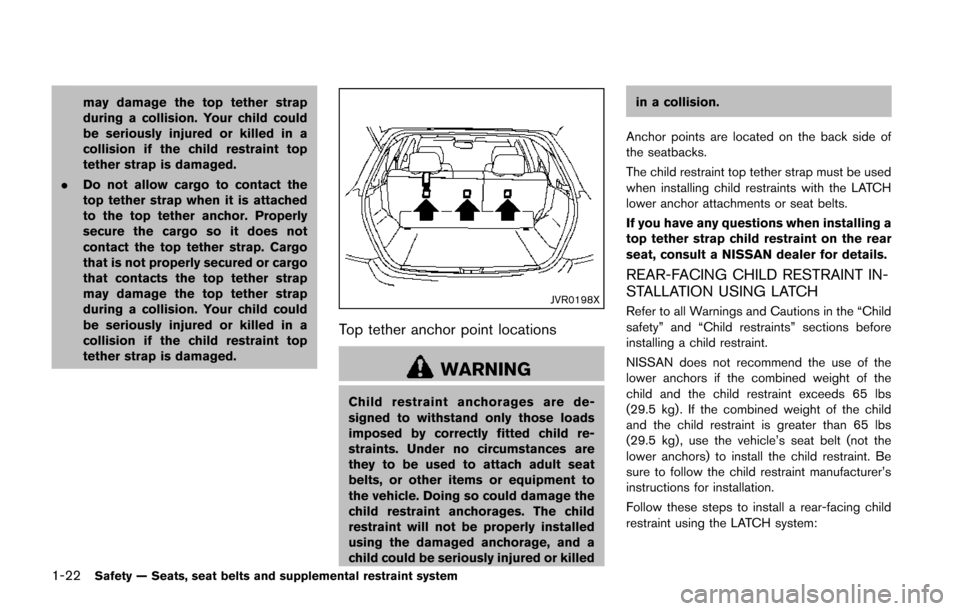
JVR0198X
Top tether anchor point locations
WARNING
Child restraint anchorages are de-
signed to withstand only those loads
imposed by correctly fitted child re-
straints. Under no circumstances are
they to be used to attach adult seat
belts, or other items or equipment to
the vehicle. Doing so could damage the
child restraint anchorages. The child
restraint will not be properly installed
using the damaged anchorage, and a
child could be seriously injured or killed in a collision.
Anchor points are located on the back side of
the seatbacks.
The child restraint top tether strap must be used
when installing child restraints with the LATCH
lower anchor attachments or seat belts.
If you have any questions when installing a
top tether strap child restraint on the rear
seat, consult a NISSAN dealer for details.
REAR-FACING CHILD RESTRAINT IN-
STALLATION USING LATCH
Refer to all Warnings and Cautions in the “Child
safety” and “Child restraints” sections before
installing a child restraint.
NISSAN does not recommend the use of the
lower anchors if the combined weight of the
child and the child restraint exceeds 65 lbs
(29.5 kg). If the combined weight of the child
and the child restraint is greater than 65 lbs
(29.5 kg) , use the vehicle’s seat belt (not the
lower anchors) to install the child restraint. Be
sure to follow the child restraint manufacturer’s
instructions for installation.
Follow these steps to install a rear-facing child
restraint using the LATCH system:
Page 46 of 402
SSS0100
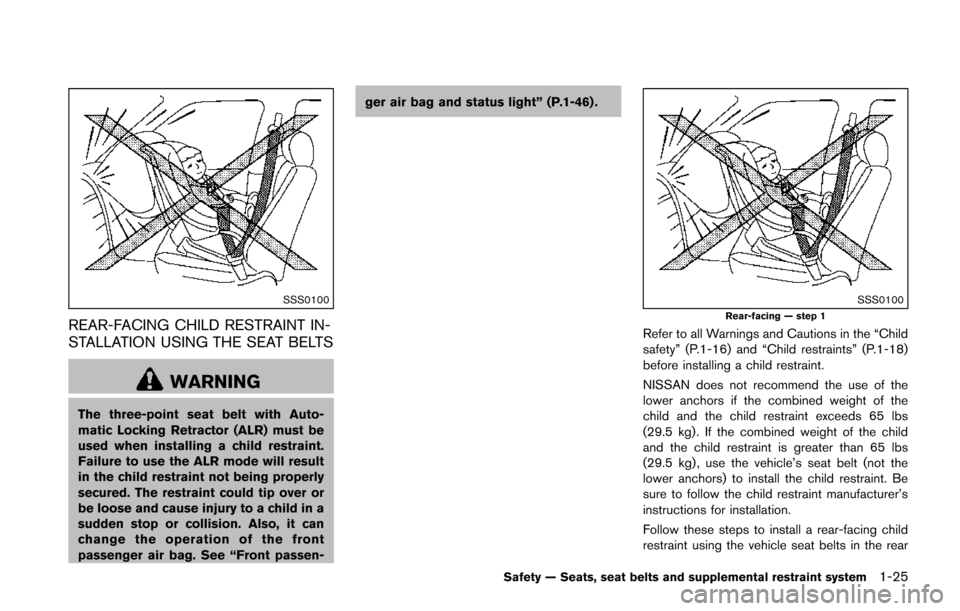
REAR-FACING CHILD RESTRAINT IN-
STALLATION USING THE SEAT BELTS
WARNING
The three-point seat belt with Auto-
matic Locking Retractor (ALR) must be
used when installing a child restraint.
Failure to use the ALR mode will result
in the child restraint not being properly
secured. The restraint could tip over or
be loose and cause injury to a child in a
sudden stop or collision. Also, it can
change the operation of the front
passenger air bag. See “Front passen-ger air bag and status light” (P.1-46) .
SSS0100Rear-facing — step 1
Refer to all Warnings and Cautions in the “Child
safety” (P.1-16) and “Child restraints” (P.1-18)
before installing a child restraint.
NISSAN does not recommend the use of the
lower anchors if the combined weight of the
child and the child restraint exceeds 65 lbs
(29.5 kg). If the combined weight of the child
and the child restraint is greater than 65 lbs
(29.5 kg) , use the vehicle’s seat belt (not the
lower anchors) to install the child restraint. Be
sure to follow the child restraint manufacturer’s
instructions for installation.
Follow these steps to install a rear-facing child
restraint using the vehicle seat belts in the rear
Safety — Seats, seat belts and supplemental restraint system1-25
Page 49 of 402
1-28Safety — Seats, seat belts and supplemental restraint system
seat belt is not locked, repeat steps 1
through 6.
After the child restraint is removed and the seat
belt fully retracted, the ALR mode (child restraint
mode) is canceled.
FORWARD-FACING CHILD RE-
STRAINT INSTALLATION USING
LATCH
Refer to all Warnings and Cautions in the “Child
safety” and “Child restraints” sections before
installing a child restraint.
NISSAN does not recommend the use of the
lower anchors if the combined weight of the
child and the child restraint exceeds 65 lbs
(29.5 kg). If the combined weight of the child
and the child restraint is greater than 65 lbs
(29.5 kg) , use the vehicle’s seat belt (not the
lower anchors) to install the child restraint. Be
sure to follow the child restraint manufacturer’s
instructions for installation.
Follow these steps to install a forward-facing
child restraint using the LATCH system:
1. Position the child restraint on the seat. Always follow the child restraint manufac-
turer’s instructions.
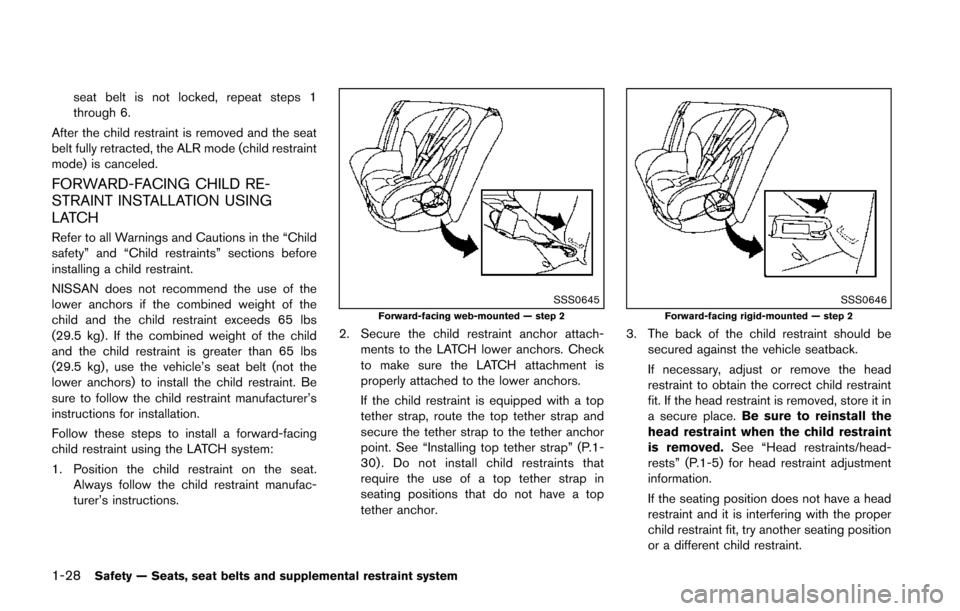
SSS0645Forward-facing web-mounted — step 2
2. Secure the child restraint anchor attach-ments to the LATCH lower anchors. Check
to make sure the LATCH attachment is
properly attached to the lower anchors.
If the child restraint is equipped with a top
tether strap, route the top tether strap and
secure the tether strap to the tether anchor
point. See “Installing top tether strap” (P.1-
30) . Do not install child restraints that
require the use of a top tether strap in
seating positions that do not have a top
tether anchor.
SSS0646Forward-facing rigid-mounted — step 2
3. The back of the child restraint should besecured against the vehicle seatback.
If necessary, adjust or remove the head
restraint to obtain the correct child restraint
fit. If the head restraint is removed, store it in
a secure place. Be sure to reinstall the
head restraint when the child restraint
is removed. See “Head restraints/head-
rests” (P.1-5) for head restraint adjustment
information.
If the seating position does not have a head
restraint and it is interfering with the proper
child restraint fit, try another seating position
or a different child restraint.
Page 51 of 402
1-30Safety — Seats, seat belts and supplemental restraint system
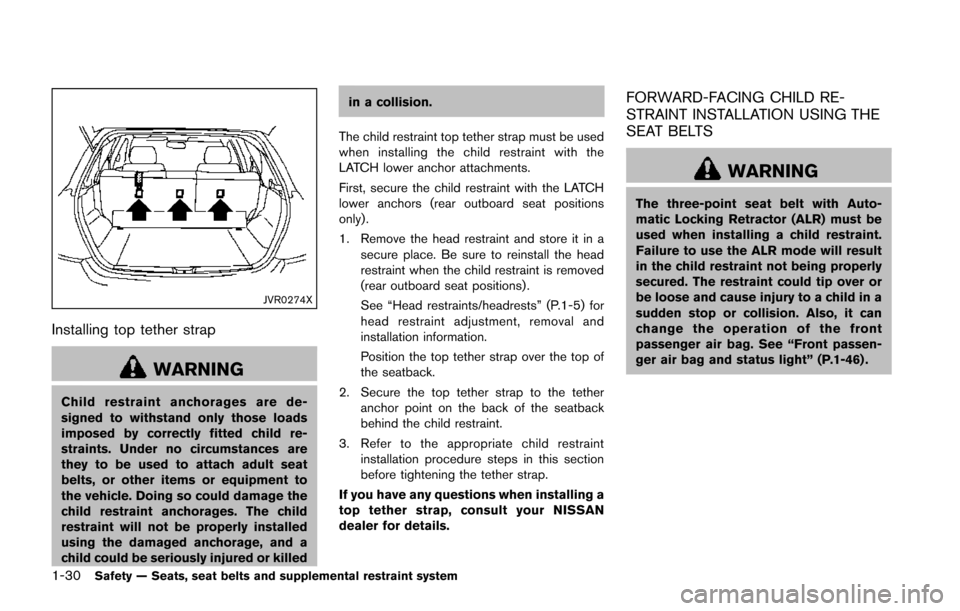
JVR0274X
Installing top tether strap
WARNING
Child restraint anchorages are de-
signed to withstand only those loads
imposed by correctly fitted child re-
straints. Under no circumstances are
they to be used to attach adult seat
belts, or other items or equipment to
the vehicle. Doing so could damage the
child restraint anchorages. The child
restraint will not be properly installed
using the damaged anchorage, and a
child could be seriously injured or killedin a collision.
The child restraint top tether strap must be used
when installing the child restraint with the
LATCH lower anchor attachments.
First, secure the child restraint with the LATCH
lower anchors (rear outboard seat positions
only).
1. Remove the head restraint and store it in a secure place. Be sure to reinstall the head
restraint when the child restraint is removed
(rear outboard seat positions) .
See “Head restraints/headrests” (P.1-5) for
head restraint adjustment, removal and
installation information.
Position the top tether strap over the top of
the seatback.
2. Secure the top tether strap to the tether anchor point on the back of the seatback
behind the child restraint.
3. Refer to the appropriate child restraint installation procedure steps in this section
before tightening the tether strap.
If you have any questions when installing a
top tether strap, consult your NISSAN
dealer for details.
FORWARD-FACING CHILD RE-
STRAINT INSTALLATION USING THE
SEAT BELTS
WARNING
The three-point seat belt with Auto-
matic Locking Retractor (ALR) must be
used when installing a child restraint.
Failure to use the ALR mode will result
in the child restraint not being properly
secured. The restraint could tip over or
be loose and cause injury to a child in a
sudden stop or collision. Also, it can
change the operation of the front
passenger air bag. See “Front passen-
ger air bag and status light” (P.1-46) .
Page 52 of 402
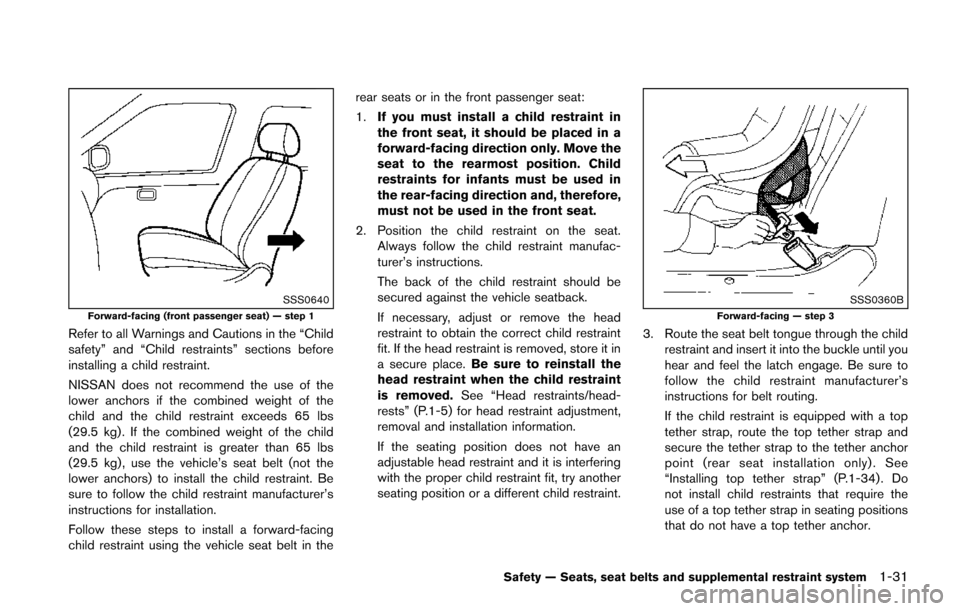
SSS0640Forward-facing (front passenger seat) — step 1
Refer to all Warnings and Cautions in the “Child
safety” and “Child restraints” sections before
installing a child restraint.
NISSAN does not recommend the use of the
lower anchors if the combined weight of the
child and the child restraint exceeds 65 lbs
(29.5 kg). If the combined weight of the child
and the child restraint is greater than 65 lbs
(29.5 kg) , use the vehicle’s seat belt (not the
lower anchors) to install the child restraint. Be
sure to follow the child restraint manufacturer’s
instructions for installation.
Follow these steps to install a forward-facing
child restraint using the vehicle seat belt in therear seats or in the front passenger seat:
1.
If you must install a child restraint in
the front seat, it should be placed in a
forward-facing direction only. Move the
seat to the rearmost position. Child
restraints for infants must be used in
the rear-facing direction and, therefore,
must not be used in the front seat.
2. Position the child restraint on the seat. Always follow the child restraint manufac-
turer’s instructions.
The back of the child restraint should be
secured against the vehicle seatback.
If necessary, adjust or remove the head
restraint to obtain the correct child restraint
fit. If the head restraint is removed, store it in
a secure place. Be sure to reinstall the
head restraint when the child restraint
is removed. See “Head restraints/head-
rests” (P.1-5) for head restraint adjustment,
removal and installation information.
If the seating position does not have an
adjustable head restraint and it is interfering
with the proper child restraint fit, try another
seating position or a different child restraint.
SSS0360BForward-facing — step 3
3. Route the seat belt tongue through the child restraint and insert it into the buckle until you
hear and feel the latch engage. Be sure to
follow the child restraint manufacturer’s
instructions for belt routing.
If the child restraint is equipped with a top
tether strap, route the top tether strap and
secure the tether strap to the tether anchor
point (rear seat installation only) . See
“Installing top tether strap” (P.1-34) . Do
not install child restraints that require the
use of a top tether strap in seating positions
that do not have a top tether anchor.
Safety — Seats, seat belts and supplemental restraint system1-31