2014 NISSAN JUKE engine overheat
[x] Cancel search: engine overheatPage 298 of 402
6 In case of emergency
Hazard warning flasher switch .............................................. 6-2
Emergency engine shut off (models with Intelligent
Key system) ........................................................................\
........ 6-2
Flat tire ........................................................................\
................. 6-3Tire Pressure Monitoring System (TPMS) .................... 6-3
Changing a flat tire ............................................................. 6-3 Jump starting ........................................................................\
..... 6-8
Push starting ........................................................................\
... 6-10
If your vehicle overheats ...................................................... 6-10
Towing your vehicle .............................................................. 6-12
Towing recommended by NISSAN ........................... 6-13
Vehicle recovery (freeing a stuck vehicle) ............... 6-14
Page 307 of 402
6-10In case of emergency
CAUTION
Do not keep the starter motor engaged
for more than 10 seconds. If the engine
does not start right away, place the
ignition switch in the OFF position and
wait 10 seconds before trying again.
9. After starting your engine, carefully discon- nect the negative cable and then the positive
cable (
*4?*3?*2?*1).
10. Replace the vent caps (if so equipped). Be sure to dispose of the cloth used to cover
the vent holes as it may be contaminated
with corrosive acid. Do not attempt to start the engine by pushing.
CAUTION
.
Continuously Variable Transmission
(CVT) models cannot be push-
started or tow-started. Attempting
to do so may cause transmission
damage.
. Three-way catalyst equipped mod-
els should not be started by pushing
since the three way catalyst may be
damaged.
. Never try to start the vehicle by
towing it; when the engine starts,
the forward surge could cause the
vehicle to collide with the tow
vehicle.
CAUTION
. Do not continue to drive if your
vehicle overheats. Doing so could
cause engine damage or a vehicle
fire.
. To avoid the danger of being
scalded, never remove the radiator
cap while the engine is still hot.
When the radiator cap is removed,
pressurized hot water will spurt out,
possibly causing serious injury.
. Do not open the hood if steam is
coming out.
If your vehicle is overheating (indicated by an
extremely high temperature gauge reading) , or if
you feel a lack of engine power, detect abnormal
noise, etc., take the following steps:
1. Move the vehicle safely off the road and apply the parking brake.
2. Continuously Variable Transmission
(CVT) models:
Move the shift lever to the P (Park) position.
Manual Transmission (MT) models:
Move the shift lever to the N (Neutral)
position.
PUSH STARTING IF YOUR VEHICLE OVERHEATS
Page 328 of 402
The engine cooling system is filled at the factory
with a pre-diluted mixture of 50% Genuine
NISSAN Long Life Antifreeze/Coolant (blue) and
50% water to provide year-round anti-freeze
and coolant protection. The anti-freeze solution
contains rust and corrosion inhibitors. Additional
engine cooling system additives are not neces-
sary.
WARNING
.Never remove the radiator or cool-
ant reservoir cap when the engine is
hot. Wait until the engine and
radiator cool down. Serious burns
could be caused by high pressure
fluid escaping from the radiator.
See precautions in “If your vehicle
overheats” (P.6-10) of this manual.
. The radiator is equipped with a
pressure type radiator cap. To pre-
vent engine damage, use only a
genuine NISSAN radiator cap.
. If the engine was stopped soon
when the engine is hot, the cooling
fan may operate for approximately
10 minutes after the engine was
stopped to cool the components in
the engine compartment. When the cooling fan is operating, be sure
that hands or other items do not get
caught in it.
CAUTION
.
Never use any cooling system ad-
ditives such as radiator sealer. Ad-
ditives may clog the cooling system
and cause damage to the engine,
transmission and/or cooling sys-
tem.
. When adding or replacing coolant,
be sure to use only Genuine
NISSAN Long Life Antifreeze/Cool-
ant (blue) or equivalent. Genuine
NISSAN Long Life Antifreeze/Cool-
ant (blue) is pre-diluted to provide
antifreeze protection to -348 F
(-378C) . If additional freeze protec-
tion is needed due to weather where
you operate your vehicle, add Gen-
uine NISSAN Long Life Antifreeze/
Coolant (blue) concentrate follow-
ing the directions on the container.
If an equivalent coolant other than
Genuine NISSAN Long Life Anti-
freeze/Coolant (blue) is used, fol- low the coolant manufacture’s
instructions to maintain minimum
antifreeze protection to -348
F
(-378C) . The use of other types of
coolant solutions other than Genu-
ine NISSAN Long Life Antifreeze/
Coolant (blue) or equivalent may
damage the engine cooling system.
. The life expectancy of the factory-fill
coolant is 105,000 miles (168,000
km) or 7 years. Mixing any other
type of coolant other than Genuine
NISSAN Long Life Antifreeze/Cool-
ant (blue) , including Genuine
NISSAN Long Life Antifreeze/Cool-
ant (green) , or the use of non-
distilled water will reduce the life
expectancy of the factory-fill cool-
ant. Refer to the NISSAN Service
and Maintenance Guide for more
details.
Maintenance and do-it-yourself8-7
ENGINE COOLING SYSTEM
Page 329 of 402
8-8Maintenance and do-it-yourself
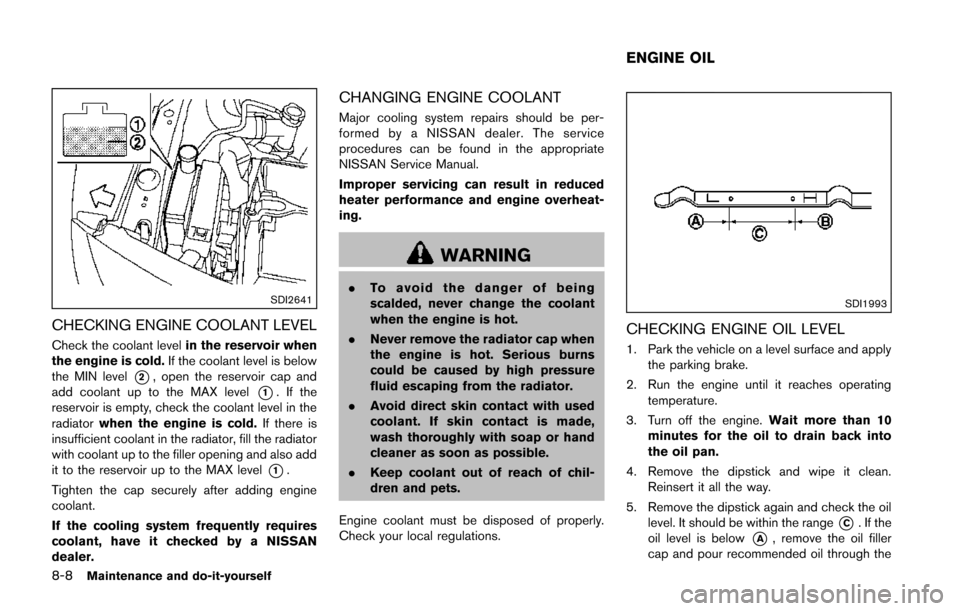
SDI2641
CHECKING ENGINE COOLANT LEVEL
Check the coolant levelin the reservoir when
the engine is cold. If the coolant level is below
the MIN level
*2, open the reservoir cap and
add coolant up to the MAX level
*1. If the
reservoir is empty, check the coolant level in the
radiator when the engine is cold. If there is
insufficient coolant in the radiator, fill the radiator
with coolant up to the filler opening and also add
it to the reservoir up to the MAX level
*1.
Tighten the cap securely after adding engine
coolant.
If the cooling system frequently requires
coolant, have it checked by a NISSAN
dealer.
CHANGING ENGINE COOLANT
Major cooling system repairs should be per-
formed by a NISSAN dealer. The service
procedures can be found in the appropriate
NISSAN Service Manual.
Improper servicing can result in reduced
heater performance and engine overheat-
ing.
WARNING
. To avoid the danger of being
scalded, never change the coolant
when the engine is hot.
. Never remove the radiator cap when
the engine is hot. Serious burns
could be caused by high pressure
fluid escaping from the radiator.
. Avoid direct skin contact with used
coolant. If skin contact is made,
wash thoroughly with soap or hand
cleaner as soon as possible.
. Keep coolant out of reach of chil-
dren and pets.
Engine coolant must be disposed of properly.
Check your local regulations.SDI1993
CHECKING ENGINE OIL LEVEL
1. Park the vehicle on a level surface and apply the parking brake.
2. Run the engine until it reaches operating temperature.
3. Turn off the engine. Wait more than 10
minutes for the oil to drain back into
the oil pan.
4. Remove the dipstick and wipe it clean. Reinsert it all the way.
5. Remove the dipstick again and check the oil level. It should be within the range
*C. If the
oil level is below
*A, remove the oil filler
cap and pour recommended oil through the
ENGINE OIL
Page 370 of 402
and/or fuel system damage.
.The fuel should be unleaded and have
an octane rating no lower than that
recommended for unleaded gasoline.
. If an oxygenate-blend, other than
methanol blend is used, it should
contain no more than 10% oxygenate.
(MTBE may, however, be added up to
15%.)
. E-15 fuel contains more than 10%
oxygenate. E-15 fuel will adversely
affect the emission control devices
and systems of the vehicle and should
not be used. Damage caused by such
fuel is not covered by the NISSAN new
vehicle limited warranty.
. If a methanol blend is used, it should
contain no more than 5% methanol
(methyl alcohol, wood alcohol) . It
should also contain a suitable amount
of appropriate cosolvents and corro-
sion inhibitors. If not properly formu-
lated with appropriate cosolvents and
corrosion inhibitors, such methanol
blends may cause fuel system damage
and/or vehicle performance problems.
At this time, sufficient data is not
available to ensure that all methanol
blends are suitable for use in NISSAN vehicles.
If any driveability problems such as engine
stalling and difficult hot-starting are experienced
after using oxygenate-blend fuels, immediately
change to a non-oxygenate fuel or a fuel with a
low blend of MTBE.
Take care not to spill gasoline during
refueling. Gasoline containing oxygenates
can cause paint damage.
E-15 fuel
E-15 fuel is a mixture of approximately 15% fuel
ethanol and 85% unleaded gasoline. E-15 can
only be used in vehicles designed to run on E-
15 fuel. Do not use E-15 in your vehicle. U.S.
government regulations require fuel ethanol
dispensing pumps to be identified with small,
square, orange and black label with the common
abbreviation or the appropriate percentage for
that region.
E-85 fuel
E-85 fuel is a mixture of approximately 85% fuel
ethanol and 15% unleaded gasoline. E-85 can
only be used in a Flexible Fuel Vehicle (FFV) . Do
not use E-85 fuel in your vehicle. U.S. govern-
ment regulations require fuel ethanol dispensing
pumps to be identified by a small, square,
orange and black label with the common
abbreviation or the appropriate percentage for that region.
Aftermarket fuel additives
NISSAN does not recommend the use of any
aftermarket fuel additives (for example, fuel
injector cleaner, octane booster, intake valve
deposit removers, etc.) which are sold commer-
cially. Many of these additives intended for gum,
varnish or deposit removal may contain active
solvent or similar ingredients that can be harmful
to the fuel system and engine.
Octane rating tips
Using unleaded gasoline with an octane
rating lower than recommended can cause
persistent, heavy “spark knock”. (Spark
knock is a metallic rapping noise.) If
severe, this can lead to engine damage. If
you detect a persistent heavy spark knock
even when using gasoline of the stated
octane rating, or if you hear steady spark
knock while holding a steady speed on
level roads, have a NISSAN dealer correct
the condition. Failure to correct the condi-
tion is misuse of the vehicle, for which
NISSAN is not responsible.
Incorrect ignition timing will result in spark
knock, after-run and/or overheating, which may
cause excessive fuel consumption or engine
damage. If any of the above symptoms are
Technical and consumer information9-5
Page 389 of 402
10-2
Continuously Variable Transmission
(CVT) fluid..................................................................... 8-11
Control panel buttons — color screen (Type A) ... 4-3
Control panel buttons — color screen
(Type B)......................................................................... 4-10
Controls, Steering wheel audio controls............... 4-69
Coolant Capacities and
recommended fuel/lubricants............................... 9-2
Changing engine coolant...................................... 8-8
Checking engine coolant level............................. 8-8
Corrosion protection .................................................... 7-7
Cover, Cargo cover.................................................... 2-44
Cruise control............................................................... 5-30
Cup holders.................................................................. 2-42
CVT, Driving with CVT (Continuously
Variable Transmission) ................................... 5-11, 5-17
D
Daytime running light system................................... 2-37
Defroster switch, Rear window and outside
mirror defroster switch............................................... 2-35
Dimensions and weights............................................. 9-9
Displaying Climate control........................................ 4-26
Door open warning light............................................ 2-14
Drive belt....................................................................... 8-15
Driving All-wheel drive (AWD)........................................ 5-33
Cold weather driving........................................... 5-43
Driving with CVT (Continuously
Variable Transmission) ............................. 5-11, 5-17
Driving with manual transmission.......... 5-11, 5-23
Precautions when starting and driving .............. 5-3
Safety precautions.................................................. 5-8
During a call ................................................................. 4-88
E
Economy, Fuel.............................................................. 5-33
Elapsed time..................................................... 2-11, 2-27
Electric power steering system ............................... 5-38
Electric power steering warning light .................... 2-14
Emission control information label.......................... 9-11
Emission control system warranty........................... 9-19
Ending a call................................................................. 4-88
Engine Before starting the engine................................. 5-15
Break-in schedule ................................................ 5-31
Capacities and
recommended fuel/lubricants............................... 9-2
Changing engine coolant...................................... 8-8
Changing engine oil and filter.............................. 8-9
Checking engine coolant level............................. 8-8
Checking engine oil level...................................... 8-8
Coolant temperature gauge ................................. 2-8
Emergency engine shut off....................... 5-14, 6-2
Engine block heater............................................. 5-44
Engine compartment check locations................ 8-6
Engine cooling system........................................... 8-7
Engine oil................................................................... 8-8
Engine oil and oil filter recommendation........... 9-6
Engine oil viscosity.................................................. 9-7
Engine serial number........................................... 9-10
Engine specifications ............................................. 9-8
If your vehicle overheats..................................... 6-10
Starting the engine .............................................. 5-15
Event Data Recorders (EDR)................................... 9-21
Exhaust gas (carbon monoxide)................................ 5-3
Extended storage fuse warning................................. 2-7
F
F.M.V.S.S./C.M.V.S.S. certification label ............... 9-11
FCC Regulatory information..................................... 4-86
Filter Air cleaner housing filter .................................... 8-16
Changing engine oil and filter.............................. 8-9
Flashers (See hazard warning flasher switch)....... 6-2
Flat tire............................................................................. 6-3
Flat towing .................................................................... 9-17
Floor mat cleaning ........................................................ 7-6
Fluid Brake and clutch fluid......................................... 8-11
Capacities and
recommended fuel/lubricants............................... 9-2
Continuously Variable Transmission
(CVT) fluid.............................................................. 8-11
Engine coolant......................................................... 8-7
Engine oil................................................................... 8-8
Window washer fluid .......................................... 8-12
FM/AM/SAT radio operation..................................... 4-58
FM-AM-SAT radio with Compact Disc
(CD) player ....................................................... 4-41, 4-48
FM-AM-SAT radio with Compact Disc (CD)
player (Type C) ............................................................ 4-57
Fog light switch........................................................... 2-39
Front manual seat adjustment.................................... 1-3
Front passenger air bag and status light.............. 1-46
Front seat, Front seat adjustment............................. 1-3
Front-seat active head restraints .............................. 1-9
Fuel Capacities and
recommended fuel/lubricants............................... 9-2
Distance to empty................................................ 2-10
Fuel economy........................................................ 5-33
Fuel information ....................................................... 9-4
Fuel octane rating ................................................... 9-4
Page 391 of 402
10-4
Warning/indicator lights and
audible reminders................................................. 2-13
Lights, Exterior and interior light replacement ..... 8-28
Loading information (See vehicle
loading information) .................................................... 9-14
Lock Automatic door locks ............................................. 3-6
Door locks................................................................. 3-4
Lift gate lock.......................................................... 3-20
Power door lock...................................................... 3-4
Loose fuel cap warning.................................... 2-7, 3-23
Low fuel warning light................................................ 2-15
Low tire pressure warning light............................... 2-15
Low tire pressure warning system
(See tire pressure monitoring system (TPMS)) .... 5-4
M
Maintenance Battery..................................................................... 8-13
General maintenance ............................................. 8-2
Inside the vehicle .................................................... 8-3
Maintenance precautions...................................... 8-5
Maintenance requirements.................................... 8-2
Outside the vehicle................................................. 8-2
Seat belt maintenance........................................ 1-15
Making a call ................................................................ 4-87
Malfunction indicator light (MIL).............................. 2-18
Manual air conditioner................................................ 4-21
Manual front seat adjustment..................................... 1-3
Map lights ..................................................................... 2-50
Mechanical key (Intelligent Key system) ................. 3-4
Meter Trip computer........................................................ 2-10
Meters and gauges....................................................... 2-5 Instrument brightness control ........................... 2-38 Mirror
Inside mirror........................................................... 3-25
Outside mirrors..................................................... 3-25
Vanity mirror........................................................... 3-27
Monitor, RearView monitor ....................................... 4-15
Moonroof....................................................................... 2-48
My APPS voice commands...................................... 4-96
N
Navigation setup............................................................ 4-7
Navigation system voice commands...................... 4-95
New vehicle break-in.................................................. 5-31
NISSAN Vehicle Immobilizer System..................... 2-31
NISSAN voice recognition system ......................... 4-92
NissanConnect
TMApp
smartphone integration.............................................. 4-71
O
Odometer........................................................................ 2-6
Off-road recovery.......................................................... 5-7
Oil Capacities and
recommended fuel/lubricants............................... 9-2
Changing engine oil and filter.............................. 8-9
Checking engine oil level...................................... 8-8
Engine oil................................................................... 8-8
Engine oil viscosity.................................................. 9-7
One Shot Call.............................................................. 4-87
Operating tips.............................................................. 4-93
Outside air temperature display.............................. 2-10
Outside mirrors............................................................ 3-25
Overheat, If your vehicle overheats ........................ 6-10
Owner’s Manual/Service Manual
order information ......................................................... 9-21
P
Pandora®audio ........................................................... 4-66
Panic alarm.......................................................... 3-8, 3-17
Parking Brake break-in....................................................... 5-39
Parking brake operation ..................................... 5-29
Parking on hills ..................................................... 5-37
Phone Bluetooth
®Hands-Free Phone System
(Type A) .................................................................. 4-72
Car phone or CB radio ...................................... 4-71
Phone settings............................................................. 4-92
Power Electric power steering system ........................ 5-38
Moonroof................................................................ 2-48
Power door lock...................................................... 3-4
Power outlet .......................................................... 2-42
Power windows .................................................... 2-45
Precautions Audio operation .................................................... 4-28
Braking precautions............................................. 5-39
Child restraints...................................................... 1-18
Cruise control........................................................ 5-30
Driving safety............................................................ 5-8
Maintenance ............................................................. 8-5
Seat belt usage .................................................... 1-10
Supplemental restraint system.......................... 1-38
When starting and driving .................................... 5-3
Push starting ................................................................ 6-10
Push-button ignition switch.......................... 5-12, 5-13
R
Radio.............................................................................. 4-28 Car phone or CB radio ...................................... 4-71
Radio operation .................................................... 4-42