2014 NISSAN JUKE ECO mode
[x] Cancel search: ECO modePage 369 of 402
9-4Technical and consumer information
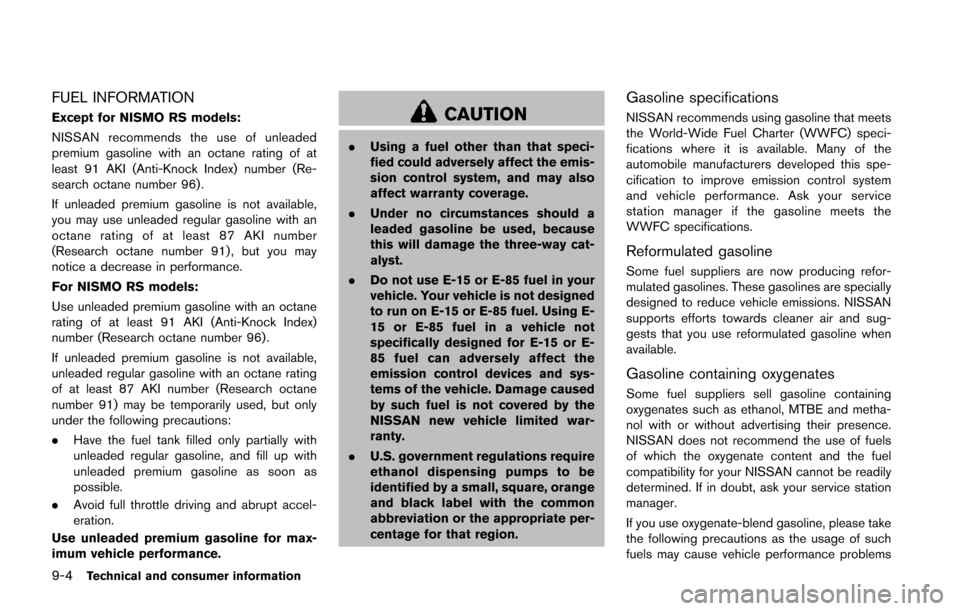
FUEL INFORMATION
Except for NISMO RS models:
NISSAN recommends the use of unleaded
premium gasoline with an octane rating of at
least 91 AKI (Anti-Knock Index) number (Re-
search octane number 96).
If unleaded premium gasoline is not available,
you may use unleaded regular gasoline with an
octane rating of at least 87 AKI number
(Research octane number 91), but you may
notice a decrease in performance.
For NISMO RS models:
Use unleaded premium gasoline with an octane
rating of at least 91 AKI (Anti-Knock Index)
number (Research octane number 96).
If unleaded premium gasoline is not available,
unleaded regular gasoline with an octane rating
of at least 87 AKI number (Research octane
number 91) may be temporarily used, but only
under the following precautions:
.Have the fuel tank filled only partially with
unleaded regular gasoline, and fill up with
unleaded premium gasoline as soon as
possible.
. Avoid full throttle driving and abrupt accel-
eration.
Use unleaded premium gasoline for max-
imum vehicle performance.CAUTION
. Using a fuel other than that speci-
fied could adversely affect the emis-
sion control system, and may also
affect warranty coverage.
. Under no circumstances should a
leaded gasoline be used, because
this will damage the three-way cat-
alyst.
. Do not use E-15 or E-85 fuel in your
vehicle. Your vehicle is not designed
to run on E-15 or E-85 fuel. Using E-
15 or E-85 fuel in a vehicle not
specifically designed for E-15 or E-
85 fuel can adversely affect the
emission control devices and sys-
tems of the vehicle. Damage caused
by such fuel is not covered by the
NISSAN new vehicle limited war-
ranty.
. U.S. government regulations require
ethanol dispensing pumps to be
identified by a small, square, orange
and black label with the common
abbreviation or the appropriate per-
centage for that region.
Gasoline specifications
NISSAN recommends using gasoline that meets
the World-Wide Fuel Charter (WWFC) speci-
fications where it is available. Many of the
automobile manufacturers developed this spe-
cification to improve emission control system
and vehicle performance. Ask your service
station manager if the gasoline meets the
WWFC specifications.
Reformulated gasoline
Some fuel suppliers are now producing refor-
mulated gasolines. These gasolines are specially
designed to reduce vehicle emissions. NISSAN
supports efforts towards cleaner air and sug-
gests that you use reformulated gasoline when
available.
Gasoline containing oxygenates
Some fuel suppliers sell gasoline containing
oxygenates such as ethanol, MTBE and metha-
nol with or without advertising their presence.
NISSAN does not recommend the use of fuels
of which the oxygenate content and the fuel
compatibility for your NISSAN cannot be readily
determined. If in doubt, ask your service station
manager.
If you use oxygenate-blend gasoline, please take
the following precautions as the usage of such
fuels may cause vehicle performance problems
Page 382 of 402
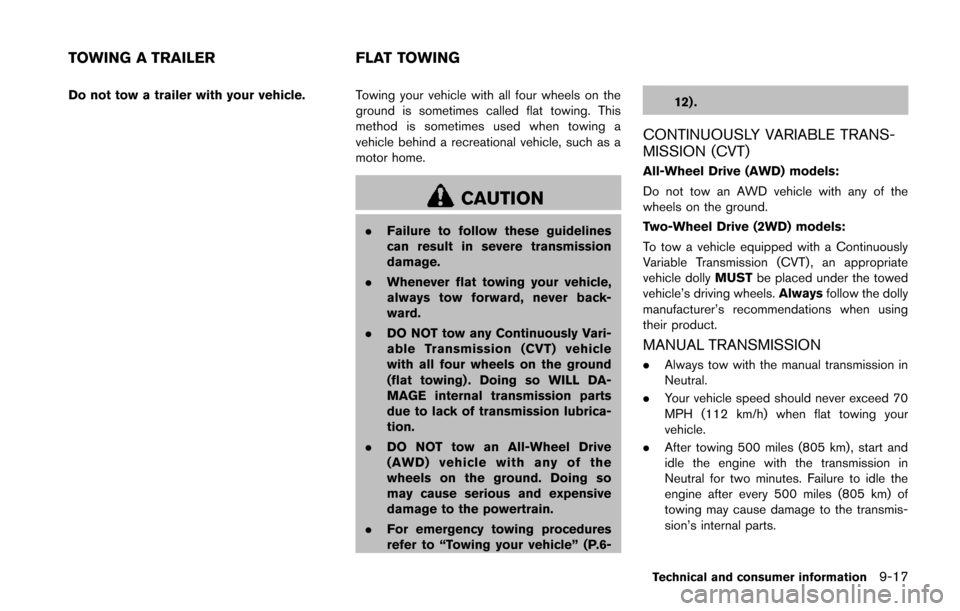
Do not tow a trailer with your vehicle.Towing your vehicle with all four wheels on the
ground is sometimes called flat towing. This
method is sometimes used when towing a
vehicle behind a recreational vehicle, such as a
motor home.
CAUTION
.Failure to follow these guidelines
can result in severe transmission
damage.
. Whenever flat towing your vehicle,
always tow forward, never back-
ward.
. DO NOT tow any Continuously Vari-
able Transmission (CVT) vehicle
with all four wheels on the ground
(flat towing) . Doing so WILL DA-
MAGE internal transmission parts
due to lack of transmission lubrica-
tion.
. DO NOT tow an All-Wheel Drive
(AWD) vehicle with any of the
wheels on the ground. Doing so
may cause serious and expensive
damage to the powertrain.
. For emergency towing procedures
refer to “Towing your vehicle” (P.6- 12) .
CONTINUOUSLY VARIABLE TRANS-
MISSION (CVT)
All-Wheel Drive (AWD) models:
Do not tow an AWD vehicle with any of the
wheels on the ground.
Two-Wheel Drive (2WD) models:
To tow a vehicle equipped with a Continuously
Variable Transmission (CVT) , an appropriate
vehicle dolly
MUSTbe placed under the towed
vehicle’s driving wheels. Alwaysfollow the dolly
manufacturer’s recommendations when using
their product.
MANUAL TRANSMISSION
. Always tow with the manual transmission in
Neutral.
. Your vehicle speed should never exceed 70
MPH (112 km/h) when flat towing your
vehicle.
. After towing 500 miles (805 km) , start and
idle the engine with the transmission in
Neutral for two minutes. Failure to idle the
engine after every 500 miles (805 km) of
towing may cause damage to the transmis-
sion’s internal parts.
Technical and consumer information9-17
TOWING A TRAILER FLAT TOWING
Page 386 of 402
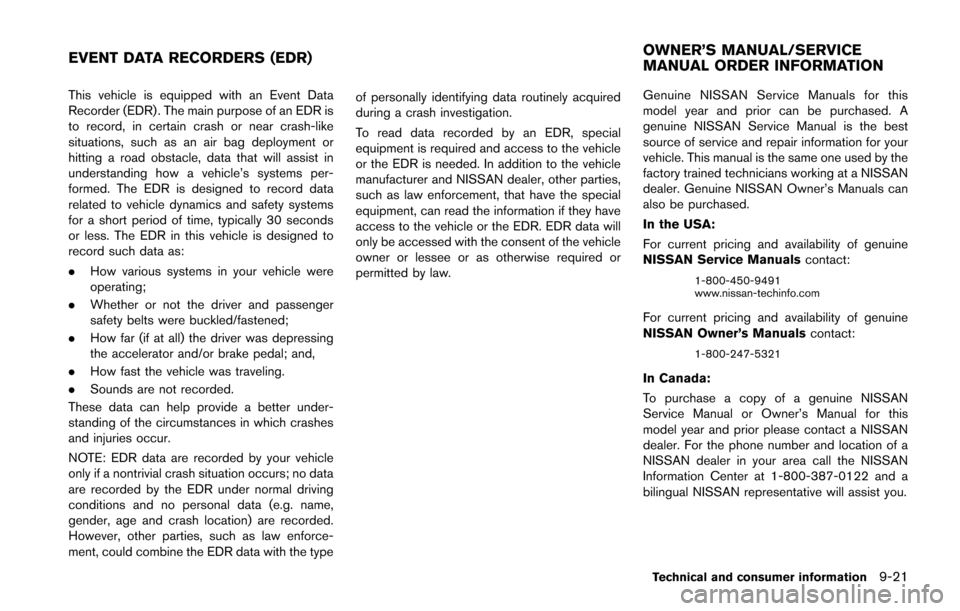
This vehicle is equipped with an Event Data
Recorder (EDR) . The main purpose of an EDR is
to record, in certain crash or near crash-like
situations, such as an air bag deployment or
hitting a road obstacle, data that will assist in
understanding how a vehicle’s systems per-
formed. The EDR is designed to record data
related to vehicle dynamics and safety systems
for a short period of time, typically 30 seconds
or less. The EDR in this vehicle is designed to
record such data as:
.How various systems in your vehicle were
operating;
. Whether or not the driver and passenger
safety belts were buckled/fastened;
. How far (if at all) the driver was depressing
the accelerator and/or brake pedal; and,
. How fast the vehicle was traveling.
. Sounds are not recorded.
These data can help provide a better under-
standing of the circumstances in which crashes
and injuries occur.
NOTE: EDR data are recorded by your vehicle
only if a nontrivial crash situation occurs; no data
are recorded by the EDR under normal driving
conditions and no personal data (e.g. name,
gender, age and crash location) are recorded.
However, other parties, such as law enforce-
ment, could combine the EDR data with the type of personally identifying data routinely acquired
during a crash investigation.
To read data recorded by an EDR, special
equipment is required and access to the vehicle
or the EDR is needed. In addition to the vehicle
manufacturer and NISSAN dealer, other parties,
such as law enforcement, that have the special
equipment, can read the information if they have
access to the vehicle or the EDR. EDR data will
only be accessed with the consent of the vehicle
owner or lessee or as otherwise required or
permitted by law.
Genuine NISSAN Service Manuals for this
model year and prior can be purchased. A
genuine NISSAN Service Manual is the best
source of service and repair information for your
vehicle. This manual is the same one used by the
factory trained technicians working at a NISSAN
dealer. Genuine NISSAN Owner’s Manuals can
also be purchased.
In the USA:
For current pricing and availability of genuine
NISSAN Service Manuals
contact:
1-800-450-9491
www.nissan-techinfo.com
For current pricing and availability of genuine
NISSAN Owner’s Manuals contact:
1-800-247-5321
In Canada:
To purchase a copy of a genuine NISSAN
Service Manual or Owner’s Manual for this
model year and prior please contact a NISSAN
dealer. For the phone number and location of a
NISSAN dealer in your area call the NISSAN
Information Center at 1-800-387-0122 and a
bilingual NISSAN representative will assist you.
Technical and consumer information9-21
EVENT DATA RECORDERS (EDR) OWNER’S MANUAL/SERVICE
MANUAL ORDER INFORMATION
Page 388 of 402
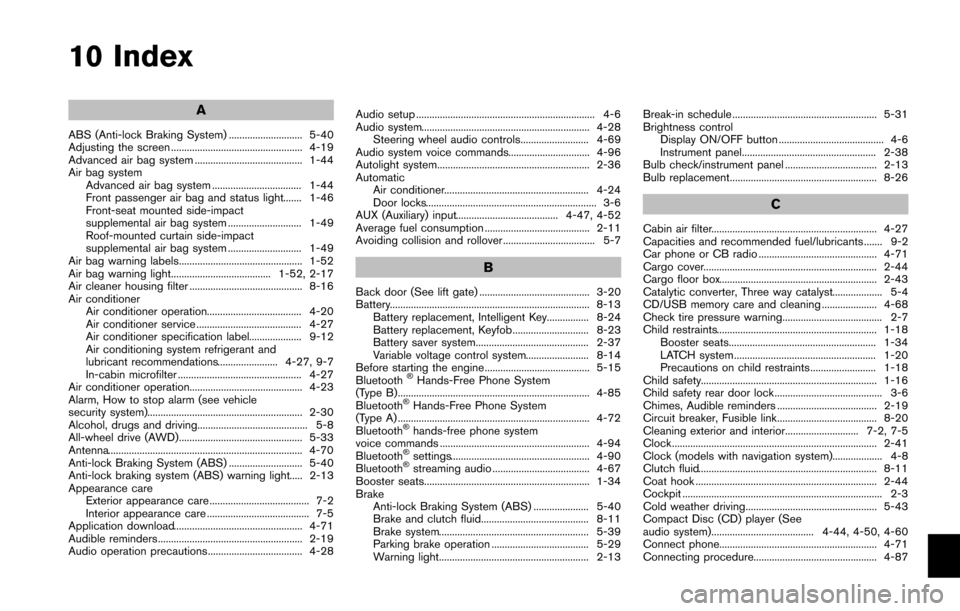
10 Index
A
ABS (Anti-lock Braking System) ............................ 5-40
Adjusting the screen .................................................. 4-19
Advanced air bag system ......................................... 1-44
Air bag systemAdvanced air bag system .................................. 1-44
Front passenger air bag and status light....... 1-46
Front-seat mounted side-impact
supplemental air bag system ............................ 1-49
Roof-mounted curtain side-impact
supplemental air bag system ............................ 1-49
Air bag warning labels............................................... 1-52
Air bag warning light...................................... 1-52, 2-17
Air cleaner housing filter ........................................... 8-16
Air conditioner Air conditioner operation.................................... 4-20
Air conditioner service ........................................ 4-27
Air conditioner specification label.................... 9-12
Air conditioning system refrigerant and
lubricant recommendations....................... 4-27, 9-7
In-cabin microfilter ............................................... 4-27
Air conditioner operation........................................... 4-23
Alarm, How to stop alarm (see vehicle
security system)........................................................... 2-30
Alcohol, drugs and driving.......................................... 5-8
All-wheel drive (AWD)............................................... 5-33
Antenna.......................................................................... 4-70
Anti-lock Braking System (ABS) ............................ 5-40
Anti-lock braking system (ABS) warning light..... 2-13
Appearance care Exterior appearance care ...................................... 7-2
Interior appearance care ....................................... 7-5
Application download................................................. 4-71
Audible reminders....................................................... 2-19
Audio operation precautions.................................... 4-28 Audio setup .................................................................... 4-6
Audio system................................................................ 4-28
Steering wheel audio controls.......................... 4-69
Audio system voice commands............................... 4-96
Autolight system.......................................................... 2-36
Automatic Air conditioner....................................................... 4-24
Door locks................................................................. 3-6
AUX (Auxiliary) input....................................... 4-47, 4-52
Average fuel consumption ........................................ 2-11
Avoiding collision and rollover ................................... 5-7
B
Back door (See lift gate) .......................................... 3-20
Battery............................................................................ 8-13 Battery replacement, Intelligent Key................ 8-24
Battery replacement, Keyfob............................. 8-23
Battery saver system........................................... 2-37
Variable voltage control system........................ 8-14
Before starting the engine........................................ 5-15
Bluetooth
®Hands-Free Phone System
(Type B)......................................................................... 4-85
Bluetooth
®Hands-Free Phone System
(Type A) ......................................................................... 4-72
Bluetooth
®hands-free phone system
voice commands ......................................................... 4-94
Bluetooth
®settings..................................................... 4-90
Bluetooth®streaming audio ..................................... 4-67
Booster seats............................................................... 1-34
Brake Anti-lock Braking System (ABS) ..................... 5-40
Brake and clutch fluid......................................... 8-11
Brake system......................................................... 5-39
Parking brake operation ..................................... 5-29
Warning light......................................................... 2-13 Break-in schedule ....................................................... 5-31
Brightness control
Display ON/OFF button ........................................ 4-6
Instrument panel................................................... 2-38
Bulb check/instrument panel ................................... 2-13
Bulb replacement........................................................ 8-26
C
Cabin air filter............................................................... 4-27
Capacities and recommended fuel/lubricants ....... 9-2
Car phone or CB radio ............................................. 4-71
Cargo cover.................................................................. 2-44
Cargo floor box............................................................ 2-43
Catalytic converter, Three way catalyst................... 5-4
CD/USB memory care and cleaning ..................... 4-68
Check tire pressure warning...................................... 2-7
Child restraints............................................................. 1-18 Booster seats........................................................ 1-34
LATCH system...................................................... 1-20
Precautions on child restraints......................... 1-18
Child safety................................................................... 1-16
Child safety rear door lock ......................................... 3-6
Chimes, Audible reminders ...................................... 2-19
Circuit breaker, Fusible link...................................... 8-20
Cleaning exterior and interior............................ 7-2, 7-5
Clock.............................................................................. 2-41
Clock (models with navigation system)................... 4-8
Clutch fluid.................................................................... 8-11
Coat hook ..................................................................... 2-44
Cockpit ............................................................................ 2-3
Cold weather driving.................................................. 5-43
Compact Disc (CD) player (See
audio system)....................................... 4-44, 4-50, 4-60
Connect phone............................................................ 4-71
Connecting procedure............................................... 4-87
Page 401 of 402
FUEL INFORMATION:
Except for NISMO RS models:
NISSAN recommends the use of unleaded
premium gasoline with an octane rating of at
least 91 AKI (Anti-Knock Index) number (Re-
search octane number 96).
If unleaded premium gasoline is not available,
you may use unleaded regular gasoline with an
octane rating of at least 87 AKI number
(Research octane number 91), but you may
notice a decrease in performance.
For NISMO RS models:
Use unleaded premium gasoline with an octane
rating of at least 91 AKI (Anti-Knock Index)
number (Research octane number 96).
If unleaded premium gasoline is not available,
unleaded regular gasoline with an octane rating
of at least 87 AKI number (Research octane
number 91) may be temporarily used, but only
under the following precautions:
.Have the fuel tank filled only partially with
unleaded regular gasoline, and fill up with
unleaded premium gasoline as soon as
possible.
. Avoid full throttle driving and abrupt accel-
eration. Use unleaded premium gasoline for max-
imum vehicle performance.
CAUTION
.
Using a fuel other than that speci-
fied could adversely affect the emis-
sion control system, and may also
affect warranty coverage.
. Under no circumstances should a
leaded gasoline be used, because
this will damage the three-way cat-
alyst.
. Do not use E-15 or E-85 fuel in your
vehicle. Your vehicle is not designed
to run on E-15 or E-85 fuel. Using E-
15 or E-85 fuel in a vehicle not
specifically designed for E-15 or E-
85 fuel can adversely affect the
emission control devices and sys-
tems of the vehicle. Damage caused
by such fuel is not covered by the
NISSAN new vehicle limited war-
ranty.
. U.S. government regulations require
ethanol dispensing pumps to be
identified by a small, square, orange and black label with the common
abbreviation or the appropriate per-
centage for that region.
For additional information, see “Capacities and
recommended fuel/lubricants” (P.9-2) .
ENGINE OIL RECOMMENDATION:
. Genuine NISSAN engine oil or equivalent
. Engine oil with API Certification Mark
. Viscosity SAE 5W-30
See “Capacities and recommended fuel/lubri-
cants” (P.9-2) for engine oil and oil filter
recommendation.
COLD TIRE PRESSURES:
The label is typically located on the driver side
center pillar or on the driver’s door. For
additional information, see “Wheels and tires”
(P.8-30) .
NEW VEHICLE BREAK-IN PROCE-
DURES RECOMMENDATION:
During the first 1,200 miles (2,000 km) of
vehicle use, follow the recommendations out-
lined in the “Break-in schedule” (P.5-31) of this
Owner’s Manual. Follow these recommenda-
tions for the future reliability and economy of
your new vehicle.
GAS STATION INFORMATION