2014 NISSAN JUKE wheel
[x] Cancel search: wheelPage 362 of 402
.Do not install a damaged or de-
formed wheel or tire even if it has
been repaired. Such wheels or tires
could have structural damage and
could fail without warning.
. The use of retread tire is not re-
commended.
. For additional information regard-
ing tires, refer to “Important Tire
Safety Information” (US) or “Tire
Safety Information” (Canada) in the
Warranty Information Booklet.
All-Wheel Drive (AWD) models
CAUTION
.Always use tires of the same size,
brand, construction (bias, bias-
belted or radial) , and tread pattern
on all four wheels. Failure to do so
may result in a circumference differ-
ence between tires on the front and
rear axles which will cause exces-
sive tire wear and may damage the
transmission, transfer case and rear
differential gears. .
Only use spare tires specified for
each AWD model.
If excessive tire wear is found, it is recom-
mended that all four tires be replaced with tires
of the same size, brand, construction and tread
pattern. The tire pressure and wheel alignment
should also be checked and corrected as
necessary. Contact a NISSAN dealer.
Wheel balance
Unbalanced wheels may affect vehicle handling
and tire life. Even with regular use, wheels can
get out of balance. Therefore, they should be
balanced as required.
Wheel balance service should be per-
formed with the wheels off the vehicle.
Spin balancing the wheels on the vehicle
could lead to mechanical damage.
For additional information regarding tires, refer
to “Important Tire Safety Information” (US) or
“Tire Safety Information” (Canada) in the War-
ranty Information Booklet.
Care of wheels
See “Cleaning exterior” (P.7-2) for details about
care of the wheels.
Spare tire
When a spare tire is mounted (TEMPORARY
USE ONLY) , the TPMS will not function.
Observe the following precautions if the TEM-
PORARY USE ONLY spare tire must be used,
otherwise your vehicle could be damaged or
involved in an accident.
WARNING
. The TEMPORARY USE ONLY spare
tire should be used for emergency
use. It should be replaced with the
standard tire at the first opportunity
to avoid possible tire or differential
damage.
. Drive carefully while the TEMPOR-
ARY USE ONLY spare tire is in-
stalled. Avoid sharp turns and
abrupt braking while driving.
. Periodically check spare tire infla-
tion pressure. Always keep the
pressure of the TEMPORARY USE
ONLY spare tire at 60 psi (420 kPa,
4.2 bar) .
Maintenance and do-it-yourself8-41
Page 363 of 402
8-42Maintenance and do-it-yourself
.With the TEMPORARY USE ONLY
spare tire installed do not drive your
vehicle at speeds faster than 50
MPH (80 km/h) .
. When driving on roads covered with
snow or ice, the TEMPORARY USE
ONLY spare tire should be used on
the rear wheels and original tire
used on the front wheels (drive
wheels) . Use tire chains only on
the front (original) tires.
. Tire tread of the TEMPORARY USE
ONLY spare tire will wear at a faster
rate than the standard tire. Replace
the spare tire as soon as the tread
wear indicators appear.
. Do not use the spare tire on other
vehicles.
. Do not use more than one spare tire
at the same time.
CAUTION
.Do not use tire chains on a TEM-
PORARY USE ONLY spare tire. Tire
chains will not fit properly and may
cause damage to the vehicle. .
Because the TEMPORARY USE
ONLY spare tire is smaller than the
original tire, ground clearance is
reduced. To avoid damage to the
vehicle, do not drive over obstacles.
Also do not drive the vehicle
through an automatic car wash
since it may get caught.
Page 366 of 402
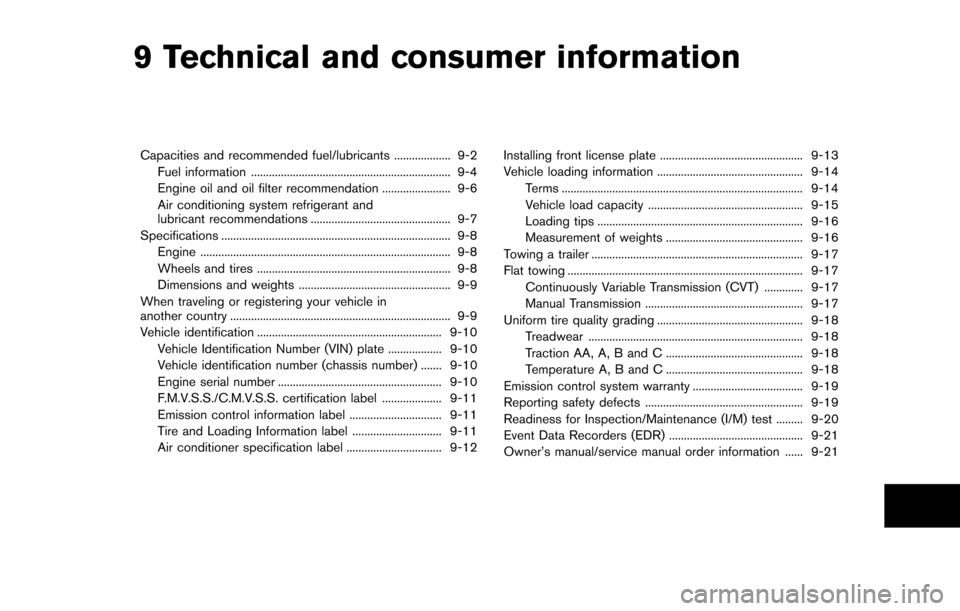
9 Technical and consumer information
Capacities and recommended fuel/lubricants ................... 9-2Fuel information ................................................................... 9-4
Engine oil and oil filter recommendation ....................... 9-6
Air conditioning system refrigerant and
lubricant recommendations ............................................... 9-7
Specifications ........................................................................\
..... 9-8
Engine ........................................................................\
............ 9-8
Wheels and tires ................................................................. 9-8
Dimensions and weights ................................................... 9-9
When traveling or registering your vehicle in
another country ........................................................................\
.. 9-9
Vehicle identification .............................................................. 9-10 Vehicle Identification Number (VIN) plate .................. 9-10
Vehicle identification number (chassis number) ....... 9-10
Engine serial number ....................................................... 9-10
F.M.V.S.S./C.M.V.S.S. certification label .................... 9-11
Emission control information label ............................... 9-11
Tire and Loading Information label .............................. 9-11
Air conditioner specification label ................................ 9-12 Installing front license plate ................................................ 9-13
Vehicle loading information ................................................. 9-14
Terms ........................................................................\
......... 9-14
Vehicle load capacity .................................................... 9-15
Loading tips ..................................................................... 9-16
Measurement of weights .............................................. 9-16
Towing a trailer ....................................................................... 9-17
Flat towing ........................................................................\
....... 9-17 Continuously Variable Transmission (CVT) ............. 9-17
Manual Transmission ..................................................... 9-17
Uniform tire quality grading ................................................. 9-18 Treadwear ........................................................................\
9-18
Traction AA, A, B and C .............................................. 9-18
Temperature A, B and C .............................................. 9-18
Emission control system warranty ..................................... 9-19
Reporting safety defects ..................................................... 9-19
Readiness for Inspection/Maintenance (I/M) test ......... 9-20
Event Data Recorders (EDR) ............................................. 9-21
Owner’s manual/service manual order information ...... 9-21
Page 373 of 402
9-8Technical and consumer information
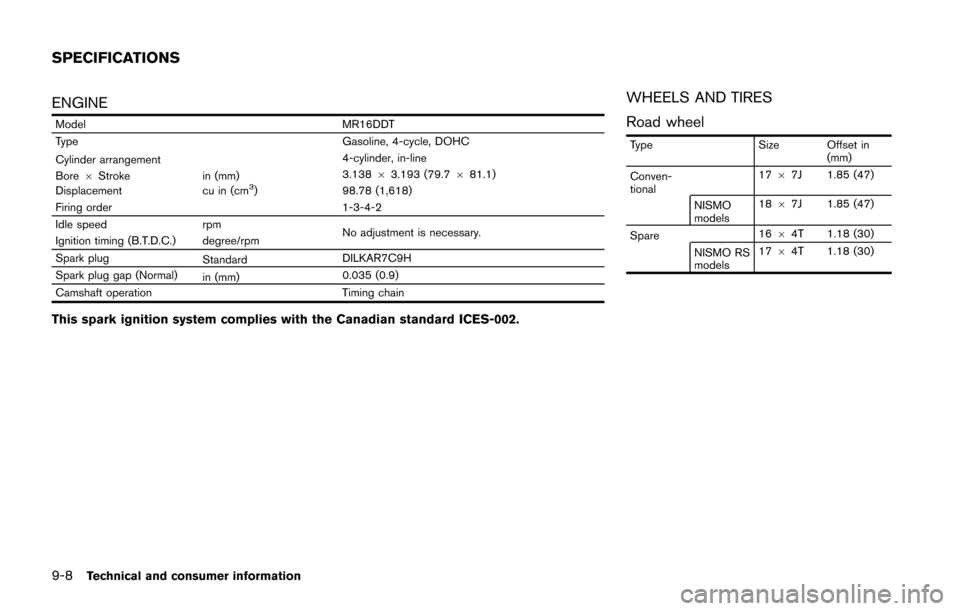
ENGINE
ModelMR16DDT
Type Gasoline, 4-cycle, DOHC
Cylinder arrangement 4-cylinder, in-line
Bore 6Stroke in (mm) 3.138
63.193 (79.7 681.1)
Displacement cu in (cm
3)98.78 (1,618)
Firing order 1-3-4-2
Idle speed rpm
No adjustment is necessary.
Ignition timing (B.T.D.C.) degree/rpm
Spark plug StandardDILKAR7C9H
Spark plug gap (Normal) in (mm)0.035 (0.9)
Camshaft operation Timing chain
This spark ignition system complies with the Canadian standard ICES-002.
WHEELS AND TIRES
Road wheel
TypeSize Offset in
(mm)
Conven-
tional 17
67J 1.85 (47)
NISMO
models 18
67J 1.85 (47)
Spare 16
64T 1.18 (30)
NISMO RS
models 17
64T 1.18 (30)
SPECIFICATIONS
Page 374 of 402
![NISSAN JUKE 2014 F15 / 1.G Owners Manual Tire
TypeSizePressure
PSI (kPa)
[Cold]
Conven-
tional P215/55-
R17 93V33 (230)*1
36 (250)*2
34 (240)*3
NISMO
models 225/45R18
95Y 33 (230)*1
35 (240)*3
Spare T135/80-
D16
101M*1*2
60 (420)
T135/90-
D1](/manual-img/5/370/w960_370-373.png "NISSAN JUKE 2014 F15 / 1.G Owners Manual Tire
TypeSizePressure
PSI (kPa)
[Cold]
Conven-
tional P215/55-
R17 93V33 (230)*1
36 (250)*2
34 (240)*3
NISMO
models 225/45R18
95Y 33 (230)*1
35 (240)*3
Spare T135/80-
D16
101M*1*2
60 (420)
T135/90-
D1")
Tire
TypeSizePressure
PSI (kPa)
[Cold]
Conven-
tional P215/55-
R17 93V33 (230)*1
36 (250)*2
34 (240)*3
NISMO
models 225/45R18
95Y 33 (230)*1
35 (240)*3
Spare T135/80-
D16
101M*1*2
60 (420)
T135/90-
D16
102M*3
NISMO RS
models T135/70-
D17 92M
*1: 2WD MT model
*2: 2WD CVT model
*3: AWD model
DIMENSIONS AND WEIGHTS
Overall length in (mm) 162.8 (4,135)*1 162.4 (4,125)*2
164.0 (4,165)*3
163.8 (4,160)*4
Overall width in (mm) 69.5 (1,765) 69.7(1,770)*5
Overall height in (mm) 61.8 (1,570)
Front tread in (mm) 60.0 (1,525)
Rear tread in (mm) 60.0 (1,525)*6 59.3 (1,505)*7
Wheelbase in (mm) 99.6 (2,530)
Gross Vehicle
Weight Rating
(GVWR) lb (kg)
See the F.M.V.S.S. or
C.M.V.S.S. certification
label on the driver’s
side center pillar.
Gross Axle
Weight Rating
(GAWR)
Front lb (kg)
Rear lb (kg)
*1: With front license plate bracket
*2: Without front license plate bracket
*3: With front license plate bracket (NISMO mod- els)
*4: Without front license plate bracket (NISMO models)
*5: NISMO models
*6: for 2WD model
*7: for AWD model
When planning to travel in another coun-
try, you should first find out if the fuel available is
suitable for your vehicle’s engine.
Using fuel with an octane rating that is too low
may cause engine damage. All gasoline vehicles
must be operated with unleaded gasoline.
Therefore, avoid taking your vehicle to areas
where appropriate fuel is not available.
When transferring the registration of your
vehicle to another country, state, province
or district, it may be necessary to modify the
vehicle to meet local laws and regulations.
The laws and regulations for motor vehicle
emission control and safety standards vary
according to the country, state, province or
district; therefore, vehicle specifications may
differ.
When any vehicle is to be taken into
another country, state, province or district
and registered, its modifications, transpor-
tation, and registration are the responsi-
bility of the user. NISSAN is not
responsible for any inconvenience that
may result.
Technical and consumer information9-9
WHEN TRAVELING OR
REGISTERING YOUR VEHICLE IN
ANOTHER COUNTRY
Page 381 of 402
9-16Technical and consumer information
4.The resulting figure equals the available
amount of cargo and luggage load
capacity. For example, if the XXX
amount equals 1400 lbs. and there will
be five 150 lb. passengers in your
vehicle, the amount of available cargo
and luggage load capacity is 650 lbs.
(1400−750 (5 x 150) = 650 lbs) or
(640 −340 (5 x 70) = 300 kg.)
5.Determine the combined weight of
luggage and cargo being loaded on
the vehicle. That weight may not safely
exceed the available cargo and luggage
load capacity calculated in Step 4.
Before driving a loaded vehicle, confirm
that you do not exceed the Gross Vehicle
Weight Rating (GVWR) or the Gross Axle
Weight Rating (GAWR) for your vehicle.
(See “Measurement of weights” (P.9-16) .)
Also check tires for proper inflation pres-
sures. See the Tire and Loading Information
label.
LOADING TIPS
.The GVW must not exceed GVWR or
GAWR as specified on the F.M.V.S.S./
C.M.V.S.S. certification label.
.Do not load the front and rear axle to
the GAWR. Doing so will exceed the
GVWR.
WARNING
.Properly secure all cargo with
ropes or straps to help prevent it
from sliding or shifting. Do not
place cargo higher than the
seatbacks. In a sudden stop or
collision, unsecured cargo could
cause personal injury.
.Do not load your vehicle any
heavier than the GVWR or the
maximum front and rear
GAWRs. If you do, parts of your
vehicle can break, tire damage
could occur, or it can change the
way your vehicle handles. This
could result in loss of control
and cause personal injury.
.Overloading not only can short-
en the life of your vehicle and
the tire, but can cause unsafe
vehicle handling and longer
braking distances. This may
cause a premature tire failure,
which could result in a serious
accident and personal injury.
Failures caused by overloading
are not covered by the vehicle’s
warranty.
MEASUREMENT OF WEIGHTS
Secure loose items to prevent weight shifts
that could affect the balance of your
vehicle. When the vehicle is loaded, drive
to a scale and weigh the front and the rear
wheels separately to determine axle loads.
Individual axle loads should not exceed
either of the Gross Axle Weight Ratings
(GAWR). The total of the axle loads should
not exceed the Gross Vehicle Weight
Rating (GVWR) . These ratings are given
on the vehicle certification label. If weight
ratings are exceeded, move or remove
items to bring all weights below the ratings.
Page 382 of 402
Do not tow a trailer with your vehicle.Towing your vehicle with all four wheels on the
ground is sometimes called flat towing. This
method is sometimes used when towing a
vehicle behind a recreational vehicle, such as a
motor home.
CAUTION
.Failure to follow these guidelines
can result in severe transmission
damage.
. Whenever flat towing your vehicle,
always tow forward, never back-
ward.
. DO NOT tow any Continuously Vari-
able Transmission (CVT) vehicle
with all four wheels on the ground
(flat towing) . Doing so WILL DA-
MAGE internal transmission parts
due to lack of transmission lubrica-
tion.
. DO NOT tow an All-Wheel Drive
(AWD) vehicle with any of the
wheels on the ground. Doing so
may cause serious and expensive
damage to the powertrain.
. For emergency towing procedures
refer to “Towing your vehicle” (P.6- 12) .
CONTINUOUSLY VARIABLE TRANS-
MISSION (CVT)
All-Wheel Drive (AWD) models:
Do not tow an AWD vehicle with any of the
wheels on the ground.
Two-Wheel Drive (2WD) models:
To tow a vehicle equipped with a Continuously
Variable Transmission (CVT) , an appropriate
vehicle dolly
MUSTbe placed under the towed
vehicle’s driving wheels. Alwaysfollow the dolly
manufacturer’s recommendations when using
their product.
MANUAL TRANSMISSION
. Always tow with the manual transmission in
Neutral.
. Your vehicle speed should never exceed 70
MPH (112 km/h) when flat towing your
vehicle.
. After towing 500 miles (805 km) , start and
idle the engine with the transmission in
Neutral for two minutes. Failure to idle the
engine after every 500 miles (805 km) of
towing may cause damage to the transmis-
sion’s internal parts.
Technical and consumer information9-17
TOWING A TRAILER FLAT TOWING
Page 383 of 402
9-18Technical and consumer information
DOT (Department Of Transportation) Quality
Grades: All passenger car tires must conform to
federal safety requirements in addition to these
grades.
Quality grades can be found where applicable
on the tire sidewall between tread shoulder and
maximum section width. For example:
Treadwear 200 Traction AA Temperature A
TREADWEAR
The treadwear grade is a comparative rating
based on the wear rate of the tire when tested
under controlled conditions on a specified
government test course. For example, a tire
graded 150 would wear one and one-half
(1 1/2) times as well on the government course
as a tire graded 100. The relative performance
of tires depends upon actual conditions of their
use, however, and may depart significantly from
the norm due to variations in driving habits,
service practices and differences in road char-
acteristics and climate.
TRACTION AA, A, B AND C
The traction grades, from highest to lowest, are
AA, A, B and C. Those grades represent the
tire’s ability to stop on wet pavement as
measured under controlled conditions on spe-
cified government test surfaces of asphalt and
concrete. A tire marked C may have poortraction performance.
WARNING
The traction grade assigned to this tire
is based on straight-ahead braking
traction tests, and does not include
acceleration, cornering, hydroplaning,
or peak traction characteristics.
TEMPERATURE A, B AND C
The temperature grades A (the highest), B, and
C, representing the tire’s resistance to the
generation of heat and its ability to dissipate
heat when tested under controlled conditions on
a specified indoor laboratory test wheel. Sus-
tained high temperature can cause the material
of the tire to degenerate and reduce tire life, and
excessive temperature can lead to sudden tire
failure. The grade C corresponds to a level of
performance which all passenger car tires must
meet under the Federal Motor Vehicle Safety
Standard No. 109. Grades B and A represent
higher levels of performance on the laboratory
test wheel than the minimum required by law.
WARNING
The temperature grade for this tire is
established for a tire that is properly
inflated and not overloaded. Excessive
speed, under-inflation, or excessive
loading, either separately or in combi-
nation, can cause heat build-up and
possible tire failure.
UNIFORM TIRE QUALITY GRADING