2014 NISSAN GT-R climate
[x] Cancel search: climatePage 24 of 354
Wheels and tires
The information and specifications in this
section apply only when engaging in
performance driving.
.Check tire wear and cracking.
. Inspect the tire side wall for damage.
. Check the tire pressure and adjust the
pressure as necessary when the tires are
cold. (
“Wheels and tires” page 8-32)
. Adjust the tire pressure to the specification
shown in the table, in order to make the
balance of rigidity between the front and rear
tires more uniform when the temperature of
the tires increases due to driving at high
speed or engaging in high performance
driving.
Condition Pressure PSI (kPa)
Starting to drive (Tires are cold) Front: 30.5 (210) - 31.9 (220), Rear: 29 (200)
Increasing tire pressure (Tires are hot) Front: Not exceeding 39.2 (270) ,
Rear: Not exceeding 37.7 (260)
The tire pressure changes depending on the
outside temperature or altitude. Check the tire
pressure regularly and when the climate condi-
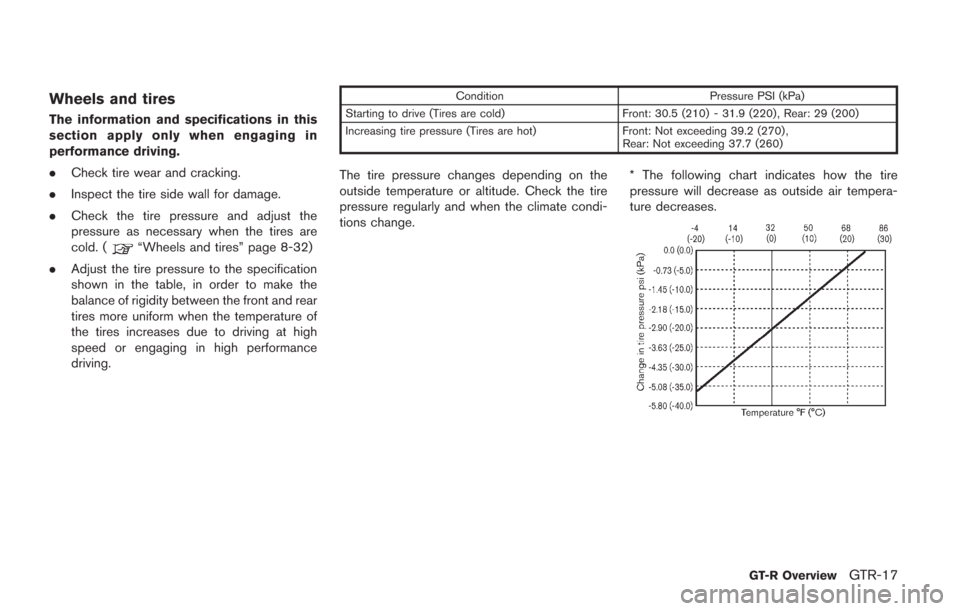
tions change. * The following chart indicates how the tire
pressure will decrease as outside air tempera-
ture decreases.
GT-R OverviewGTR-17
Page 294 of 354
If the brakes do not operate properly, have the
brakes checked by a GT-R certified NISSAN
dealer.
SELF-ADJUSTING BRAKES
Your vehicle is equipped with self-adjusting
brakes.
The disc-type brakes self-adjust every time the
brake pedal is applied.
WARNING
See a GT-R certified NISSAN dealer for
a brake system check if the brake pedal
height does not return to normal.
BRAKE PAD WEAR WARNING
The disc brake pads have audible wear warn-
ings. When a brake pad requires replacement, it
will make a high pitched scraping sound when
the vehicle is in motion. This scraping sound will
first occur only when the brake pedal is
depressed. After more wear of the brake pad,
the sound will always be heard even if the brake
pedal is not depressed. Have the brakes
checked as soon as possible if the wear warning
sound is heard.
Under some driving or climate conditions,occasional brake squeak, squeal or other noise
may be heard. Occasional brake noise during
light to moderate stops is normal and does not
affect the function or performance of the brake
system.
Proper brake inspection intervals should
be followed.
For additional information, see the
maintenance log section of your NISSAN
Service and Maintenance Guide for mainte-
nance intervals.
HIGH PERFORMANCE BRAKE SYS-
TEM
This vehicle is equipped with high performance
brake pads that provide appropriate braking
force in a broad range of driving environments.
Due to the material used for the brake pads, the
road wheels may become more easily covered
by brake dust, however this does not indicate
that there is a malfunction.
The GT-R brake pads use material that contains
a lot of iron to maintain steady braking perfor-
mance even in high and low temperatures.
However, if the brake system is wet and the
parking brake is applied for a long time, the iron
in this material may get rusty and the brake pad
and disc rotor may be fixed together. This may
cause noise and vibration while driving. Before
parking the vehicle, dry the brake by driving on a dry road, especially after washing the vehicle or
driving in rain. Contact a GT-R certified NISSAN
dealer if the noise and vibration continue.
Frequent hard braking may cause scorching of
the brake pads. This will require the brake pads
to be replaced, even if the wear limit has not
been reached. Have the brake pads and disc
rotors inspected at the regular vehicle inspec-
tions.
For more details, contact a GT-R certified
NISSAN dealer.
REPLACING THE BRAKE PADS
NISSAN generally recommends to replace all
four sets of brake pads and disc rotors at the
same time to maintain maximum brake perfor-
mance.
However, replacing only the brake pads may be
allowed in some cases (four wheels or only front
wheels depending on the conditions). A GT-R
certified technician must inspect the vehicle and
determine that only the brake pads need to be
replaced. In this case, replacing all brake pads
and disc rotors as a set is not necessary.
Note that the replacement of brake pads and the
disc rotors as a set on all four wheels should be
performed when a GT-R certified technician
determines that this is the correct repair.
Maintenance and do-it-yourself8-23
BRAKES
Page 337 of 354
9-18Technical and consumer information
DOT (Department Of Transportation) Quality
Grades: All passenger car tires must conform to
federal safety requirements in addition to these
grades.
Quality grades can be found where applicable
on the tire sidewall between tread shoulder and
maximum section width. For example:
Treadwear 200 Traction AA Temperature A
TREADWEAR
The treadwear grade is a comparative rating
based on the wear rate of the tire when tested
under controlled conditions on a specified
government test course. For example, a tire
graded 150 would wear one and one-half (1
1/2) times as well on the government course as
a tire graded 100. The relative performance of
tires depends upon actual conditions of their
use, however, and may depart significantly from
the norm due to variations in driving habits,
service practices and differences in road char-
acteristics and climate.
TRACTION AA, A, B AND C
The traction grades, from highest to lowest, are
AA, A, B and C. Those grades represent the
tire’s ability to stop on wet pavement as
measured under controlled conditions on spe-
cified government test surfaces of asphalt and
concrete. A tire marked C may have poor
traction performance.
WARNING
The traction grade assigned to this tire
is based on straight-ahead braking
traction tests, and does not include
acceleration, cornering, hydroplaning,
or peak traction characteristics.
TEMPERATURE A, B AND C
The temperature grades A (the highest), B, and
C, representing the tire’s resistance to the
generation of heat and its ability to dissipate
heat when tested under controlled conditions on
a specified indoor laboratory test wheel. Sus-
tained high temperature can cause the material
of the tire to degenerate and reduce tire life, and
excessive temperature can lead to sudden tire
failure. The grade C corresponds to a level of
performance which all passenger car tires mustmeet under the Federal Motor Vehicle Safety
Standard No. 109. Grades B and A represent
higher levels of performance on the laboratory
test wheel than the minimum required by law.
WARNING
The temperature grade for this tire is
established for a tire that is properly
inflated and not overloaded. Excessive
speed, under-inflation, or excessive
loading, either separately or in combi-
nation, can cause heat build-up and
possible tire failure.
UNIFORM TIRE QUALITY GRADING