2014 NISSAN GT-R change wheel
[x] Cancel search: change wheelPage 312 of 354
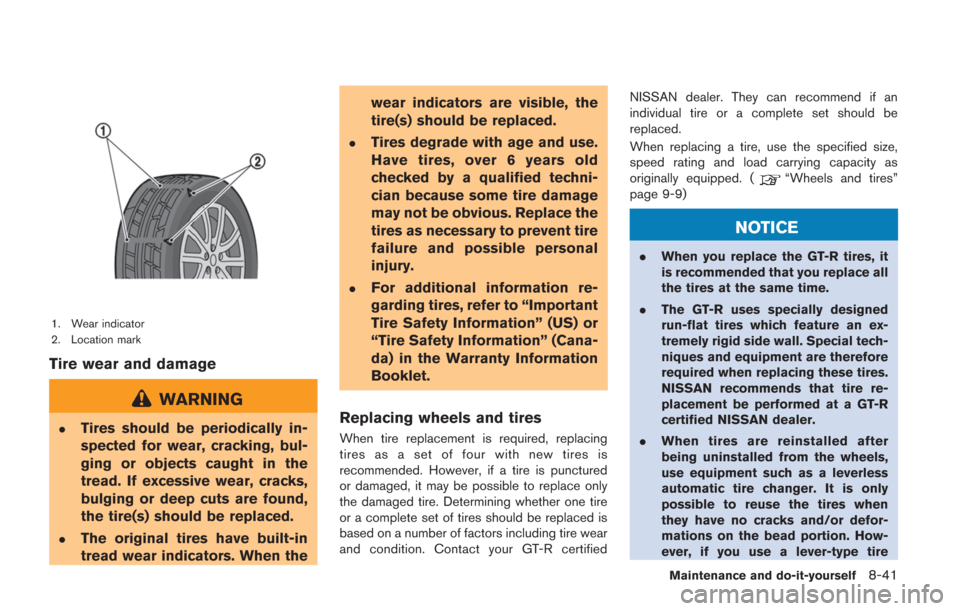
1. Wear indicator
2. Location mark
Tire wear and damage
WARNING
.Tires should be periodically in-
spected for wear, cracking, bul-
ging or objects caught in the
tread. If excessive wear, cracks,
bulging or deep cuts are found,
the tire(s) should be replaced.
.The original tires have built-in
tread wear indicators. When thewear indicators are visible, the
tire(s) should be replaced.
.Tires degrade with age and use.
Have tires, over 6 years old
checked by a qualified techni-
cian because some tire damage
may not be obvious. Replace the
tires as necessary to prevent tire
failure and possible personal
injury.
.For additional information re-
garding tires, refer to “Important
Tire Safety Information” (US) or
“Tire Safety Information” (Cana-
da) in the Warranty Information
Booklet.
Replacing wheels and tires
When tire replacement is required, replacing
tires as a set of four with new tires is
recommended. However, if a tire is punctured
or damaged, it may be possible to replace only
the damaged tire. Determining whether one tire
or a complete set of tires should be replaced is
based on a number of factors including tire wear
and condition. Contact your GT-R certified NISSAN dealer. They can recommend if an
individual tire or a complete set should be
replaced.
When replacing a tire, use the specified size,
speed rating and load carrying capacity as
originally equipped. (
“Wheels and tires”
page 9-9)
NOTICE
. When you replace the GT-R tires, it
is recommended that you replace all
the tires at the same time.
. The GT-R uses specially designed
run-flat tires which feature an ex-
tremely rigid side wall. Special tech-
niques and equipment are therefore
required when replacing these tires.
NISSAN recommends that tire re-
placement be performed at a GT-R
certified NISSAN dealer.
. When tires are reinstalled after
being uninstalled from the wheels,
use equipment such as a leverless
automatic tire changer. It is only
possible to reuse the tires when
they have no cracks and/or defor-
mations on the bead portion. How-
ever, if you use a lever-type tire
Maintenance and do-it-yourself8-41
Page 313 of 354
8-42Maintenance and do-it-yourself
changer, cracks and deformation
may occur on the bead portion of
the tires meaning that the tires
cannot be reused.
. Make sure the tire valve stem cap is
installed and that the valve stem is
tight. When installing the cap, make
sure to tighten the cap by hand. If a
tool is used to tighten the cap, the
cap may be damaged.
WARNING
.The use of tires other than those
specified or the mixed use of tires of
different brands, construction (bias,
bias-belted, radial or run-flat) , or
tread patterns can adversely affect
the ride, braking, VDC system, hand-
ling, ground clearance, body-to-tire
clearance, tire chain clearance,
speedometer calibration, headlight
aim and bumper height. Some of
these effects may lead to accidents
and could result in serious personal
injury.
. If the wheels are changed for any
reason, always replace with wheels which have the same off-set dimen-
sion. Wheels of a different off-set
could cause premature tire wear,
degrade vehicle handling character-
istics, affect the VDC system and/or
cause interference with the brake
discs. Such interference can lead to
decreased braking efficiency and/or
early brake pad wear. (
“Wheels
and tires” page 9-9)
. When a wheel is replaced, tire
pressure will not be indicated, the
TPMS will not function and the low
tire pressure warning light will flash
for approximately 1 minute and
remain on after the 1 minute. Con-
tact a GT-R certified NISSAN dealer
as soon as possible for tire replace-
ment and/or system resetting.
. Replacing tires with those not ori-
ginally specified by NISSAN could
affect the proper operation of the
TPMS.
. Do not install a damaged or de-
formed wheel or tire even if it has
been repaired. Such wheels or tires
could have structural damage and
could fail without warning. .
Never use retread tires.
. For additional information regard-
ing tires, refer to “Important Tire
Safety Information” (US) or “Tire
Safety Information” (Canada) in the
Warranty Information Booklet.
. Always use tires of the specified
type, size, brand, construction (bias,
bias-belted, radial or run-flat) , and
tread pattern on all four wheels.
Failure to do so may result in a
circumference difference between
tires on the front and rear axles
which will cause excessive tire wear
and may damage the transmission,
transfer case and differential gears.
Wheel balance
Unbalanced wheels may affect vehicle handling
and tire life. Even with regular use, wheels can
get out of balance. Therefore, they should be
balanced as required.
Wheel balance service should be performed
with the wheels off the vehicle. Spin balancing
the rear wheels on the vehicle could lead to
mechanical damage.
For additional information regarding tires, refer
Page 314 of 354
to “Important Tire Safety Information” (US) or
“Tire Safety Information” (Canada) in the War-
ranty Information Booklet.
Care of wheels
(“Cleaning exterior” page 7-2)
JACKING VEHICLE AND REMOVING
WHEELS
WARNING
.Make sure the parking brake is
securely applied and the transmis-
sion is shifted into the
&Pposition.
. Never change tires when the vehicle
is on a slope, ice or slippery areas.
This is hazardous.
. Never change tires if oncoming
traffic is close to your vehicle. Wait
for professional road assistance.
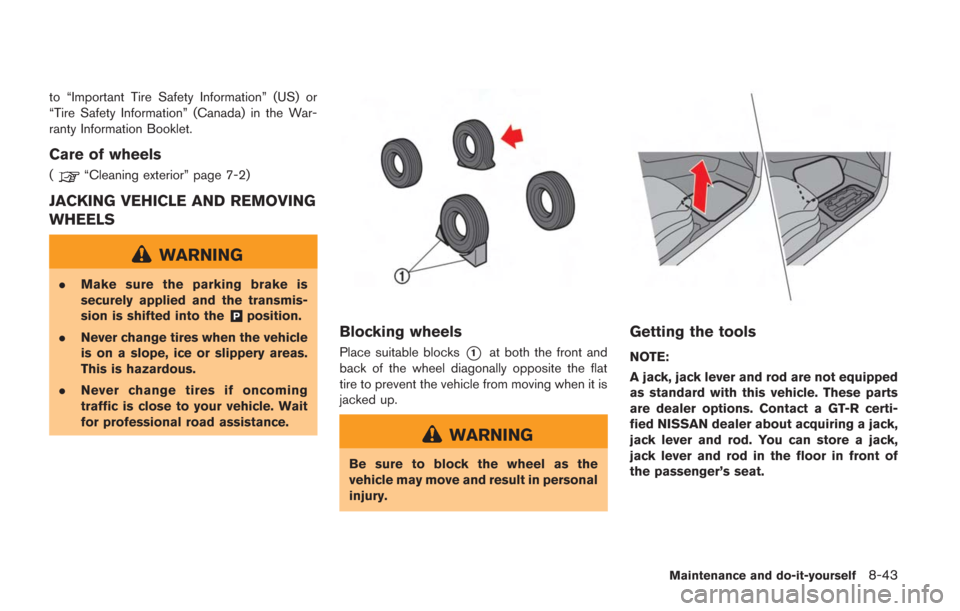
Blocking wheels
Place suitable blocks*1at both the front and
back of the wheel diagonally opposite the flat
tire to prevent the vehicle from moving when it is
jacked up.
WARNING
Be sure to block the wheel as the
vehicle may move and result in personal
injury.
Getting the tools
NOTE:
A jack, jack lever and rod are not equipped
as standard with this vehicle. These parts
are dealer options. Contact a GT-R certi-
fied NISSAN dealer about acquiring a jack,
jack lever and rod. You can store a jack,
jack lever and rod in the floor in front of
the passenger’s seat.
Maintenance and do-it-yourself8-43
Page 335 of 354
9-16Technical and consumer information
4.The resulting figure equals the available
amount of cargo and luggage load
capacity. For example, if the XXX
amount equals 1400 lbs. and there will
be five 150 lb. passengers in your
vehicle, the amount of available cargo
and luggage load capacity is 650 lbs.
(1400−750 (5 x 150) = 650 lbs) or
640 −340 (5 x 70) = 300 kg.)
5.Determine the combined weight of
luggage and cargo being loaded on
the vehicle. That weight may not safely
exceed the available cargo and luggage
load capacity calculated in Step 4.
6.If your vehicle will be towing a trailer,
load from your trailer will be transferred
to your vehicle. Consult this manual to
determine how this reduces the avail-
able cargo and luggage load capacity
of your vehicle.
Before driving a loaded vehicle, confirm
that you do not exceed the Gross Vehicle
Weight Rating (GVWR) or the Gross Axle
Weight Rating (GAWR) for your vehicle.
(
“Measurement of weights” page 9-
16) Also check tires for proper inflation pres-
sures. See the Tire and Loading Information
label.
LOADING TIPS
.The GVW must not exceed GVWR or
GAWR as specified on the F.M.V.S.S./
C.M.V.S.S. certification label.
.Do not load the front and rear axle to
the GAWR. Doing so will exceed the
GVWR.
WARNING
.Properly secure all cargo to help
prevent it from sliding or shift-
ing. Do not place cargo higher
than the seatbacks. In a sudden
stop or collision, unsecured car-
go could cause personal injury.
.Do not load your vehicle any
heavier than the GVWR or the
maximum front and rear
GAWRs. If you do, parts of your
vehicle can break, tire damage
could occur, or it can change the
way your vehicle handles. Thiscould result in loss of control
and cause personal injury.
.Overloading could not only
shorten the life of your vehicle
and the tires, but also could lead
to hazardous vehicle handling
and long braking distance. This
may cause a premature tire
malfunction, which could result
in a serious accident and perso-
nal injury. Repairs due to over-
loading the vehicle are not
covered by the vehicle’s war-
ranty. (See the 2014 NISSAN
GT-R Warranty Information
Booklet.)
MEASUREMENT OF WEIGHTS
Secure loose items to prevent weight shifts
that could affect the balance of your
vehicle. When the vehicle is loaded, drive
to a scale and weigh the front and the rear
wheels separately to determine axle loads.
Individual axle loads should not exceed
either of the gross axle weight ratings