2014 NISSAN GT-R brake light
[x] Cancel search: brake lightPage 133 of 354
2-36Instruments and controls
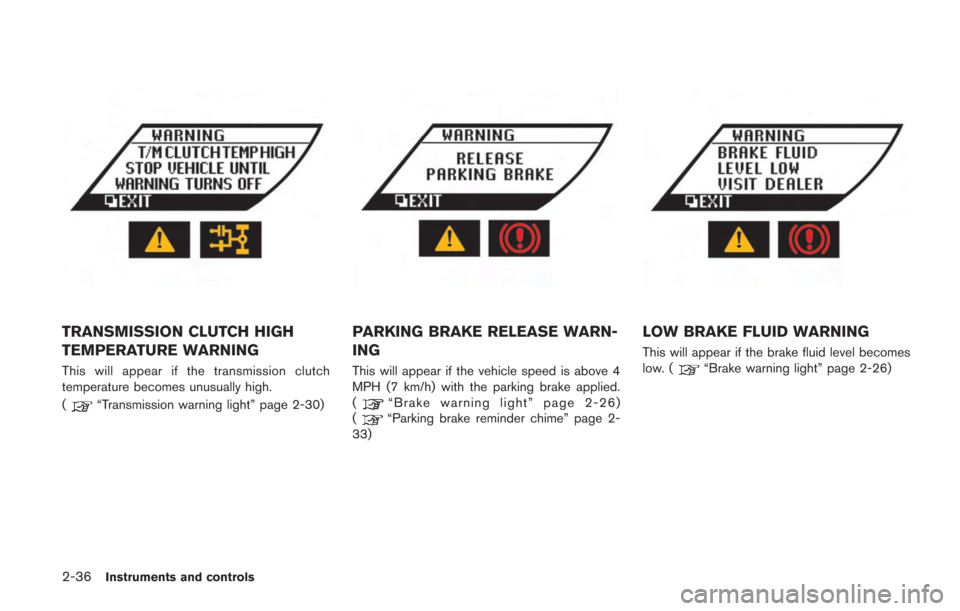
TRANSMISSION CLUTCH HIGH
TEMPERATURE WARNING
This will appear if the transmission clutch
temperature becomes unusually high.
(
“Transmission warning light” page 2-30)
PARKING BRAKE RELEASE WARN-
ING
This will appear if the vehicle speed is above 4
MPH (7 km/h) with the parking brake applied.
(
“Brake warning light” page 2-26)
(“Parking brake reminder chime” page 2-
33)
LOW BRAKE FLUID WARNING
This will appear if the brake fluid level becomes
low. (“Brake warning light” page 2-26)
Page 134 of 354
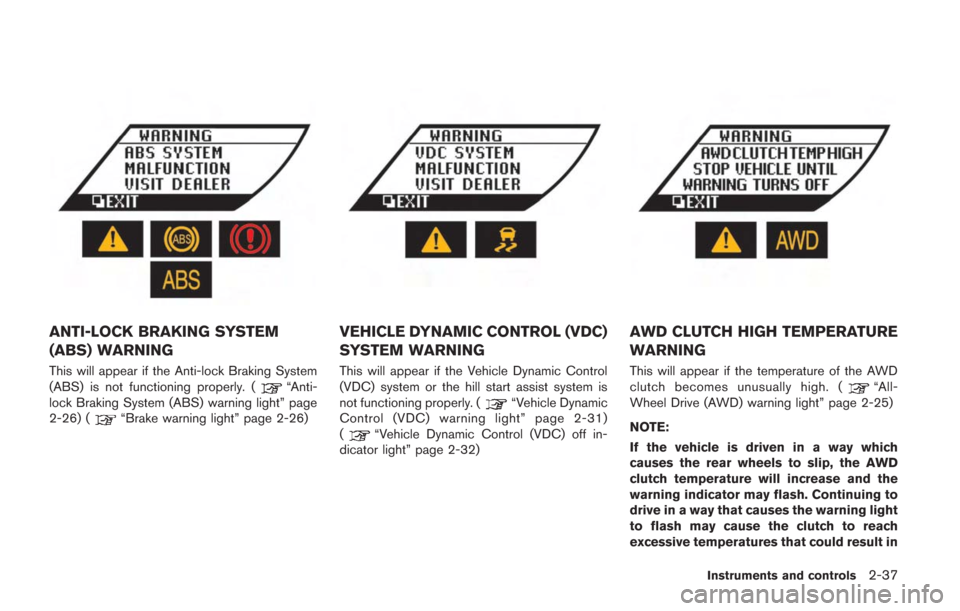
ANTI-LOCK BRAKING SYSTEM
(ABS) WARNING
This will appear if the Anti-lock Braking System
(ABS) is not functioning properly. (“Anti-
lock Braking System (ABS) warning light” page
2-26) (
“Brake warning light” page 2-26)
VEHICLE DYNAMIC CONTROL (VDC)
SYSTEM WARNING
This will appear if the Vehicle Dynamic Control
(VDC) system or the hill start assist system is
not functioning properly. (
“Vehicle Dynamic
Control (VDC) warning light” page 2-31)
(
“Vehicle Dynamic Control (VDC) off in-
dicator light” page 2-32)
AWD CLUTCH HIGH TEMPERATURE
WARNING
This will appear if the temperature of the AWD
clutch becomes unusually high. (“All-
Wheel Drive (AWD) warning light” page 2-25)
NOTE:
If the vehicle is driven in a way which
causes the rear wheels to slip, the AWD
clutch temperature will increase and the
warning indicator may flash. Continuing to
drive in a way that causes the warning light
to flash may cause the clutch to reach
excessive temperatures that could result in
Instruments and controls2-37
Page 149 of 354
2-52Instruments and controls
CAUTION
Use low beams when there are cars
approaching from the opposite direc-
tion, during city driving and at similar
times.
Battery saver system
A chime will sound when the driver side door is
opened with the light switch in theorposition and the ignition switch in the ACC,
OFF or LOCK position. (“Light reminder
chime” page 2-32)
When the headlight switch is in the
orposition while the ignition switch is in the ON
position, the lights will automatically turn off after
a period of time when the ignition switch has
been pushed to the OFF position.
When the headlight switch remains in the
orposition after the lights automatically turn
off, the lights will turn on when the ignition
switch is pushed to the ON position.
NOTICE
. When you turn on the headlight
switch again after the lights auto-
matically turn off, the lights will not
turn off automatically. Be sure to
turn the light switch to the OFF
position when you leave the vehicle
for extended periods of time, other-
wise the battery will be discharged.
. Never leave the light switch on
when the engine is not running for
extended periods of time even if the
headlights turn off automatically.
Daytime running light system
The daytime running lights automatically illumi-
nate when the engine is started with the parking
brake released. The daytime running lights
operate with the headlight switch in the OFF
position. Turn the headlight switch to the
position for full illumination when driving at night.
If the parking brake is applied before the engine
is started, the daytime running lights do not
illuminate. The daytime running lights illuminate
once the parking brake is released. The daytime
running lights will remain on until the ignition
switch is pushed to the OFF position.
WARNING
When the daytime running light system
is active, tail lights on your vehicle are
not on. It is necessary at dusk to turn on
your headlights. Failure to do so could
cause an accident injuring yourself and
others.
Page 198 of 354
5 Starting and driving
Precautions when starting and driving ............................... 5-3Exhaust gas (carbon monoxide) ..................................... 5-3Three-way catalyst ............................................................. 5-3
Tire Pressure Monitoring System (TPMS) ................... 5-4
Avoiding collision and rollover ........................................ 5-7
Off-road recovery ............................................................... 5-7
Rapid air pressure loss ..................................................... 5-8
Drinking alcohol/drugs and driving ................................ 5-8All-Wheel Drive (AWD) driving safety precautions .... 5-9
Push-button ignition switch ................................................... 5-9
Operating range for engine start ................................ 5-10
Ignition switch operation ............................................... 5-10
Ignition switch positions ................................................ 5-10
Emergency engine shut off ........................................... 5-11
Intelligent Key battery discharge ................................. 5-11
Before starting the engine .................................................. 5-13
Starting the engine ............................................................... 5-13
Driving the vehicle ................................................................ 5-15 Dual clutch transmission ............................................... 5-15
Driving tips ........................................................................\
5-21
VDC, transmission and suspension setup switches .... 5-24 How to switch the modes ............................................ 5-25
Features of each mode .................................................. 5-26
Turbocharger system ............................................................ 5-30 R mode start function ......................................................... 5-31
How to use R mode start function ........................... 5-32
Parking brake ........................................................................\
. 5-32
Cruise control ........................................................................\
5-33 Precautions on cruise control .................................... 5-34Steering-wheel-mounted controls ............................ 5-34
Indicators and display .................................................. 5-35
Cruise control operations ........................................... 5-35
Hill Start Assist ..................................................................... 5-37
Break-in schedule ................................................................ 5-38
Wheel alignment ........................................................... 5-38
Fuel Efficient Driving Tips .................................................. 5-39
Increasing fuel economy ..................................................... 5-40
All-Wheel Drive (AWD) ...................................................... 5-40 AWD warning light ....................................................... 5-40
Tight corner braking phenomenon ........................... 5-42
Tires ........................................................................\
.......... 5-43AWD system characteristics ...................................... 5-43
Limited Slip Differential (LSD) .......................................... 5-44
Parking/parking on hills ....................................................... 5-45
Power steering ...................................................................... 5-46
Brake system ........................................................................\
. 5-47 Braking precautions ..................................................... 5-47
Parking brake break-in ................................................. 5-47
Page 205 of 354
5-8Starting and driving
.If you decide that it is not safe to return
the vehicle to the road surface based on
vehicle, road or traffic conditions, gradu-
ally slow the vehicle to a stop in a safe
place off the road.
RAPID AIR PRESSURE LOSS
Rapid air pressure loss or a “blow-out” can
occur if the tire is punctured or is damaged due
to hitting a curb or pothole. Rapid air pressure
loss can also be caused by driving on under-
inflated tires.
Rapid air pressure loss can affect the handling
and stability of the vehicle, especially at highway
speeds.
Help prevent rapid air pressure loss by main-
taining the correct air pressure and visually
inspect the tires for wear and damage.
(
“Wheels and tires” page 8-32)
If a tire rapidly loses air pressure or “blows-out”
while driving maintain control of the vehicle by
following the procedure below. Please note that
this procedure is only a general guide. The
vehicle must be driven as appropriate based on
the conditions of the vehicle, road and traffic.
WARNING
The following actions can increase the
chance of losing control of the vehicle if
there is a sudden loss of tire air
pressure. Losing control of the vehicle
may cause a collision and result in
personal injury.
. The vehicle generally moves or pulls
in the direction of the flat tire.
. Do not rapidly apply the brakes.
. Do not rapidly release the accelera-
tor pedal.
. Do not rapidly turn the steering
wheel.
1. Remain calm and do not overreact.
2. Maintain a firm grip on the steering wheel with both hands and try to hold a straight
course.
3. When appropriate, slowly release the accel- erator pedal to gradually slow the vehicle.
4. Gradually steer the vehicle to a safe location off the road and away from traffic if possible.
5. Lightly apply the brake pedal to gradually stop the vehicle. 6. Turn on the hazard warning flashers and
contact a roadside emergency service to
change the tire.
DRINKING ALCOHOL/DRUGS AND
DRIVING
WARNING
Never drive under the influence of
alcohol or drugs. Alcohol in the blood-
stream reduces coordination, delays
reaction time and impairs judgement.
Driving after drinking alcohol increases
the likelihood of being involved in an
accident injuring yourself and others.
Additionally, if you are injured in an
accident, alcohol can increase the se-
verity of the injury.
NISSAN is committed to safe driving. However,
you must choose not to drive under the influence
of alcohol. Every year thousands of people are
injured or killed in alcohol-related accidents.
Although the local laws vary on what is
considered to be legally intoxicated, the fact is
that alcohol affects all people differently and
most people underestimate the effects of
alcohol.
Page 210 of 354
.Make sure the area around the vehicle is
clear.
. Check fluid levels such as engine oil, cool-
ant, brake fluid and window washer fluid as
frequently as possible, or at least whenever
you refuel.
. Check that all windows and lights are clean.
. Visually inspect tires for their appearance
and condition. Also check tires for proper
inflation.
. Lock all doors.
. Position seat.
. Adjust inside and outside mirrors.
. Fasten seat belts and ask all passengers to
do likewise.
. Check the operation of warning lights when
the ignition switch is pushed to the ON
position. (
“Warning/indicator lights
and audible reminders” page 2-25)
NOTE:
. This vehicle includes spark plugs that
are designed for maximum perfor-
mance. If the start time becomes long-
er, the plugs may be fouled, making the
engine difficult to start. If this occurs,
start the engine using the procedure
described in this section.
. A click sound may be heard when the
brake pedal is depressed and released.
This is normal.
. A low rattling operating sound may
occur when the engine is started or
stopped. This is because of the trans-
mission gear design, light flywheel and
dry sump lubrication system used in
this transmission. This does not indi-
cate that there is a malfunction. This
sound is likely to occur in particular if
the engine is stopped when the tem-
perature of the transmission oil is high.
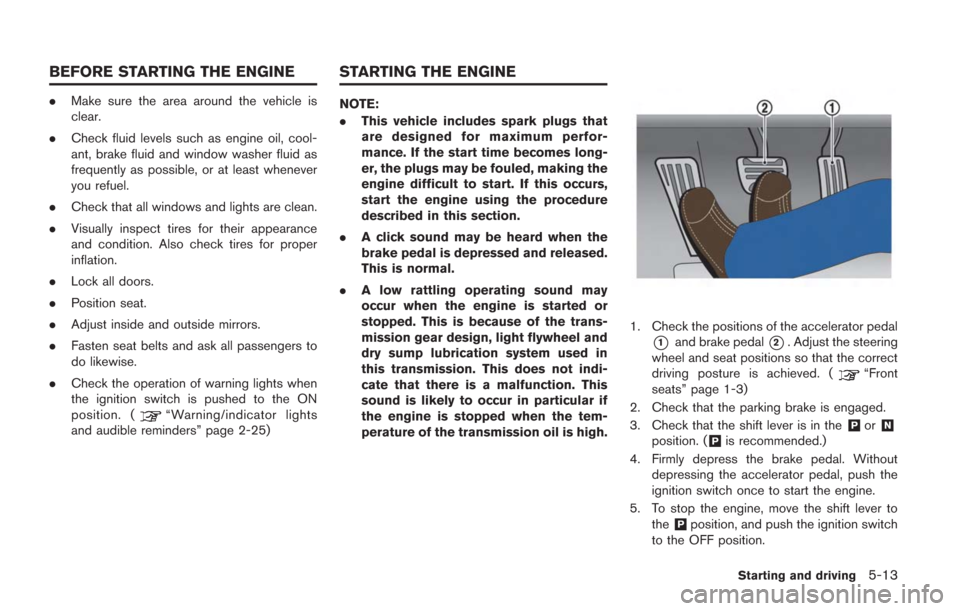
1. Check the positions of the accelerator pedal
*1and brake pedal*2. Adjust the steering
wheel and seat positions so that the correct
driving posture is achieved. (
“Front
seats” page 1-3)
2. Check that the parking brake is engaged.
3. Check that the shift lever is in the
&Por&N
position. (&Pis recommended.)
4. Firmly depress the brake pedal. Without depressing the accelerator pedal, push the
ignition switch once to start the engine.
5. To stop the engine, move the shift lever to the
&Pposition, and push the ignition switch
to the OFF position.
Starting and driving5-13
BEFORE STARTING THE ENGINE STARTING THE ENGINE
Page 212 of 354
DUAL CLUTCH TRANSMISSION
The GT-R dual clutch transmission is a newly-
developed system that uses an electronically
controlled multiple-disc wet clutch attached to
the highly efficient manual transmission. This
transmission has two driving modes.
.
&Aposition (Automatic gearshift):
allows automatic shifting of the manual
transmission.
.
&Mposition (Manual gearshift):
allows quick shifting of the manual transmis-
sion.
NOTE:
When starting or driving on a steep uphill
grade, shift to the
&Mposition and operate
the paddle shifter to shift down to 1st gear
similar to a manual transmission vehicle.
The GT-R dual clutch transmission was devel-
oped specifically to maximize vehicle perfor-
mance and driving enjoyment. The GT-R
transmission components were designed using
different engineering standards than typical
passenger car transmissions. Because of this,
the GT-R has different operating characteristics,
and various rattle noises may be heard during
some driving conditions because of the follow-
ing items: .
Gear clearances
. Ultralight flywheel
. Dry sump lubrication
These noises do not indicate that there is a
malfunction.
WARNING
. Do not depress the accelerator
pedal while shifting from the&Por
&Nposition to the&Ror&A↔&M
position. Always depress the brake
pedal until shifting is completed.
Failure to do so could cause loss
of control and an accident.
. Cold engine idle speed is high, so
use caution when shifting into a
forward or reverse gear before the
engine has warmed up.
. Never shift to the
&Por&Rposition
while the vehicle is moving forward.
Never shift to the
&Por&A↔&M
position while the vehicle is moving
rearward. Doing so could cause loss
of control and an accident.
. The shift lever contains a powerful
magnet. Do not place electronic medical devices or other electronic
products that are susceptible to
magnetic force close to the shift
lever.
. Do not downshift abruptly on slip-
pery roads. This may cause a loss of
control.
. If the shift lever is moved from
&Rto
&A↔&Mposition, or&A↔&Mto&R
position before the vehicle stops,
you may not be able to shift gear or
it may take longer to shift gear.
Make sure to depress the brake
pedal and check that the vehicle
has stopped before shifting.
CAUTION
.Because the vehicle includes a dual
clutch transmission that automati-
cally controls the clutch and shifting
operation of the manual transmis-
sion, whenever the shift lever is in a
position other then
&Por&N, the
vehicle will begin to move slowly, in
the same way as when the clutch in
a manual transmission vehicle is
Starting and driving5-15
DRIVING THE VEHICLE
Page 214 of 354
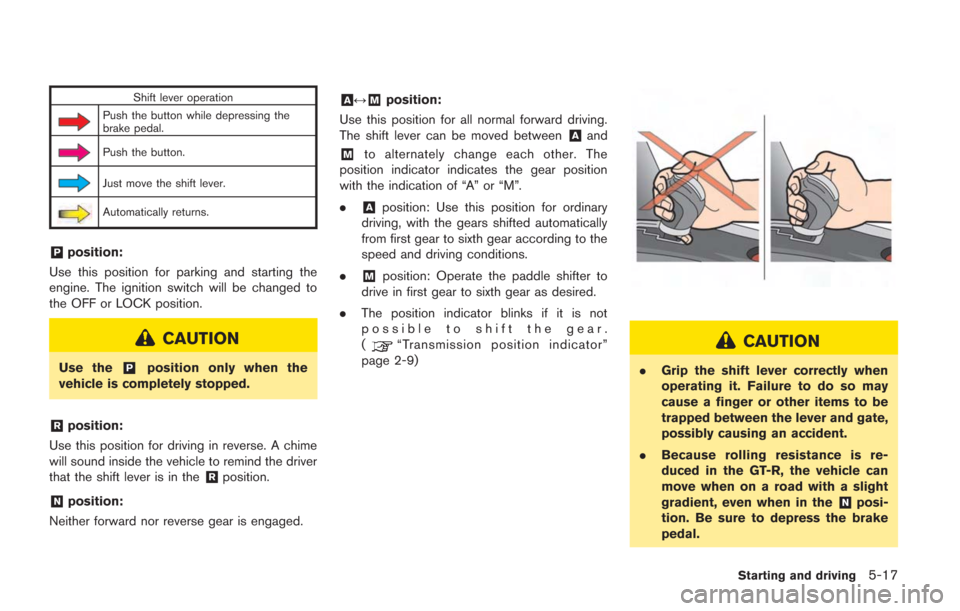
Shift lever operation
Push the button while depressing the
brake pedal.
Push the button.
Just move the shift lever.
Automatically returns.
&Pposition:
Use this position for parking and starting the
engine. The ignition switch will be changed to
the OFF or LOCK position.
CAUTION
Use the&Pposition only when the
vehicle is completely stopped.
&Rposition:
Use this position for driving in reverse. A chime
will sound inside the vehicle to remind the driver
that the shift lever is in the
&Rposition.
&Nposition:
Neither forward nor reverse gear is engaged.
&A↔&Mposition:
Use this position for all normal forward driving.
The shift lever can be moved between
&Aand
&Mto alternately change each other. The
position indicator indicates the gear position
with the indication of “A” or “M”.
.
&Aposition: Use this position for ordinary
driving, with the gears shifted automatically
from first gear to sixth gear according to the
speed and driving conditions.
.
&Mposition: Operate the paddle shifter to
drive in first gear to sixth gear as desired.
. The position indicator blinks if it is not
possible to shift the gear.
(
“Transmission position indicator”
page 2-9)CAUTION
. Grip the shift lever correctly when
operating it. Failure to do so may
cause a finger or other items to be
trapped between the lever and gate,
possibly causing an accident.
. Because rolling resistance is re-
duced in the GT-R, the vehicle can
move when on a road with a slight
gradient, even when in the
&Nposi-
tion. Be sure to depress the brake
pedal.
Starting and driving5-17