2014 NISSAN GT-R Fuel
[x] Cancel search: FuelPage 129 of 354
2-32Instruments and controls
and then blinks for 10 seconds when the engine
is not running, it indicates that the vehicle is not
ready for an emission control system inspection/
maintenance test. (
“Readiness for Inspec-
tion/Maintenance (I/M) test (US only)” page 9-
20)
Operation:
The malfunction indicator light will come on in
one of two ways:
. Malfunction indicator light on steady — An
emission control system malfunction has
been detected. Check the fuel-filler cap. If
the fuel-filler cap is loose or missing, tighten
or install the cap and continue to drive the
vehicle. The
light should turn off after a
few driving trips. If thelight does not
turn off after a few driving trips, have the
vehicle inspected by a GT-R certified
NISSAN dealer. You do not need to have
your vehicle towed to the dealer.
. Malfunction indicator light blinking — An
engine misfire has been detected which may
damage the emission control system.
To reduce or avoid emission control system
damage:
a. Do not drive at speeds above 45 MPH
(72 km/h). b. Avoid hard acceleration or deceleration.
c. Avoid steep uphill grades.
d. If possible, reduce the amount of cargo
being hauled or towed.
The malfunction indicator light may stop
blinking and remain on.
Have the vehicle inspected by a GT-R
certified NISSAN dealer. You do not need
to have your vehicle towed to the dealer.
NOTICE
Continued vehicle operation without
having the emission control system
checked and repaired as necessary
could lead to poor driveability, reduced
fuel economy, and possible damage to
the emission control system.
Turn signal/hazard indicator
lights
The light flashes when the turn signal switch
lever or hazard switch is turned on.
Vehicle Dynamic Control (VDC)
off indicator light
The light comes on when the Vehicle Dynamic
Control (VDC) set up switch is pushed to OFF for more than 1 second. (
“VDC, transmis-
sion and suspension setup switches” page 5-
24)
This indicates that the vehicle dynamic control
system and traction control system are not
operating. (
“Vehicle Dynamic Control
(VDC) system” page 5-49)
AUDIBLE REMINDERS
Key reminder chime
A chime will sound if the driver side door is
opened while the ignition switch is pushed to
the ACC position or pushed to the OFF or
LOCK position with the Intelligent Key left in the
Intelligent Key port. Make sure the ignition
switch is pushed to the OFF position, and take
the Intelligent Key with you when leaving the
vehicle.
Light reminder chime
A chime will sound when the driver side door is
opened with the light switch in theorposition and the ignition switch in the ACC, OFF
or LOCK position.
Turn the light switch off when you leave the
vehicle.
Page 131 of 354
2-34Instruments and controls
If there are multiple warnings, the warning lights
remain lit or continue to blink and the warnings
displayed in the vehicle information display are
switched at regular intervals. The warnings
displayed in the vehicle information display can
be switched voluntarily by pushing the ENTER
switch
.
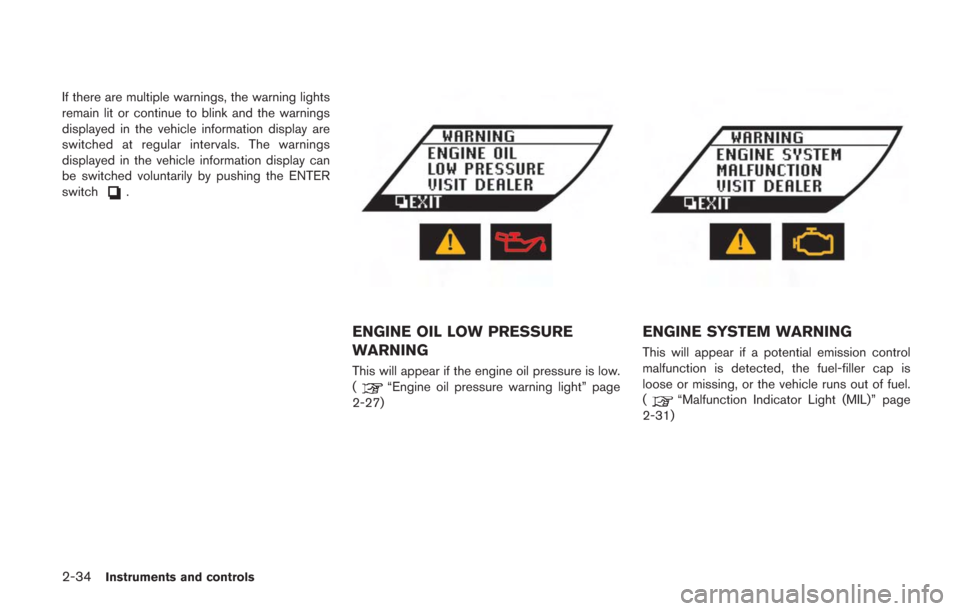
ENGINE OIL LOW PRESSURE
WARNING
This will appear if the engine oil pressure is low.
(“Engine oil pressure warning light” page
2-27)
ENGINE SYSTEM WARNING
This will appear if a potential emission control
malfunction is detected, the fuel-filler cap is
loose or missing, or the vehicle runs out of fuel.
(
“Malfunction Indicator Light (MIL)” page
2-31)
Page 137 of 354
2-40Instruments and controls
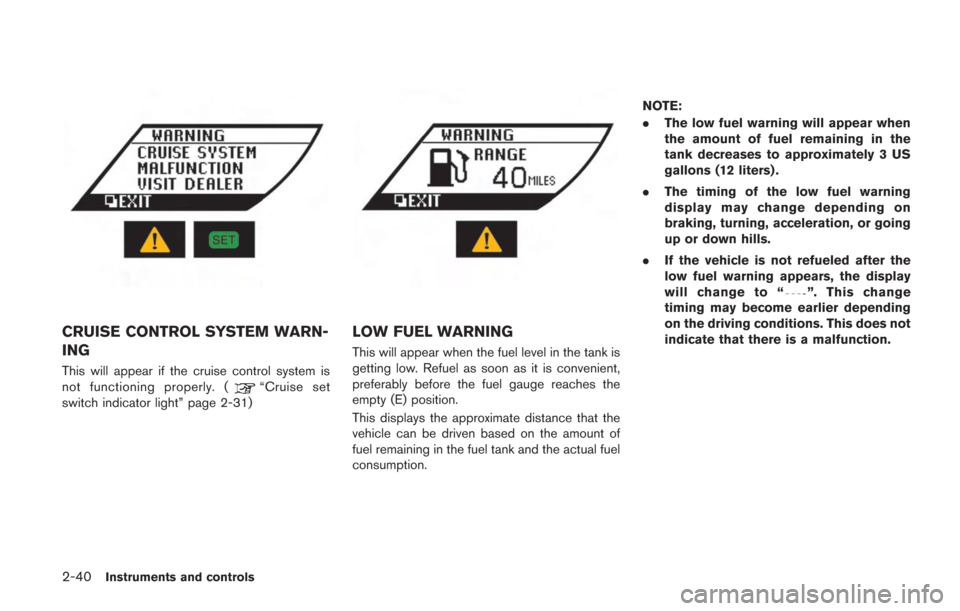
CRUISE CONTROL SYSTEM WARN-
ING
This will appear if the cruise control system is
not functioning properly. (“Cruise set
switch indicator light” page 2-31)
LOW FUEL WARNING
This will appear when the fuel level in the tank is
getting low. Refuel as soon as it is convenient,
preferably before the fuel gauge reaches the
empty (E) position.
This displays the approximate distance that the
vehicle can be driven based on the amount of
fuel remaining in the fuel tank and the actual fuel
consumption. NOTE:
.
The low fuel warning will appear when
the amount of fuel remaining in the
tank decreases to approximately 3 US
gallons (12 liters) .
. The timing of the low fuel warning
display may change depending on
braking, turning, acceleration, or going
up or down hills.
. If the vehicle is not refueled after the
low fuel warning appears, the display
will change to “
”. This change
timing may become earlier depending
on the driving conditions. This does not
indicate that there is a malfunction.
Page 166 of 354

3 Pre-driving checks and adjustments
Keys ........................................................................\
..................... 3-2Intelligent Key ...................................................................... 3-2
Doors ........................................................................\
................... 3-4
Locking with inside lock knob ........................................ 3-5
Locking with power door lock switch ........................... 3-5
Automatic door lock system ............................................ 3-5
Locking with mechanical key ........................................... 3-6
Opening the doors ............................................................ 3-7
Intelligent Key system ............................................................. 3-8 Intelligent Key functions .................................................... 3-9
Remote keyless entry functions ................................... 3-12
Setting hazard indicator and horn mode .................. 3-13
Warning signals ............................................................... 3-16
Troubleshooting guide ................................................... 3-17
Hood ........................................................................\
................. 3-18 Opening the hood ........................................................... 3-18
Closing the hood ............................................................. 3-19 Trunk ........................................................................\
................ 3-20
Trunk open request switch ......................................... 3-20
Trunk lid release switch ............................................... 3-20
Trunk release power cancel switch .......................... 3-21Opening and closing the trunk .................................. 3-21
Emergency trunk lid release ....................................... 3-22
Fuel-filler door ....................................................................... 3-23 Opening the fuel filler door ........................................ 3-24
Closing the fuel-filler door .......................................... 3-25
Steering wheel ...................................................................... 3-26
Tilt/telescopic steering column .................................. 3-26
Sun visors ........................................................................\
....... 3-27
Mirrors ........................................................................\
............. 3-27
Inside mirror .................................................................... 3-27
Outside mirrors .............................................................. 3-28
Vanity mirror .................................................................... 3-29
Page 169 of 354
3-4Pre-driving checks and adjustments
WARNING
.Always have the doors locked while
driving. Along with the use of seat
belts, this provides greater safety in
the event of an accident by helping
to prevent persons from being
thrown from the vehicle. This also
helps keep children and others from
unintentionally opening the doors,
and will help keep out intruders.
. Before opening any door, always
look for and avoid oncoming traffic.
. Do not leave children unattended
inside the vehicle. They could un-
knowingly activate switches or con-
trols. Unattended children could
become involved in serious acci-
dents.
CAUTION
To prevent theft or accidents, be sure to
stop the engine and lock the doors
before stepping away from the vehicle.
NOTICE
When the battery cable is removed from
the battery terminal, do not close either
of the front doors. The automatic win-
dow adjusting function will not work,
and the side roof panel may be da-
maged. (
“Automatic adjusting
function” page 2-61)
NOTE:
. The doors of this vehicle are somewhat
harder to close than those of an
ordinary vehicle (especially when the
vehicle is new) . This is because the
stiffness of the rubber has been in-
creased to improve the airtightness of
the vehicle interior during situations
such as higher speed driving. This does
not indicate that there is a malfunction.
. When the driver’s door is locked or
unlocked, the fuel-filler door is auto-
matically locked or unlocked at the
same time.
When the door is being opened, the window is
automatically lowered slightly to avoid contact
between the window and the side roof panel.
When the door is closed, the window is automatically raised slightly. (
“Automatic
adjusting function” page 2-61)
DOORS
Page 172 of 354
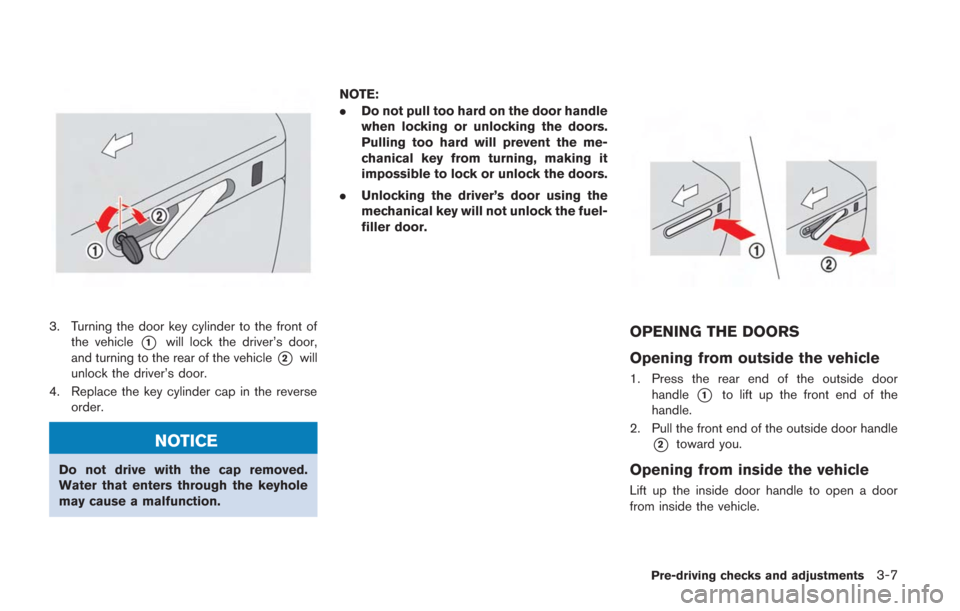
3. Turning the door key cylinder to the front ofthe vehicle
*1will lock the driver’s door,
and turning to the rear of the vehicle
*2will
unlock the driver’s door.
4. Replace the key cylinder cap in the reverse order.
NOTICE
Do not drive with the cap removed.
Water that enters through the keyhole
may cause a malfunction. NOTE:
.
Do not pull too hard on the door handle
when locking or unlocking the doors.
Pulling too hard will prevent the me-
chanical key from turning, making it
impossible to lock or unlock the doors.
. Unlocking the driver’s door using the
mechanical key will not unlock the fuel-
filler door.
OPENING THE DOORS
Opening from outside the vehicle
1. Press the rear end of the outside door
handle
*1to lift up the front end of the
handle.
2. Pull the front end of the outside door handle
*2toward you.
Opening from inside the vehicle
Lift up the inside door handle to open a door
from inside the vehicle.
Pre-driving checks and adjustments3-7
Page 174 of 354
— When any type of radio wave remotecontrol is used nearby.
— When the Intelligent Key is placed near an electric appliance such as a personal
computer.
— When the vehicle is parked near a parking meter.
. Although the life of the battery varies
depending on the operating conditions, the
battery’s life is approximately 2 years. If the
battery is discharged, replace it with a new
one. (
“Intelligent Key battery replace-
ment” page 8-27)
. Since the Intelligent Key is continuously
receiving radio waves, if the key is left near
equipment which transmits strong radio
waves, such as signals from a TV and
personal computer, the battery life may
become shorter.
. Because the steering wheel is locked
electrically, unlocking the steering wheel
with the ignition switch in the LOCK position
is impossible when the vehicle battery is
completely discharged. Pay special atten-
tion that the vehicle battery is not completely
discharged.
. Do not push the door handle request switch
with the Intelligent Key held in your hand. The close distance to the door handle will
cause the Intelligent Key system to have
difficulty recognizing that the Intelligent Key
is outside the vehicle.
. After locking the doors, check that the doors
are securely locked by testing them.
. To prevent the Intelligent Key from being left
inside the vehicle, make sure you carry the
key with you and then lock the doors.
. To prevent the Intelligent Key from being left
inside the trunk, make sure you carry the key
with you and then close the trunk.
. Do not pull the door handle before pushing
the door handle request switch. The door
will be unlocked but will not open. Release
the door handle once and pull it again to
open the door.
INTELLIGENT KEY FUNCTIONS
It is possible to lock/unlock all doors, fuel-filler
door and trunk lid by pushing the request switch
on the outside door handles and the trunk lid.
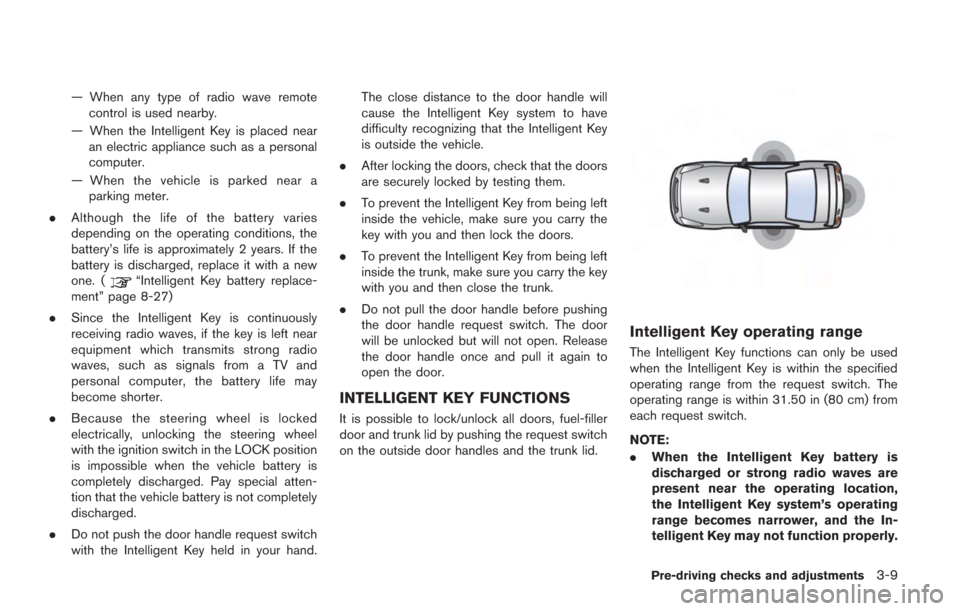
Intelligent Key operating range
The Intelligent Key functions can only be used
when the Intelligent Key is within the specified
operating range from the request switch. The
operating range is within 31.50 in (80 cm) from
each request switch.
NOTE:
.When the Intelligent Key battery is
discharged or strong radio waves are
present near the operating location,
the Intelligent Key system’s operating
range becomes narrower, and the In-
telligent Key may not function properly.
Pre-driving checks and adjustments3-9
Page 175 of 354
3-10Pre-driving checks and adjustments
.If the Intelligent Key is too close to the
door glass, handle or rear bumper, the
request switches may not function.
. When the Intelligent Key is within the
operating range, it is possible for any-
one who does not carry the Intelligent
Key to push the request switch to lock/
unlock the doors.
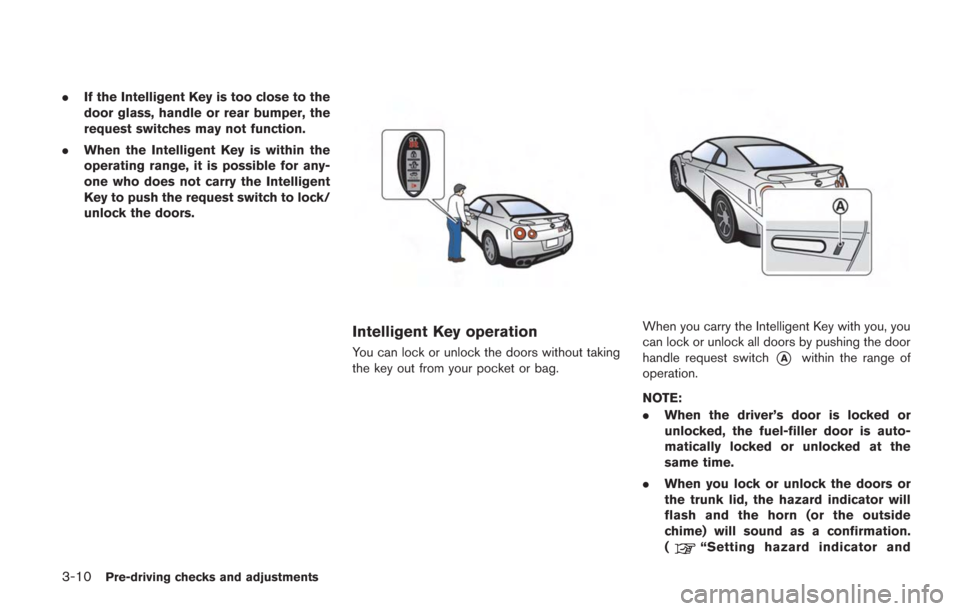
Intelligent Key operation
You can lock or unlock the doors without taking
the key out from your pocket or bag.
When you carry the Intelligent Key with you, you
can lock or unlock all doors by pushing the door
handle request switch
*Awithin the range of
operation.
NOTE:
. When the driver’s door is locked or
unlocked, the fuel-filler door is auto-
matically locked or unlocked at the
same time.
. When you lock or unlock the doors or
the trunk lid, the hazard indicator will
flash and the horn (or the outside
chime) will sound as a confirmation.
(
“Setting hazard indicator and