Page 26 of 434
The reclining feature allows adjustment of the
seatback for occupants of different sizes for
added comfort and to help obtain proper seat
belt fit (see “Precautions on seat belt usage” later
in this section) . Also, the seatback can be re-
clined to allow occupants to rest when the ve-
hicle is stopped and the shift lever is in P (Park) or
N (Neutral) position with the parking brake fully
applied.
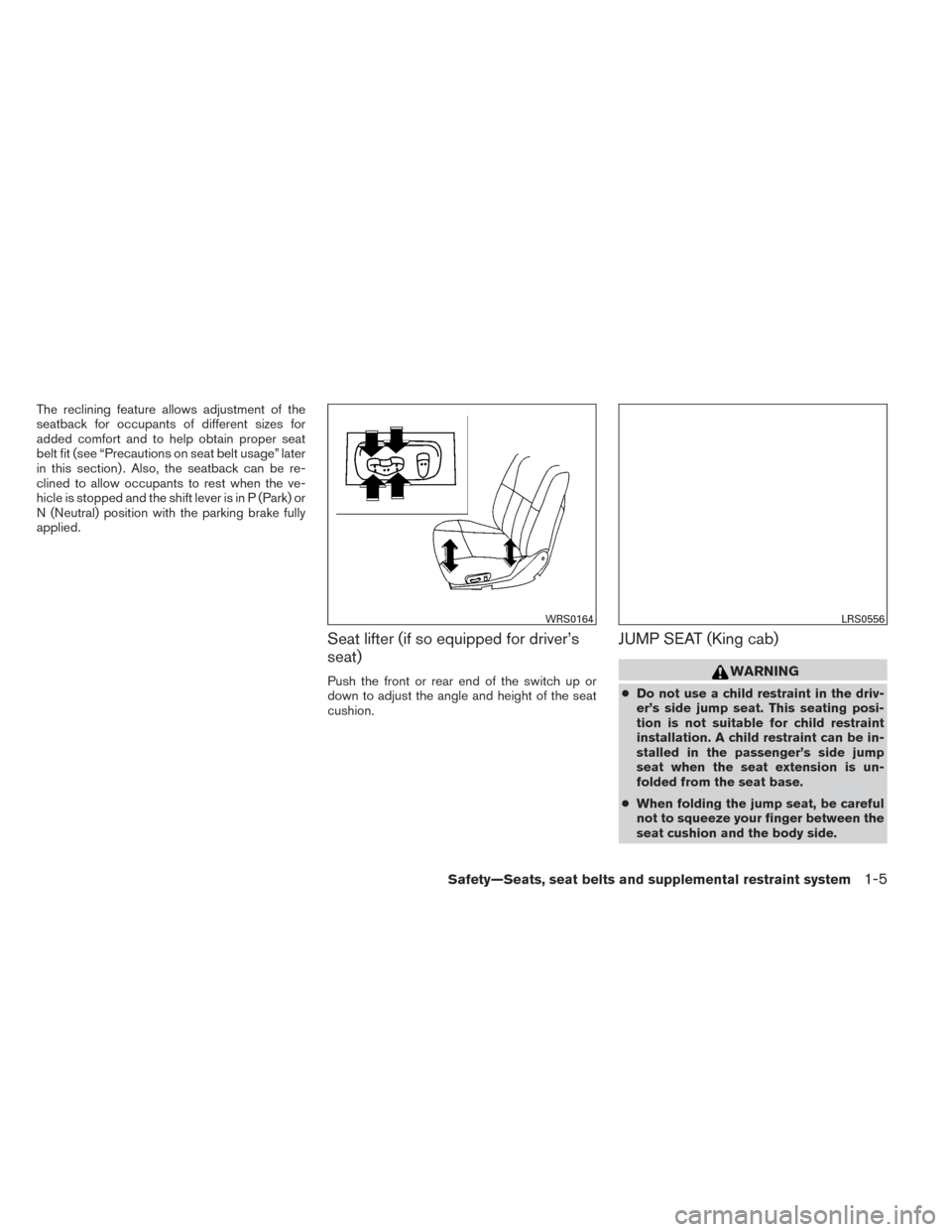
Seat lifter (if so equipped for driver’s
seat)
Push the front or rear end of the switch up or
down to adjust the angle and height of the seat
cushion.
JUMP SEAT (King cab)
WARNING
●Do not use a child restraint in the driv-
er’s side jump seat. This seating posi-
tion is not suitable for child restraint
installation. A child restraint can be in-
stalled in the passenger’s side jump
seat when the seat extension is un-
folded from the seat base.
● When folding the jump seat, be careful
not to squeeze your finger between the
seat cushion and the body side.
WRS0164LRS0556
Safety—Seats, seat belts and supplemental restraint system1-5
Page 27 of 434
ARMREST (if so equipped)
To use the center armrest on the 2nd row bench
seat, pull on the tab in the center of the seat and
fold it down to the resting position.
HEAD RESTRAINTS/HEADRESTS
WARNING
Head restraints/headrests supplement
the other vehicle safety systems. They may
provide additional protection against in-
jury in certain rear end collisions. Adjust-
able head restraints/headrests must be
adjusted properly, as specified in this sec-
tion. Check the adjustment after someone
else uses the seat. Do not attach anything
to the head restraint/headrest stalks or
remove the head restraint/headrest. Do
not use the seat if the head
restraint/headrest has been removed. If
the head restraint/headrest was removed,
reinstall and properly adjust the head
restraint/headrest before an occupant
uses the seating position. Failure to fol-
low these instructions can reduce the ef-
fectiveness of the head
restraints/headrests. This may increase
the risk of serious injury or death in a
collision.The illustration shows the seating positions
equipped with head restraints/headrests.
�
Indicates the seating position is equipped with
a head restraint.
� Indicates the seating position is equipped with
a headrest.
+ Indicates the seating position is not equipped
with a head restraint or headrest (if applicable) .
● Your vehicle is equipped with a head
restraint/headrest that may be integrated,
adjustable or non-adjustable.
LRS2089
Crew Cab
LRS2361
1-6Safety—Seats, seat belts and supplemental restraint system
Page 32 of 434
Adjust the Active Head Restraints properly as
described in this section.
FLEXIBLE SEATING
WARNING
●Never allow anyone to ride in the cargo
area or on the rear seats when they are
in the fold-down position. In a collision,
people riding in these areas without
proper restraints are more likely to be
seriously injured or killed.
● Do not allow people to ride in any area
of your vehicle that is not equipped with
seats and seat belts. Be sure everyone
in your vehicle is in a seat and using a
seat belt properly.
● Do not fold down the rear seats when
occupants are in the rear seat area or
any luggage is on the rear seats.
● Head restraints/headrests should be
adjusted properly as they may provide
significant protection against injury in
an accident. Always replace and adjust
them properly if they have been re-
moved for any reason. ●
If the head restraints/headrests are re-
moved for any reason, they should be
securely stored to prevent them from
causing injury to passengers or damage
to the vehicle in case of sudden braking
or an accident.
● When returning the seatbacks to the
upright position, be certain they are
completely secured in the latched posi-
tion. If they are not completely secured,
passengers may be injured in an acci-
dent or sudden stop.
● Properly secure all cargo to help pre-
vent it from sliding or shifting. Do not
place cargo higher than the seatbacks.
In a sudden stop or collision, unsecured
cargo could cause personal injury.
Folding the front passenger’s seatback
flat (if so equipped)
To fold the front passenger’s seatback flat for
extra storage length when transporting long
items:
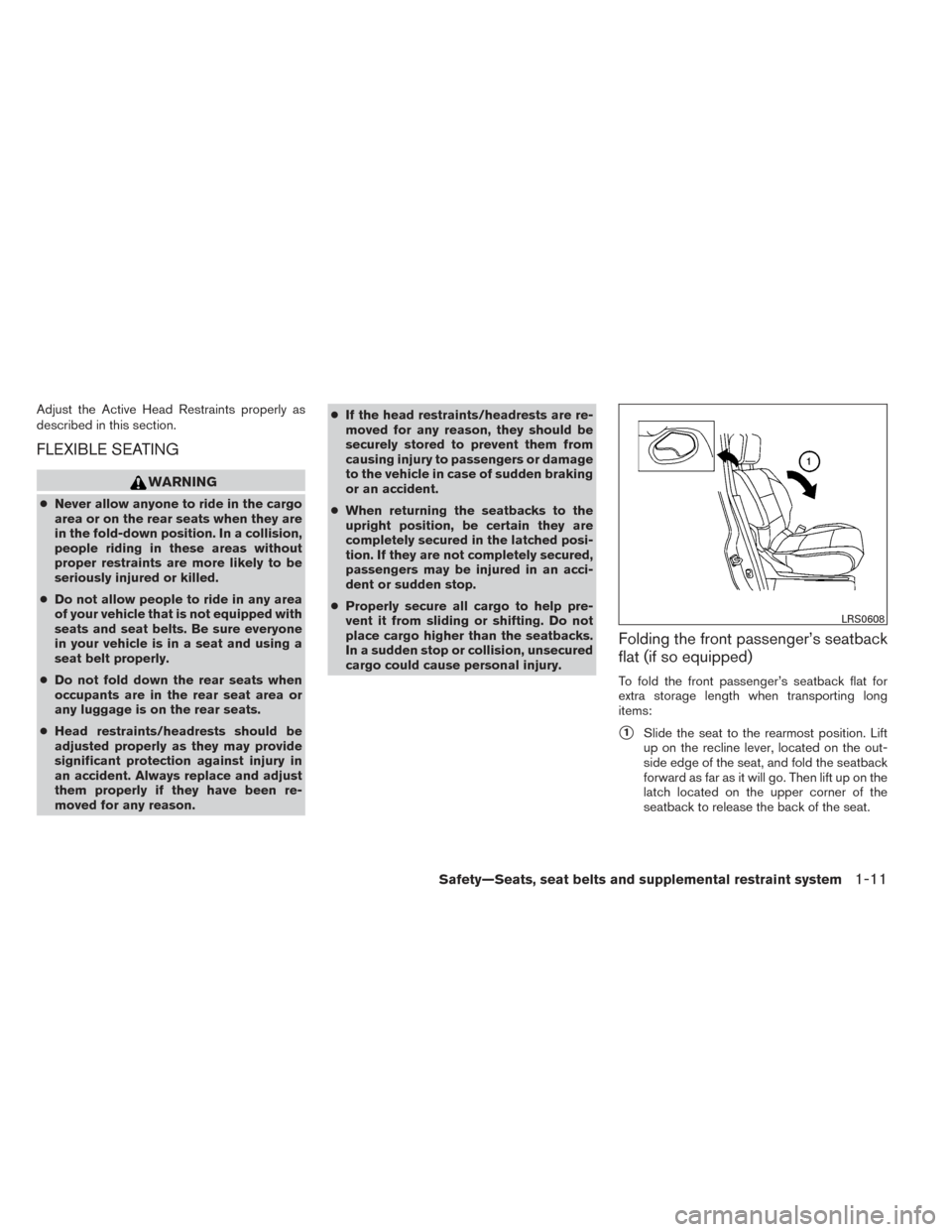
�1Slide the seat to the rearmost position. Lift
up on the recline lever, located on the out-
side edge of the seat, and fold the seatback
forward as far as it will go. Then lift up on the
latch located on the upper corner of the
seatback to release the back of the seat.
LRS0608
Safety—Seats, seat belts and supplemental restraint system1-11
Page 33 of 434
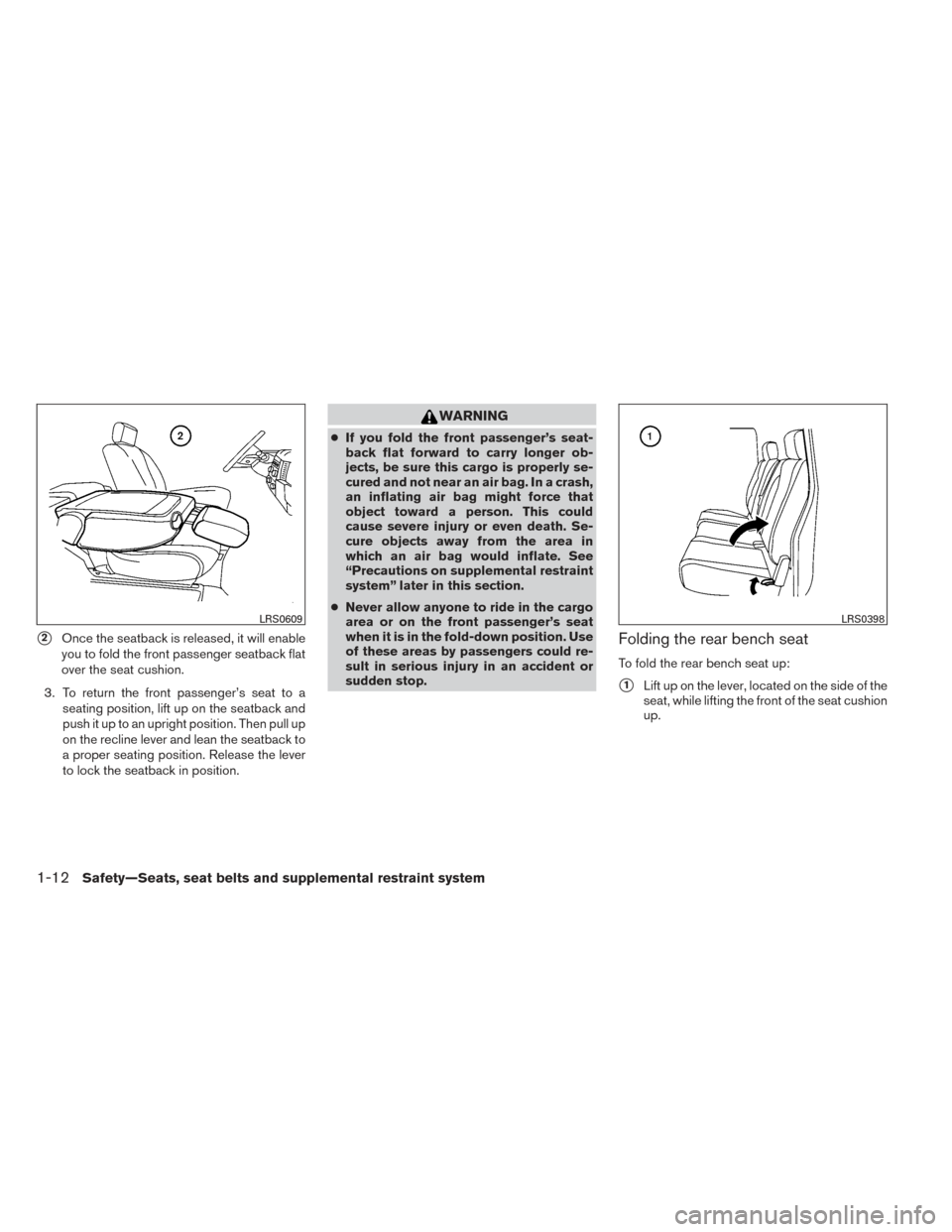
�2Once the seatback is released, it will enable
you to fold the front passenger seatback flat
over the seat cushion.
3. To return the front passenger’s seat to a seating position, lift up on the seatback and
push it up to an upright position. Then pull up
on the recline lever and lean the seatback to
a proper seating position. Release the lever
to lock the seatback in position.
WARNING
●If you fold the front passenger’s seat-
back flat forward to carry longer ob-
jects, be sure this cargo is properly se-
cured and not near an air bag. In a crash,
an inflating air bag might force that
object toward a person. This could
cause severe injury or even death. Se-
cure objects away from the area in
which an air bag would inflate. See
“Precautions on supplemental restraint
system” later in this section.
● Never allow anyone to ride in the cargo
area or on the front passenger’s seat
when it is in the fold-down position. Use
of these areas by passengers could re-
sult in serious injury in an accident or
sudden stop.
Folding the rear bench seat
To fold the rear bench seat up:
�1Lift up on the lever, located on the side of the
seat, while lifting the front of the seat cushion
up.
LRS0609LRS0398
1-12Safety—Seats, seat belts and supplemental restraint system
Page 34 of 434
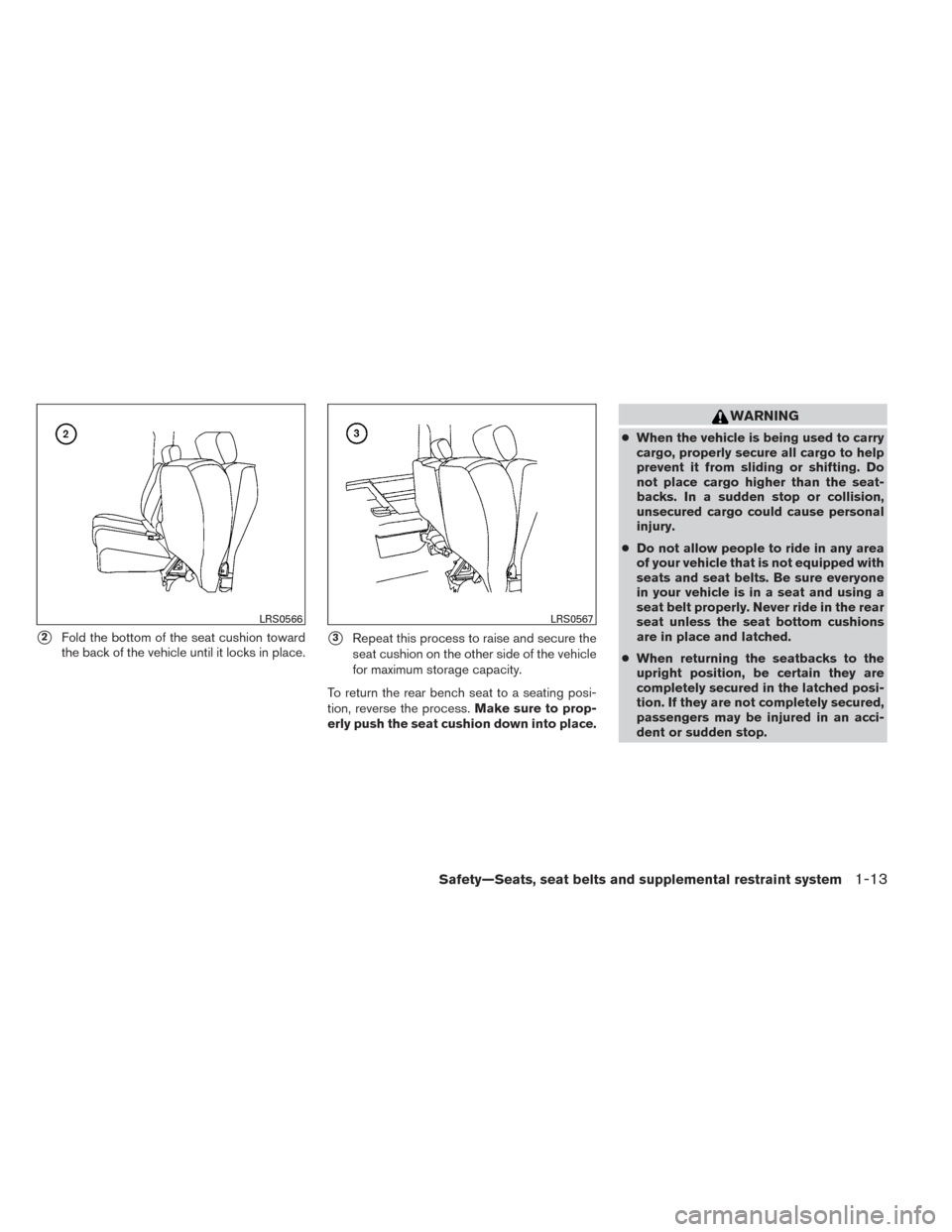
�2Fold the bottom of the seat cushion toward
the back of the vehicle until it locks in place.�3Repeat this process to raise and secure the
seat cushion on the other side of the vehicle
for maximum storage capacity.
To return the rear bench seat to a seating posi-
tion, reverse the process. Make sure to prop-
erly push the seat cushion down into place.
WARNING
● When the vehicle is being used to carry
cargo, properly secure all cargo to help
prevent it from sliding or shifting. Do
not place cargo higher than the seat-
backs. In a sudden stop or collision,
unsecured cargo could cause personal
injury.
● Do not allow people to ride in any area
of your vehicle that is not equipped with
seats and seat belts. Be sure everyone
in your vehicle is in a seat and using a
seat belt properly. Never ride in the rear
seat unless the seat bottom cushions
are in place and latched.
● When returning the seatbacks to the
upright position, be certain they are
completely secured in the latched posi-
tion. If they are not completely secured,
passengers may be injured in an acci-
dent or sudden stop.
LRS0566LRS0567
Safety—Seats, seat belts and supplemental restraint system1-13
Page 35 of 434
Folding the rear bench seat down
The rear bench seatback can be tilted forward to
access the child restraint anchor point locations
or the jacking equipment.
To tilt the seatback forward, pull the strap up
�1
and tilt the seatback. The child restraint anchor
points
�2can be accessed behind the rear
bench seatback. The jacking equipment can be
accessed from behind the passenger’s side
seatback.
WARNING
Never allow anyone to ride in the cargo
area or on the rear seat when it is in the
fold-down position. Use of these areas by
passengers without proper restraints
could result in serious injury in an acci-
dent or sudden stop.
WRS0840
1-14Safety—Seats, seat belts and supplemental restraint system
Page 54 of 434
5. Check to make sure the child restraint isproperly secured prior to each use. If the
child restraint is loose, repeat steps 2
through 4.
REAR-FACING CHILD RESTRAINT
INSTALLATION USING LATCH —
JUMP SEAT (King cab models only)
WARNING
●If a child restraint system is not in-
stalled properly, the child could be seri-
ously injured or killed in a sudden stop
or collision.
– Never install a rear-facing child re- straint system on the driver’s side
jump seat. – Do not install a child restraint system
on the passenger’s side jump seat
without unfolding the seat extender.
LRS2357
Safety—Seats, seat belts and supplemental restraint system1-33
Page 55 of 434
WARNING
●To install a rear-facing child restraint on
the passenger’s side jump seat, it will
be necessary to move the front passen-
ger’s seat fully forward and place the
front seatback upright or tilt it forward.
Failure to do so may cause the child
restraint to not be installed properly
and cause serious injury or death in a
sudden stop or collision. – The front seat cannot be used when a
rear-facing child restraint is installed
on the jump seat. Attempting to do so
could cause serious injury in a sud-
den stop or collision.
Refer to all Warnings and Cautions in the “Child
Safety” and “Child Restraint” sections before in-
stalling a child restraint.
Follow these steps to install a child restraint on
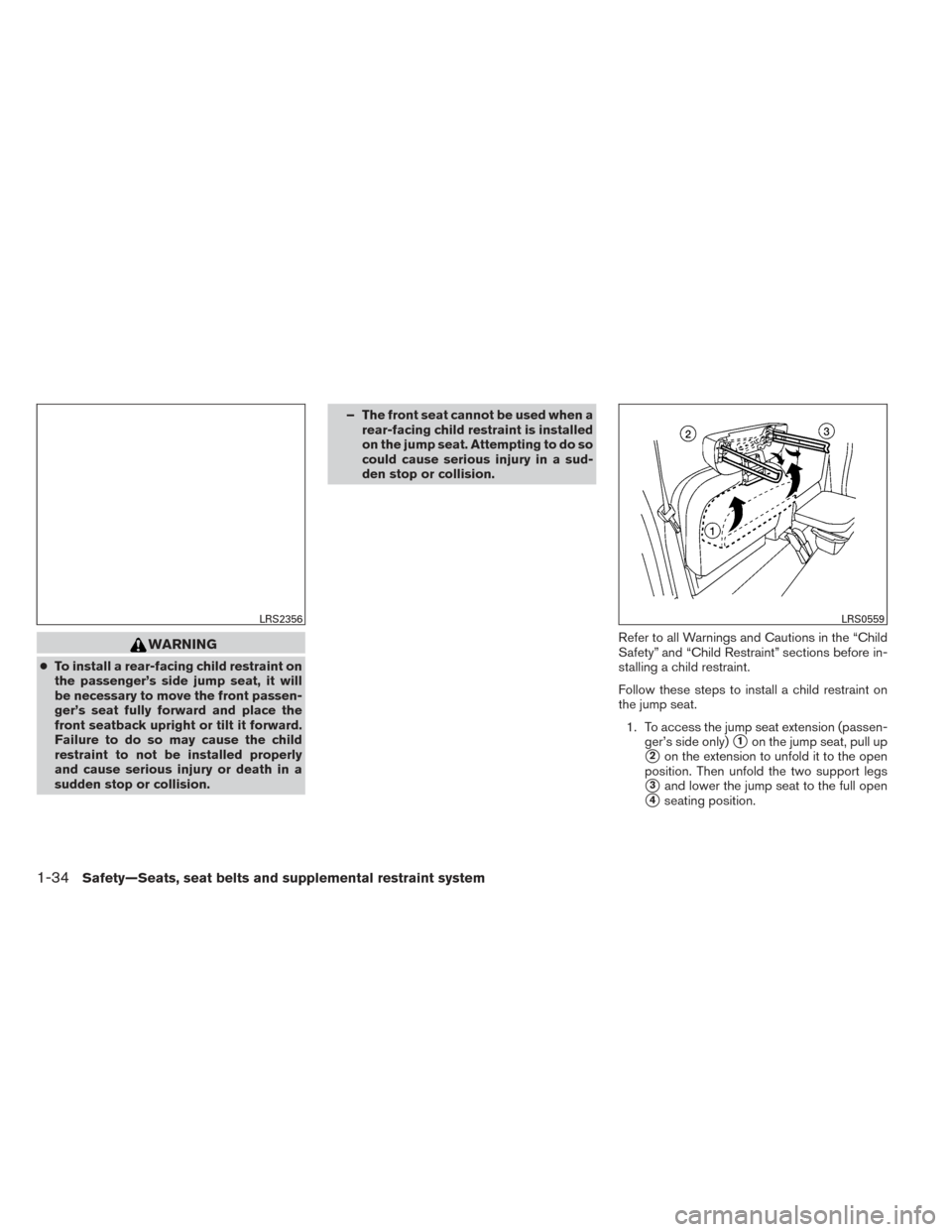
the jump seat.1. To access the jump seat extension (passen- ger’s side only)
�1on the jump seat, pull up
�2on the extension to unfold it to the open
position. Then unfold the two support legs
�3and lower the jump seat to the full open
�4seating position.
LRS2356LRS0559
1-34Safety—Seats, seat belts and supplemental restraint system