Page 51 of 434
Top tether anchor
WARNING
●Do not allow cargo to contact the top
tether strap when it is attached to the
top tether anchor. Properly secure the
cargo so it does not contact the top
tether strap. Cargo that is not properly
secured or cargo that contacts the top
tether strap may damage it during a
collision. A child could be seriously in-
jured or killed in a collision if the top
tether strap is damaged.
● Child restraint anchorages are de-
signed to withstand only those loads
imposed by correctly fitted child re-
straints. Under no circumstances are
they to be used to attach adult seat
belts, or other items or equipment to
the vehicle. Doing so could damage the
child restraint anchorages. The child re-
straint will not be properly installed us-
ing the damaged anchorages, and a
child could be seriously injured or killed
in a collision. 1. Top tether strap
2. Anchor point
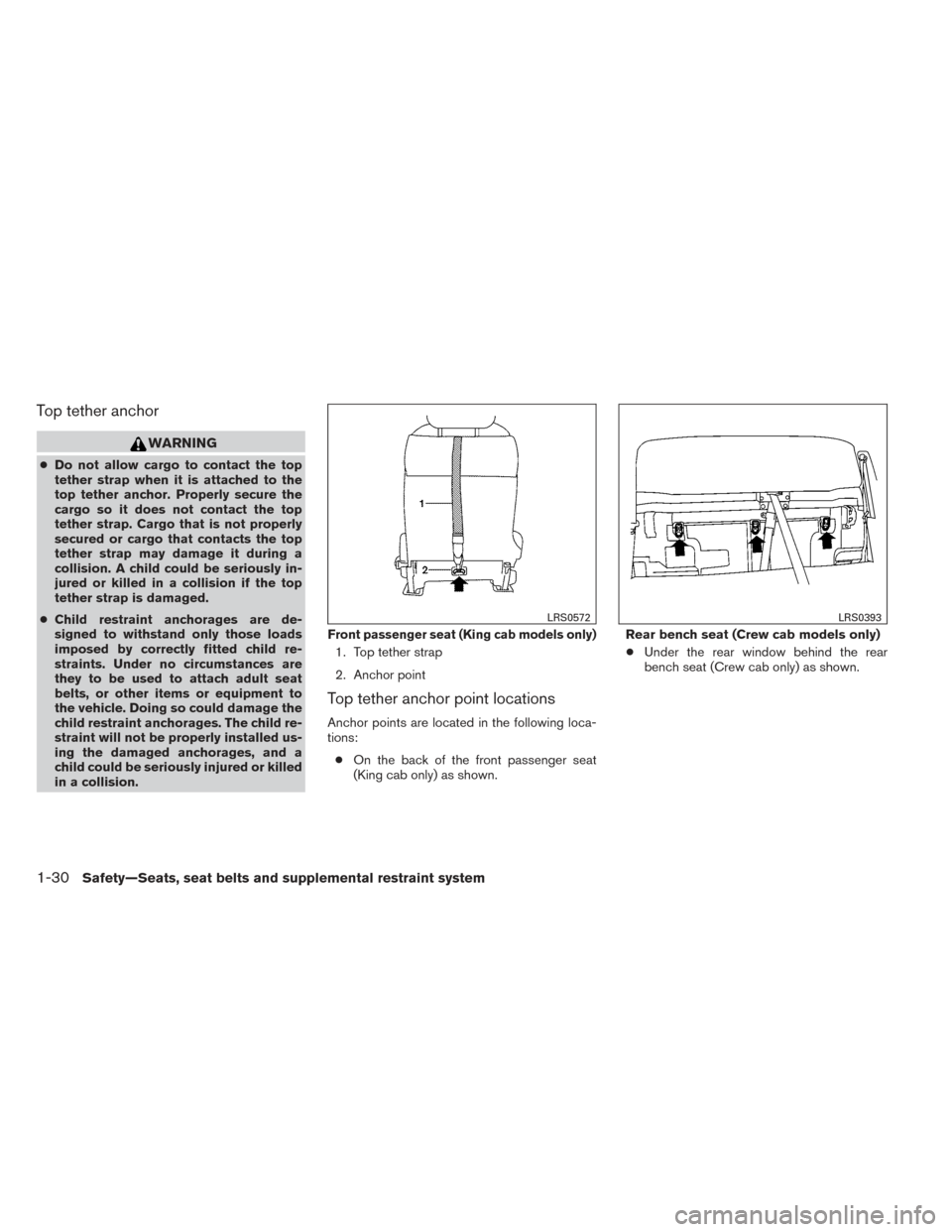
Top tether anchor point locations
Anchor points are located in the following loca-
tions:
● On the back of the front passenger seat
(King cab only) as shown. ●
Under the rear window behind the rear
bench seat (Crew cab only) as shown.
Front passenger seat (King cab models only)
LRS0572
Rear bench seat (Crew cab models only)
LRS0393
1-30Safety—Seats, seat belts and supplemental restraint system
Page 52 of 434
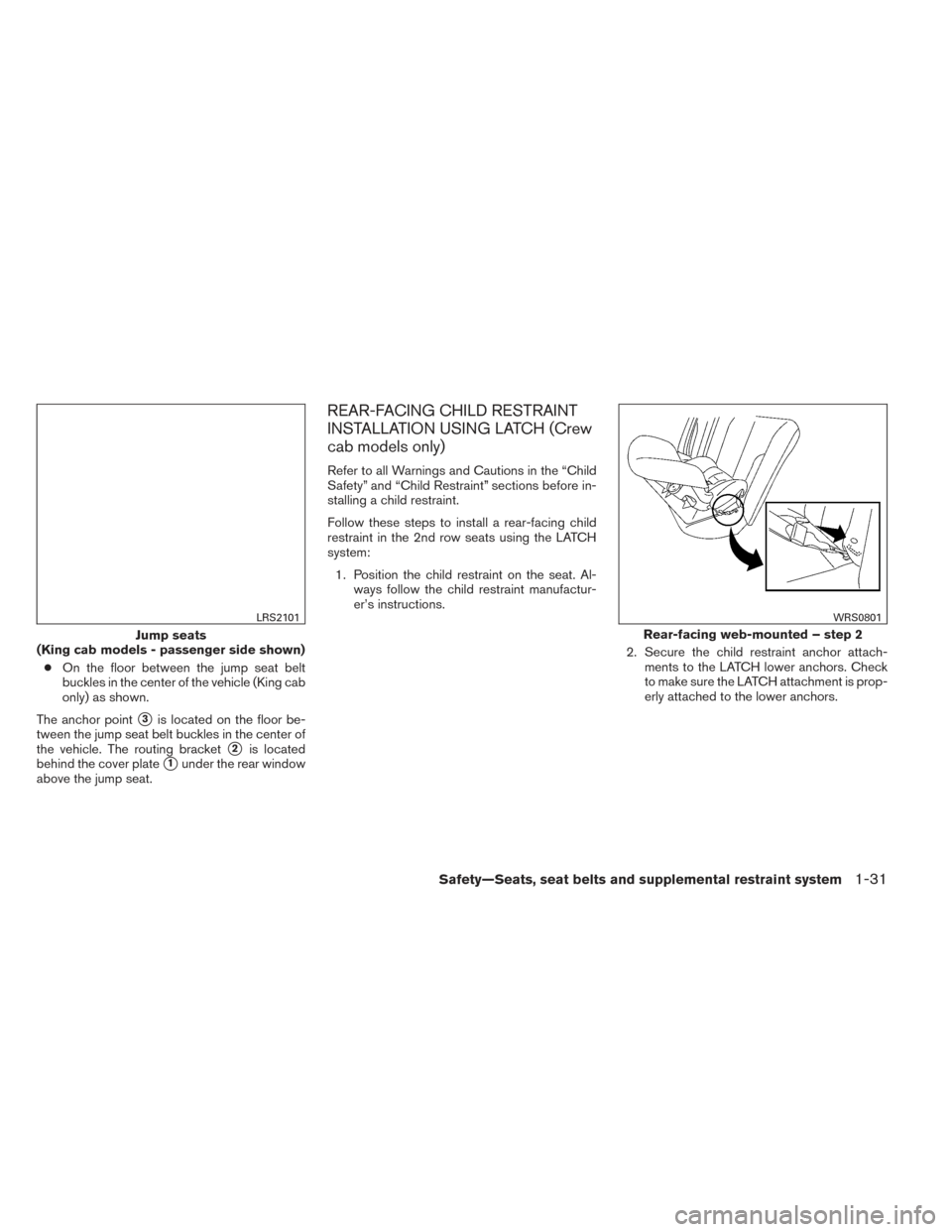
●On the floor between the jump seat belt
buckles in the center of the vehicle (King cab
only) as shown.
The anchor point
�3is located on the floor be-
tween the jump seat belt buckles in the center of
the vehicle. The routing bracket
�2is located
behind the cover plate
�1under the rear window
above the jump seat.
REAR-FACING CHILD RESTRAINT
INSTALLATION USING LATCH (Crew
cab models only)
Refer to all Warnings and Cautions in the “Child
Safety” and “Child Restraint” sections before in-
stalling a child restraint.
Follow these steps to install a rear-facing child
restraint in the 2nd row seats using the LATCH
system:
1. Position the child restraint on the seat. Al- ways follow the child restraint manufactur-
er’s instructions.
2. Secure the child restraint anchor attach-ments to the LATCH lower anchors. Check
to make sure the LATCH attachment is prop-
erly attached to the lower anchors.
Jump seats
(King cab models - passenger side shown)
LRS2101
Rear-facing web-mounted – step 2
WRS0801
Safety—Seats, seat belts and supplemental restraint system1-31
Page 54 of 434
5. Check to make sure the child restraint isproperly secured prior to each use. If the
child restraint is loose, repeat steps 2
through 4.
REAR-FACING CHILD RESTRAINT
INSTALLATION USING LATCH —
JUMP SEAT (King cab models only)
WARNING
●If a child restraint system is not in-
stalled properly, the child could be seri-
ously injured or killed in a sudden stop
or collision.
– Never install a rear-facing child re- straint system on the driver’s side
jump seat. – Do not install a child restraint system
on the passenger’s side jump seat
without unfolding the seat extender.
LRS2357
Safety—Seats, seat belts and supplemental restraint system1-33
Page 55 of 434
WARNING
●To install a rear-facing child restraint on
the passenger’s side jump seat, it will
be necessary to move the front passen-
ger’s seat fully forward and place the
front seatback upright or tilt it forward.
Failure to do so may cause the child
restraint to not be installed properly
and cause serious injury or death in a
sudden stop or collision. – The front seat cannot be used when a
rear-facing child restraint is installed
on the jump seat. Attempting to do so
could cause serious injury in a sud-
den stop or collision.
Refer to all Warnings and Cautions in the “Child
Safety” and “Child Restraint” sections before in-
stalling a child restraint.
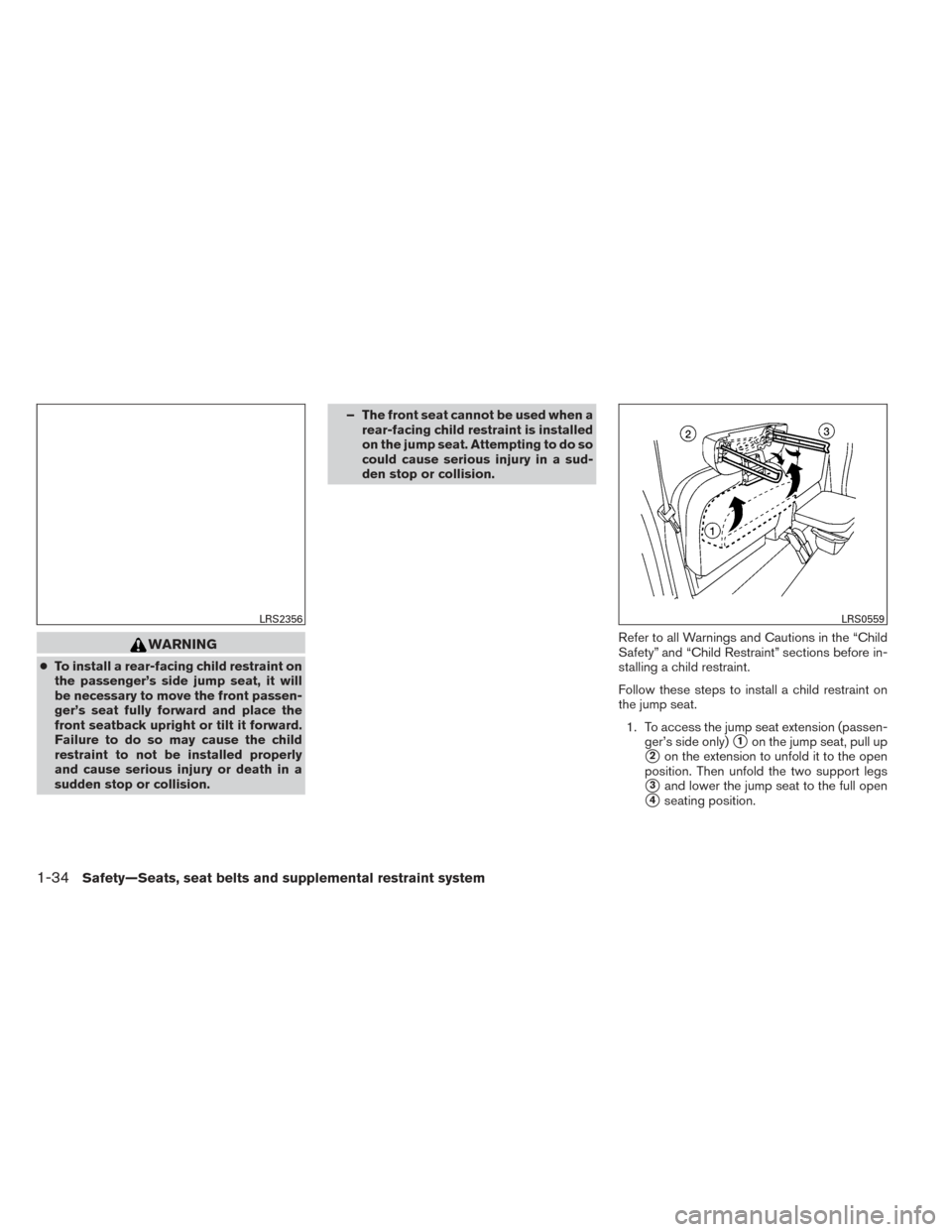
Follow these steps to install a child restraint on
the jump seat.1. To access the jump seat extension (passen- ger’s side only)
�1on the jump seat, pull up
�2on the extension to unfold it to the open
position. Then unfold the two support legs
�3and lower the jump seat to the full open
�4seating position.
LRS2356LRS0559
1-34Safety—Seats, seat belts and supplemental restraint system
Page 58 of 434
7. Check to make sure the child restraint isproperly secured prior to each use. If the
child restraint is loose, repeat steps 1
through 6.
REAR-FACING CHILD RESTRAINT
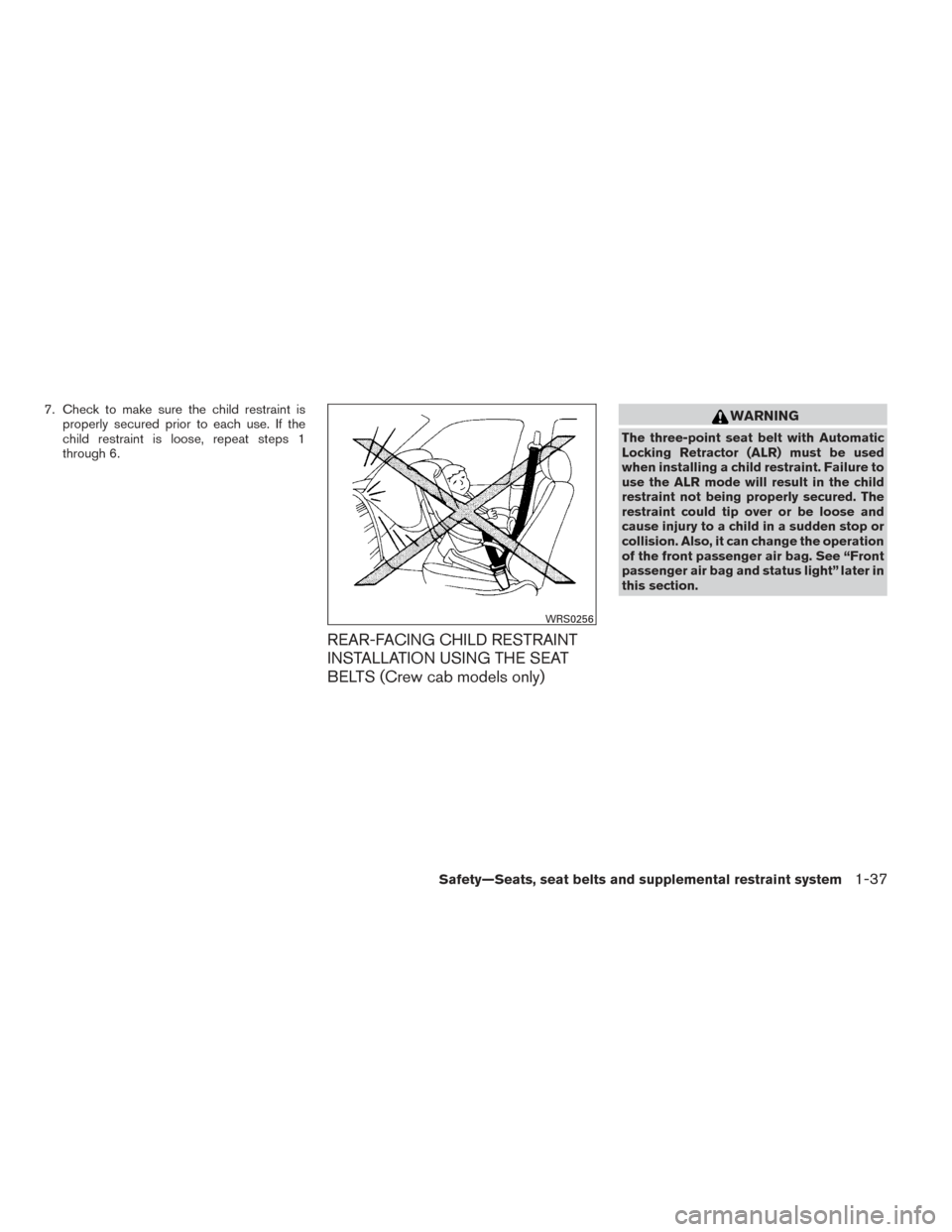
INSTALLATION USING THE SEAT
BELTS (Crew cab models only)
WARNING
The three-point seat belt with Automatic
Locking Retractor (ALR) must be used
when installing a child restraint. Failure to
use the ALR mode will result in the child
restraint not being properly secured. The
restraint could tip over or be loose and
cause injury to a child in a sudden stop or
collision. Also, it can change the operation
of the front passenger air bag. See “Front
passenger air bag and status light” later in
this section.
WRS0256
Safety—Seats, seat belts and supplemental restraint system1-37
Page 59 of 434
Refer to all Warnings and Cautions in the “Child
Safety” and “Child Restraint” sections before in-
stalling a child restraint.
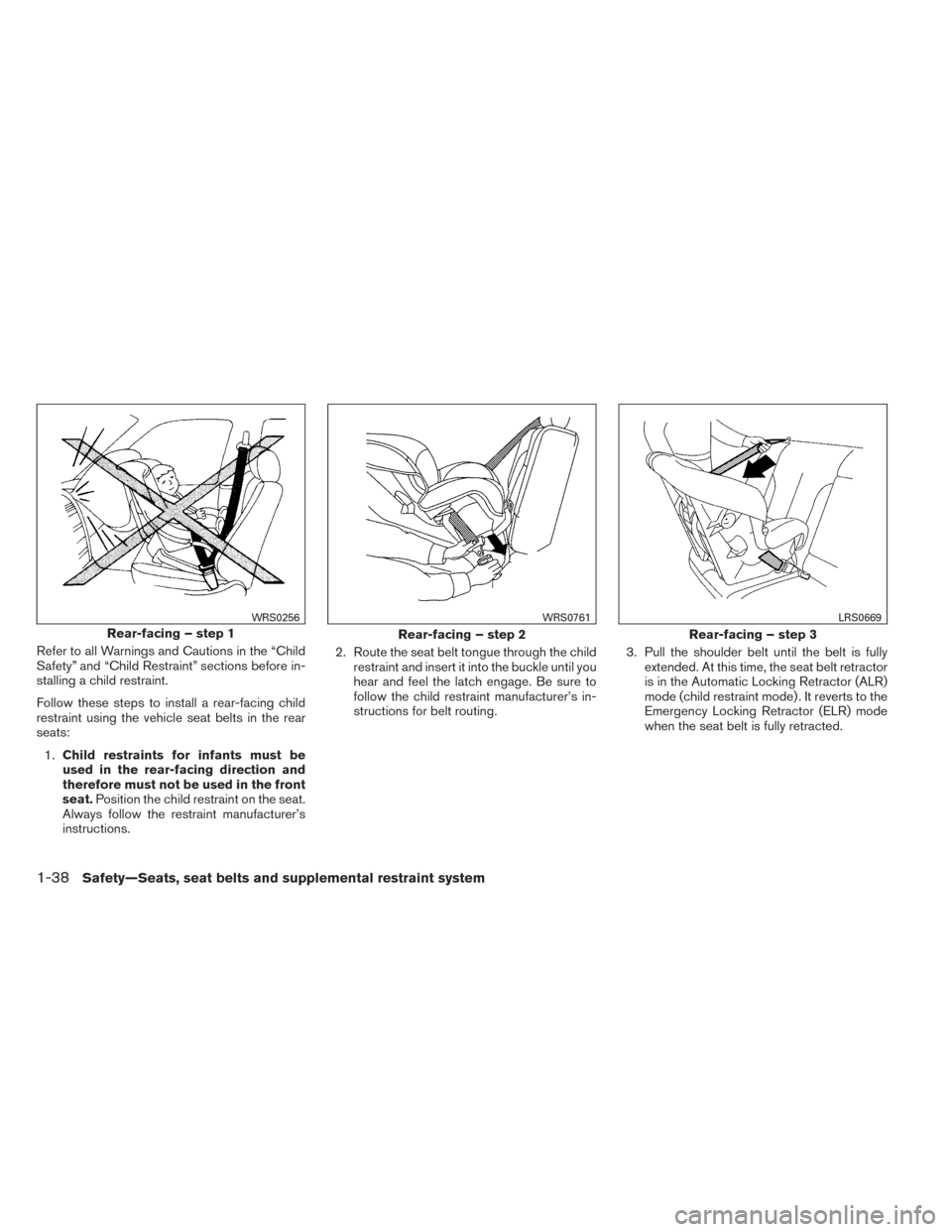
Follow these steps to install a rear-facing child
restraint using the vehicle seat belts in the rear
seats:1. Child restraints for infants must be
used in the rear-facing direction and
therefore must not be used in the front
seat. Position the child restraint on the seat.
Always follow the restraint manufacturer’s
instructions. 2. Route the seat belt tongue through the child
restraint and insert it into the buckle until you
hear and feel the latch engage. Be sure to
follow the child restraint manufacturer’s in-
structions for belt routing. 3. Pull the shoulder belt until the belt is fully
extended. At this time, the seat belt retractor
is in the Automatic Locking Retractor (ALR)
mode (child restraint mode) . It reverts to the
Emergency Locking Retractor (ELR) mode
when the seat belt is fully retracted.
Rear-facing – step 1
WRS0256
Rear-facing – step 2
WRS0761
Rear-facing – step 3
LRS0669
1-38Safety—Seats, seat belts and supplemental restraint system
Page 61 of 434
7. Check to make sure that the child restraint isproperly secured prior to each use. If the
seat belt is not locked, repeat steps 3
through 6.
After the child restraint is removed and the seat
belt fully retracted, the ALR mode (child restraint
mode) is canceled.
REAR-FACING CHILD RESTRAINT
INSTALLATION USING THE SEAT
BELTS — JUMP SEAT (King cab
models only)
WARNING
● The three-point seat belt with Auto-
matic Locking Retractor (ALR) must be
used when installing a child restraint.
Failure to use the ALR mode will result
in the child restraint not being properly
secured. The restraint could tip over or
be loose and cause injury to a child in a
sudden stop or collision. Also, it can
change the operation of the front pas-
senger air bag. See “Front passenger
air bag and status light” later in this
section.
● A child restraint system will not be in-
stalled properly and the child could be
seriously injured or killed in a sudden
stop or collision.
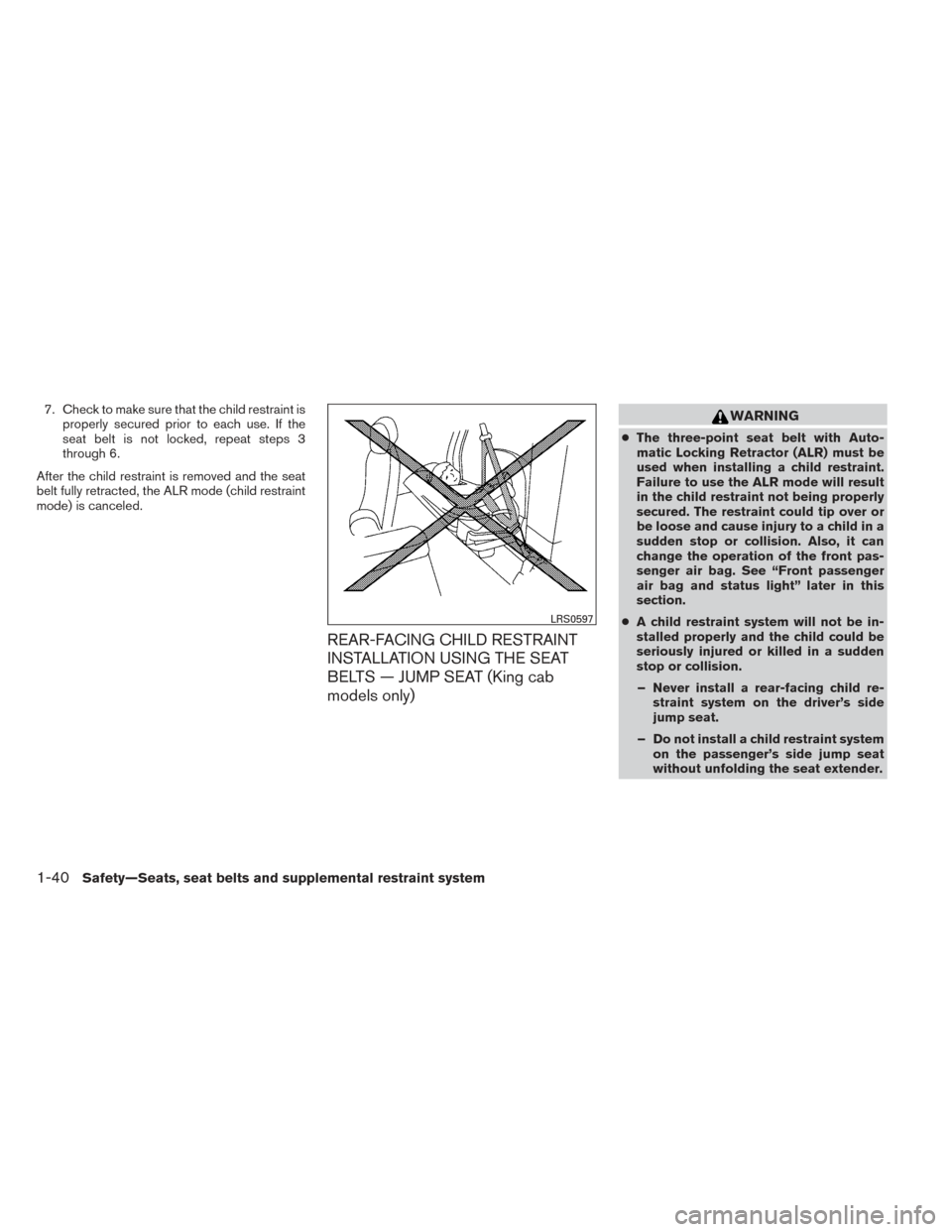
– Never install a rear-facing child re- straint system on the driver’s side
jump seat.
– Do not install a child restraint system on the passenger’s side jump seat
without unfolding the seat extender.
LRS0597
1-40Safety—Seats, seat belts and supplemental restraint system
Page 62 of 434
WARNING
●To install a rear-facing child restraint on
the passenger’s side jump seat, it will
be necessary to move the front passen-
ger’s seat fully forward and place the
front seatback upright or tilt it forward.
Failure to do so may cause the child
restraint to not be installed properly
and cause serious injury or death in a
sudden stop or collision. – The front seat cannot be used when a
rear-facing child restraint is installed
on the jump seat. Attempting to do so
could cause serious injury in a sud-
den stop or collision.
Refer to all Warnings and Cautions in the “Child
Safety” and “Child Restraint” sections before in-
stalling a child restraint.
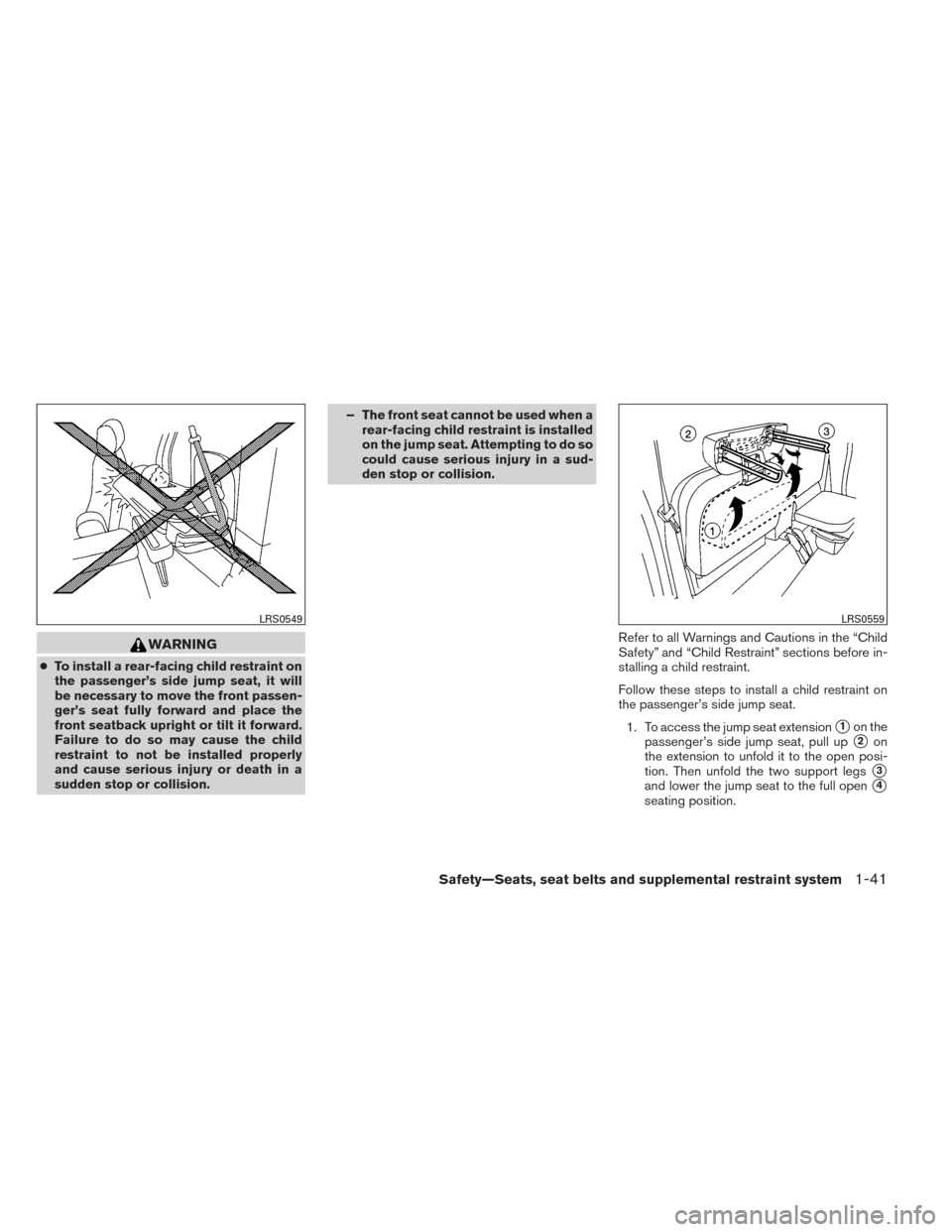
Follow these steps to install a child restraint on
the passenger’s side jump seat.1. To access the jump seat extension
�1on the
passenger’s side jump seat, pull up
�2on
the extension to unfold it to the open posi-
tion. Then unfold the two support legs
�3
and lower the jump seat to the full open�4
seating position.
LRS0549LRS0559
Safety—Seats, seat belts and supplemental restraint system1-41