2014 NISSAN FRONTIER ECU
[x] Cancel search: ECUPage 409 of 434
MEASUREMENT OF WEIGHTS
Secure loose items to prevent weight
shifts that could affect the balance of your
vehicle. When the vehicle is loaded, drive
to a scale and weigh the front and the rear
wheels separately to determine axle
loads. Individual axle loads should not ex-
ceed either of the gross axle weight rat-
ings (GAWR) . The total of the axle loads
should not exceed the gross vehicle
weight rating (GVWR) . These ratings are
given on the vehicle certification label. If
weight ratings are exceeded, move or re-
move items to bring all weights below the
ratings.
WARNING
Overloading or improper loading of a
trailer and its cargo can adversely affect
vehicle handling, braking and perfor-
mance and may lead to accidents.
CAUTION
●Do not tow a trailer or haul a heavy load
for the first 500 miles (800 km) . Your
engine, axle or other parts could be
damaged.
● For the first 500 miles (800 km) that you
tow a trailer, do not drive over 50 mph
(80 km/h) and do not make starts at full
throttle. This helps the engine and other
parts of your vehicle wear in at the
heavier loads.
Your new vehicle was designed to be used pri-
marily to carry passengers and cargo. Remember
that towing a trailer places additional loads on
your vehicle’s engine, drive train, steering, brak-
ing and other systems.
A NISSAN Towing Guide (U.S. only) is available
on the website at www.nissanusa.com. This
guide includes information on trailer towing ca-
pability and the special equipment required for
proper towing.
MAXIMUM LOAD LIMITS
Maximum trailer loads
Never allow the total trailer load to exceed the
value specified in the “Towing
Load/Specification” chart found later in this sec-
tion. The total trailer load equals trailer weight
plus its cargo weight. ● When towing a trailer load of 3,500 lbs.
(1,587 kg) or more, trailers with a brake
system MUST be used.
The maximum Gross Combined Weight Rating
(GCWR) should not exceed the value specified
in the following “Towing Load/Specification”
chart.
TOWING A TRAILER
9-24Technical and consumer information
Page 414 of 434
TOWING SAFETY
Trailer hitch
Your vehicle may be equipped with an optional
trailer tow package. The trailer tow package in-
cludes a receiver-type frame mounted hitch. This
hitch is rated for the maximum towing capacity of
this vehicle when the proper towing equipment is
used. Choose a proper ball mount and hitch ball
that is rated for the trailer to be towed. Genuine
NISSAN ball mounts and hitch balls are available
from your NISSAN dealer.
If your vehicle is not equipped with the optional
trailer tow package, check the towing capacity of
your bumper hitch or receiver-type frame
mounted hitch. Choose a proper hitch for your
vehicle and trailer. A genuine NISSAN trailer
hitch is available from your NISSAN dealer. Make
sure the trailer hitch is securely attached to the
vehicle to help avoid personal injury or property
damage due to sway caused by crosswinds,
rough road surfaces or passing trucks.
WARNING
Trailer hitch components have specific
weight ratings. Your vehicle may be ca-
pable of towing a trailer heavier than the
weight rating of the hitch components.
Never exceed the weight rating of the
hitch components. Doing so can cause
serious personal injury or property
damage.
Hitch ball
Choose a hitch ball of the proper size and weight
rating for your trailer:● The required hitch ball size is stamped on
most trailer couplers. Most hitch balls also
have the size printed on the top of the ball.
● Choose the proper class hitch ball based on
the trailer weight.
● The diameter of the threaded shank of the
hitch ball must be matched to the ball mount
hole diameter. The hitch ball shank should
be no more than 1/16” smaller than the hole
in the ball mount. ●
The threaded shank of the hitch ball must be
long enough to be properly secured to the
ball mount. There should be at least 2
threads showing beyond the lock washer
and nut.
Ball mount
The hitch ball is attached to the ball mount and
the ball mount is inserted into the hitch receiver.
Choose a proper class ball mount based on the
trailer weight. Additionally, the ball mount should
be chosen to keep the trailer tongue level with the
ground.
Technical and consumer information9-29
Page 416 of 434
Sway control device
Sudden maneuvers, wind gusts, and buffeting
caused by other vehicles can affect trailer han-
dling. Sway control devices may be used to help
control these affects. If you choose to use one,
contact a reputable trailer hitch supplier to make
sure the sway control device will work with the
vehicle, hitch, trailer and the trailer’s brake sys-
tem. Follow the instructions provided by the
manufacturer for installing and using the sway
control device.
Class I hitch
Class I trailer hitch equipment (receiver, ball
mount and hitch ball) can be used to tow trailers
of a maximum weight of 2,000 lb (907 kg) .
Class II hitch
Class II trailer hitch equipment (receiver, ball
mount and hitch ball) can be used to tow trailers
of a maximum weight of 3,500 lb (1,587 kg).
The genuine NISSAN step bumper is considered
a Class II ball mount.
Class III hitch
Class III trailer hitch equipment (receiver, ball
mount and hitch ball) can be used to tow trailers
of a maximum weight of 5,000 lb (2,268 kg).
Class IV hitch
Class IV trailer hitch equipment (receiver, ball
mount and hitch ball) can be used to tow trailers
of a maximum weight of 10,000 lb (4,535 kg). A
weight distributing hitch should be used to tow
trailers that weigh over 5,000 lb (2,268 kg).
Your vehicle may be equipped with Class IV
trailer hitch equipment that has a 10,000 lb
(4,535 kg) maximum weight rating, but your ve-
hicle is only capable of towing the maximum
trailer weights shown in the “Towing
Load/Specification” chart earlier in this section.
CAUTION
●Special hitches which include frame re-
inforcements are required for towing
above 2,000 lb (907 kg) . Suitable genu-
ine NISSAN hitches, ball mounts and
hitch balls for pickup trucks and sport
utility vehicles are available at a
NISSAN dealer.
● The hitch should not be attached to or
affect the operation of the impact-
absorbing bumper.
● Do not use axle-mounted hitches.
● Do not modify the vehicle exhaust sys-
tem, brake system, etc. to install a
trailer hitch. ●
To reduce the possibility of additional
damage if your vehicle is struck from
the rear, where practical, remove the
receiver when not in use.
● Regularly check that all trailer hitch
mounting bolts are securely mounted.
Tire pressures
● When towing a trailer, inflate the ve-
hicle tires to the recommended cold
tire pressure indicated on the Tire
and Loading Information label.
● Trailer tire condition, size, load rating
and proper inflation pressure should
be in accordance with the trailer and
tire manufacturer’s specifications.
Safety chains
Always use suitable safety chains between your
vehicle and the trailer. The safety chains should
be crossed and should be attached to the hitch,
not to the vehicle bumper or axle. The safety
chains can be attached to the bumper if the hitch
ball is mounted to the bumper. Be sure to leave
enough slack in the chains to permit turning
corners.
Technical and consumer information9-31
Page 418 of 434
Pre-towing tips
●Be certain your vehicle maintains a level
position when a loaded and/or unloaded
trailer is hitched. Do not drive the vehicle if it
has an abnormal nose-up or nose-down
condition; check for improper tongue load,
overload, worn suspension or other possible
causes of either condition.
● Always secure items in the trailer to prevent
load shift while driving.
●
Keep the cargo load as low as possible in the
trailer to keep the trailer center of gravity low.
● Load the trailer so approximately 60% of the
trailer load is in the front half and 40% is in
the back half. Also make sure the load is
balanced side to side.
● Check your hitch, trailer tire pressure, ve-
hicle tire pressure, trailer light operation, and
trailer wheel lug nuts every time you attach a
trailer to the vehicle.
● Be certain your rearview mirrors conform to
all federal, state or local regulations. If not,
install any mirrors required for towing before
driving the vehicle.
●
Determine the overall height of the vehicle and
trailer so the required clearance is known.
Trailer towing tips
In order to gain skill and an understanding of the
vehicle’s behavior, you should practice turning,
stopping and backing up in an area which is free
from traffic. Steering stability and braking perfor-
mance will be somewhat different than under
normal driving conditions.
● Always secure items in the trailer to prevent
load shift while driving.
● Lock the trailer hitch coupler with a pin or
lock to prevent the coupler from inadver-
tently becoming unlatched.
● Avoid abrupt starts, acceleration or stops.
● Avoid sharp turns or lane changes.
● Always drive your vehicle at a moderate
speed.
● When backing up, hold the bottom of the
steering wheel with one hand. Move your
hand in the direction in which you want the
trailer to go. Make small corrections and
back up slowly. If possible, have someone
guide you when you are backing up. Always block the wheels on both vehicle and
trailer when parking. Parking on a slope is not
recommended; however, if you must do so:
CAUTION
If you move the shift lever to the P (Park)
position before blocking the wheels and
applying the parking brake, transmission
damage could occur.
1. Apply and hold the brake pedal.
2. Have someone place blocks on the downhill side of the vehicle and trailer wheels.
3. After the wheel blocks are in place, slowly release the brake pedal until the blocks ab-
sorb the vehicle load.
4. Apply the parking brake.
5. Shift the transmission into P (Park) .
6.
Make sure theindicator light (if so
equipped) indicates the transfer case is in 4H,
4L, or 2H and that the ATP light is off. If
the
indicator light is flashing, or the ATP
light is ON, make sure the transmission is in P
(Park) (A/T) and turn the 4WD switch to 2WD
or 4H. See “Automatic transmission park
warning light” in the “Instruments and con-
trols” section and “Using four wheel drive
(4WD)” in the “Starting and driving” section.
7. Turn off the engine.
Technical and consumer information9-33
Page 423 of 434
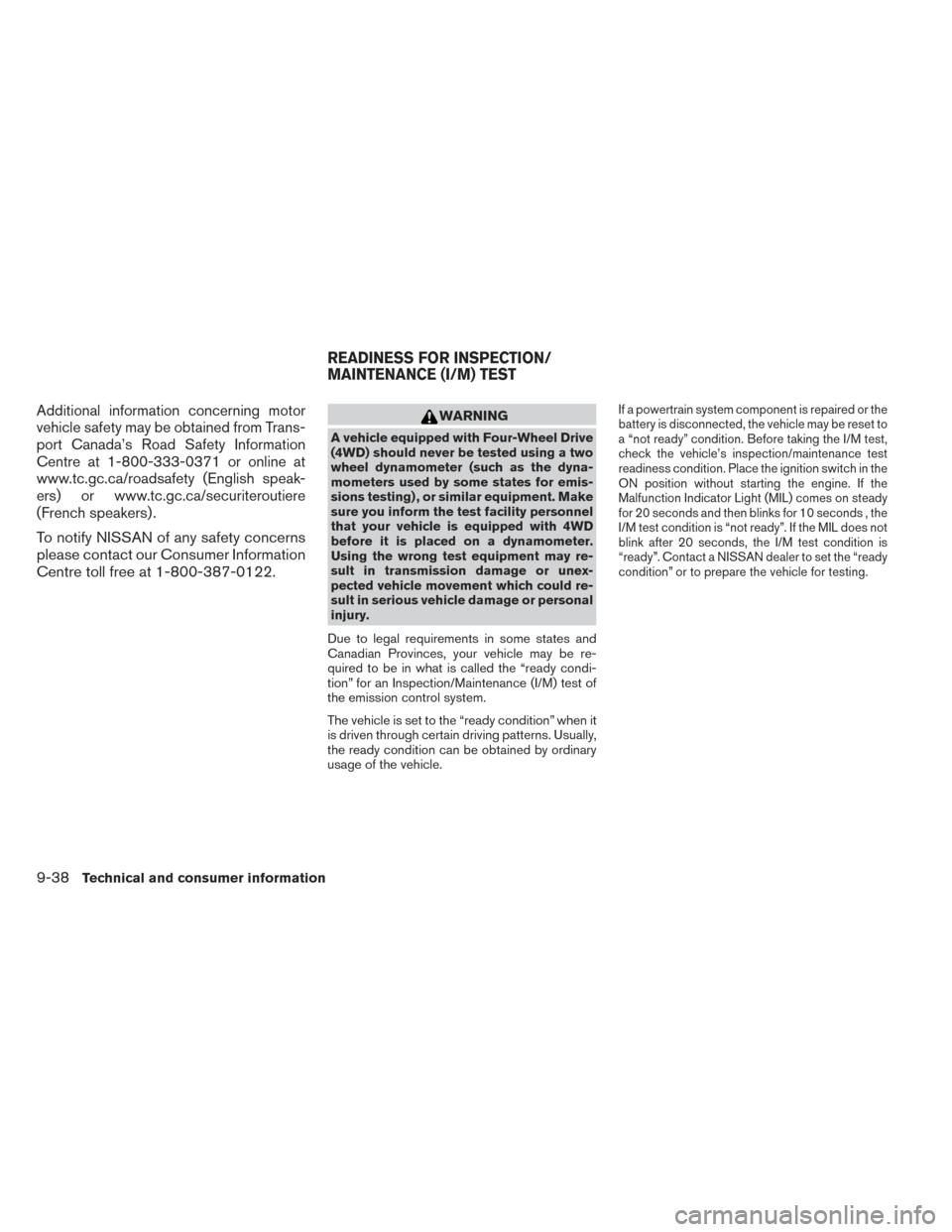
Additional information concerning motor
vehicle safety may be obtained from Trans-
port Canada’s Road Safety Information
Centre at 1-800-333-0371 or online at
www.tc.gc.ca/roadsafety (English speak-
ers) or www.tc.gc.ca/securiteroutiere
(French speakers) .
To notify NISSAN of any safety concerns
please contact our Consumer Information
Centre toll free at 1-800-387-0122.
WARNING
A vehicle equipped with Four-Wheel Drive
(4WD) should never be tested using a two
wheel dynamometer (such as the dyna-
mometers used by some states for emis-
sions testing) , or similar equipment. Make
sure you inform the test facility personnel
that your vehicle is equipped with 4WD
before it is placed on a dynamometer.
Using the wrong test equipment may re-
sult in transmission damage or unex-
pected vehicle movement which could re-
sult in serious vehicle damage or personal
injury.
Due to legal requirements in some states and
Canadian Provinces, your vehicle may be re-
quired to be in what is called the “ready condi-
tion” for an Inspection/Maintenance (I/M) test of
the emission control system.
The vehicle is set to the “ready condition” when it
is driven through certain driving patterns. Usually,
the ready condition can be obtained by ordinary
usage of the vehicle.
If a powertrain system component is repaired or the
battery is disconnected, the vehicle may be reset to
a “not ready” condition. Before taking the I/M test,
check the vehicle’s inspection/maintenance test
readiness condition. Place the ignition switch in the
ON position without starting the engine. If the
Malfunction Indicator Light (MIL) comes on steady
for 20 seconds and then blinks for 10 seconds , the
I/M test condition is “not ready”. If the MIL does not
blink after 20 seconds, the I/M test condition is
“ready”. Contact a NISSAN dealer to set the “ready
condition” or to prepare the vehicle for testing.
READINESS FOR INSPECTION/
MAINTENANCE (I/M) TEST
9-38Technical and consumer information
Page 426 of 434
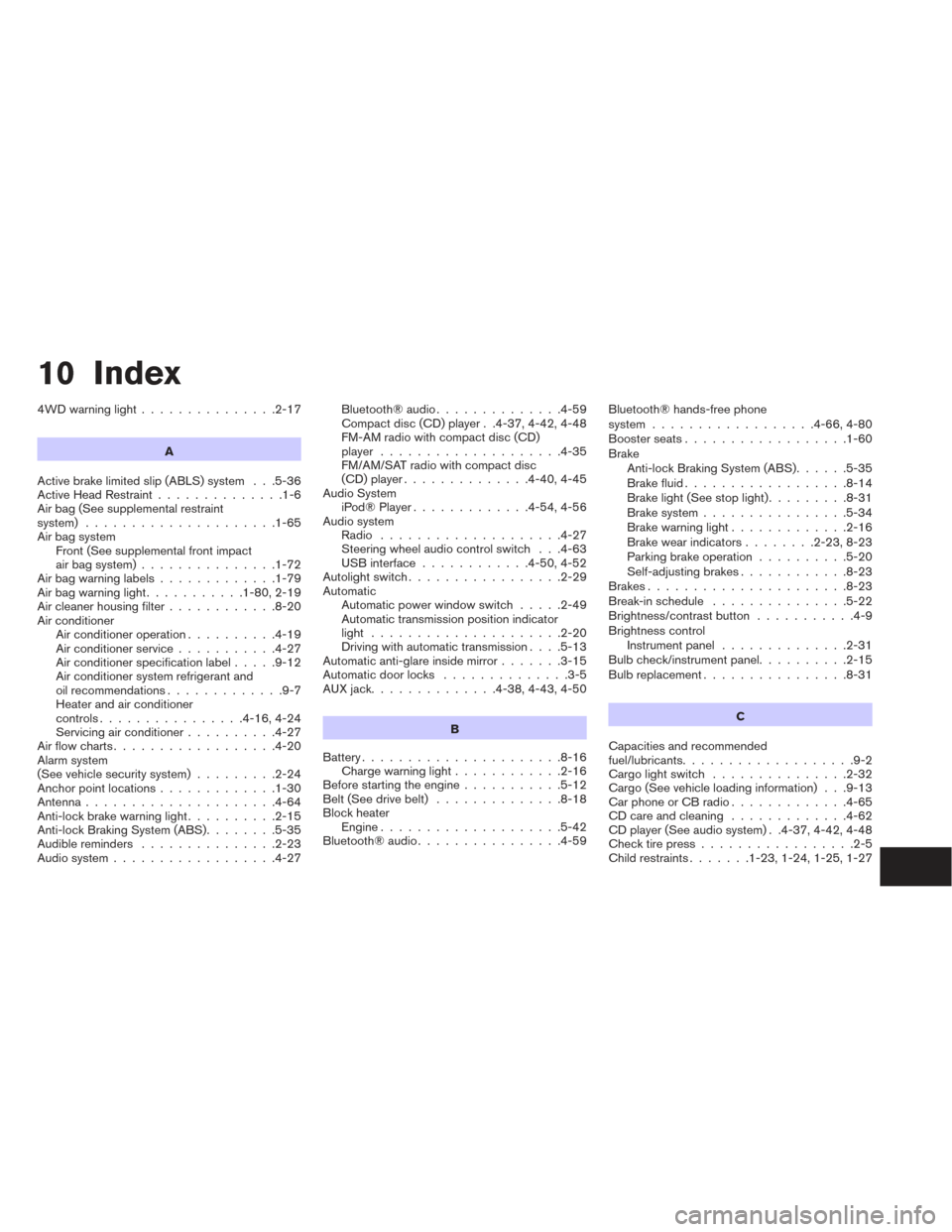
10 Index
4WDwarninglight...............2-17A
Active brake limited slip (ABLS) system . . .5-36
Active Head Restraint ..............1-6
Air bag (See supplemental restraint
system) .....................1-65
Air bag system Front (See supplemental front impact
air bag system) ...............1-72
Airbagwarninglabels.............1-79
Airbagwarninglight...........1-80,2-19
Air cleaner housing filter ............8-20
Air conditioner Air conditioner operation ..........4-19
Air conditioner service ...........4-27
Air conditioner specification label .....9-12
Air conditioner system refrigerant and
oil recommendations .............9-7
Heater and air conditioner
controls................4-16,4-24
Servicing air conditioner ..........4-27
Airflowcharts..................4-20
Alarm system
(See vehicle security system) .........2-24
Anchor point locations .............1-30
Antenna.....................4-64
Anti-lock brake warning light ..........2-15
Anti-lock Braking System (ABS) ........5-35
Audible reminders ...............2-23
Audio system ..................4-27 Bluetooth®audio..............4-59
Compact disc (CD) player . .4-37, 4-42, 4-48
FM-AM radio with compact disc (CD)
player ....................4-35
FM/AM/SAT radio with compact disc
(CD) player
..............4-40,4-45
Audio System iPod®Player.............4-54,4-56
Audio system Radio ....................4-27
Steering wheel audio control switch . . .4-63
USB interface ............4-50,4-52
Autolight switch .................2-29
Automatic Automatic power window switch .....2-49
Automatic transmission position indicator
light .....................2-20
Driving with automatic transmission ....5-13
Automatic anti-glare inside mirror .......3-15
Automatic door locks ..............3-5
AUXjack..............4-38,4-43,4-50
B
Battery ......................8-16
Charge warning light ............2-16
Before starting the engine ...........5-12
Belt (See drive belt) ..............8-18
Block heater Engine ....................5-42
Bluetooth®audio................4-59 Bluetooth® hands-free phone
system
..................4-66,4-80
Boosterseats..................1-60
Brake Anti-lock Braking System (ABS) ......5-35
Brakefluid..................8-14
Brakelight(Seestoplight).........8-31
Brake system ................5-34
Brake warning light .............2-16
Brake wear indicators ........2-23,8-23
Parking brake operation ..........5-20
Self-adjusting brakes ............8-23
Brakes ......................8-23
Break-inschedule ...............5-22
Brightness/contrast button ...........4-9
Brightness control Instrument panel ..............2-31
Bulb check/instrument panel ..........2-15
Bulbreplacement................8-31
C
Capacities and recommended
fuel/lubricants ...................9-2
Cargo light switch ...............2-32
Cargo (See vehicle loading information) . . .9-13
Car phone or CB radio .............4-65
CD care and cleaning .............4-62
CD
player (See audio system) . .4-37, 4-42, 4-48
Check tire press .................2-5
Child restraints .......1-23,1-24,1-25,1-27
Page 429 of 434
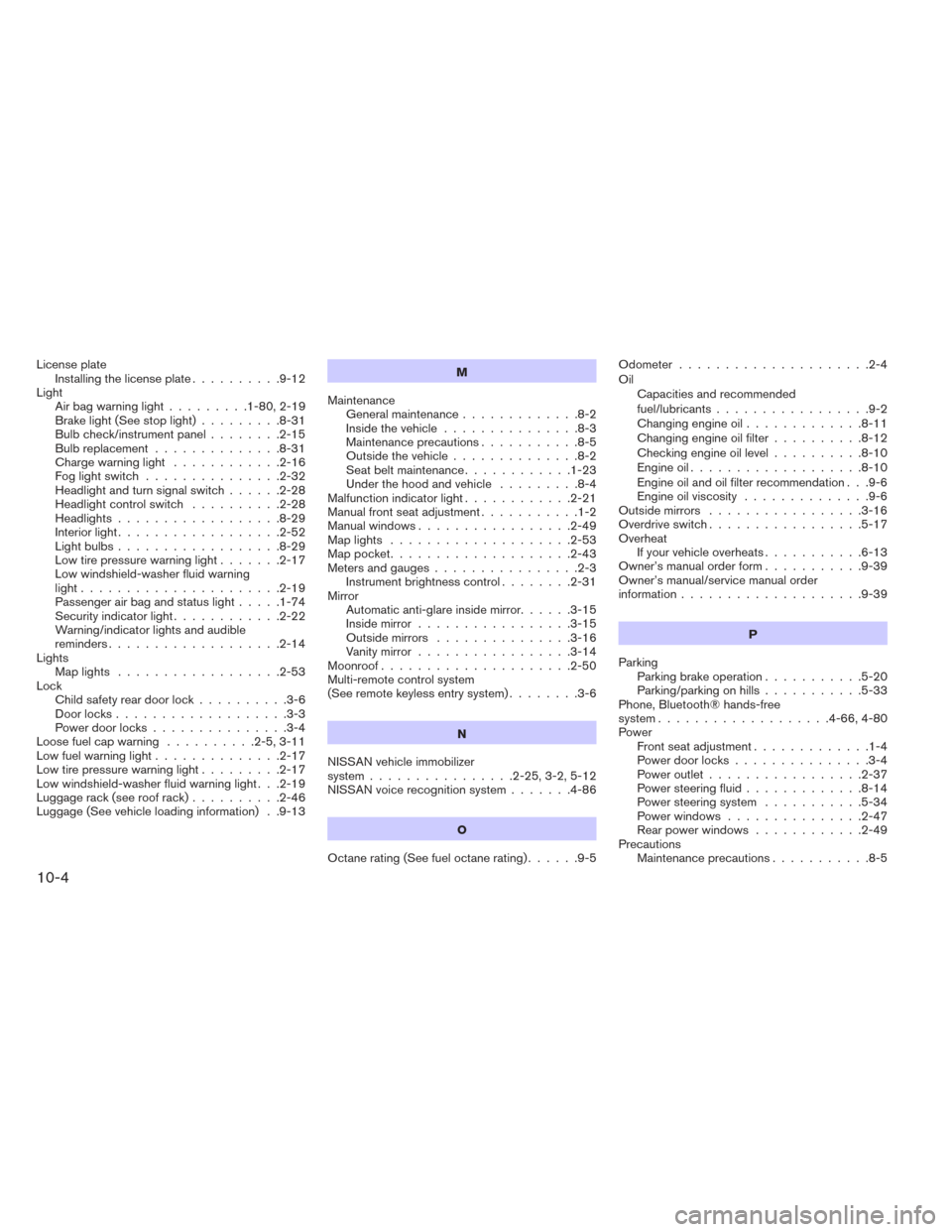
License plateInstalling the license plate ..........9-12
Light Airbagwarninglight.........1-80,2-19
Brakelight(Seestoplight).........8-31
Bulb check/instrument panel ........2-15
Bulb replacement ..............8-31
Chargewarninglight ............2-16
Foglightswitch ...............2-32
Headlight and turn signal switch ......2-28
Headlightcontrolswitch ..........2-28
Headlights..................8-29
Interiorlight..................2-52
Lightbulbs..................8-29
Low tire pressure warning light .......2-17
Low windshield-washer fluid warning
light......................2-19
Passenger air bag and status light .....1-74
Security indicator light ............2-22
Warning/indicator lights and audible
reminders ...................2-14
Lights Maplights ..................2-53
Lock Child safety rear door lock ..........3-6
Door locks ...................3-3
Power door locks ...............3-4
Loose fuel cap warning ..........2-5,3-11
Lowfuelwarninglight..............2-17
Low tire pressure warning light .........2-17
Low windshield-washer fluid warning light . . .2-19
Luggage rack (see roof rack) ..........2-46
Luggage (See vehicle loading information) . .9-13 M
Maintenance Generalmaintenance.............8-2
Insidethevehicle...............8-3
Maintenance precautions ...........8-5
Outside the vehicle ..............8-2
Seatbeltmaintenance............1-23
Underthehoodandvehicle .........8-4
Malfunction indicator light ............2-21
Manual front seat adjustment ...........1-2
Manual windows .................2-49
Maplights ....................2-53
Map pocket ....................2-43
Meters and gauges ................2-3
Instrument brightness control ........2-31
Mirror Automatic anti-glare inside mirror ......3-15
Inside mirror .................3-15
Outside mirrors ...............3-16
Vanity mirror .................3-14
Moonroof .....................2-50
Multi-remote control system
(See remote keyless entry system) ........3-6
N
NISSAN vehicle immobilizer
system ................2-25,3-2,5-12
NISSAN voice recognition system .......4-86
O
Octane rating (See fuel octane rating) ......9-5Odometer
.....................2-4
Oil Capacities and recommended
fuel/lubricants .................9-2
Changing engine oil .............8-11
Changing engine oil filter ..........8-12
Checking engine oil level ..........8-10
Engine oil ...................8-10
Engine oil and oil filter recommendation . . .9-6
Engine oil viscosity ..............9-6
Outside mirrors .................3-16
Overdrive switch .................5-17
Overheat If your vehicle overheats ...........6-13
Owner’s manual order form ...........9-39
Owner’s manual/service manual order
information ....................
9-39
P
Parking Parking brake operation ...........5-20
Parking/parking on hills ...........5-33
Phone, Bluetooth® hands-free
system ...................4-66,4-80
Power Frontseatadjustment.............1-4
Power door locks ...............3-4
Power outlet .................2-37
Power steering fluid .............8-14
Power steering system ...........5-34
Power windows ...............2-47
Rear power windows ............2-49
Precautions Maintenanceprecautions...........8-5
10-4
Page 430 of 434
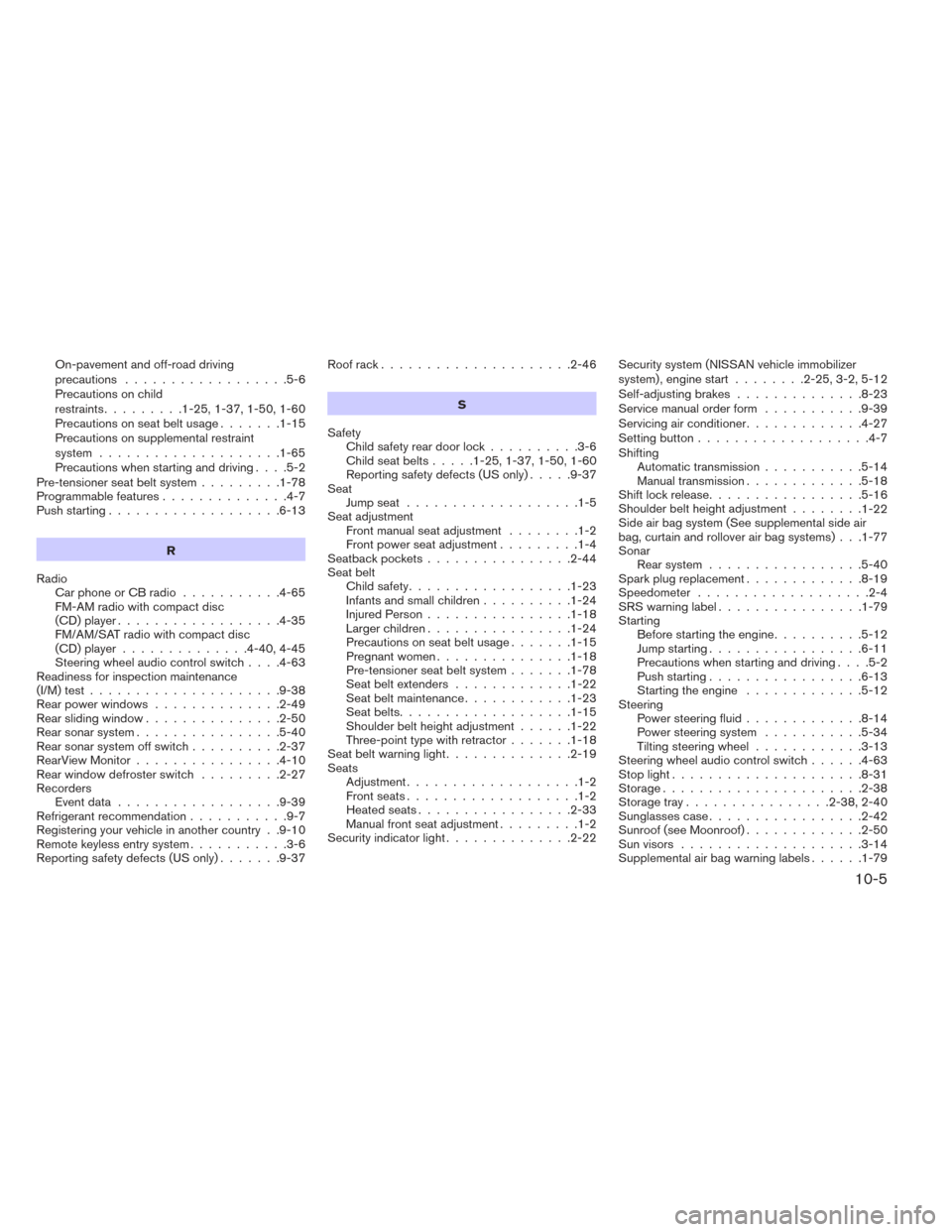
On-pavement and off-road driving
precautions..................5-6
Precautions on child
restraints .........1-25,1-37,1-50,1-60
Precautionsonseatbeltusage.......1-15
Precautions on supplemental restraint
system ....................1-65
Precautions when starting and driving ....5-2
Pre-tensioner seat belt system .........1-78
Programmable features ..............4-7
Push starting ...................6-13
R
Radio Car phone or CB radio ...........4-65
FM-AM radio with compact disc
(CD) player ..................4-35
FM/AM/SAT radio with compact disc
(CD) player ..............4-40,4-45
Steering wheel audio control switch ....4-63
Readiness for inspection maintenance
(I/M) test .....................9-38
Rear power windows ..............2-49
Rear sliding window ...............2-50
Rear sonar system ................5-40
Rear sonar system off switch ..........2-37
RearViewMonitor................4-10
Rear window defroster switch .........2-27
Recorders Eventdata..................9-39
Refrigerant recommendation ...........9-7
Registering your vehicle in another country . .9-10
Remote keyless entry system ...........3-6
Reporting safety defects (US only) .......9-37Roof rack
.....................2-46
S
Safety Child safety rear door lock ..........3-6
Childseatbelts.....1-25,1-37,1-50,1-60
Reporting safety defects (US only) .....9-37
Seat Jumpseat ...................1-5
Seat adjustment Frontmanualseatadjustment ........1-2
Front power seat adjustment .........1-4
Seatback pockets ................2-44
Seat belt Child safety ..................1-23
Infants and small children ..........1-24
Injured Person ................1-18
Largerchildren................1-24
Precautions on seat belt usage .......1-15
Pregnant women ...............1-18
Pre-tensioner seat belt system .......1-78
Seatbeltextenders .............1-22
Seatbeltmaintenance............1-23
Seatbelts...................1-15
Shoulder belt height adjustment ......1-22
Three-point type with retractor .......1-18
Seat belt warning light ..............2-19
Seats Adjustment ...................1-2
Frontseats...................1-2
Heatedseats.................2-33
Manual front seat adjustment .........1-2
Security indicator light ..............2-22 Security system (NISSAN vehicle immobilizer
system) , engine start
........2-25,3-2,5-12
Self-adjusting brakes ..............8-23
Service manual order form ...........9-39
Servicing air conditioner .............4-27
Setting button ...................4-7
Shifting Automatic transmission ...........5-14
Manual transmission .............5-18
Shiftlockrelease.................5-16
Shoulder belt height adjustment ........
1-22
Side air bag system (See supplemental side air
bag, curtain and rollover air bag systems) . . .1-77
Sonar Rear system .................5-40
Spark plug replacement .............8-19
Speedometer ...................2-4
SRSwarninglabel................1-79
Starting Before starting the engine ..........5-12
Jump starting .................6-11
Precautions when starting and driving ....5-2
Push starting .................6-13
Starting the engine .............5-12
Steering Power steering fluid .............8-14
Power steering system ...........5-34
Tilting steering wheel ............3-13
Steering wheel audio control switch ......4-63
Stoplight.....................8-31
Storage......................2-38
Storage tray ................2-38,2-40
Sunglasses case .................2-42
Sunroof (see Moonroof) .............2-50
Sun visors ....................3-14
Supplemental air bag warning labels ......1-79
10-5