Page 397 of 460
Vehicle care and maintenance
7-23
7
Tire inflation pressures
N00939300903
Proper tire inflation pressure is essential for the safe and satis-
factory operation of your vehicle. The wrong tire pressure will
cause problems in three major areas:
�Safety
Too little pressure increases flexing in the tire and can
cause tire failure. Too much pressure can cause a tire to
lose its ability to cushion shock. Objects on the road and
potholes could then cause tire damage that may result in
tire failure.
�Economy
The wrong tire pressure can cause uneven wear patterns in
the tire tread. These abnormal wear patterns will reduce
the tread life, and the tire will have to be replaced sooner.
Too little pressure also makes it harder for the tire to roll,
and this uses up more fuel.
�Ride comfort and vehicle stability
The superior riding experience built into your vehicle
partly depends on the correct tire pressure. Too much
pressure gives an uncomfortable and jarring ride. Too lit-
tle pressure feels as if your vehicle is slow to respond.
Unequal tire pressures can make steering your vehicle
uneven and unpredictable.
The tire pressure for your vehicle under normal driving condi-
tions is listed on the placard attached to the driver’s door sill.
(Refer to “Tire and loading information placard” on page 9-4.)The recommended inflation pressures under normal driving
conditions should be used for the tires listed below.
Tire pressures should be checked, and adjusted if necessary, at
least once a month.
Pressures should be checked more often whenever weather
temperatures change severely, because tire pressures change
with outdoor temperatures. The pressures listed are always
“cold inflation pressure”.
Cold inflation pressure is measured after the vehicle has been
parked for at least three hours or is driven less than 1 mile (1.6
km) after having been parked for three hours.
Cold inflation pressure must not go above the maximum values
molded into the tire sidewall. After driving several miles, your
tire inflation pressure may increase 2 to 6 psi (14 to 41 kPa)
from the cold inflation pressure. Do not let air out of the tires to
get back to the specified cold pressure, or your tires will be too
low.
Item
Tire size
Front
Rear
Normal tire 165/65R14240 kPa,
35 psi240 kPa,
35 psi
Compact spare
wheel (if so
equipped)T115/70D14 420 kPa, 60 psi
BK0162600US.book 23 ページ 2013年3月22日 金曜日 午後2時41分
Page 407 of 460
Vehicle care and maintenance
7-33
7 General maintenance
N00941500292
The next pages list the maintenance service recommended by
Mitsubishi Motors Corporation. In addition to the general
maintenance that needs to be performed at the times listed,
there are other parts which do not usually need regular mainte-
nance.
But, if any of these parts stops working properly, your vehicle
performance could suffer. Have these items checked if you
notice a problem with them.
If you have any questions, see your authorized Mitsubishi
Motors dealer for assistance.Disc brake pads
N00941600059
Good brakes are essential for safe driving. Check the brake
pads for wear. For good braking performance, replace the brake
pads with the same type pads as the originals.Brake hoses
N00941700076
Brake hoses and tubing should be checked for:
�Severe surface cracking, scuffing or worn spots. If the
fabric casing of the hose is showing through any cracks or
worn spots in the rubber hose cover, the hose should be
replaced. The brakes can fail if the hose wears through.
�Improper installation may cause twisting, or wheel, tire or
chassis interference.
Ball joint, steering linkage seals and drive shaft
boots
N00941800077
Check the following parts for damage and grease leaks:
�Ball joint boots of the front suspension and steering link-
age
�Bellows on both ends of the drive shaft
BK0162600US.book 33 ページ 2013年3月22日 金曜日 午後2時41分
Page 424 of 460
7-50 Vehicle care and maintenance
7
Front fog lights
(if so equipped)
N00943600763
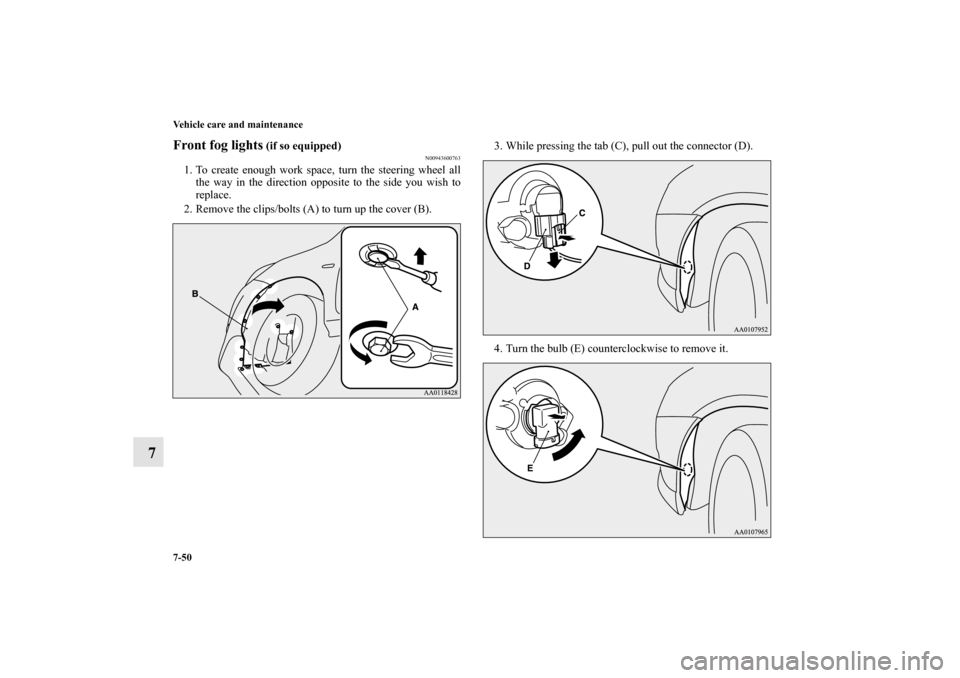
1. To create enough work space, turn the steering wheel all
the way in the direction opposite to the side you wish to
replace.
2. Remove the clips/bolts (A) to turn up the cover (B).3. While pressing the tab (C), pull out the connector (D).
4. Turn the bulb (E) counterclockwise to remove it.
BK0162600US.book 50 ページ 2013年3月22日 金曜日 午後2時41分
Page 453 of 460
Alphabetical index
1
A
Accessory (installation) 1-8
Active stability control (ASC) 3-76
Air bag 2-35
Air cleaner filter 7-13
Air conditioning
Automatic air conditioning 5-17
Important air conditioning operating tips 5-28
Manual air conditioning 5-11
Air purifier 5-29
Aluminum wheels 7-61
Antenna 5-64
Anti-lock braking system 3-72
Assist grip 3-169
Audio
AM/FM electronically tuned radio with CD player 5-30
Error codes 5-60
Handling of compact discs 5-62
Automatic air conditioning 5-17
Automatic transaxle
Fluid 9-9
B
Back-up light
Bulb capacity 7-44
Ball joint, steering linkage seals and drive shaft boots 7-33
Battery 7-17
Charging system warning light 3-113Checking battery electrolyte level 7-17
Disconnection and connection 7-18
During cold weather 7-17
Specification 9-8
Bluetooth
® 2.0 interface 3-128
Bottle holders 3-166
Brake
Fluid 9-9
Brake assist system 3-71
Braking 4-7
Anti-lock braking system 3-72
Hose 7-33
Pad wear alarm 3-69
Parking brake 3-48
Pedal 3-68
Pedal free play 7-29
Power brakes 3-68
Service brake 3-68
Warning lights 3-111
Break-in recommendations 3-2
Bulb capacity 7-44
C
California Perchlorate Materials Requirements 1-10
Capacities 9-9
Card holder 3-161
Cargo loads 4-13
Cargo room light
Bulb capacity 7-45
BK0162600US.book 1 ページ 2013年3月22日 金曜日 午後2時41分
Page 454 of 460

Alphabetical index
2Catalytic converter 7-4
Certification label 9-5
Charging system warning light 3-113
Child restraint systems 2-24
Child safety locks for rear door 3-40
Cleaning
Inside of your vehicle 7-56
Outside of your vehicle 7-58
Clutch
Pedal free play 7-28
Consumer information 8-2
Continuously variable transmission (CVT) 3-61
Fluid 7-15
,9-9
Selector lever operation 3-61
Selector lever positions 3-64
Convenience hook 3-168
Coolant (engine) 7-11
,9-9
Cruise control 3-80
Cup holders 3-165
D
Daytime running lights
Bulb capacity 7-44
Defogger (rear window) 3-125
Defrosting or defogging (windshield, door windows) 5-15
,5-
26
Dimensions 9-5
Dimmer (high/low beam change) 3-117
Disc brake pads 7-33Dome light
Bulb capacity 7-45
Door-ajar warning buzzer 3-114
Door-ajar warning light 3-114
Doors
Lock 3-35
Power door locks 3-38
Driving during cold weather 4-6
Driving, alcohol and drugs 4-2
E
Electric power steering system (EPS) 3-75
Electric rear window defogger switch 3-125
Electronic immobilizer (Anti-theft starting system) 3-5
,3-28
Emission-control system maintenance 7-31
Engine
Compartment 7-7
Coolant 7-11
,9-9
High coolant temperature warning light 3-113
Hood 7-5
Oil and oil filter 7-8
,9-9
Overheating 6-5
Serial number 9-2
Specification 9-7
Engine hood 7-5
Engine switch 3-20
Error codes 5-60
Exhaust system 7-34
BK0162600US.book 2 ページ 2013年3月22日 金曜日 午後2時41分
Page 458 of 460

Alphabetical index
6Starting the engine 3-56
Steering
Electric power steering system (EPS) 3-75
Steering wheel height adjustment 3-49
Stop lights
Bulb capacity 7-44
Replacement 7-51
Storage spaces 3-164
Sun visors 3-160
Supplemental Restraint System 2-35
How the Supplemental Restraint System works 2-39
Maintenance service 2-58
T
Tail light
Bulb capacity 7-44
Replacement 7-51
Tank capacity 9-9
Tire
Inflation pressures 7-23
Maintenance 7-25
Quality grading 8-2
Replacing tires and wheels 7-24
Rotation 7-26
Size (tire and wheel) 9-8
Snow tires 7-28
To change a tire 6-18
Tread wear indicator 7-25
Tire pressure monitoring system 3-87Tire repair kit 6-9
Tires 7-19
Tire and loading information placard 9-4
Tire chains 7-28
Tools 6-7
Storage 6-7
Towing 6-29
Trailer towing 4-14
Turn signal light
Indicators 3-110
Lever 3-118
U
USB input terminal 3-153
How to connect a USB memory device 3-154
How to connect an iPod 3-156
V
Vanity mirror 3-160
Vehicle care precautions 7-55
Vehicle dimensions 9-5
Vehicle labeling 9-2
Vehicle preparation before driving 4-5
Vehicle weights 9-6
Vents 5-2
W
Warning lights 3-111
Washer
BK0162600US.book 6 ページ 2013年3月22日 金曜日 午後2時41分