2014 MITSUBISHI LANCER SE AWC wheel
[x] Cancel search: wheelPage 38 of 434

Seat belts
Seat and restraint systems 4-9
4
senger in the event of an accident. Always use the provided seat belts. Carefully review the following information for proper seat belt usage.
N00406201470
All seats are equipped with a seat belt whichuses one combined lap-and-shoulder belt withan emergency locking retractor. This system is designed to provide both com- fort and safety. It permits full extension and automatic retraction of the belts during nor-mal vehicle operation. A sensing device inside the belt retractor is designed to lock the retractor in the event of a sudden change inthe vehicle’s motion.
WA R N I N G To help reduce the risk of injury or death in an accident, seat belts and childrestraint systems must always be used. Refer to “Child restraint systems” on page 4-14 for additional information. Never use one seat belt for more than one person. Never carry more people in your vehicle than there are seat belts. Always adjust the seat belt for a snug fit.Always place the shoulder belt over your shoulder and across your chest. Never put it behind you or under your arm. Always wear the lap belt as low as possible across your hips, not around your waist. Never modify or alter the seat belts in your vehicle. To reduce the risk to the driver of serious injury or death during deployment of thedriver’s airbag, always properly wear the seat belt and adjust th
e driver’s seat as far
back as possible while maintaining a posi- tion that still enables
you to fully apply the
pedals, easily control the steering wheel,and safely operate the vehicle.
To reduce the risk to a front seat passen- ger of serious injury or death from a deploying airbag, make sure the passenger always wears the seat belt properly, remains seated all the way back andupright in their seat, and moves the seat as far back as possible. Refer to “Supplemen- tal Restraint System (SRS) - airbag” onpage 4-22 for additional information. Never hold an infant or child in your arms or on your lap when riding in this vehicle even when you are wearing your seat belt. Never place any part of the seat belt youare wearing around an infant or child. Failure to follow these simple instructions creates a risk of serious injury or death toyour child in the event of an accident or sudden stop. Children 12 years old and under should always ride in the rear seat and be prop- erly restrained. This reduces their risk ofserious injury or death in an accident, especially due to a deploying front passen- ger airbag. Refer to “Child restraint sys-tems” on page 4-14 for additional information.WA R N I N G
Any child who is too small to properly wear a seat belt must be properly restrained in an appropriate child restraint system. Children 12 years old and under should be seated only in therear seat to reduce their risk of serious injury or death in an accident, especially from the deployment of a front passengerairbag. Infants MUST be placed in a rear-facing child safety seat and positioned in the rear seat. In the event of an accident, all seat belt assemblies, including retractors and attachment hardware, should be inspectedby an authorized Mitsubishi Motors dealer to determine whether replacement is necessary.
Seat belt instructions
WA R N I N G
Page 39 of 434

Seat belts 4-10 Seat and restraint systems
4
1. Occupants should always sit back in their seats with their backs against the upright seatback. To reduce the risk of seriousinjury or death during deployment of theairbag, adjust the driver’s seat as far back as possible while maintaining a position that still enables you to fully apply thepedals, easily control the steering wheel, and safely operate the vehicle. The front passenger seat should also be moved asfar back as possible. Refer to “Supple- mental Restraint System (SRS) - airbag” on page 4-22. Also refer to “To adjust theseat forward or backward” on page 4-3.
2. Grasp the latch plate and slide it up the webbing so that it easily pulls across yourbody.
3. Pull the seat belt out slowly while holding the latch plate. Push the latch plate into the buckle until you hear a “click”. Pull up on the belt to be sure the latch plate islocked securely in the buckle.
NOTE
For instructions on installing a child restraint system using a seat belt, refer to “Installing a child restraint system using the seat belt” on page 4-19.
WA R N I N G To reduce the risk of serious injury or death in the event of an accident or sud- den stop, all seatbacks should be kept in the upright position while the vehicle is in motion.Seat belt performance during an accident can be adversely affected if the seatbacks are reclined. The more a seatback isreclined, the more likely seat belt perfor- mance will be adversely affected. If the seat belt is not properly positioned againstthe body during an accident, there is increased risk you will slide under the belt and receive serious injury or death.
NOTE
If the seat belt locks up and cannot be pulled out, pull it once with force and let it retractall the way. Then, pull the belt out slowly once again.
Page 52 of 434

Supplemental Restraint System (SRS) - airbag
Seat and restraint systems 4-23
4
• Seat belts reduce the risk of being thrown from your vehicle in a collision or rollover.
IT IS VERY IMPORTANT TO BE PROP- ERLY SEATED.• A driver or front passenger sitting tooclose to the steering wheel or instrument panel during airbag deployment can be seriously injured or killed.• Airbags inflate very quickly and withgreat force. If the driver and front pas-senger are not properly seated and restrained, the airbag may not provide the proper protection and can cause seri-ous injuries or death when it inflates.• To reduce the risk to the driver of seriousinjury or death due to a deploying driver’s airbag, always properly wear your seat belt and adjust the driver’s seatas far back as possible, maintaining a position that still allows the driver to have good control of the steering wheel,brake, accelerator, and other vehicle con- trols.• To reduce the risk to the front passengerof serious injury or death from a deploy- ing passenger’s airbag, make sure the passenger always wears the seat belt properly, remains seated upright and allthe way back in the seat, and positions the seat as far back as possible. WA R N I N G
• Seat all infants and children in the rearseat, properly restrained in an appropri- ate child restraint system.
Airbags inflate very quickly and with great force. Do not sit on the edge of the seat or sit with your lower legs too close to the instrument panel, or lean your head orchest close to the steering wheel or the instrument panel. Do not put your feet or legs on or against the instrument panel.WA R N I N G
WA R N I N G Infants and small children should never ride unrestrained, or lean against the instrument panel. They should never ride held in your arms or on your lap. They can be seriously injured or killed in anaccident, especially when the airbags inflate. Infants and children should be properly seated in the rear seat in anappropriate child restraint system. Refer to “Child restraint systems” on page 4-14.
Page 57 of 434

Supplemental Restraint System (SRS) - airbag 4-28 Seat and restraint systems
4
Warning display type 1 Warning display type 2If there is an error in the system, the warning light will come on and the warning displaywill appear on the information screen in the multi-information display. Under normal conditions, the warning lightcomes on when the ignition switch is turned to the “ON” position and goes off a few sec- onds later.The warning light will also come on and remain on when the SRS airbags and the seat belt pre-tensioner system have been acti-vated.The warning light/display is used for both SRS airbag warnings and seat belt pre-ten- sioner system warnings.
N00407900318
The driver’s airbag is located under the pad-ded cover in the middle of the steering wheel. The front passenger’s airbag is contained in the instrument panel above the glove com-partment. The driver’s airbag and the front passenger’s airbag are designed to deploy at the same time. However, the front passen-ger’s airbag does not deploy when the front passenger seat is not occupied or when the weight sensor in the front passenger seat
senses a weight on the seat of less than approximately 66 pounds (30 kg).
N00404500010
The driver’s knee airbag
is located under the
steering wheel. The driver’s knee airbag isdesigned to deploy at the same time as the driver’s front airbag.
WA R N I N G There may be a system error if the warn- ing light/display appears as indicated. In such cases, an SRS airbag or a seat belt pre-tensioner system may not function properly in a collision. Have your vehiclechecked by an authorized Mitsubishi Motors dealer:• Even when the ignition switch is in the“ON” position, the warning light does not come on or it remains on a few sec-onds later• When warning light comes on while driv-ing• When warning display appears whiledriving
Driver’s and passenger’s front airbag system
Driver’s knee airbag system Driver
Front passenger
Page 61 of 434

Supplemental Restraint System (SRS) - airbag 4-32 Seat and restraint systems
4
WA R N I N G Do not attach anything to the steering wheel’s padded cover, such as trim mate- rial, badges, etc. These could strike and injure an occupant if the airbag inflates. Do not set anything on, or attach anything to, the instrument panel above the glove compartment. Such items could strike andinjure an occupant if the airbag inflates. WA R N I N G Do not attach accessories to, or put them in front of, the windshield. They could restrict the airbag inflation, or strike andinjure an occupant, when the airbag inflates.
Do not attach additional keys or accesso- ries (hard, pointed or heavy objects) to the ignition key. Such objects could prevent the driver’s knee airbag from inflating normally or could be propelled to causeserious injury if the airbag inflates. Do not attach accessories to the lower por- tion of the driver’s side instrument panel. Such objects could prevent the driver’s knee airbag from inflating normally orcould be propelled to cause serious injury if the airbag inflates.WA R N I N G Do not attempt to remove, install, disas- semble or repair the SRS airbags.WA R N I N G
Do not place objects, such as packages or pets, between the airbags and the driver or the front passenger. Such objects can adversely affect airbag performance, or cause serious injury or death when theairbag deploys. Immediately after airbag inflation, some parts of the airbag system will be hot. Do not touch them. You could be burned. The airbag system is designed to work only once. After the airbags deploy, they will not work again. They must promptlybe replaced and the entire airbag system must be inspected by an authorized Mit- subishi Motors dealer.WA R N I N G
Page 65 of 434

Supplemental Restraint System (SRS) - airbag 4-36 Seat and restraint systems
4
The side airbag and curtain airbag are not designed to deploy in situations where they cannot provide protection to the occupants. Typical situations where the side airbags andcurtain airbags cannot provide protection are shown in the illustrations below. Because the side airbags and curtain airbags do not protect the occupants in all types ofcollisions, be sure to always wear your seatbelts properly.
N00408500672
The side airbag and curtain airbag ARE NOT DESIGNED TO DEPLOY when … Oblique side impact Vehicle rolls onto its side or roof
Head-on collision Rear end collision
SRS servicing
WA R N I N G Any maintenance performed on or near the components of the SRS should be per- formed only by an authorized Mitsubishi Motors dealer. Do not permit anyone elseto do any service, inspection, maintenance or repair on any SRS components or wir- ing. Similarly, no part of the SRS shouldever be handled, removed or disposed by anyone except an authorized Mitsubishi Motors dealer.Improper work methods on the SRS com- ponents or wiring could result in an acci- dental airbag deployment or could makethe SRS inoperable. Either of these situa- tions could result in serious injury or death. Do not modify your steering wheel or any other SRS component or related vehiclepart. For example, replacement of the steering wheel, or modifications to the front bumper or body structure canadversely affect SRS performance and may lead to injury. If your vehicle has received any damage, you should have the SRS inspected by an authorized Mitsubishi Motors dealer to make sure it is in proper working order.
Page 66 of 434

Supplemental Restraint System (SRS) - airbag
Seat and restraint systems 4-37
4
Do not modify your front seats, center pil- lar or center console. Such modifications can adversely affect SRS performance and may lead to injury. Also, if you discover any tear or openseam in the seat fabric near the side air- bag, have the seat inspected by an autho- rized Mitsubishi Motors dealer. If you find a crack in or damage to the front pillar, rear pillar, or roof side railwhere the curtain airbag is located, have the SRS inspected by an authorized Mit- subishi Motors dealer.NOTE
When you transfer ownership of the vehicle to another person, we urge you to alert the new owner that it is equipped with the SRS and refer that owner to the applicable sec-tions in this owner’s manual. If you decide to junk or scrap your vehicle, we urge you to first take
it to an authorized
Mitsubishi Motors dealer so that the SRS can be made safe for disposal. If any of the following parts needs to be modified for use by a handicapped person, the advanced airbag system will be greatly affected. Please consult an authorized Mit-subishi Motors dealer for assistance. • Driver’s seat• Front passenger seat • Front seat beltWA R N I N G
• Steering wheel • Instrument panel[For vehicles sold in U.S.A.] To contact Mitsubishi Motors North America, Inc. call 1-888-648-7820 or write to:Mitsubishi Motors North America, Inc. Customer Relations DepartmentP. O. Box 6400Cypress, CA 90630-0064 [For vehicles sold in Canada] To contact Mitsubishi Motor Sales of Canada, Inc. call 1-888-576-4878 or write to:Mitsubishi Motor Sales of Canada, Inc. Customer Relations DepartmentP.O. Box 41009 4141 Dixie Road Mississauga, ON L4W 5C9NOTE
[For vehicles sold in Puerto Rico]To contact Mitsubishi Motor Sales of Caribbean, Inc. call 1-787-251-8715 or write to: Mitsubishi Motor Sales of Caribbean, Inc. Customer Service Department P.O. Box 192216SAN JUAN PR 00919-2216 [For vehicles sold in Guam] To contact Triple J Enterprises Inc.call (671) 649-3673 or write to: Triple J Enterprises, Inc. P.O. Box 6066TAMUNING GUAM 96931 [For vehicles sold in Saipan] To contact Triple J Motors call (670) 234-7133 or write to:Triple J Motors P.O. Box 500487 SAIPAN, MP96950-0487
Page 68 of 434
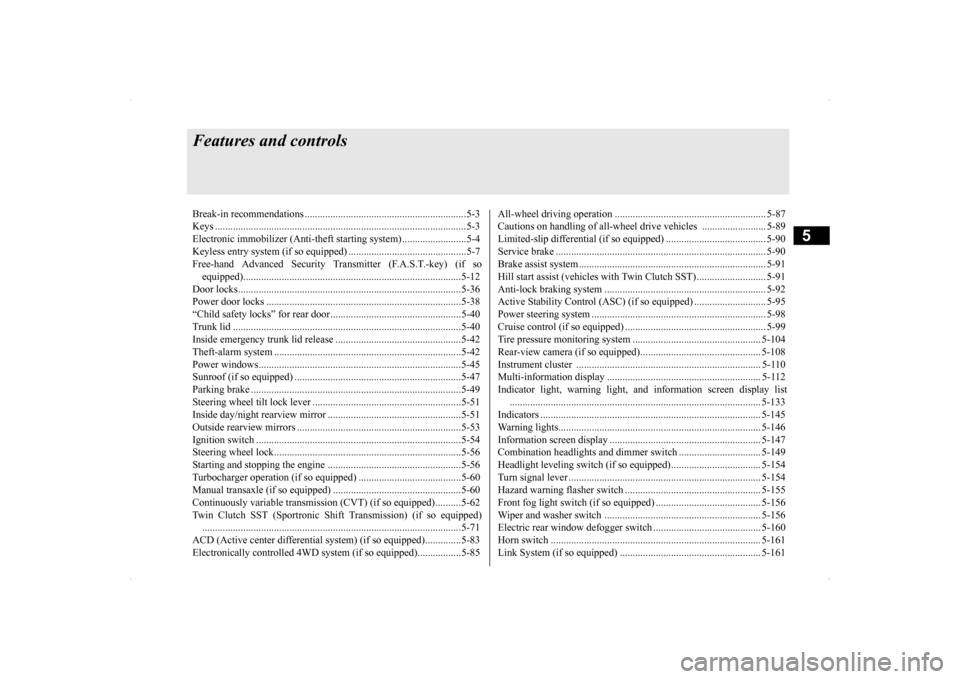
5
Features and controlsBreak-in recommendation
s ...............................................................5-3
Keys .....................................................
.............................................5-3
Electronic immobilizer (Anti-theft starting system) .........................5-4 Keyless entry system (if so equipped) ..............................................5-7Free-hand Advanced Security Transmitter (F.A.S.T.-key) (if so equipped)................................
.....................................................5-12
Door locks........................
...............................................................5-36
Power door locks .............
...............................................................5-38
“Child safety locks” for
rear door...................................................5-40
Trunk lid ....................................
.....................................................5-40
Inside emergency trunk lid
release .................................................5-42
Theft-alarm system ..........
...............................................................5-42
Power windows................
...............................................................5-45
Sunroof (if so equipped
) .........................................
........................5-47
Parking brake ...................
...............................................................5-49
Steering wheel tilt lock lever ..........................................................5-51Inside day/night rearview
mirror ....................................................5-51
Outside rearview mirr
ors ................................................................5-53
Ignition switch .................
...............................................................5-54
Steering wheel lock..........
...............................................................5-56
Starting and stopping the e
ngine ....................................................5-56
Turbocharger operation (if so equipped) ........................................5-60Manual transaxle (if so equipped) ..................................................5-60Continuously variable transmissi
on (CVT) (if so equipped)..........5-62
Twin Clutch SST (Sportronic Shif
t Transmission) (if so equipped)
...................................................................
..................................5-71
ACD (Active center differential system) (if so equipped)..............5-83 Electronically controlled 4WD system (if so equipped).................5-85
All-wheel driving opera
tion ........................................................... 5-87
Cautions on handling of all-wheel drive vehicles ......................... 5-89 Limited-slip differential (i
f so equipped) ....................................... 5-90
Service brake ..................
.................................................
............... 5-90
Brake assist system
................................................
......................... 5-91
Hill start assist (vehicles with
Twin Clutch SST) ........................... 5-91
Anti-lock braking syst
em ......................................
......................... 5-92
Active Stability Control (ASC
) (if so equipped) ............................ 5-95
Power steering system
...........................................
......................... 5-98
Cruise control (if so eq
uipped) ....................................................... 5-99
Tire pressure monitoring
system .................................................. 5-104
Rear-view camera (if so
equipped)..............
................................. 5-108
Instrument cluster ..........
.............................................................. 5-110
Multi-information display ............................................................ 5-112 Indicator light, warning light, and information screen display list
.................................................................
................................. 5-133
Indicators ..................................
.................................................... 5-145
Warning lights.................
.................................................
............. 5-146
Information screen disp
lay ....................................
....................... 5-147
Combination headlights and dimmer switch ................................ 5-149 Headlight leveling switch (if
so equipped)................................... 5-154
Turn signal lever ...
.................................................
....................... 5-154
Hazard warning flasher
switch ..................................................... 5-155
Front fog light switch (if so
equipped) ......................................... 5-156
Wiper and washer swit
ch ......................................
....................... 5-156
Electric rear window def
ogger switch .......................................... 5-160
Horn switch ..............................
.................................................... 5-161
Link System (if so equi
pped) ....................................................... 5-161