2014 MITSUBISHI LANCER Belt
[x] Cancel search: BeltPage 64 of 434
Supplemental Restraint System (SRS) - airbag
Seat and restraint systems 4-35
4
N00408200507
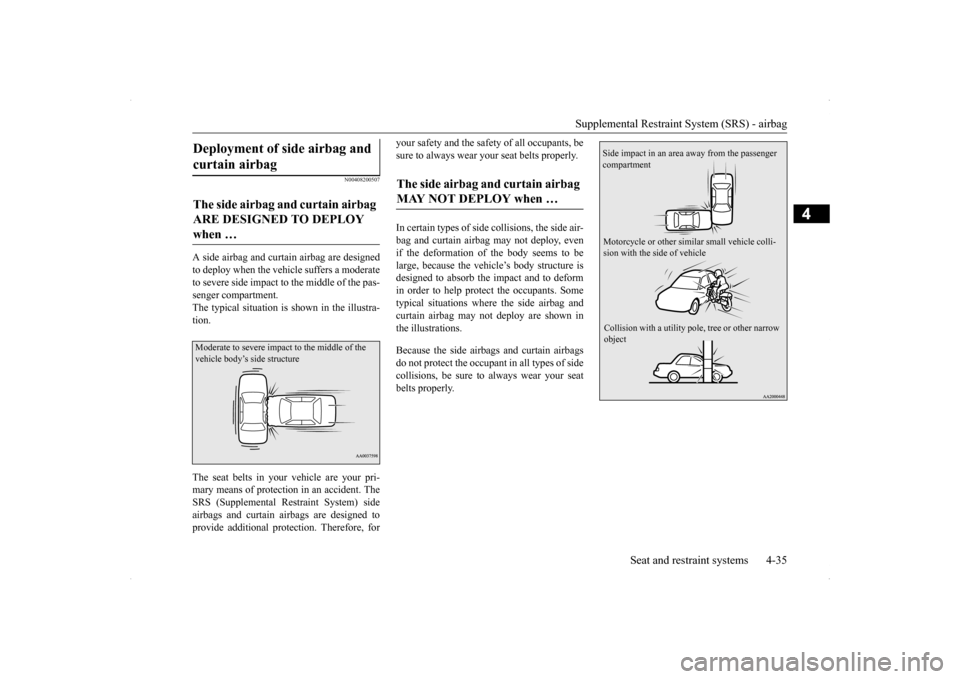
A side airbag and curtain airbag are designed to deploy when the vehicle suffers a moderateto severe side impact to the middle of the pas- senger compartment. The typical situation is shown in the illustra-tion. The seat belts in your vehicle are your pri- mary means of protection in an accident. The SRS (Supplemental Restraint System) sideairbags and curtain airbags are designed to provide additional protection. Therefore, for
your safety and the safety of all occupants, be sure to always wear your seat belts properly. In certain types of side
collisions, the side air-
bag and curtain airbag may not deploy, evenif the deformation of the body seems to be large, because the vehicle’s body structure is designed to absorb the impact and to deformin order to help protect the occupants. Sometypical situations where the side airbag and curtain airbag may not deploy are shown in the illustrations. Because the side airbags and curtain airbags do not protect the occupant in all types of side collisions, be sure to always wear your seat belts properly.
Deployment of side airbag and curtain airbag The side airbag and curtain airbag ARE DESIGNED TO DEPLOY when … Moderate to severe impact to the middle of the vehicle body’s side structure
The side airbag and curtain airbag MAY NOT DEPLOY when …
Side impact in an area away from the passenger compartment Motorcycle or other si
milar small vehicle colli-
sion with the side of vehicle Collision with a utility pole
, tree or other narrow
object
Page 65 of 434

Supplemental Restraint System (SRS) - airbag 4-36 Seat and restraint systems
4
The side airbag and curtain airbag are not designed to deploy in situations where they cannot provide protection to the occupants. Typical situations where the side airbags andcurtain airbags cannot provide protection are shown in the illustrations below. Because the side airbags and curtain airbags do not protect the occupants in all types ofcollisions, be sure to always wear your seatbelts properly.
N00408500672
The side airbag and curtain airbag ARE NOT DESIGNED TO DEPLOY when … Oblique side impact Vehicle rolls onto its side or roof
Head-on collision Rear end collision
SRS servicing
WA R N I N G Any maintenance performed on or near the components of the SRS should be per- formed only by an authorized Mitsubishi Motors dealer. Do not permit anyone elseto do any service, inspection, maintenance or repair on any SRS components or wir- ing. Similarly, no part of the SRS shouldever be handled, removed or disposed by anyone except an authorized Mitsubishi Motors dealer.Improper work methods on the SRS com- ponents or wiring could result in an acci- dental airbag deployment or could makethe SRS inoperable. Either of these situa- tions could result in serious injury or death. Do not modify your steering wheel or any other SRS component or related vehiclepart. For example, replacement of the steering wheel, or modifications to the front bumper or body structure canadversely affect SRS performance and may lead to injury. If your vehicle has received any damage, you should have the SRS inspected by an authorized Mitsubishi Motors dealer to make sure it is in proper working order.
Page 66 of 434

Supplemental Restraint System (SRS) - airbag
Seat and restraint systems 4-37
4
Do not modify your front seats, center pil- lar or center console. Such modifications can adversely affect SRS performance and may lead to injury. Also, if you discover any tear or openseam in the seat fabric near the side air- bag, have the seat inspected by an autho- rized Mitsubishi Motors dealer. If you find a crack in or damage to the front pillar, rear pillar, or roof side railwhere the curtain airbag is located, have the SRS inspected by an authorized Mit- subishi Motors dealer.NOTE
When you transfer ownership of the vehicle to another person, we urge you to alert the new owner that it is equipped with the SRS and refer that owner to the applicable sec-tions in this owner’s manual. If you decide to junk or scrap your vehicle, we urge you to first take
it to an authorized
Mitsubishi Motors dealer so that the SRS can be made safe for disposal. If any of the following parts needs to be modified for use by a handicapped person, the advanced airbag system will be greatly affected. Please consult an authorized Mit-subishi Motors dealer for assistance. • Driver’s seat• Front passenger seat • Front seat beltWA R N I N G
• Steering wheel • Instrument panel[For vehicles sold in U.S.A.] To contact Mitsubishi Motors North America, Inc. call 1-888-648-7820 or write to:Mitsubishi Motors North America, Inc. Customer Relations DepartmentP. O. Box 6400Cypress, CA 90630-0064 [For vehicles sold in Canada] To contact Mitsubishi Motor Sales of Canada, Inc. call 1-888-576-4878 or write to:Mitsubishi Motor Sales of Canada, Inc. Customer Relations DepartmentP.O. Box 41009 4141 Dixie Road Mississauga, ON L4W 5C9NOTE
[For vehicles sold in Puerto Rico]To contact Mitsubishi Motor Sales of Caribbean, Inc. call 1-787-251-8715 or write to: Mitsubishi Motor Sales of Caribbean, Inc. Customer Service Department P.O. Box 192216SAN JUAN PR 00919-2216 [For vehicles sold in Guam] To contact Triple J Enterprises Inc.call (671) 649-3673 or write to: Triple J Enterprises, Inc. P.O. Box 6066TAMUNING GUAM 96931 [For vehicles sold in Saipan] To contact Triple J Motors call (670) 234-7133 or write to:Triple J Motors P.O. Box 500487 SAIPAN, MP96950-0487
Page 88 of 434

Free-hand Advanced Security Transmit
ter (F.A.S.T.-key) (if so equipped)
Features and controls 5-21
5
If the engine will not start because the bat- tery is weak or discharged, refer to “Jump-starting the engine” on page 8-2 for instructions. A longer warm up period will only con- sume extra fuel. The engine is warmed up enough for driving when the bar graph ofthe engine coolant temperature display starts to move. Refer to “Interrupt display screen (With ignition
switch in the “ON”
position)” on page 5-121. On vehicles equipped with the Twin Clutch SST, the following may occur after the engine is started, but they do not indi-cate an abnormality. • You may hear operational sounds of the Twin Clutch SST and you may feelvibration in the vehicle body. • If you shift the gearshift lever into the “N” (NEUTRAL) position and depressthe accelerator pedal, increases in the engine speed will be limited.
Your vehicle is equipped with an electroni- cally controlled fuel injection system. This isa system that automatically controls fuel injection. There is no need to depress the accelerator pedal when starting the engine.The starter motor should not be run for more than 15 seconds at a time. To prevent battery drain, wait a few secondsbetween attempts to restart the engine. 1. Make sure all occupants are properly seated with seat belts fastened. 2. Press and hold the brake pedal down withyour right foot.
3. Press and hold the clutch pedal all the way down (manual transaxle). 4. On vehicles with manual transaxle, place the gearshift lever in the “N” (Neutral)position.On vehicles with continuously variable transmission (CVT) or Twin Clutch SST, make sure the selector lever (CVT) or thegearshift lever (Twin Clutch SST) is in the “P” (PARK) position.
WA R N I N G Never run the engine in a closed or poorly ventilated area any longer than is needed to move your vehicle out of the area. Car- bon monoxide gas, which is odorless andextremely poisonous, could build up and cause serious injury or death.
CAUTION Do not push-start the vehicle.Do not run the engine
at high rpms or drive
at high speeds until the engine has had a chance to warm up. Release the ignition switch as soon as the engine starts. Otherwise, the starter motorwill be damaged.
Starting the engine
NOTE
For models equipped with a manual trans- axle, the starter will not operate unless the clutch pedal is fully depressed (Clutch inter-lock). This is a safety feature.NOTE
On vehicles with CVT, the starter will not operate unless the selector lever is in the “P” (PARK) or “N” (NEUTRAL) position. On vehicles with Twin Clutch SST, thestarter will not operate unless the gearshift lever is in the “P” (P
ARK) position or the
gearshift lever is in the “N” (NEUTRAL) position with the brake pedal depressed. For safety reasons, start the engine in the “P”(PARK) position so that the wheels are locked.
Page 93 of 434

Free-hand Advanced Security Transmitter (F.A.S.T.-key) (if so equipped) 5-26 Features and controls
5
A longer warm up period will only con- sume extra fuel. The
engine is warmed up
enough for driving when the bar graph of the engine coolant temperature displaystarts to move. Refer to “Interrupt display screen (With ignition switch in the “ON” position)” on page 5-121. On vehicles equipped with the Twin Clutch SST, the following may occur after the engine is started, but they do not indi-cate an abnormality.• You may hear operational sounds of the Twin Clutch SST and you may feel vibration in the vehicle body.• If you shift the gearshift lever into the “N” (NEUTRAL) position and depress the accelerator pedal, increases in theengine speed will be limited.
Starting the engine Your vehicle is equipped with an electroni-cally controlled fuel injection system. This is a system that automatically controls the fuel injection. There is no need to depress theaccelerator pedal when starting the engine. The starter motor should not be run for more than 15 seconds at a time.To prevent battery drain, wait a few seconds between attempts to restart the engine. 1. Make sure all occupants are properly seated with seat belts fastened.
2. While pushing the lock release buttons (A), remove the cover of the ignition switch. 3. Insert the emergency key into the ignition switch.
WA R N I N G Never run the engine in a closed or poorly ventilated area any longer than is needed to move your vehicle out of the area. Car- bon monoxide gas, which is odorless andextremely poisonous, could build up and cause serious injury or death.CAUTION Do not push-start the vehicle.
Do not run the engine
at high rpms or drive
at high speeds until the engine has had a chance to warm up. Release the emergency key as soon as the engine starts. It will damage the starter motor.CAUTION
Page 103 of 434

Door locks 5-36 Features and controls
5
N00509200491
Turn the key toward the front of the vehicle to lock the door. After checking that the door is
locked, turn the key back to the center and remove it.
Door locks
WA R N I N G Make sure all doors are tightly closed and locked while driving.• Locked doors, in combination with theuse of seat belts, can help reduce the risk of ejection in an accident.• Locked doors can help keep passengers,especially small chil
dren, from opening
doors and falling out of moving vehicles.• Locked doors can help prevent outsidersfrom gaining access to your vehicle whenyou slow or come to a stop.
Lock your vehicle whenever you leave it. Children who get into unlocked vehicles may not be able to get out. Children trapped inside vehicles can quickly beovercome by heat and suffer serious injury or death due to heat stroke. Never leave children unattended inside a vehicle. In addition to the risk of heat stroke, children can activate switches andcontrols, resulting in an injury or fatal accident.
NOTE
When locking or unlocking with the key, only the driver’s door will be locked or unlocked. To lock or unlock all doors, use the power door lock switches, the keyless entry system,the F.A.S.T-key or the remote control trans- mitter of the F.A.S.T.-key. Refer to “Power door locks” on page 5-38, “Keyless entry system” on page 5-7 and 5-30, and “To operate using the F.A.S.T.- key” on page 5-14. In vehicles equipped with the F.A.S.T.-key, the driver’s door can be locked and unlockedusing the emergency key. Refer to “Emergency key” on page 5-23.
To lock or unlock the front doors with the key
1- Insert or remove the key 2- Lock 3- Unlock
Page 124 of 434
![MITSUBISHI LANCER 2014 8.G Owners Manual Starting and stopping the engine Features and controls 5-57
5
[Except for vehicles equipped with the turbocharger] The engine is warmed up enough for driv- ing when the bar graph of engine coolant](/manual-img/19/7460/w960_7460-123.png "MITSUBISHI LANCER 2014 8.G Owners Manual Starting and stopping the engine Features and controls 5-57
5
[Except for vehicles equipped with the turbocharger] The engine is warmed up enough for driv- ing when the bar graph of engine coolant")
Starting and stopping the engine Features and controls 5-57
5
[Except for vehicles equipped with the turbocharger] The engine is warmed up enough for driv- ing when the bar graph of engine coolanttemperature display starts to move. A lon- ger warm up period will only consume extra fuel. [For vehicles equipped with the turbo- charger] The engine is warmed up enough for driv-ing when the bar graph of engine coolanttemperature display starts to move. Driv- ing before the bar graph moves may cause deterioration of turbocharger performanceand driveability. A longer warm up period will only consume extra fuel. On vehicles equipped with the Twin Clutch SST, the following may occur after the engine is started, but they do not indi- cate an abnormality.• You may hear operational sounds of the Twin Clutch SST and you may feel vibration in the vehicle body.• If you shift the gearshift lever into the “N” (NEUTRAL) position and depress the accelerator pedal, increases in theengine speed will be limited.
N00542200146
[For vehicles equipped with the F.A.S.T.-key.]For information on operation for vehicles equipped with the F.A.S.T.-key, refer to “F.A.S.T.-key: Starting the engine” on page5-20. [Except for vehicles equipped with the F. A . S . T. - k e y. ]Your vehicle is equipped with an electroni- cally controlled fuel injection system, which automatically controls the release of fuel.
There is usually no need to depress the accel- erator pedal when starting the engine. The starter should not be run for more than 15 seconds at a time.To prevent battery drain, wait a few seconds between attempts to restart the engine. 1. Make sure all occupants are properly seated with seat belts fastened 2. Insert the ignition key. 3. Make sure the parking brake is applied.4. Press and hold the brake pedal down withyour right foot. 5. Press and hold the clutch pedal all the way down (manual transaxle).
WA R N I N G Never run the engine in a closed or poorly ventilated area any longer than is needed to move your vehicle out of the area. Car- bon monoxide gas, which is odorless and extremely poisonous, could build up andcause serious injury or death.CAUTION Do not push-start the vehicle.Do not run the engine
at high rpms or drive
at high speeds until the engine has had a chance to warm up. Release the ignition switch as soon as the engine starts. Otherwise, the starter motorwill be damaged.
Starting the engine
NOTE
For models equipped with a manual trans- axle, the starter will not operate unless the clutch pedal is fully depressed (Clutch inter-lock). This is a safety feature.
Page 200 of 434

Indicator light, warning light, an
d information screen display list Features and controls 5-133
5
N00557700035 N00557800238
Indicator light, warning light, and information screen display list Indicator and warning light list Type A Type B1- Position indicator
P.5-145
2- High beam indicator
P.5-145
3- Charging system warning light
P.5-147
4- Turn signal indicator/hazard warning
light
P.5-145
5- Front fog light indicator (if so
equipped)
P.5-145
6- Anti-lock braking system warning light
P.5-93
7- Tire pressure monitoring system warn-
ing light
P.5-105
8- Brake warning light
P.5-146
9- Cruise control indicator (if so
equipped)
P.5-100
10- Seat belt reminder/warning light
P. 4 - 1 1
11- Supplemental Restraint System (SRS)
warning light P.4-27
12- ECO mode indicator (if so equipped)
P.5-123
13- Engine malfunction indicator (“SER-
VICE ENGINE SOON” or “Check engine light”)
P.5-146
14- Active stability
control (ASC) OFF
indicator (if so equipped)
P.5-96
15- Active stability control (ASC) indicator
(if so equipped)
P. 5 - 9 6
16- Information screen display list
P.5-134