2014 MITSUBISHI LANCER lock
[x] Cancel search: lockPage 368 of 434

Air cleaner filter
Vehicle care and maintenance 9-9
9
Mitsubishi Motors Genuine Coolant provides excellent protection against corrosion and rust formation on all metals, including alumi-num, and prevents blockages in some parts of engine. If you need to add co
olant often, or if the
level in the reserve tank does not drop whenthe engine cools, the cooling system should be pressure-tested for leaks. Take your vehi- cle to an authorized
Mitsubishi Motors dealer
or a repair facility of your choice for testing.
The radiator cap must be tight sealed to pre- vent losing coolant which may result in engine damage. Only use a Genuine Mitsubi-shi Parts radiator cap, or an approved equiva- lent. Do not overfill the reserve tank.
Your vehicle uses a special radiator cap that stays sealed and lets the coolant flow from the reserve tank back to the radiator when the engine cools down. If you needto change the cap, use the exact same kind. Check the coolant freeze point in the radi- ator with the proper gauge, and only when it is safe. If you add antifreeze, the con- tents of the reserve tank must be protectedagainst freezing. Keep the front of the radiator and con- denser clean. If the temperature of the engine coolant does not rise after th
e engine is warmed-
up, take your vehicle to an authorized Mitsubishi Motors dealer or a repair facil-ity of your choice to have the thermostat checked, and replaced if necessary.
N00937901423
The air cleaner filter w
ill get dirty and dusty
from use and not filter properly. Replace it with a new filter using the schedule in the“WARRANTY AND MAINTENANCE MANUAL”.
* : similar high quality ethylene glycol
based non-silicate, non-amine, non-nitrate and non-borate coolant with long life hybrid organic acid technologyCAUTION Do not use alcohol or methanol antifreeze or any engine coolants that contain them. Using the wrong antifreeze can corrode aluminum parts. The required concentration of anti-freeze dif- fers depending on the expected ambient tem-perature. Above -31 °F (-35 °C) : 50 % concentration of anti-freeze Below -31 °F (-35 °C) : 60% concentration of anti-freezeYou can check the concentration level with a gauge from an automotive supply store, or your authorized Mitsubishi Motors dealer orservice station can check it for you.
Do not use water to adjust the concentration of coolant. Do not top off the tank with plain water only. Water by itself boils at a lower temperatureand does not stop rust or freezing. If the water freezes, it will damage your cooling system. Do not use tapwater. It can causecorrosion and rust.
Radiator cap
WA R N I N G Wait for the engine to cool down before opening the radiator cap. Otherwise hotsteam or boiling coolant could spray up from the radiator and scald you.
Points to remember
CAUTION
Air cleaner filter
Page 371 of 434

Transfer oil (All-wheel drive models) 9-12 Vehicle care and maintenance
9
Mitsubishi Motors Corporation does not rec- ommend the addition of any fluid additives tothe transmission.
N00938400239
Whenever the transfer oil level is checked,add oil as necessary to maintain the properlevel. Fill or change the oil according to the table.
N00915200227
Whenever the oil level is checked, add oil as necessary to maintain the proper level. Fill or change oil according to the table.
N00915300026
Remove the lid on the trunk room right sidetrim. Check the fluid level in the reservoir 90 min-utes or more after turning the ignition switch to the “LOCK” position. Check to make certain that the AWC controlfluid level is always between the “MAX” and “MIN” level markings on the fluid reservoir and refill the fluid, if necessary.
N00938600273
The windshield washer fluid reservoir is inthe engine compartment.
Special additives
Transfer oil (All-wheel drive models) Oil type Lubri- cant
Mitsubishi Motors Genuine LSD
gear oil or equivalent
Rear axle oil (All-wheel drive models)
Oil type Lubri- cant
Mitsubishi Motors Genuine LSD
gear oil or equivalent
AWC control fluid
(if so
equipped)To check the fluid level
Fluid type
Lubricant DIAMOND ATF SP IIIWasher fluid
Page 373 of 434

Power steering fluid (if so equipped) 9-14 Vehicle care and maintenance
9
N00939000388
Check the fluid level in the reservoir while the engine is idling. Check to make certain that the power steering fluid level is always between the “MAX” and“MIN” level markings on the fluid reservoirand refill the fluid, if necessary.
N00939100783
The condition of the battery is very importantfor quick starting and to keep the vehicle’selectrical system working properly. Check the battery regularly.
N00901300012
1. Remove the clips (A), and then removethe air duct (B). 2. Turn the plastic nuts (C) counterclock- wise, and then remove the battery uppercover (D).
Power steering fluid
(if so
equipped)To check the fluid level
Fluid type
Lubricant
Mitsubishi Motors Genuine
Power Steering Fluid
Battery
WA R N I N G An SRS airbag sensor is located in the front of the engine compartment near the battery. When checking or replacing the battery,or when working around this area, do not strike or damage this sensor.
Removing and installing the battery upper cover (vehicles with turbocharger)
WA R N I N G Turn the ignition key to the “LOCK” posi- tion on vehicle. Make sure that your clothes cannot be caught by the fan or drive belt. Personal injury could result.
To remove
Page 387 of 434

For cold and snowy weather 9-28 Vehicle care and maintenance
9
N00942500114
The hood lock release mechanism and hood safety catch should be checked, cleaned, and oiled when needed for easy movement and to stop rust and wear. Use Multipurpose GreaseNLGI Grade 2 sparingly for all sliding parts of the hood latch and release lever. Work the grease into the hood lock mechanism until allthe movable surfaces are covered.Also, put a light coat of the same grease on the safety catch wherever moving parts touch.
N00942600102
The ventilation slots in front of the wind-shield should be brushed clear after a heavy snowfall so that the operation of the heatingand ventilation systems will not be impaired. To prevent freezing of the weatherstripping on the doors, engine hood, etc., they should be treated with silicone grease.
It is a good idea to carry a shovel or a short- handled spade in the vehicle during the win- ter so that you can clear away snow if you getstranded. A small hand-brush for sweeping snow off the vehicle and a plastic scraper for the windshield, side and rear window are alsouseful.
N00942700259
The fusible links will melt
to prevent a fire if
a large current attempts to flow through cer-tain electrical systems. In case of a melted fusible link, see your authorized Mitsubishi Motors dealer or arepair facility of your choice for inspection and replacement. For the fusible links, please refer to “Fuseload capacities” on page 9-29.
N00942800801
To prevent damage to the electrical systemfrom short-circuiting or overloading, eachindividual circuit is equipped with a fuse. The fuse blocks are located in the passenger com- partment and in the engine compartment. The fuse blocks in the passenger compart- ment are located behind the fuse lid on the driver’s side as shown.
Hood lock release mechanism and safety catch For cold and snowy weather Ventilation slots Weatherstripping
Additional equipment (For regions where snow is encoun- tered) Fusible links
WA R N I N G Fusible links must not be replaced by any other device. Failing to fit the correct fus- ible link may result in fire in the vehicle,property destruction and serious or fatal injuries at any time.
Fuses Fuse block location Passenger compartment A- Main fuse block B- Sub fuse block
Page 388 of 434
Fuses
Vehicle care and maintenance 9-29
9
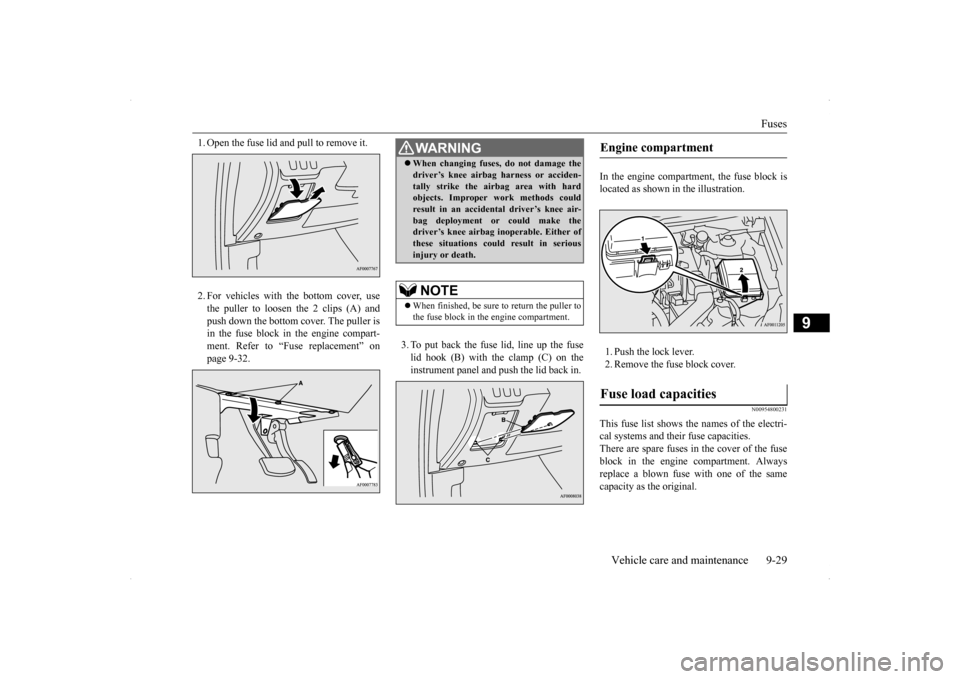
1. Open the fuse lid and pull to remove it. 2. For vehicles with the bottom cover, use the puller to loosen the 2 clips (A) and push down the bottom cover. The puller is in the fuse block in the engine compart-ment. Refer to “Fuse replacement” on page 9-32.
3. To put back the fuse lid, line up the fuse lid hook (B) with the clamp (C) on theinstrument panel and push the lid back in.
In the engine compartment, the fuse block is located as shown in the illustration. 1. Push the lock lever. 2. Remove the fuse block cover.
N00954800231
This fuse list shows the names of the electri- cal systems and their fuse capacities. There are spare fuses in the cover of the fuseblock in the engine compartment. Always replace a blown fuse with one of the same capacity as the original.
WA R N I N G When changing fuses, do not damage the driver’s knee airbag harness or acciden- tally strike the airbag area with hard objects. Improper work methods could result in an accidental driver’s knee air-bag deployment or could make the driver’s knee airbag inoperable. Either of these situations could result in seriousinjury or death.NOTE
When finished, be sure to return the puller to the fuse block in the engine compartment.
Engine compartment Fuse load capacities
Page 389 of 434

Fuses 9-30 Vehicle care and maintenance
9
* - Fusible link Some fuses may not be installed on your vehicle, depending on the vehicle model or specifications. The table above shows the main equip- ment corresponding to each fuse.
Passenger compartment fuse loca- tion table No.
Sym- bol
Electrical system
Capacity
1 Heater 30 A
*
2
Stop lights (Brake lights)
15 A
3 Rear fog light 10 A
Main fuse block
Sub fuse block
Passenger compartme
nt fuse location
4 Windshield wiper 30 A 5 Optional 10 A 6 Door locks 20 A 7 Radio 15 A8 Control unit relay 7.5 A 9
Interior lights (Dome lights)
15 A
10
Hazard warning
flasher
15 A
11 Rear window wiper 15 A 12 Gauges 7.5 A 13
Cigarette
lighter/Accessory
socket
15 A
14 Ignition switch 10 A 15 Sunroof 20 A 16
Outside rearview mir-
rors
10 A
17
All-wheel drive sys-
tem
10 A
18 Back-up lights 7.5 A 19 Accessory socket 15 ANo.
Sym- bol
Electrical system
Capacity
20
Power window con-
trol
30 A
*
21 Defogger 30 A
*
22
Heated
outside rearview mir-
rors
7.5 A
23 115V Power outlet 15 A 24 Power seats
25 (20) A
25 Heated seats 30 ANo.
Sym- bol
Electrical system
Capacity
Page 390 of 434

Fuses
Vehicle care and maintenance 9-31
9
Engine compartment fuse location table * - Front of the vehicle
No.
Sym- bol
Electrical system
Capacity
1 Front fog lights 15 A 2 Engine 7.5 AEngine compartment fuse location
* Behind the fuse
block cover
*
3 Automatic transaxle 20 A 4 Horn 10 A 5 Alternator 7.5 A 6 Headlight washer 20 A 7 Air conditioning 10 A 8
/
ETV/Oil cooler fan (Twin Clutch SST)
Except for vehi- cles with turbo- charger
15 A
ETV
Vehicles with tur-bocharger
9 Security horn 20 A 10 Wiper deicer 15 A 11 — — — 12 Power gate 30 A 13
Daytime running
lights
10 A
14
Headlight
(high beam) (left)
10 A
15
Headlight
(high beam) (right)
10 A
No.
Sym- bol
Electrical system
Capacity
16
Headlight
(low/high beam) (left)
Discharge 20 A
17
Headlight
(low/high beam) (right)
Discharge 20 A
18
Headlight (low beam) (left)
Halogen 10 A
19
Headlight (low beam) (right)
Halogen 10 A
20
ENG/PO WER
Except for vehi- cles with turbo- charger
10 A
I/C SPRAY
Vehicles with tur-bocharger
21 Ignition coil 10 ANo.
Sym- bol
Electrical system
Capacity
Page 391 of 434

Fuses 9-32 Vehicle care and maintenance
9
* - Fusible link Some fuses may not be installed on your vehicle, depending on the vehicle modelor specifications. The table above shows the main equip- ment corresponding to each fuse.
There are no 7.5 A, 25 A or 30 A spare fuses. If a fuse of one of these capacities blows,replace it temporarily by borrowing one of the fuses indicated below. 7.5 A: 10 A spare fuse25 A: 20 A spare fuse 30 A: 30 A audio amplifier fuse
Replace the borrowed fuse with a fuse that has the correct capacity as soon as possible.
N00954900027
1. Before replacing a fuse, always turn offthe electrical item connected to the fuseand turn the ignition switch to the“LOCK” position.
22
ENG/PO WER
Vehicles with tur-bocharger
20 A
ENG/PO WER
Except for vehi- cles with turbo- charger
20 A
Fuel line heater
25 A
23
Fuel pump
Except for vehi-cles with turbo- charger
15 A
Vehicles with tur- bocharger
20 A
24 Starter 30 A
*
25
Valve lift control
Except for vehi- cles with turbo- charger
40 A
*
——
Vehicles with tur-bocharger
—
26
Anti-lock braking
system
40 A
*
No.
Sym- bol
Electrical system
Capacity
27
Anti-lock braking
system
30 A
*
28
Air conditioning con- denser fan motor
30 A
*
29 Radiator fan motor 40 A
*
30 IOD IOD 30 A31 Audio amplifier 30 A 32 Diesel 30 A 33 — Spare fuse 10 A 34 — Spare fuse 15 A35 — Spare fuse 20 ANo.
Sym- bol
Electrical system
Capacity
Identification of fuse Capacity
Color
7.5 A Brown10 A Red15 A Blue20 A Yellow25 A Natural (White) 30 A
Green (fuse type)/Pink (fusible
link type)
40 A Green
Fuse replacement