2014 MITSUBISHI LANCER fuel
[x] Cancel search: fuelPage 26 of 434
Modifications to and racing of your vehicle
General information 3-5
3
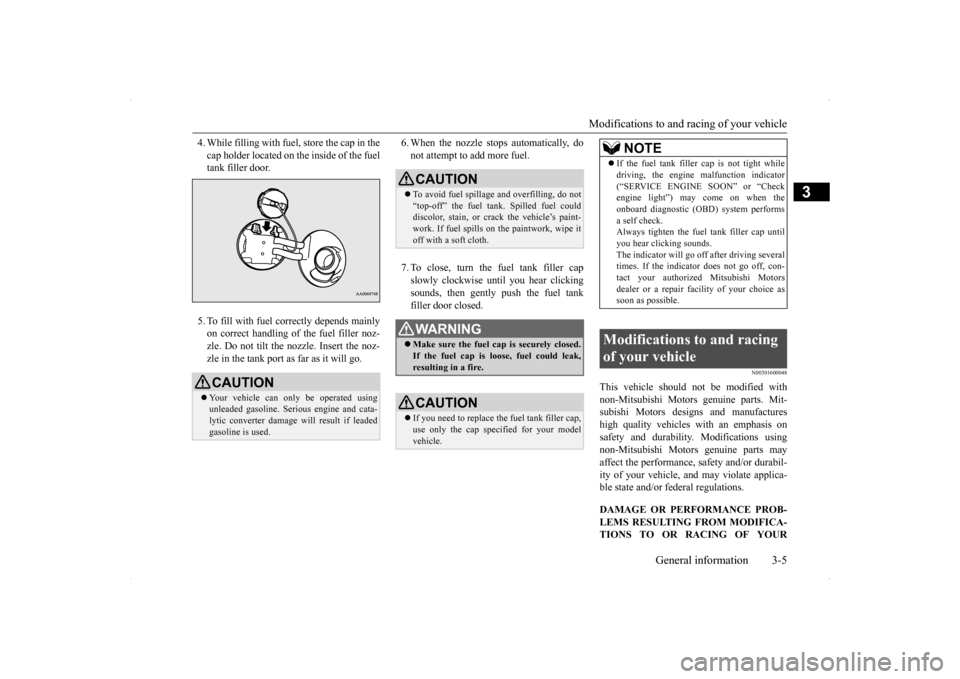
4. While filling with fuel, store the cap in the cap holder located on the inside of the fuel tank filler door. 5. To fill with fuel correctly depends mainly on correct handling of the fuel filler noz- zle. Do not tilt the nozzle. Insert the noz-zle in the tank port as far as it will go.
6. When the nozzle stops automatically, do not attempt to add more fuel. 7. To close, turn the fuel tank filler cap slowly clockwise until you hear clickingsounds, then gently push the fuel tank filler door closed.
N00301600048
This vehicle should not be modified withnon-Mitsubishi Motors genuine parts. Mit- subishi Motors designs and manufactureshigh quality vehicles
with an emphasis on
safety and durability. Modifications using non-Mitsubishi Motors genuine parts mayaffect the performance, safety and/or durabil- ity of your vehicle, and may violate applica- ble state and/or federal regulations. DAMAGE OR PERFORMANCE PROB- LEMS RESULTING FROM MODIFICA- TIONS TO OR RACING OF YOUR
CAUTION Your vehicle can only be operated using unleaded gasoline. Serious engine and cata-lytic converter damage will result if leaded gasoline is used.
CAUTION To avoid fuel spillage and overfilling, do not “top-off” the fuel tank. Spilled fuel coulddiscolor, stain, or crack the vehicle’s paint- work. If fuel spills on the paintwork, wipe it off with a soft cloth.WA R N I N G Make sure the fuel cap is securely closed. If the fuel cap is loose, fuel could leak, resulting in a fire.CAUTION If you need to replace the fuel tank filler cap, use only the cap specified for your model vehicle.
NOTE
If the fuel tank filler
cap is not tight while
driving, the engine malfunction indicator (“SERVICE ENGINE SOON” or “Check engine light”) may come on when the onboard diagnostic (OBD) system performsa self check. Always tighten the fuel tank filler cap until you hear clicking sounds.The indicator will go off after driving several times. If the indicator does not go off, con- tact your authorized Mitsubishi Motorsdealer or a repair facility of your choice as soon as possible.
Modifications to and racing of your vehicle
Page 27 of 434

Modifications to and racing of your vehicle 3-6 General information
3
VEHICLE ARE NOT COVERED UNDER WARRANTY. Examples of modifications to your vehicle that can cause damage or performance prob- lems include the following: Failure to use Mitsubishi Motors genuine parts Failure to use required fuel and fluids Failure to use proper size tires and wheels Modification of the fuel, intake, exhaust, emission, suspension, engine, drive train or electrical wiring systems Modification of any onboard com- puter/control module, including repro- gramming, or replacing/adding chips to any onboard computer/control module
Review the Warranty and Maintenance Man- ual for further details regarding warranty cov- erage.
N00301700182
The installation of accessories, optional parts, etc., should only be carried out within the limits prescribed by law in the driving area and in accordance with theguidelines and warnings contained within the documents accompanying this vehicle. Only Mitsubishi Motors approved acces-sories should be fitted to your vehicle. Improper installation of electrical parts could cause fire. Refer to the “Modifica-tion/alterations to the electrical or fuelsystems” section within this owner’s man- ual. Using a cellular phone or radio set inside the vehicle without an external antenna may cause electrical system interference, which could lead to unsafe vehicle opera-tion. Tires and wheels which do not meet spec- ifications must not be used.Refer to the “Specifications” section for information regarding wheel and tire sizes.
Due to the large number of accessory and replacement parts provided by different man- ufacturers in the market, it is not always pos-sible for an authorized Mitsubishi Motors dealer to check whether the attachment or installation of non-Mitsubishi Motors genu-ine parts will affect the driving safety of your Mitsubishi-vehicle.
N00301800040
Mitsubishi Motors manuf
actures high quality
vehicles with an emphasis on safety. It isimportant to consult an authorized Mitsubishi Motors dealer before installation of any
Installation of accessories
CAUTION Before any electrical or electronic accesso- ries are installed, consult an authorized Mit- subishi Motors dealer.
WA R N I N G If you choose to use
a cellular phone while
driving, you must not allow that usage to distract you in the safe operation of your vehicle. Anything, including cellular phone usage, that distracts you from thesafe operation of your vehicle increases your risk of an accident. Refer to and follow all state and local lawsin your area regarding cellular phone usage while driving.
Important point! Modification/alterations to the electrical or fuel systems
Page 28 of 434
Mitsubishi Motors genuine parts
General information 3-7
3
accessory which may involve modification of the electrical or fuel systems.
N00301400105
Mitsubishi Motors Genuine Parts are designed and manufactured to meet high stan- dards of performance, and are recommendedfor all of your maintenance needs. Also avail- able from your Mitsubi
shi Motors dealer are
a wide variety of accessories to personalizeyour new vehicle. Each Mitsubishi vehicle has a selection of Mitsubishi Motors autho- rized accessories to choose from to tailor yournew vehicle to your own personal preference. Your Mitsubishi Motors dealer’s Parts Man- ager has information on various audio sys-tems, protection items, as well as interior and exterior accessories available for your spe- cific model.
N00300100017
Certain components of this vehicle, such asairbag modules, seat belt pretensioners, andbutton cell batteries, may contain perchlorate materials. Special handling may apply. For additionalinformation, see www.dtsc.ca.gov/hazardous- waste/perchlorate.
CAUTION Please consult an authorized Mitsubishi Motors dealer concerning any such acces- sory fitment or modification. If the wires interfere with the vehicle body or improper installation methods are used (pro- tective fuses not included, etc.), electronicdevices may be adversely affected, resulting in a fire, vehicle damage, or other accident.
Mitsubishi Motors genuine parts
California Perchlorate Materials Requirements
Page 70 of 434

Break-in recommendations
Features and controls 5-3
5
N00508700297
Advanced automobile manufacturing tech- niques permit you to operate your new vehi-cle without requiring a long break-in period of low-speed driving. However, you can add to the future perfor-mance and economy of your vehicle by observing the following precautions during the first 300 miles (500 km).Drive your vehicle at moderate speeds duringthe break-in period. Avoid revving the engine. For vehicles with turbocharger, do not exceed 5,000 rpm for the first 600 miles (1,000 km). Avoid rough driving such as fast starts, sudden acceleration, prolonged high- speed driving and sudden braking. Thesewould have a detrimental effect on the engine and also cause increased fuel and oil consumption, which could result inmalfunction of the engine components. Be particularly careful to avoid full accelera- tion while in low gear. Do not overload the vehicle. Observe the seating capacity (See “Cargo load precau- tions” on page 6-11). Do not use this vehicle for trailer towing.
N00508800559
Two keys are provided. The keys fit all locks. Keep one in a safe place as a spare key. Two keys are provided. The keys fit all locks. Keep one in a safe place as a spare key.
Two Free-hand Advanced Security Transmit- ter (F.A.S.T.-key) and two emergency keysare provided. Keep one F.A.S.T.-key and one emergency key in a safe place together as a set of sparekeys.
Break-in recommendations
Keys Type 1 1- Key for the electronic immobilizer2- Key number plateType 2
1- Key for the electronic immobilizer and
keyless entry system
2- Key number plateType 3
Page 88 of 434

Free-hand Advanced Security Transmit
ter (F.A.S.T.-key) (if so equipped)
Features and controls 5-21
5
If the engine will not start because the bat- tery is weak or discharged, refer to “Jump-starting the engine” on page 8-2 for instructions. A longer warm up period will only con- sume extra fuel. The engine is warmed up enough for driving when the bar graph ofthe engine coolant temperature display starts to move. Refer to “Interrupt display screen (With ignition
switch in the “ON”
position)” on page 5-121. On vehicles equipped with the Twin Clutch SST, the following may occur after the engine is started, but they do not indi-cate an abnormality. • You may hear operational sounds of the Twin Clutch SST and you may feelvibration in the vehicle body. • If you shift the gearshift lever into the “N” (NEUTRAL) position and depressthe accelerator pedal, increases in the engine speed will be limited.
Your vehicle is equipped with an electroni- cally controlled fuel injection system. This isa system that automatically controls fuel injection. There is no need to depress the accelerator pedal when starting the engine.The starter motor should not be run for more than 15 seconds at a time. To prevent battery drain, wait a few secondsbetween attempts to restart the engine. 1. Make sure all occupants are properly seated with seat belts fastened. 2. Press and hold the brake pedal down withyour right foot.
3. Press and hold the clutch pedal all the way down (manual transaxle). 4. On vehicles with manual transaxle, place the gearshift lever in the “N” (Neutral)position.On vehicles with continuously variable transmission (CVT) or Twin Clutch SST, make sure the selector lever (CVT) or thegearshift lever (Twin Clutch SST) is in the “P” (PARK) position.
WA R N I N G Never run the engine in a closed or poorly ventilated area any longer than is needed to move your vehicle out of the area. Car- bon monoxide gas, which is odorless andextremely poisonous, could build up and cause serious injury or death.
CAUTION Do not push-start the vehicle.Do not run the engine
at high rpms or drive
at high speeds until the engine has had a chance to warm up. Release the ignition switch as soon as the engine starts. Otherwise, the starter motorwill be damaged.
Starting the engine
NOTE
For models equipped with a manual trans- axle, the starter will not operate unless the clutch pedal is fully depressed (Clutch inter-lock). This is a safety feature.NOTE
On vehicles with CVT, the starter will not operate unless the selector lever is in the “P” (PARK) or “N” (NEUTRAL) position. On vehicles with Twin Clutch SST, thestarter will not operate unless the gearshift lever is in the “P” (P
ARK) position or the
gearshift lever is in the “N” (NEUTRAL) position with the brake pedal depressed. For safety reasons, start the engine in the “P”(PARK) position so that the wheels are locked.
Page 93 of 434

Free-hand Advanced Security Transmitter (F.A.S.T.-key) (if so equipped) 5-26 Features and controls
5
A longer warm up period will only con- sume extra fuel. The
engine is warmed up
enough for driving when the bar graph of the engine coolant temperature displaystarts to move. Refer to “Interrupt display screen (With ignition switch in the “ON” position)” on page 5-121. On vehicles equipped with the Twin Clutch SST, the following may occur after the engine is started, but they do not indi-cate an abnormality.• You may hear operational sounds of the Twin Clutch SST and you may feel vibration in the vehicle body.• If you shift the gearshift lever into the “N” (NEUTRAL) position and depress the accelerator pedal, increases in theengine speed will be limited.
Starting the engine Your vehicle is equipped with an electroni-cally controlled fuel injection system. This is a system that automatically controls the fuel injection. There is no need to depress theaccelerator pedal when starting the engine. The starter motor should not be run for more than 15 seconds at a time.To prevent battery drain, wait a few seconds between attempts to restart the engine. 1. Make sure all occupants are properly seated with seat belts fastened.
2. While pushing the lock release buttons (A), remove the cover of the ignition switch. 3. Insert the emergency key into the ignition switch.
WA R N I N G Never run the engine in a closed or poorly ventilated area any longer than is needed to move your vehicle out of the area. Car- bon monoxide gas, which is odorless andextremely poisonous, could build up and cause serious injury or death.CAUTION Do not push-start the vehicle.
Do not run the engine
at high rpms or drive
at high speeds until the engine has had a chance to warm up. Release the emergency key as soon as the engine starts. It will damage the starter motor.CAUTION
Page 124 of 434
![MITSUBISHI LANCER 2014 8.G Owners Manual Starting and stopping the engine Features and controls 5-57
5
[Except for vehicles equipped with the turbocharger] The engine is warmed up enough for driv- ing when the bar graph of engine coolant](/manual-img/19/7460/w960_7460-123.png "MITSUBISHI LANCER 2014 8.G Owners Manual Starting and stopping the engine Features and controls 5-57
5
[Except for vehicles equipped with the turbocharger] The engine is warmed up enough for driv- ing when the bar graph of engine coolant")
Starting and stopping the engine Features and controls 5-57
5
[Except for vehicles equipped with the turbocharger] The engine is warmed up enough for driv- ing when the bar graph of engine coolanttemperature display starts to move. A lon- ger warm up period will only consume extra fuel. [For vehicles equipped with the turbo- charger] The engine is warmed up enough for driv-ing when the bar graph of engine coolanttemperature display starts to move. Driv- ing before the bar graph moves may cause deterioration of turbocharger performanceand driveability. A longer warm up period will only consume extra fuel. On vehicles equipped with the Twin Clutch SST, the following may occur after the engine is started, but they do not indi- cate an abnormality.• You may hear operational sounds of the Twin Clutch SST and you may feel vibration in the vehicle body.• If you shift the gearshift lever into the “N” (NEUTRAL) position and depress the accelerator pedal, increases in theengine speed will be limited.
N00542200146
[For vehicles equipped with the F.A.S.T.-key.]For information on operation for vehicles equipped with the F.A.S.T.-key, refer to “F.A.S.T.-key: Starting the engine” on page5-20. [Except for vehicles equipped with the F. A . S . T. - k e y. ]Your vehicle is equipped with an electroni- cally controlled fuel injection system, which automatically controls the release of fuel.
There is usually no need to depress the accel- erator pedal when starting the engine. The starter should not be run for more than 15 seconds at a time.To prevent battery drain, wait a few seconds between attempts to restart the engine. 1. Make sure all occupants are properly seated with seat belts fastened 2. Insert the ignition key. 3. Make sure the parking brake is applied.4. Press and hold the brake pedal down withyour right foot. 5. Press and hold the clutch pedal all the way down (manual transaxle).
WA R N I N G Never run the engine in a closed or poorly ventilated area any longer than is needed to move your vehicle out of the area. Car- bon monoxide gas, which is odorless and extremely poisonous, could build up andcause serious injury or death.CAUTION Do not push-start the vehicle.Do not run the engine
at high rpms or drive
at high speeds until the engine has had a chance to warm up. Release the ignition switch as soon as the engine starts. Otherwise, the starter motorwill be damaged.
Starting the engine
NOTE
For models equipped with a manual trans- axle, the starter will not operate unless the clutch pedal is fully depressed (Clutch inter-lock). This is a safety feature.
Page 128 of 434

Manual transaxle (if so equipped)
Features and controls 5-61
5
Press the clutch pedal all the way down and shift into 1st or “R” (Reverse) position. Then gradually release the clutch pedal while depressing the accelerator pedal.
N00537400049
Always use care to change the gear with the vehicle speed matched to the engine speed. Proper shifting will improve fuel economyand prolong engine life.
N00548101027
Always use care to change the gear with thevehicle speed matched to the engine speed. Proper shifting will improve fuel economy and prolong engine life.Avoid shifting down at high speed, as this may cause excessive engine speed (the tachometer needle into the red zone) anddamage the engine.
NOTE
During cold weather, shifting may be diffi- cult until the transaxle lubricant has warmed up. This is normal and not harmful to the transaxle.
To start
CAUTION Do not move the gearshift lever into reverse while the vehicle is moving forward; doing so will damage the transaxle.
Do not rest your foot on the clutch pedal because this will cause premature clutch wear or damage. Do not coast in the “N” (Neutral) position (illegal in many states). Do not use the gearshift lever as a handrest, because this can result in premature wear of the transaxle shift forks.NOTE
If it is hard to shift into 1st, depress the clutch pedal a second time; the shift will thenbe easier. To shift into reverse from 5th gear, move the gearshift lever to the “N” (Neutral) position, and then shift it into reverse.
Proper shift points
CAUTION Avoid downshifting that may cause the tachometer pointer to enter the red zone. This puts the engine at risk of being dam-aged.CAUTION
Changing gears while the vehi- cle is moving
NOTE
The gearshift indicator shows recommended gearshift points for fuel-efficient driving. It shows a “ ” when an upshift is recom- mended, and it shows a “ ” when a down- shift is recommended.