2014 MERCEDES-BENZ SPRINTER warning light
[x] Cancel search: warning lightPage 20 of 338

Switching the surround lighting
on/off (on-board computer)
.............195
Switch unit see Control panel
Swivel seat .......................................... .84T
Tachometer ........................................ 183
Tail lamps Changing ....................................... 104
Replacing bulbs ............................. 103
see Lights
Tail lamps (Chassis Cab)
Replacing bulbs ............................. 104
Tank
see Fuel tank
Tank content
Fuel gauge ..................................... 183
Range (vehicles with steering
wheel buttons) ............................... 197
Reserve fuel warning lamp .............227
Technical data
Capacities ...................................... 320
Cargo tie-down points .................... 331
Cargo tie-down rings ..................... .331
Loading rails .................................. 331
Roof carrier .................................... 331
Tires/wheels ................................. 297
Trailer tow hitch ............................. 332
Vehicle data ................................... 331
Telephone .......................................... 239
Telephone (on-board computer) Accepting an incoming call ............198
Display messages ..........................220
Numbers from the phone book ......198
Operating ...................................... .198
Redialing ........................................ 199
Rejecting or ending a call ..............198
Temperature
Outside temperature ..................... .183
Setting (climate control) ................117
Setting the unit (vehicles with
steering wheel buttons) .................191
Theft deterrent systems
ATA (Anti-Theft Alarm system) .........62
Immobilizer ...................................... 62
Tow-away alarm ............................... 63Thoraxbag
............................................ 45
Tightening torques for wheel nuts/
wheel bolts ........................................ 312
Time Setting the time (vehicles without
steering wheel buttons) .................185
Setting the time (vehicles with
steering wheel buttons) .................193
Timer
Activating ....................................... 128
Important safety notes ..................127
Overview ........................................ 127
Setting the heating level (auxiliary
heating) ......................................... 130
Setting the preselection time
(auxiliary heating) .......................... 129
Setting weekday, time and oper-
ating duration (auxiliary heating) ...128
Switching immediate heating
mode on/off (auxiliary heating) .....128
Tire pressure
Calling up (on-board computer) .....293
Checking manually ........................292
Display messages (vehicles with-
out steering wheel buttons) ...........201
Display messages (vehicles with
steering wheel buttons) .................218
Maximum ....................................... 292
Notes ............................................. 291
Recommended ............................... 290
Setting the unit (vehicles with
steering wheel buttons) .................193
Tire label ................................ 290, 291
Tire pressure loss warning system ..294
Tire pressure monitor Display message ............................ 218
Indicator lamp ................................ 229
Tire pressure monitoring system
Checking the tire pressure elec-
tronically ........................................ 294
Function/notes ............................. 293
Restarting ...................................... 295
Warning lamp ................................. 294
Tire pressure table ............................297
Tires Aspect ratio (definition) .................306
Average weight of the vehicle
occupants (definition) ....................30518
Index
Page 23 of 338

Ventilation
Setting the vents ........................... 121
Voltage supply
Fuses ............................................. 283W
Warning and indicator lamps Brakes ........................................... 222
Check Engine ................................. 227
Coolant .......................................... 226
Diesel Exhaust Fluid (DEF) .............224
Electrical step ................................ 230
ESP ®
.............................................. 221
ESP ®
function ................................ 224
Overview .......................................... 35
Seat belt ........................................ 230
Warning- and indicator lamps
ABS ................................................ 221
Air filter .......................................... 228
ASR ................................................ 221
BAS ................................................ 221
Battery charge ............................... 225
Brake wear .................................... 225
Bulbs .............................................. 230
Doors ............................................. 230
Engine oil level ............................... 225
Preglow .......................................... 228
Reserve fuel ................................... 227
Tire pressure monitor ....................229
Water separator ............................. 229
Windshield washer fluid .................229
Warning lamp .................................... 277
Warning triangle ................................ 277
Washer fluid Adding ........................................... 257
Capacities ...................................... 331
Display message ............................ 220
Indicator lamp ................................ 229
Notes ............................................. 330
Wiping with .................................... 107
Wheels
Changing a wheel .......................... 307
Checking ........................................ 287
Cleaning ......................................... 269
Important safety notes ..................286
Interchanging/changing ................307
Mounting a wheel .......................... 308Removing and mounting the spare
wheel
............................................. 314
Storing ........................................... 308
Tightening torque ........................... 312
Window curtain air bag ....................... 46
Windows see Side windows
Windshield
Defrosting ...................................... 118
Windshield heating
Problem (malfunction) ...................119
Switching on/off ........................... 119
Windshield washer fluid
Adding ........................................... 257
Indicator lamp ................................ 229
Windshield wipers
Problem (malfunction) ...................110
Rain and light sensor .....................107
Rear window wiper ........................108
Replacing the wiper blades ............108
Setting the sensitivity (vehicles
with steering wheel buttons and
rain/light sensor) ........................... 196
Switching on/off ........................... 107
Wiping with windshield washer
fluid ............................................... 107
Winter diesel ..................................... 323
Winter driving Slippery road surfaces ...................158
Snow chains .................................. 289
Winter operation
General notes ................................ 288
Radiator cover ................................. 28
Winter tires
M+S tires ....................................... 288
Setting a limit speed ......................155
Wiper blades
Cleaning ......................................... 270
Replacing ....................................... 108
Workshop
see Qualified specialist workshop Index
21
Page 29 of 338

Exhaust gas aftertreatment
The exhaust gas aftertreatment requires a
reducing agent known as Diesel Exhaust Fluid
(DEF) in order to function correctly. Filling up
the DEF tank is usually part of the service
scope. DEF consumption depends on opera-
tional and driving conditions and it is not nec-
essary to wait until the next scheduled
service to replenish the fluid. Fluid should be
added regularly to the DEF supply reservoir
during vehicle operation or, at the latest, after
receiving the first warning message via the
on-board computer.
To conform to emission regulations, you must
operate the vehicle with DEF and refill the
supply regularly. The engine management
recognizes attempts to operate the vehicle
without DEF, with thinned DEF or with
another reducing agent. After previous warn-
ing messages, the engine management then
prevents a further engine start.
If the DEF level drops below 1.5 US gal
(5.5 l), the first warning message is issued
and a warning tone sounds. After the mes-
sage appears for the first time, and under
normal driving conditions, the remaining DEF
reserve will last for approximately
1000 miles (1600 km) before the next mes-
sage.
After that, the 0.8 US gal (3.0 l)reserve mark
is reached. Once the reserve range has been
reached, you will receive the next warning
message and you will hear a series of warning
tones. After the first message, the DEF
reserve will last for approximately
1,200 miles (1,900 km) until the next mes-
sage is shown. However, you will only be able
to start the engine another 16 times.
You should immediately add 2.0 US gal
(7.6 l) of DEF (Y page 150) or have the DEF
supply reservoir filled at a qualified specialist
workshop.
When the number of remaining engine starts
is 0
0 the engine management prevents the
vehicle being driven at a speed exceeding 5 mph (8 km/h). The
Idle Mode Idle Modemessage
appears in the multifunction display:
If the 00B9 Check Engine indicator lamp lights
up, the exhaust gas aftertreatment is faulty or
an emission-related malfunction has occur-
red (Y page 213). You will then only be able
to drive a maximum 50 mi (80 km) before the
engine management restricts the number of
starts remaining.
If the exhaust gas aftertreatment is faulty,
have it checked and repaired at a qualified
specialist workshop.
Further information on DEF can be found in
the "Refueling" (Y page 149) and "Service
products and capacities" (Y page 324) sec-
tions. Attachments, bodies, equipment and
conversions
General notes !
For safety reasons, have add-on equip-
ment manufactured and installed accord-
ing to the Sprinter body/equipment mount-
ing directives in force. These body/equip-
ment mounting directives ensure that the
chassis and the body form one unit and that
maximum operating and road safety is ach-
ieved.
We recommend for safety reasons that:
R you carry out no other modifications to
the vehicle.
R you obtain the agreement of the distrib-
utor named on the inside of the front
cover for any deviations from the
approved body/equipment mounting
directives.
Approval from certified inspection agen-
cies or official approvals cannot rule out
risks to your safety.
We recommend that you use genuine
Mercedes-Benz parts as well as conversion
parts and accessories that have been specif-
ically approved by Mercedes-Benz for the
type of vehicle. Introduction
27 Z
Page 34 of 338
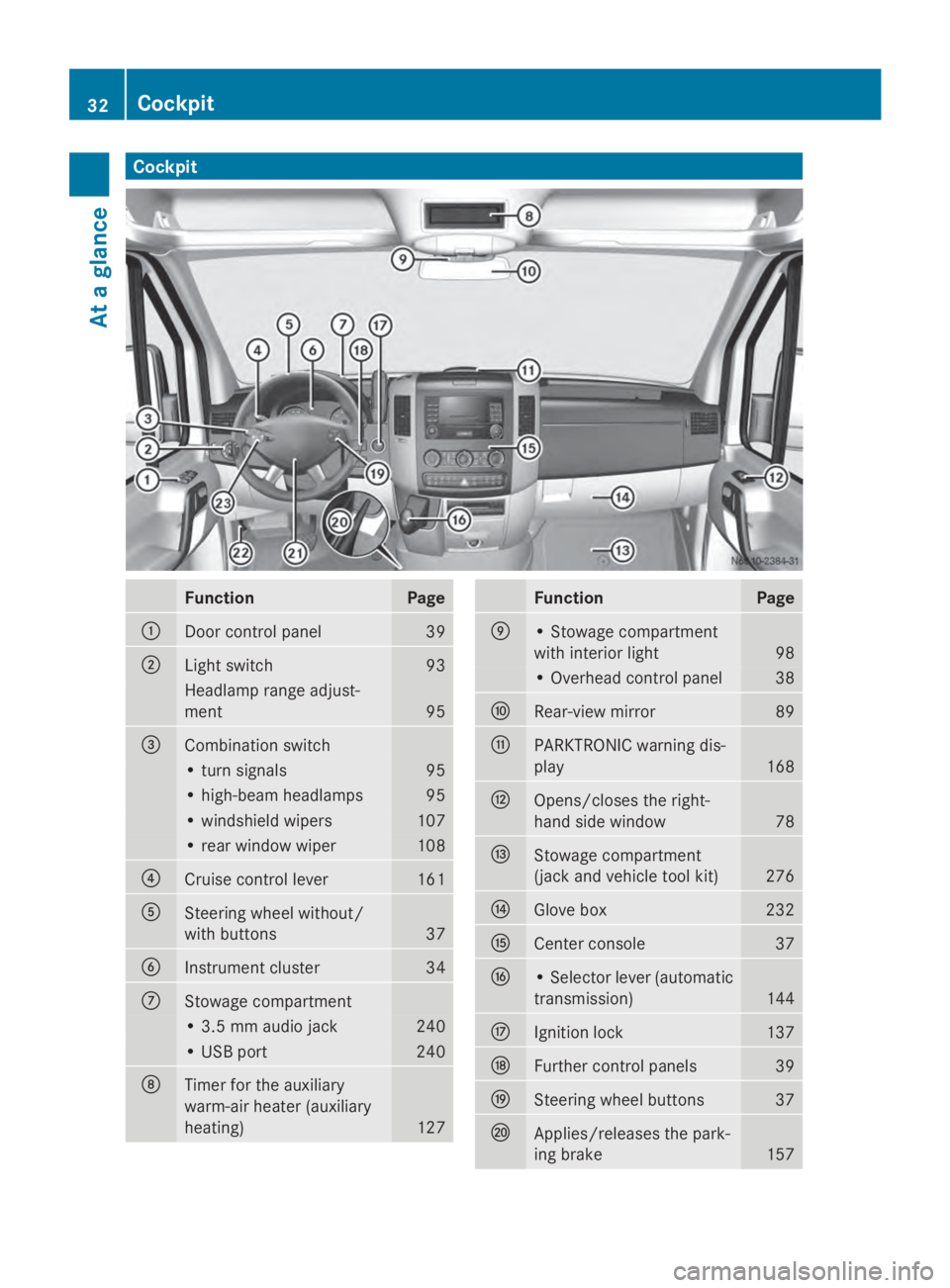
Cockpit
Function Page
0043
Door control panel 39
0044
Light switch 93
Headlamp range adjust-
ment 95
0087
Combination switch
• turn signals 95
• high-beam headlamps 95
• windshield wipers 107
• rear window wiper 108
0085
Cruise control lever 161
0083
Steering wheel without/
with buttons
37
0084
Instrument cluster 34
006B
Stowage compartment
• 3.5 mm audio jack 240
• USB port 240
006C
Timer for the auxiliary
warm-air heater (auxiliary
heating)
127 Function Page
006D
• Stowage compartment
with interior light
98
• Overhead control panel 38
006E
Rear-view mirror 89
006F
PARKTRONIC warning dis-
play
168
0070
Opens/closes the right-
hand side window
78
0071
Stowage compartment
(jack and vehicle tool kit)
276
0072
Glove box 232
0073
Center console 37
0074
• Selector lever (automatic
transmission)
144
0075
Ignition lock 137
0076
Further control panels 39
0077
Steering wheel buttons 37
0078
Applies/releases the park-
ing brake
15732
CockpitAt a glance
Page 40 of 338

Function Page
002F
Switches the hazard warn-
ing lamps on/off
96
00E3
Activates/deactivates ASR 60
00BF
00C0
Central locking, interior/
rear compartment
71
00D4
Activating/deactivating
the distance warning func-
tion
59
00B0
Activates/deactivates
Lane Keeping Assist
167
006C
Activates/deacti-
vates Blind Spot Assist 164
0083
• Stowage compartment or
• CD changer, see separate
operating instructions or
0084
Cup holder with: 236
• ashtray 237
• cigarette lighter 238
006B
12 V socket 238 Overhead control panel
Function Page
0043
Microphone for the mobile
phone 239
0044
Switches the reading lamp
on/off, right 98
0087
Switches the automatic
interior lighting on/off 98
0085
• Eyeglasses compartment
or
233
• Anti-Theft Alarm system
(ATA)
62
0083
Switches the interior light-
ing on/off 98
0084
Switches the reading lamp
on/off, left 9838
Overhead control panelAt a glance
Page 45 of 338

When you switch on the ignition, the
007E
warning lamp in the instrument cluster lights
up for approximately 4 seconds.
A malfunction has occurred if the 007Ewarn-
ing lamp:
R does not light up when you switch on the
ignition, or
R does not go out within a few seconds of
switching on the ignition, or
R lights up again
Safety guidelines for seat belts, Emer-
gency Tensioning Devices (ETDs) and
air bags G
WARNING
R Damaged seat belts or seat belts that have
been subjected to stress in an accident
must be replaced and their anchoring
points must also be checked. Only use seat
belts which have been installed or supplied
by a qualified specialist workshop.
R Air bags and pyrotechnic Emergency Ten-
sioning Devices (ETDs) contain perchlorate
material, which may require special han-
dling and regard for the environment.
Check with your local government's dis-
posal guidelines. California residents, see
www.dtsc.ca.gov/HazardousWaste/
Perchlorate/index.cfm.
R Air bags and ETDs are designed to function
on a one-time-only basis. An air bag or ETD
that has deployed must be replaced.
R Do not pass seat belts over sharp edges.
They could tear.
R Do not make any modification that could
change the effectiveness of the seat belts.
R Do not bleach or dye seat belts as this may
severely weaken them. In a crash they may
not be able to provide adequate protection.
R No modifications of any kind may be made
to any components or wiring of the SRS.
R Do not change or remove any component
or part of the SRS. R
Do not install additional paneling, seat cov-
ers, badges etc. over the steering wheel
hub, co-driver's front air bag cover, out-
board sides of the seat backrests, door trim
panels, or door frame trims.
R Do not install additional electrical/elec-
tronic equipment on or near SRS compo-
nents and wiring.
R Keep the area between air bags and occu-
pants free of objects (e.g. packages,
purses, umbrellas etc.).
R Do not hang items such as coat hangers
from the coat hooks or handles over the
door. These items may be thrown around in
the vehicle and cause head and other inju-
ries when the window curtain air bag is
deployed.
R Air bag system components will be hot after
an air bag has inflated. Do not touch them.
R Never place your feet on the instrument
panel or on the seat. Always keep both feet
on the floor in front of the seat.
R Improper repair work creates a risk of ren-
dering the SRS inoperative or causing unin-
tended air bag deployment. Work on the
SRS must therefore only be performed by
qualified technicians. Please contact a
qualified specialist workshop.
R For your protection and the protection of
others, when scrapping the air bag unit or
ETD, our safety instructions must be fol-
lowed. These instructions are available
from any authorized Sprinter Dealer.
R Given the considerable deployment speed,
required inflation volume, and the material
of the air bags, there is the possibility of
abrasions or other, potentially more serious
injuries resulting from air bag deployment.
If you sell your vehicle, we strongly recom-
mend that you inform the subsequent owner
that the vehicle is equipped with SRS. Also
refer them to the applicable section in the
Operator's Manual. Occupant safety
43Safety Z
Page 47 of 338

The air bag installation locations are identi-
fied by the label SRS/AIRBAG or AIRBAG.
R Front air bags (Y page 45)
R Thoraxbags (Y page 45)
R Window curtain air bags (Y page 46)
The air bags are deployed if the air bag control
unit detects the need for deployment. Only in
the event of such a situation will they provide
their supplemental protection.
If the driver and co-driver do not wear their
seat belts, it is not possible for the air bags to
provide their supplemental protection.
In the event of other types of impacts and
impacts below air bag deployment thresh-
olds, the air bags will not deploy. The driver
and passengers will then be protected to the
extent possible by a properly fastened seat
belt. A properly fastened seat belt is also
needed to provide the best possible protec-
tion in a rollover.
Air bags provide additional protection, but are
not a substitute for the seat belts. All vehicle
occupants must fasten their seat belts
regardless of whether your vehicle is equip-
ped with air bags or not.
If an air bag is deployed, you will hear a bang
and a small amount of powder is released
briefly. Only in rare cases will the bang affect
your hearing. The powder emitted is not gen-
erally hazardous to health. The 007Ewarning
lamp lights up. If it is safe to do so:
X Exit the vehicle immediately.
If you are unable to leave the vehicle:
X Open a window.
You will be able to breathe in fresh air and
avoid respiratory problems.
It is important for your safety and that of any
passengers to have deployed air bags
replaced and to have any malfunctioning air
bags repaired. This will help to make sure the
air bags continue to perform their protective
function for the vehicle occupants in the
event of a crash. Front air bags
Driver's air bag
0043inflates in front of the
steering wheel; co-driver's front air bag 0044
inflates in front of and above the glove box
and center console.
The front air bags increase the degree of pro-
tection afforded to the driver and co-driver
against head and chest injuries.
They are deployed:
R in certain frontal collision situations
R if the system determines that air bag
deployment can offer additional protection
to that provided by the seat belt
R if the respective seat belt is fastened
R independently of other air bags in the vehi-
cle
If the vehicle rolls over, the front air bags are
generally not deployed. The front air bags are
deployed if it is detected that the vehicle is
decelerating rapidly in the longitudinal direc-
tion.
In collision situations with low predicted
impact severity the front air bags are not
deployed. You will then be protected by the
seat belt, provided that it is fastened.
Thoraxbags G
WARNING
Only use seat covers which have been tested
and approved for your vehicle type by the dis-
tributor named on the inside of the front
cover. The use of seat covers or other seat
coverings may cause a malfunction when the Occupant safety
45Safety
Z
Page 51 of 338

erly secured in an appropriately sized child
restraint system or booster seat recom-
mended for the size and weight of the child.
For additional information, see the "Children
in the vehicle" section.
A child's risk of serious or fatal injuries is sig-
nificantly increased if the child restraints are
not properly secured in the vehicle and/or the
child is not properly secured in the child
restraint.
! Make sure that the seat belt retracts fully.
The seat belt or belt buckle may otherwise
become trapped in the door or the seat
adjustment mechanism. This could dam-
age the door, door trim panels and the seat
belt. Damaged seat belts can no longer ful-
fill their protective function and must be
replaced at a qualified specialist workshop. X
To fasten the seat belt: adjust the seat
and move the backrest to an almost vertical
position (Y page 82).
X Pull the seat belt smoothly through belt
sash guide 0044.
X Without twisting it, guide the shoulder sec-
tion of the seat belt across the middle of
your shoulder and the lap section across
your hips.
X Engage belt tongue 0087in seat belt buckle
0083. X
The upper part of the seat belt must be
routed across the middle of your shoulder.
Adjust the seat belt to the appropriate
height as necessary.
X If necessary, pull upwards on the shoulder
section of the seat belt to tighten the belt
across your body.
X To raise the seat belt: slide belt sash
guide 0044upwards.
Belt sash guide 0044engages in various posi-
tions.
X To lower the seat belt: press and hold
release button 0043.
X Adjust belt sash guide 0044to the appropri-
ate height.
X Let go of release button 0043and make sure
that belt sash guide 0044has engaged.
X To release the seat belt: press release
button 0085on seat belt buckle 0083.
X Guide seat belt to belt sash guide 0044.
All seat belts in the vehicle, except the driv-
er's seat belt, are equipped with a special seat
belt retractor. This helps to secure the child
restraint system properly in the vehicle. For
further information on "Special seat belt
retractors", see (Y page 54).
Belt warning for drivers and co-drivers Regardless of whether the driver's and co-
driver's seat belts have already been fas-
tened, the
0076seat belt warning lamp lights
up for six seconds each time the engine is
started. It then goes out if the driver and the
co-driver have fastened their seat belts. If the
driver's seat belt is not fastened when the
engine is started, an additional warning tone
will sound. This warning tone switches off
after approximately six seconds or once the
driver's seat belt is fastened. Occupant safety
49Safety Z