2014 MERCEDES-BENZ M-Class weight
[x] Cancel search: weightPage 337 of 462

i
Depending on the vehicle's equipment,
there may be open stowage spaces above
and below the stowage compartment. Stowage net
G
WARNING
Vehicles with the Occupant Classification
Syste m(OCS):
If the gross weight of the objects in the
stowage net on the back of the front-
passenger seat is greater than 4.4 lb (2 kg),
OCS cannot correctly assess the occupant's
weight category. The front-passenger front air
bag could deploy without cause, or may fail to
deploy in the event of an accident. This poses
an increased risk of injury or even fatal injury.
Never exceed the permissibleg ross weight of
4.4 lb (2 kg). Stow and secure heavy objects
in the cargo compartment.
Stowage nets are located in the front-
passenger footwell and on the back of the
driver's and the front-passenge rseat.
Observe the loading guidelines (Y page 332)
and the safety notes regarding stowage
spaces (Y page 333). Through-loading facility in the rear
If objects or loads are not secured when being
transported in the through-loading facility,
they could slip or be thrown around and
thereby hit vehicle occupants.
Observe the loading guidelines (Y page 332)
and the safety notes regarding stowage
spaces (Y page 333). The through-loading facility is opened from
the cargo compartment.
X
Release the seat backrests in the second
row of seats and tilt them in the cargo/load
position (Y page 108).
X Fold down the rear seat armrest.
X Pull the center head restraint on the rear
bench seat into the uppermost position
(Y page 106).
X Slide release catch 0002to the left and swing
flap 0003to the left until it is lying on the rear
side of the rear bench seat. X
Push cover 0023forward until it is lying on the
rear seat armrest. Cargo compartment enlargement
Important safety notes G
WARNING
If the rear bench seat/rear seat and seat
backrest are not engaged they could fold Stowage areas
335Stowage and features
Z
Page 340 of 462
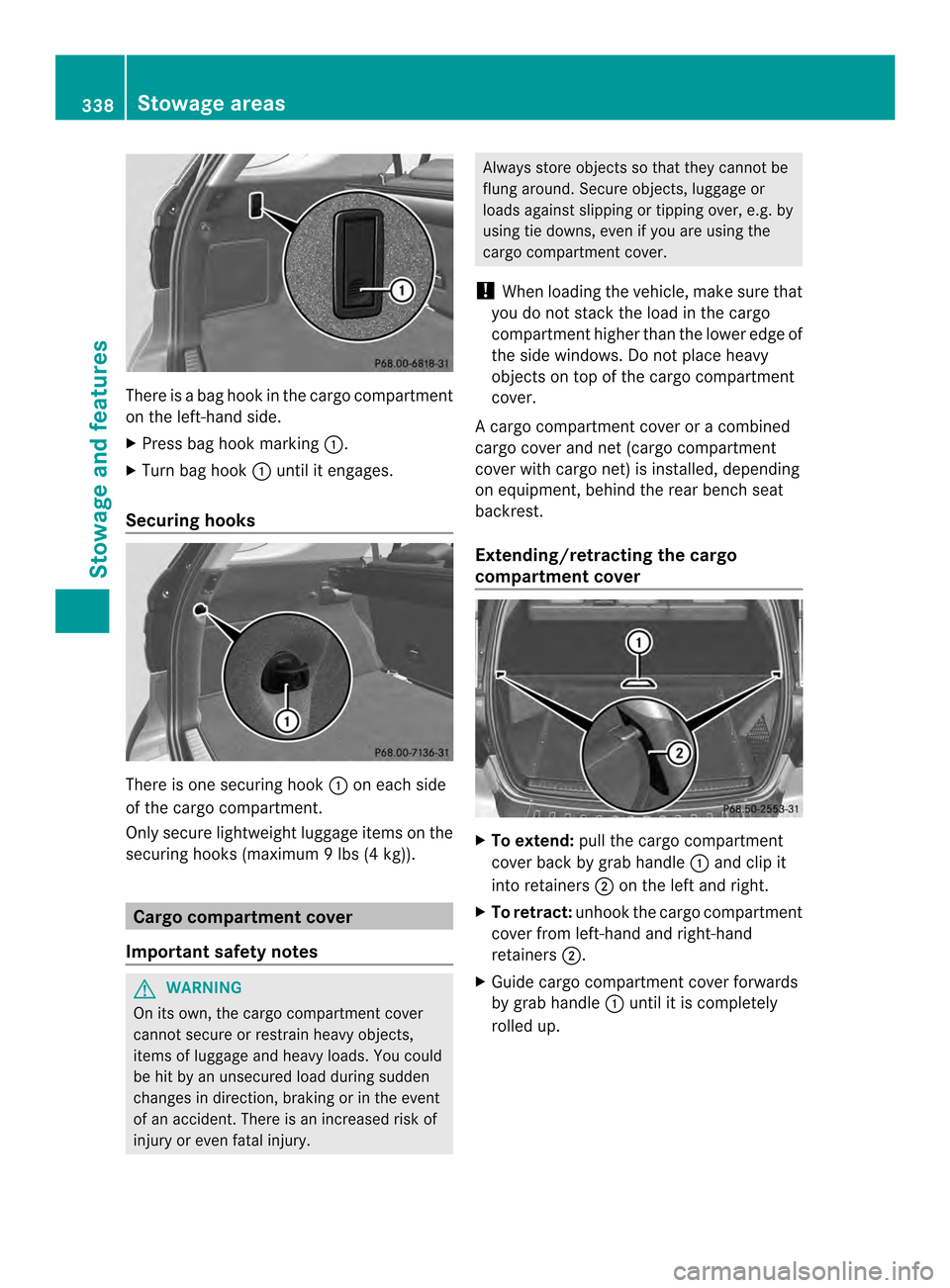
There is a bag hook in the cargo compartment
on the left-hand side.
X
Press bag hook marking 0002.
X Turn bag hook 0002until it engages.
Securing hooks There is one securing hook
0002on each side
of the cargo compartment.
Only secure lightweight luggage items on the
securing hooks (maximum 9lbs (4 kg)). Cargo compartment cover
Important safety notes G
WARNING
On its own, the cargo compartment cover
cannot secure or restrain heavy objects,
items of luggage and heavy loads. You could
be hit by an unsecured load during sudden
changes in direction, braking or in the event
of an accident. There is an increased risk of
injury or even fatal injury. Always store objects so that they cannot be
flung around. Secure objects, luggage or
loads against slipping or tipping over, e.g. by
using tie downs, even if you are using the
cargo compartment cover.
! When loading the vehicle, make sure that
you do not stac kthe load in the cargo
compartmenth igher than the lower edge of
the side windows .Do not place heavy
objects on top of the cargo compartment
cover.
A cargo compartment cover or a combined
cargo cover and net (cargo compartment
cover with cargo net) is installed, depending
on equipment, behind the rear bench seat
backrest.
Extending/retracting the cargo
compartment cover X
To extend: pull the cargo compartment
cover back by grab handle 0002and clip it
into retainers 0003on the left and right.
X To retract: unhook the cargo compartment
cover from left-hand and right-hand
retainers 0003.
X Guide cargo compartment cover forwards
by grab handle 0002until it is completely
rolled up. 338
Stowage areasStowage and features
Page 343 of 462

Inserting the brackets int
othe loading
rail X
Insert bracket 0002into the center of loading
rail 0022.
X Press release button 0003and push
bracket 0002into the desired position in
loading rail 0022.
X Let go of release button 0003.
X Press locking button 0023.
Bracket 0002is locked in loading rail 0022.
X If necessary, fold cargo tie-dow nring 0020
upwards.
Luggage holder !
Only use the luggage holder to secure
cargo with a maximum weight of 15.4 lbs
(7 kg) and with dimensions that the luggage
holder can safely and securely contain. The luggage holder can be used to secure
light loads against the side wall of the cargo
compartment to prevent them from moving
around. X
To install: insert two brackets 0020into the
left or right loading rail (Y page 340).
X Press release button 0002of the luggage
holder and pull the strap out slightly.
X Insert luggage holder 0003into brackets 0020
and, while doing so, press release button
0023 and push the luggage holder downwards
until it engages.
X Press release button 0002of the luggage
holder and pull the strap out in the direction
of the arrow.
X Place the load between the strap and the
cargo compartmen tside wall.
X Using one hand, press locking button 0002of
the luggage holder.
X With your other hand, let the strap go slowly
until the load is secured.
X Make sure that locking button 0022on
brackets 0020is pressed.
This keeps brackets 0020in place on the
loading rail.
X To remove: press release button 0023on
respective bracket 0020and remove luggage
holder 0003by pulling upwards and out.
Telescopic rod The telescopic rod can be used to secure the
load against the rear seats to prevent it from
moving around. Stowage areas
341Stowage and features Z
Page 346 of 462

The bottles are not secured or prevented from
tipping over. Therefore, do not place any open
drink containers in the stowage
compartments.
Cup holder in the front-compartment
center console
0002
Cup holder
0003 Cover
X To open: slide cover 0003to its foremost
position.
X To close: pull cover 0003back as far as it will
go.
You can remove the cup holder's rubber mat
for cleaning. Clean with clear, lukewarm
water only.
Temperature-controlled cup holder in
the front-compartment center console 0002
Cup holder
0003 Residual heat indicator lamp
0023 Switch The temperature-controlled cup holder can
be used to keep cold drink
scool and warm
drinks warm.
X Turn the SmartKey to position 2in the
ignition lock.
X To switch on the cooling function: press
and hold button 0023until the blue indicator
lamp on the button lights up.
X To switch on the heating function: press
and hold button 0023until the red indicator
lamp on the button lights up.
X To switch off the function: press and hold
button 0023until the indicator lamp on the
button goes out.
When the heating function is used, the metal
insert of the cup holder is heated. Once a
certain temperature is reached, residual heat
indicator lamp 0003lights up. This means that
the metal insert of the cup holder is hot. For
this reason, you must not reach into the cup
holder metal insert.
Do not use hard or sharp objects to clean the
cup holder. Use only a soft cloth to clean it.
Cup holder in the rear seat armrest !
Do not sit on or support your body weight
on the rear seat armrest when it is folded
down, as you could otherwise damage it. X
Fold down the rear seat armrest.
Cup holder 0002is located in the rear seat
armrest. 344
FeaturesStowage and features
Page 393 of 462

X
Slide cover 0002of positive terminal 0003in the direction of the arrow.
X Connect positive terminal 0003on your vehicle to positive terminal 0023of donor battery 0021
using the jumper cable, always begi nwith positive terminal 0003on your own vehicle first.
X Start the engine of the dono rvehicle and run it at idling speed.
X Connec tnegative terminal 0022of donor battery 0021to ground point 0020of your vehicle using
the jumper cable, connecting the jumper cable to battery of other vehicle 0021first.
X Start the engine.
X Before disconnecting the jumper cables, let the engin erun for several minutes.
X First, remove the jumper cables from earth point 0020and negative terminal 0022, then from
positive clamp 0003and positive terminal 0023. Begin each time at the contacts on your own
vehicle first.
X Close cover 0002of positive terminal 0003after removing the jumper cables.
X Have the battery checke dataqualified specialist workshop.
i Jump-starting is not considered to be a normal operating condition.
i Jumper cables and further information regarding jump-starting can be obtained at any
qualified specialist workshop. Towing and tow-starting
Important safety notes
G
WARNING
Functions relevant to safety are restricted or
no longer available if:
R the engine is not running.
R the brake system or the power steering is
malfunctioning.
R there is a malfunction in the voltage supply
or the vehicle's electrical system.
If your vehicle is being towed, much more
force may be necessary to steer or brake.
There is a risk of an accident.
In such cases, use a tow bar. Before towing,
make sure that the steering moves freely. G
WARNING
If the weight of the vehicle to be towed or tow-
started is greater than the permissible gross
weight of your vehicle:
R the towing eye could detach itself
R the vehicle/trailer combination could
rollover. There is a risk of an accident.
When towing or tow-starting another vehicle,
its weight should not be greater than the
permissible gross weight of your vehicle.
! If DISTRONIC PLUS or the HOLD function
is activated, the vehicle brakes
automatically in certain situations. To
preven tdamage to the vehicle, deactivate
DISTRONI CPLUS and the HOLD function in
the following or other similar situations:
R when towing the vehicle
R in the car wash
! Make sure that the electric parking brake
is released. If the electric parking brake is
faulty, visit a qualified specialist workshop.
! Only secure the tow rope or tow bar at the
towing eyes, or the traile rtow hitch, if
available. You could otherwise damage the
vehicle.
! Do not use the towing eye for recovery,
this could damage the vehicle. If in doubt,
recover the vehicle with acrane. Towing and tow-starting
391Breakdown assistance Z
Page 394 of 462

!
When towing, pull away slowly and
smoothly. If the tractive power is too high,
the vehicles could be damaged.
! When towing vehicles with KEYLESS-GO,
use the key instead of the Start/Stop
button. Otherwise, the automatic
transmission may shift to position Pwhen
the driver's or front-passenger door are
opened, which could lead to damage to the
transmission.
! Do not tow with sling-type equipment.
This could damage the vehicle.
! Vehicles with differential locks: make
sure the differential locks are in automatic
mode. When towing, the differential locks
must not be switched on. The transmission
may otherwise be damaged.
! The vehicle can be towed a maximum of
30 miles (50km). The towing speed of
30 mph (50 km/h) must not be exceeded.
If the vehicle has to be towed more than
30 miles (50km), the entire vehicle must be
raised and transported.
! If you tow or tow-start another vehicle, its
weight must not exceed the maximum
permissible gross vehicle weight of your
vehicle.
Information on your vehicle's gross vehicle
weight rating can be found on the vehicle
identification plate (Y page 442).
It is better to have the vehicle transported
than to have it towed.
If the vehicle has suffered transmission
damage, have it transported on a transporter
or trailer.
The automatic transmission must be in
position Nwhen the vehicle is being towed. The battery must be connected and charged.
Otherwise, you:
R
cannot turn the SmartKey to position 2in
the ignition lock
R cannot release the electric parking brake
R cannot shift the automatic transmission to
position N
i Deactivate the automatic locking feature
before the vehicle is towed (Y page 276).
You could otherwise be locked out when
pushing or towing the vehicle. Installing/removing the towing eye
Installing the towing eye Example: towing eye mounting covers
0002 Front cover
0003 Back cover
Vehicles with a trailer tow hitch: if possible,
connect the towbar to the trailer tow hitch
(Y page 253).
The brackets for the screw-in towing eyes are
located in the bumpers. They are at the front
and at the rear, under the covers. 392
Towing and tow-startingBreakdown assistance
Page 412 of 462
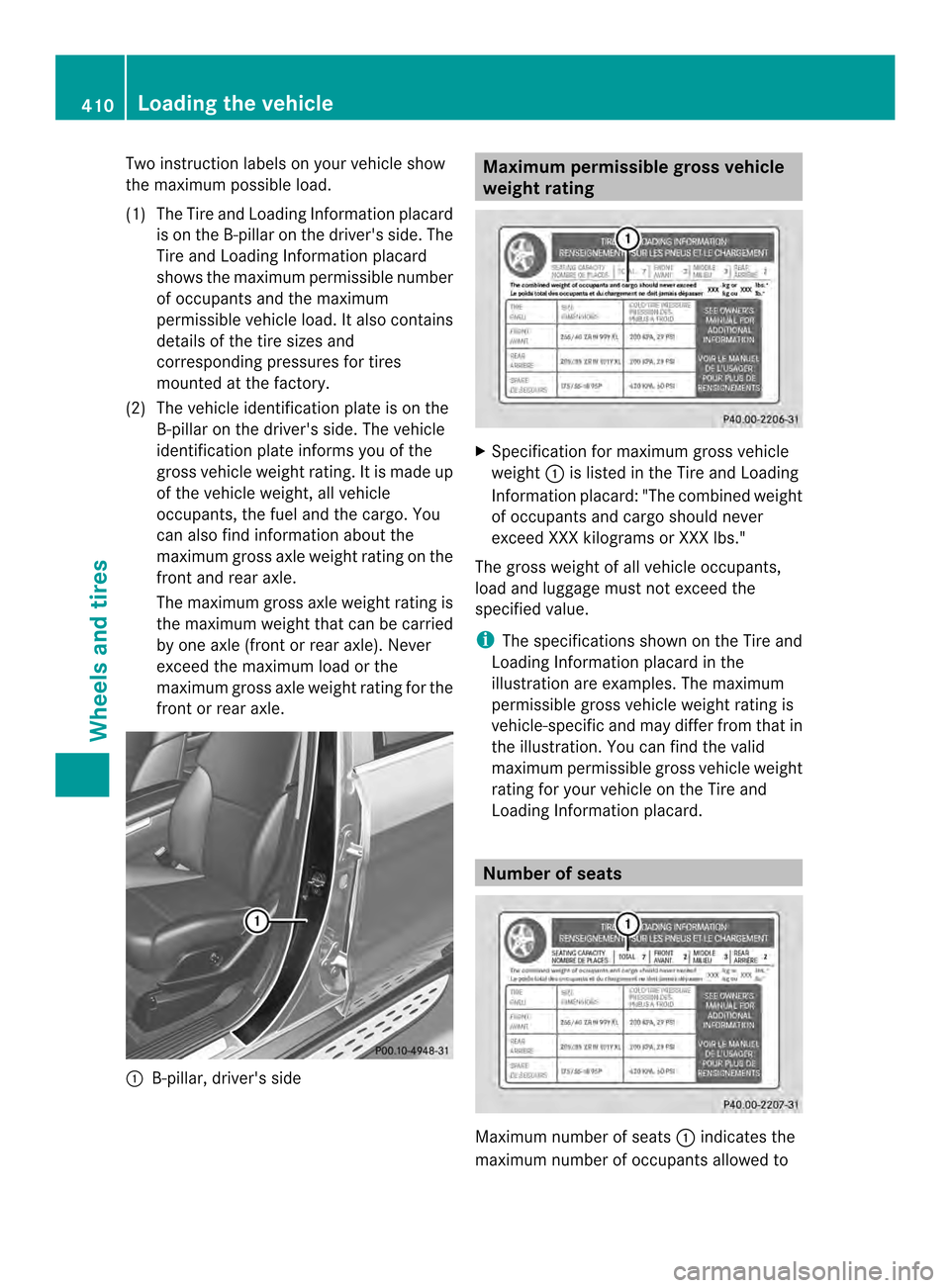
Two instruction labels on your vehicle show
the maximum possible load.
(1) The Tire and Loading Information placard
is on the B-pillar on the driver's side. The
Tire and Loading Information placard
shows the maximum permissible number
of occupants and the maximum
permissible vehicle load. It also contains
details of the tire sizes and
corresponding pressures for tires
mounted at the factory.
(2) The vehicle identification plate is on the B-pillar on the driver's side. The vehicle
identification plate inform syou of the
gross vehicle weight rating. It is made up
of the vehicle weight, all vehicle
occupants, the fuel and the cargo. You
can also find information about the
maximum gross axle weight rating on the
front and rear axle.
The maximum gross axle weight rating is
the maximum weight that can be carried
by one axle (front or rear axle). Never
exceed the maximum load or the
maximum gross axle weight rating for the
front or rear axle. 0002
B-pillar, driver's side Maximu
mpermissible gross vehicle
weight rating X
Specification for maximum gross vehicle
weight 0002is listed in the Tire and Loading
Information placard: "The combined weight
of occupants and cargo should never
exceed XXX kilograms or XXX lbs."
The gross weight of all vehicle occupants,
load and luggage must no texceed the
specified value.
i The specifications shown on the Tire and
Loading Information placard in the
illustratio nare examples. The maximum
permissible gross vehicle weight rating is
vehicle-specific and may differ from that in
the illustration. You can find the valid
maximu mpermissible gross vehicle weight
rating for your vehicle on the Tire and
Loading Information placard. Number of seats
Maximum number of seats
0002indicates the
maximum number of occupants allowed to 410
Loading the vehicleWheels and tires
Page 413 of 462
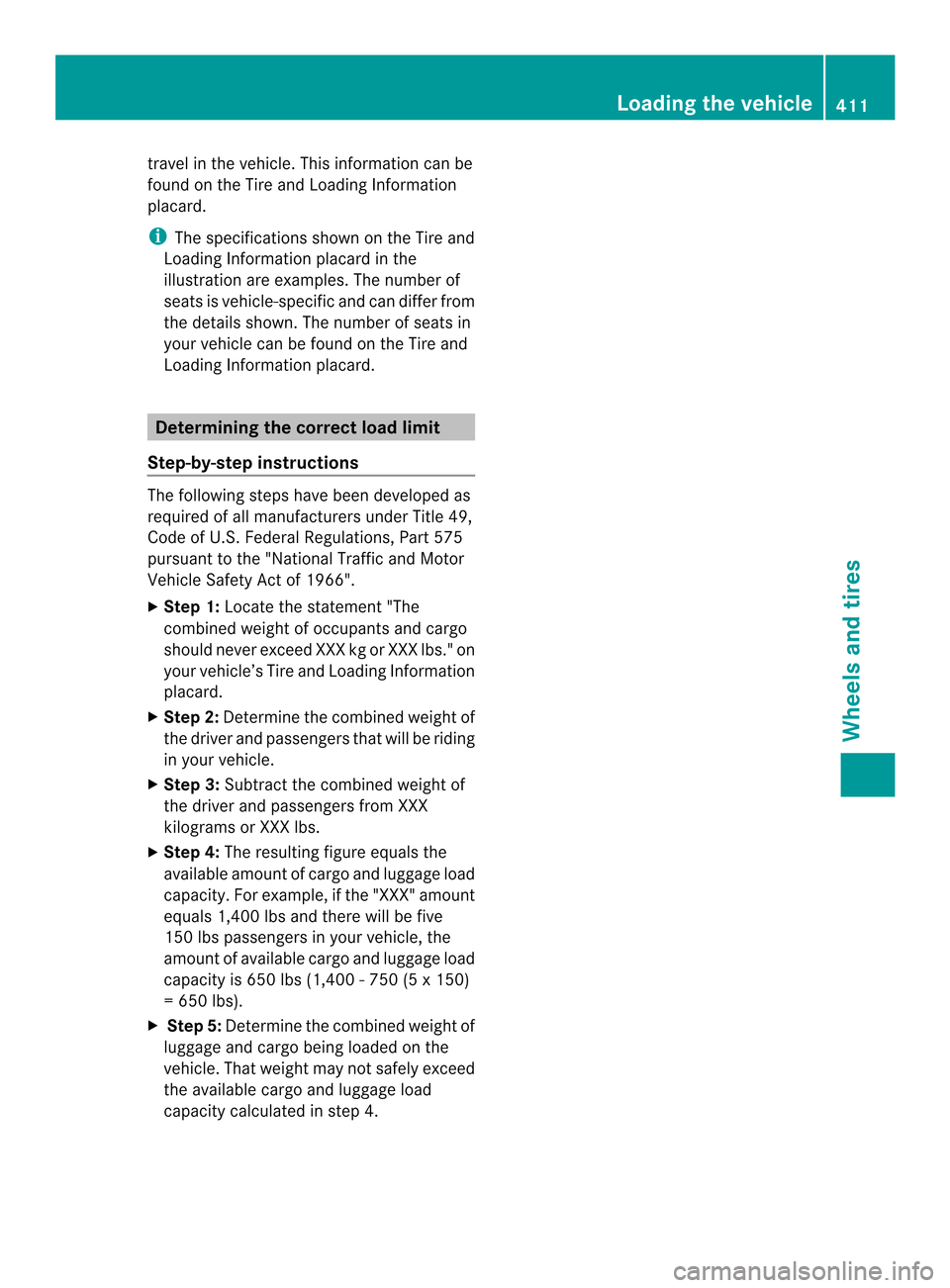
travel in the vehicle. This information can be
found on the Tire and Loading Information
placard.
i The specifications shown on the Tire and
Loading Information placard in the
illustratio nare examples. The number of
seats is vehicle-specific and can differ from
the details shown. The number of seats in
yourv ehicle can be found on the Tire and
Loading Information placard. Determining the correct load limit
Step-by-step instructions The following steps have been developed as
required of all manufacturers under Title 49,
Code of U.S.F ederal Regulations, Part 575
pursuant to the "National Traffic and Motor
Vehicle Safety Act of 1966".
X Step 1: Locate the statement "The
combined weight of occupants and cargo
should never exceed XXX kg or XXX lbs." on
your vehicle’s Tire and Loading Information
placard.
X Step 2: Determine the combined weight of
the driver and passengers that will be riding
in your vehicle.
X Step 3: Subtract the combined weight of
the driver and passengers from XXX
kilograms or XXX lbs.
X Step 4: The resulting figure equals the
available amount of cargo and luggage load
capacity. For example, if the "XXX" amount
equals 1,400 lbs and there will be five
150 lbs passengers in your vehicle, the
amount of available cargo and luggage load
capacity is 650 lbs (1,400 - 750 (5 x 150)
= 650 lbs).
X Step 5: Determine the combined weight of
luggage and cargo being loaded on the
vehicle. That weight may not safely exceed
the available cargo and luggage load
capacity calculated in step 4. Loading the vehicle
411Wheels and tires Z