2014 MERCEDES-BENZ GL door lock
[x] Cancel search: door lockPage 221 of 462
clearance. You will otherwise damage the
vehicle.
!When you raise the vehicle in such a way
that not all wheels have contact with the
ground, remove the SmartKey from the
ignition lock.
RUtility vehicles have a significantly higher
rollover rate than other types of vehicles.
Failure to operate this vehicle safely may
result in an accident, rollover of the vehicle,
and severe or fatal injury.
RIn a rollover crash, an unbelted person is
significantly more likely to die than a
person wearing a seat belt.
You and all vehicle occupants should
always wear your seat belts.
General notes
Further information about "Driving off-road"
(Ypage 197).
Level control adapts the vehicle level
automatically to the current operating and
driving situation. This results in reduced fuel
consumption and improved handling.
If you select ADS comfort mode
(Ypage 217), the vehicle is lowered to high-
speed level as the speed increases. As the
vehicle speed decreases, the vehicle is raised
back up to highway level.
If you select ADS sport mode (Ypage 217),
the vehicle skips highway level and lowers
directly to high-speed level depending on the
basic setting (Ypage 219).
Make changes to the vehicle level while the
vehicle is in motion. This enables the vehicle
to adjust to the new level as quickly as
possible.
The vehicle level may change visibly if you
park the vehicle and the outside temperature
changes. If the temperature drops, the
vehicle level is lower; with an increase in
temperature, the vehicle level rises.
If you unlock the vehicle or open a door, the
vehicle begins to compensate for load
discrepancies while still parked. However, for
significant level changes, such as after the
vehicle has been stationary for a long period,
the engine must be on. For safety reasons,
the vehicle is only lowered when the doors are
closed. Lowering is interrupted if a door is
opened, and it continues once the door has
been closed.
Basic settings (excluding AMG vehicles)
The extent to which the vehicle is raised or
lowered depends on the basic setting
selected. Select raised level for off-road
driving or highway/high-speed level for
normal roads.
The individual vehicle levels differ from
highway level as follows:
Rhighway level: +/–0 in (+/–0 mm)
Rhigh-speed level: –0.6 in (–15 mm)
Rraised level: +2.3 in (+60 mm)
Basic settings for AMG vehicles
The extent to which the vehicle is raised or
lowered depends on the AMG adaptive sport
suspension setting selected. Select the
raised level for off-road driving or highway/
high-speed level for normal roads.
The raised level corresponds to a vehicle level
raised by 50 mm when compared with
highway level in comfort mode.
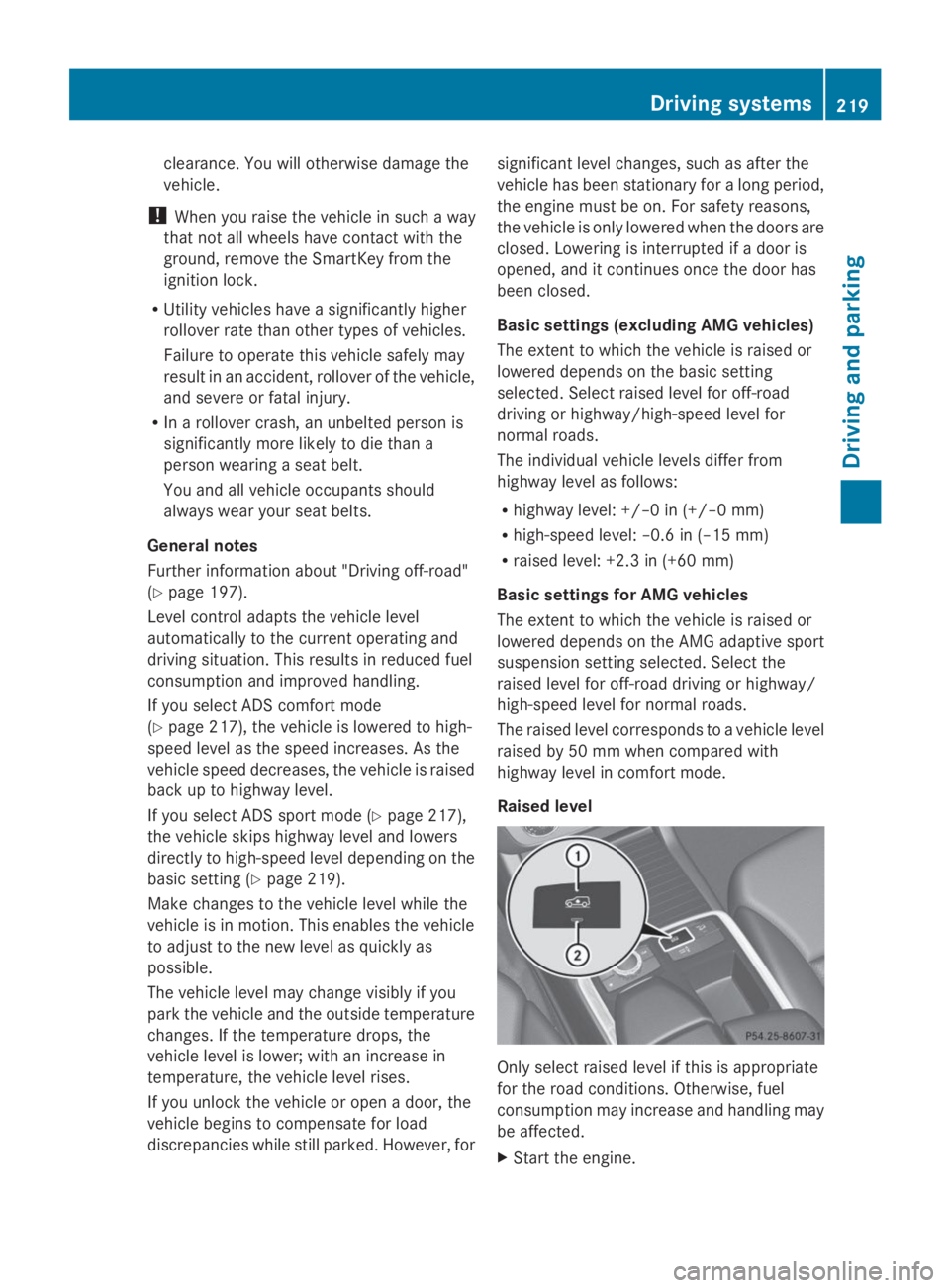
Raised level
Only select raised level if this is appropriate
for the road conditions. Otherwise, fuel
consumption may increase and handling may
be affected.
XStart the engine.
Driving systems219
Driving and parking
Z
Page 269 of 462
of the towing vehicle, as the latter is
equipped with an anti-lock brake system.
Doing so will result in a loss of function of
the brake systems of both the vehicle and
the trailer.
XMake sure that the automatic transmission
is set to positionP.
XApply the vehicle's electric parking brake.
XStart the engine.
XVehicles with the AIRMATIC package:
select highway level.
XVehicles with ADS:set ADS toAUTOor
COMF.
XSwitch off the engine.
XClose all doors and the tailgate.
XCouple up the trailer.
XEstablish all electrical connections.
XCheck that the trailer lighting system is
working.
iVehicles with the AIRMATIC package:
with a trailer attached, the vehicle will
always remain at highway level. When
coupling up a trailer, please observe the
following:
RUnless highway level has been set
manually, the vehicle is automatically
lowered to highway level. This is the case
if a speed of 5 mph(8km/h) is reached.
RHigh-speed level is not available.
These restrictions apply to all accessories
powered through a connection to the trailer
power socket of your vehicle, e.g. a bicycle
carrier.
Observe the maximum permissible trailer
dimensions (width and length).
Most U.S. states and all Canadian provinces
require by law:
RSafety chains between the towing vehicle
and the trailer. The chains should be cross-
wound under the trailer drawbar. They must
be fastened to the vehicle's trailer
coupling, not to the bumper or the axle.
Leave enough play in the chains to make
tight cornering possible.
RA separate brake system for certain types
of trailer.
RA safety switch for braked trailers. Check
the specific legal requirements applicable
to your state.
If the trailer detaches from the towing
vehicle, the safety switch applies the
trailer's brakes.
Towing a trailer
There are numerous legal requirements
concerning the towing of a trailer, e.g. speed
restrictions. Make sure that your vehicle/
trailer combination complies with the local
requirements not only in your area of
residence but also at any location to which
you are traveling. The police and local
authorities can provide reliable information.
Please observe the following when towing a
trailer:
RIn order to accumulate driving experience
and accustom yourself to the new handling
characteristics, practice the following at a
location where there is no traffic:
-Cornering
-Stopping
-Backing up
RBefore driving, check:
-the trailer tow hitch
-the safety switch for braked trailers
-the safety chains
-electrical connections
-the lights
-the wheels
RAdjust the exterior mirrors to provide an
unobstructed view of the rear section of the
trailer.
RIf the trailer has electronically controlled
brakes, pull away carefully. Brake manually
using the brake controller and check
whether the brakes function correctly.
Towing a trailer267
Driving an d parking
Z
Page 286 of 462
Surround lighting and exterior lighting
delayed switch-off
XPress theYorebutton on the
steering wheel to select theSett.Sett.menu.
XPress thedorcbutton to select the
LightsLightssubmenu.
XPressvto confirm.
XPressdorcto select the
Surround LightingSurround Lightingfunction.
When theSurround LightingSurround Lightingfunction is
activated, the light cone and the area
around the vehicle are displayed in orange
in the multifunction display.
XPress thevbutton to save the setting.
Deactivating delayed switch-off of the
exterior lighting temporarily:
XBefore leaving the vehicle, turn the
SmartKey to position0in the ignition lock.
XTurn the SmartKey to position2in the
ignition lock.
The exterior lighting delayed switch-off is
deactivated.
Delayed switch-off of the exterior lighting is
reactivated the next time you start the
engine.
If you have activated theSurroundSurround
LightingLightingfunction and the light switch is set
toX, the following functions are activated
when it is dark:
Rsurround lighting:the exterior lighting
remains lit for 40 seconds after unlocking
with the SmartKey. If you start the engine,
the surround lighting is switched off and
automatic headlamp mode is activated
(Ypage 128).
Rexterior lighting delayed switch-off:the
exterior lighting remains lit for
60 seconds after the engine is switched off.
If you close all the doors and the tailgate,
the exterior lighting goes off after
5 seconds.
iDepending on your vehicle's equipment,
when the surround lighting and delayed
switch-off exterior lighting are on, the
following light up:
RParking lamps
RDaytime running lamps
RSide marker lamps
RSurround lighting in the exterior mirrors
Activating/deactivating the interior
lighting delayed switch-off
If you activate theInterior LightingInterior Lighting
DelayDelayfunction, the interior lighting remains
on for 20 seconds after you remove the
SmartKey from the ignition lock.
XPress theYorebutton on the
steering wheel to select theSettSettmenu.
XPress thedorcbutton to select the
LightLightsubmenu.
XPressvto confirm.
XPress thedorcbutton to select the
Interior Lighting DelayfInterior Lighting Delayffunction.
If theInteriorInteriorLightingLightingDelayDelayfunction
has been switched on, the vehicle interior
is displayed in orange in the multifunction
display.
XPress thevbutton to save the setting.
Vehicle submenu
Activating/deactivating the automatic
door locking mechanism
If you activate theAutomatic Door LockAutomatic Door Lock
function, the vehicle is centrally locked above
a speed of approximately 9 mph (15 km/h).
XPress theYorebutton on the
steering wheel to select theSettSettmenu.
XPress thedorcbutton to select the
VehicleVehiclesubmenu.
XPressvto confirm.
XPress thedorcbutton to select the
Automatic Door LockAutomatic Door Lockfunction.
When theAutomaticAutomaticDoorDoorLockLockfunction
is activated, the vehicle doors are displayed
in orange in the multifunction display.
XPress thevbutton to save the setting.
284Menus and submenus
On-board computer and displays
Page 288 of 462
XPress thedorcbutton to select the
Belt AdjustmentBelt Adjustmentfunction.
If theBelt AdjustmentBelt Adjustmentfunction is
activated, the vehicle seat belt is shown in
orange in the multifunction display.
XPress thevbutton to save the setting.
For further information on belt adjustment,
see (Ypage 57).
Switching the fold-in mirrors with the
locking feature on/off
This function is only available on vehicles with
the memory function (Ypage 125).
When you activate theAuto. MirrorAuto. Mirror
FoldingFoldingfunction, the exterior mirrors are
folded in when the vehicle is locked. If you
unlock the vehicle and then open a door, the
exterior mirrors fold out again.
XPress theYorebutton on the
steering wheel to select theSett.Sett.menu.
XPress thedorcbutton to select the
ConvenienceConveniencesubmenu.
XPressvto confirm.
XPressdorcto select theAuto.Auto.
Mirror FoldingMirror Foldingfunction.
If theAuto. Mirror FoldingAuto. Mirror Foldingfunction is
activated, the vehicle's exterior mirror is
displayed in orange in the multifunction
display.
XPress thevbutton to save the setting.
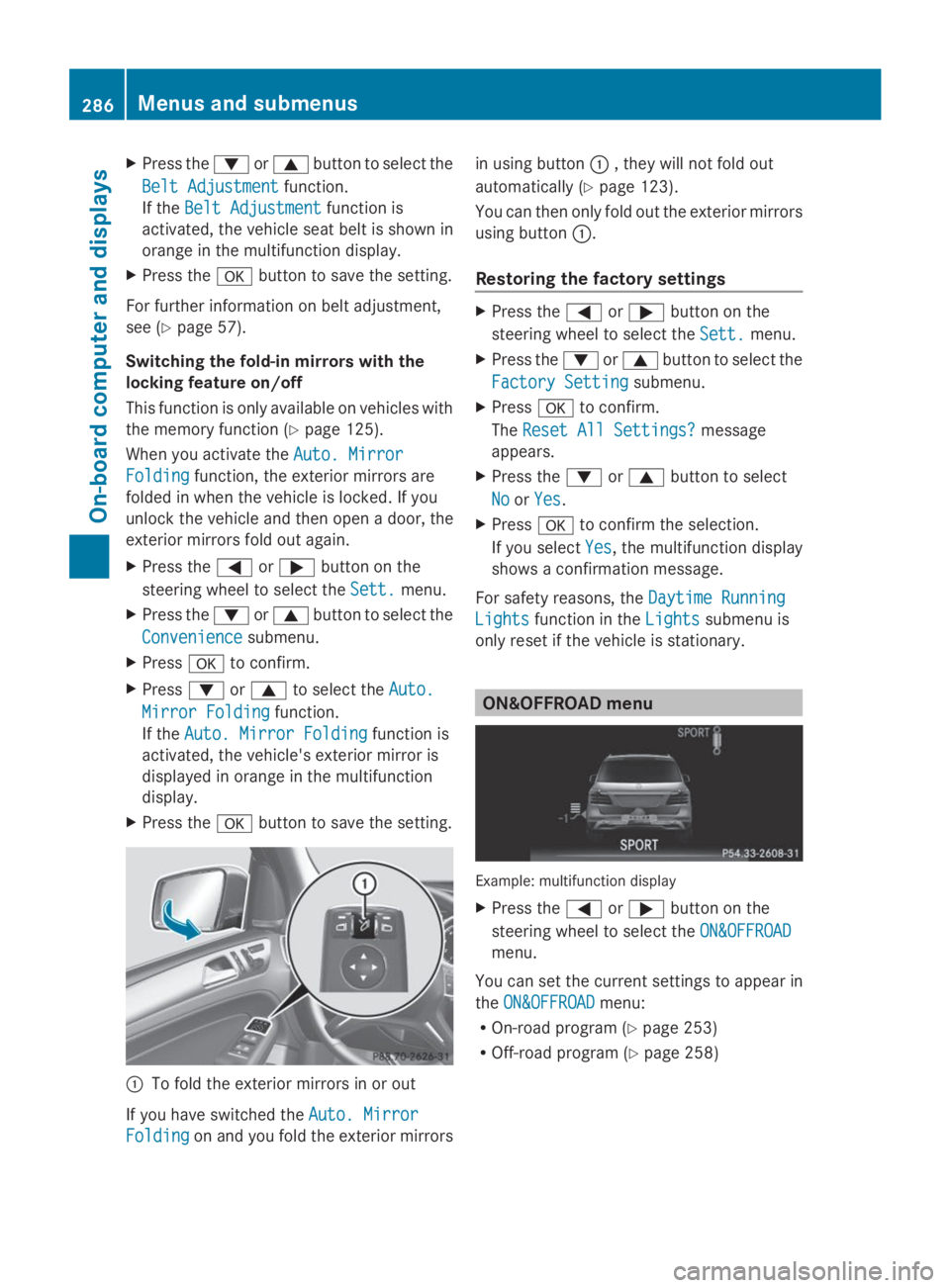
CTo fold the exterior mirrors in or out
If you have switched theAuto. MirrorAuto. Mirror
FoldingFoldingon and you fold the exterior mirrors
in using buttonC, they will not fold out
automatically (Ypage 123).
You can then only fold out the exterior mirrors
using buttonC.
Restoring the factory settings
XPress theYorebutton on the
steering wheel to select theSett.Sett.menu.
XPress thedorcbutton to select the
Factory SettingFactory Settingsubmenu.
XPressvto confirm.
TheReset All Settings?Reset All Settings?message
appears.
XPress thedorcbutton to select
NoNoorYesYes.
XPressvto confirm the selection.
If you selectYesYes, the multifunction display
shows a confirmation message.
For safety reasons, theDaytime RunningDaytime Running
LightsLightsfunction in theLightsLightssubmenu is
only reset if the vehicle is stationary.
ON&OFFROAD menu
Example: multifunction display
XPress theYorebutton on the
steering wheel to select theON&OFFROADON&OFFROAD
menu.
You can set the current settings to appear in
theON&OFFROADON&OFFROADmenu:
ROn-road program (Ypage 253)
ROff-road program (Ypage 258)
286Menus and submenus
On-board computer and displays
Page 323 of 462
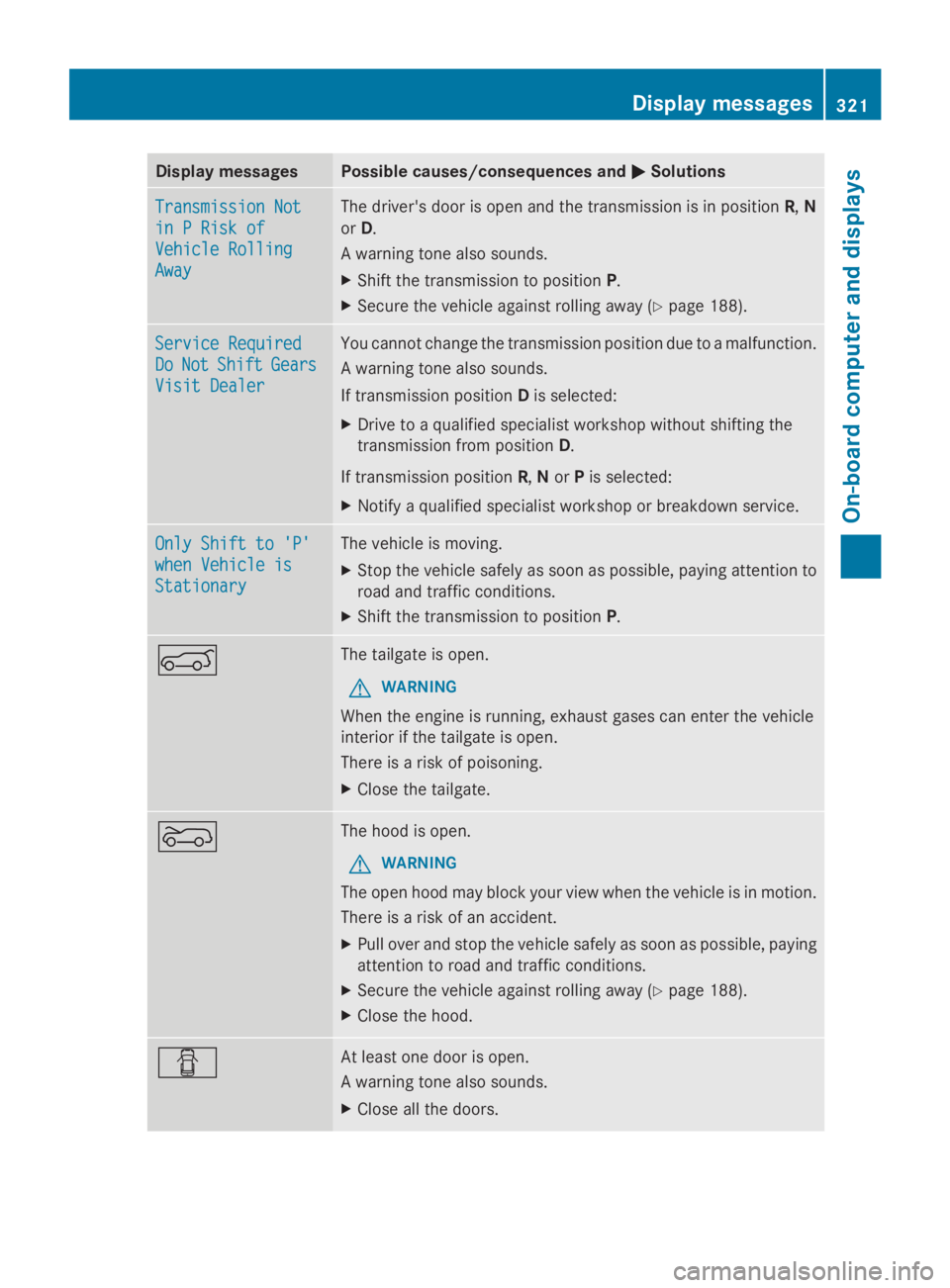
Display messagesPossible causes/consequences andPPSolutions
Transmission NotTransmission Not
in P Risk ofin P Risk of
Vehicle RollingVehicle Rolling
AwayAway
The driver's door is open and the transmission is in positionR,N
orD.
A warning tone also sounds.
XShift the transmission to positionP.
XSecure the vehicle against rolling away (Ypage 188).
Service RequiredService Required
DoDoNotNotShiftShiftGearsGears
Visit DealerVisit Dealer
You cannot change the transmission position due to a malfunction.
A warning tone also sounds.
If transmission positionDis selected:
XDrive to a qualified specialist workshop without shifting the
transmission from positionD.
If transmission positionR,NorPis selected:
XNotify a qualified specialist workshop or breakdown service.
Only Shift to 'P'Only Shift to 'P'
when Vehicle iswhen Vehicle is
StationaryStationary
The vehicle is moving.
XStop the vehicle safely as soon as possible, paying attention to
road and traffic conditions.
XShift the transmission to positionP.
eThe tailgate is open.
GWARNING
When the engine is running, exhaust gases can enter the vehicle
interior if the tailgate is open.
There is a risk of poisoning.
XClose the tailgate.
fThe hood is open.
GWARNING
The open hood may block your view when the vehicle is in motion.
There is a risk of an accident.
XPull over and stop the vehicle safely as soon as possible, paying
attention to road and traffic conditions.
XSecure the vehicle against rolling away (Ypage 188).
XClose the hood.
QAt least one door is open.
A warning tone also sounds.
XClose all the doors.
Displaymessages321
On-b oard computer and displays
Z
Page 342 of 462
Useful information
iThis Operator's Manual describes all
models and all standard and optional
equipment of your vehicle available at the
time of publication of the Operator's
Manual. Country-specific differences are
possible. Please note that your vehicle may
not be equipped with all features
described. This also applies to safety-
related systems and functions.
iRead the information on qualified
specialist workshops: (Ypage 28).
Stowage areas
Loading guidelines
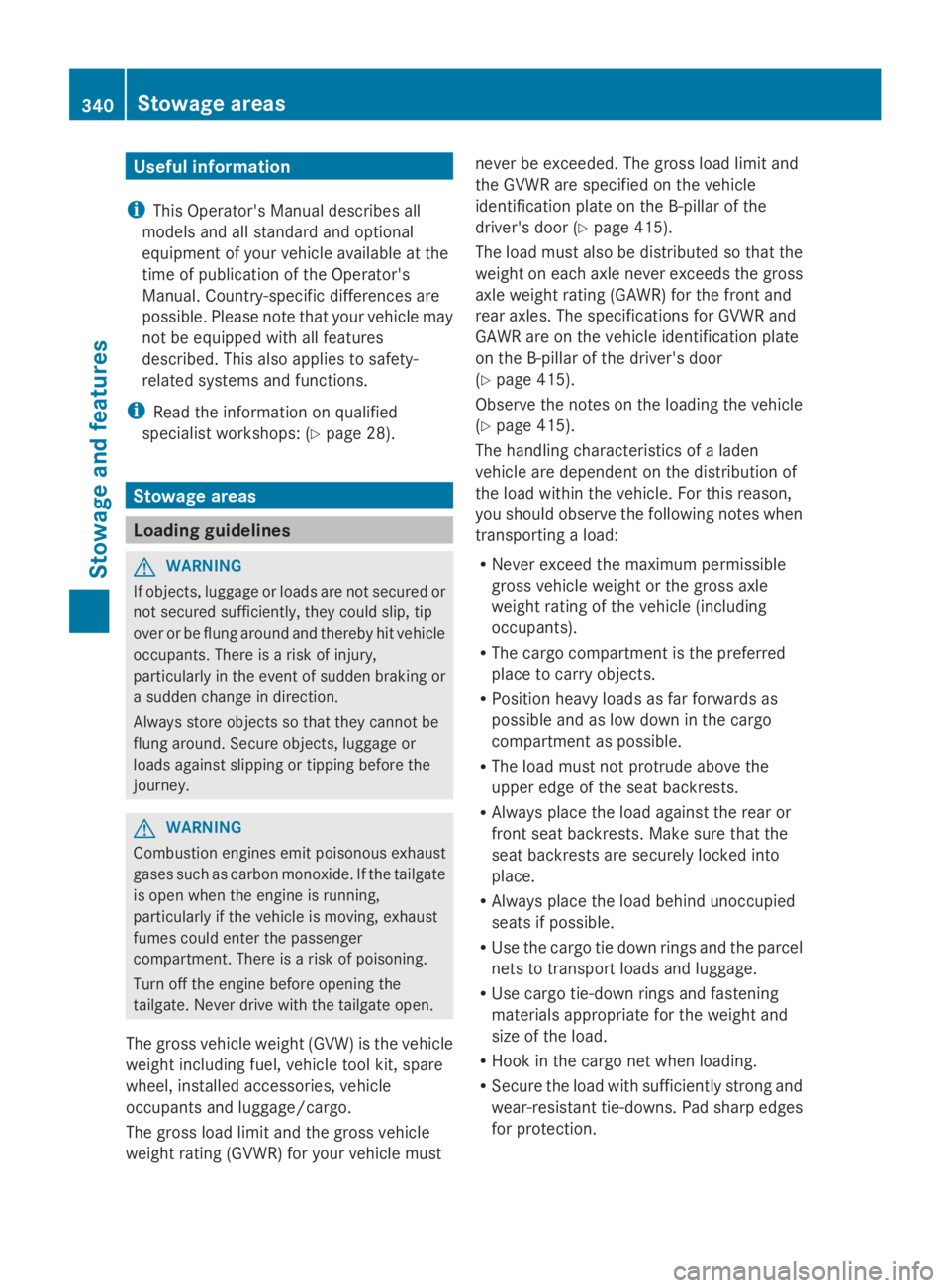
GWARNING
If objects, luggage or loads are not secured or
not secured sufficiently, they could slip, tip
over or be flung around and thereby hit vehicle
occupants. There is a risk of injury,
particularly in the event of sudden braking or
a sudden change in direction.
Always store objects so that they cannot be
flung around. Secure objects, luggage or
loads against slipping or tipping before the
journey.
GWARNING
Combustion engines emit poisonous exhaust
gases such as carbon monoxide. If the tailgate
is open when the engine is running,
particularly if the vehicle is moving, exhaust
fumes could enter the passenger
compartment. There is a risk of poisoning.
Turn off the engine before opening the
tailgate. Never drive with the tailgate open.
The gross vehicle weight (GVW) is the vehicle
weight including fuel, vehicle tool kit, spare
wheel, installed accessories, vehicle
occupants and luggage/cargo.
The gross load limit and the gross vehicle
weight rating (GVWR) for your vehicle must
never be exceeded. The gross load limit and
the GVWR are specified on the vehicle
identification plate on the B-pillar of the
driver's door (Ypage 415).
The load must also be distributed so that the
weight on each axle never exceeds the gross
axle weight rating (GAWR) for the front and
rear axles. The specifications for GVWR and
GAWR are on the vehicle identification plate
on the B-pillar of the driver's door
(Ypage 415).
Observe the notes on the loading the vehicle
(Ypage 415).
The handling characteristics of a laden
vehicle are dependent on the distribution of
the load within the vehicle. For this reason,
you should observe the following notes when
transporting a load:
RNever exceed the maximum permissible
gross vehicle weight or the gross axle
weight rating of the vehicle (including
occupants).
RThe cargo compartment is the preferred
place to carry objects.
RPosition heavy loads as far forwards as
possible and as low down in the cargo
compartment as possible.
RThe load must not protrude above the
upper edge of the seat backrests.
RAlways place the load against the rear or
front seat backrests. Make sure that the
seat backrests are securely locked into
place.
RAlways place the load behind unoccupied
seats if possible.
RUse the cargo tie down rings and the parcel
nets to transport loads and luggage.
RUse cargo tie-down rings and fastening
materials appropriate for the weight and
size of the load.
RHook in the cargo net when loading.
RSecure the load with sufficiently strong and
wear-resistant tie-downs. Pad sharp edges
for protection.
340Stowage areas
Stowage and features
Page 351 of 462
RAlways stow objects so that they cannot be
thrown around in such situations.
RAlways make sure that objects do not
protrude from stowage spaces, parcel nets
or stowage nets.
RClose the lockable stowage spaces while
driving.
RStow and secure objects that are heavy,
hard, pointy, sharp-edged, fragile or too
large in the cargo compartment.
!Only use the cup holders for containers of
the right size and which have lids. The
drinks could otherwise spill.
The stowage compartments in the doors
provide space for bottles with a capacity of
up to 34 fl. oz. (1.0 l).
The bottles are not secured or prevented from
tipping over. Therefore, do not place any open
drink containers in the stowage
compartments.
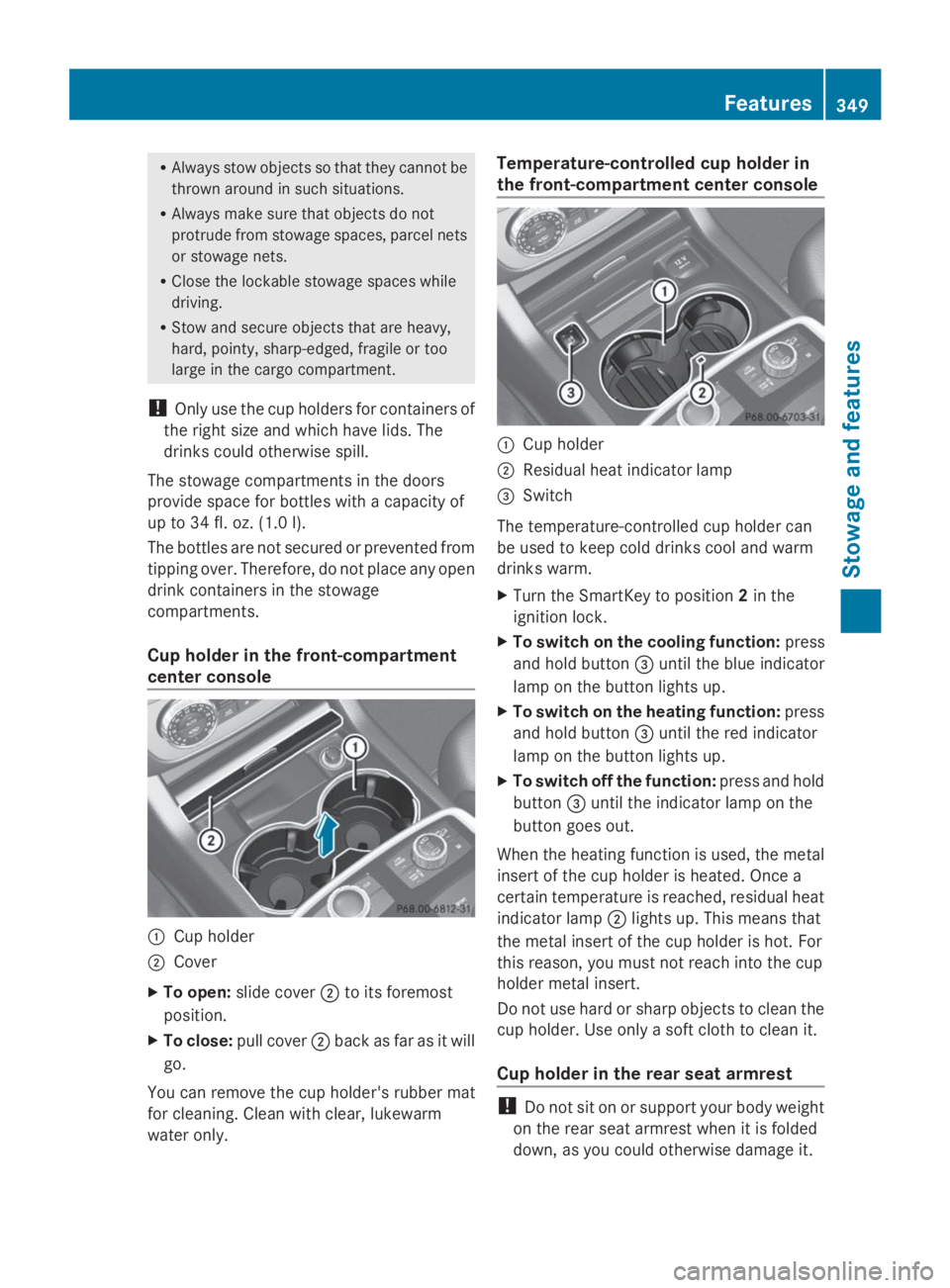
Cup holder in the front-compartment
center console
CCup holder
DCover
XTo open:slide coverDto its foremost
position.
XTo close:pull coverDback as far as it will
go.
You can remove the cup holder's rubber mat
for cleaning. Clean with clear, lukewarm
water only.
Temperature-controlled cup holder in
the front-compartment center console
CCup holder
DResidual heat indicator lamp
Page 363 of 462
If you own multiple Mercedes-Benz
vehicles with mbrace and activated mbrace
accounts:
If multiple vehicles are registered under the
same e-mail address, the destination will
be sent to all the vehicles.
Vehicle remote opening
You can use the vehicle remote opening if you
have unintentionally locked your vehicle and
a replacement SmartKey is not available.
The vehicle can be opened by the Mercedes-
Benz Customer Assistance Center.
The vehicle can be immediately opened
remotely within four days of the ignition being
turned off. After this time, the remote
unlocking may be delayed by 15 to 60
minutes. After 30 days, the vehicle can no
longer be opened remotely.
XContact the following service hotlines:
RUSA:Mercedes-Benz Customer
Assistance Center at 1-800-FOR-
MERCedes (1-800-367-6372) or
1-866-990-9007
RCanada:Customer Service at
1-888-923-8367
You will be asked for your password.
XReturn to your vehicle at the time agreed
upon with the Mercedes-Benz Customer
Assistance Center.
USA only: alternatively, the vehicle can be
opened via:
Rthe Internet, under the "Owners Online"
section
Rthe telephone application (e.g. iPhone®,
Blackberry)
To do this, you will need your identification
number and password.
iVehicle remote opening is only possible if
the corresponding mobile phone network
is accessible.
Vehicle remote closing
The remote closing feature can be used when
you have forgotten to lock the vehicle and you
are no longer nearby.
The vehicle can then be locked by the
Mercedes-Benz Customer Assistance Center.
The vehicle can be immediately remotely
locked within four days of the ignition being
turned off. After this time, the remote closing
may be delayed by 15 to 60 minutes. After
30 days the vehicle can no longer be closed
remotely.
XContact the following service hotlines:
RUSA:Mercedes-Benz Customer
Assistance Center at 1-800-FOR-
MERCedes (1-800-367-6372) or
1-866-990-9007
RCanada:Customer Service at
1-888-923-8367
You will be asked for your password.
The next time you are inside the vehicle and
you switch on the ignition, theDoorsDoors
Locked RemotelyLocked Remotelymessage appears in the
multifunction display.
USA only: alternatively, the vehicle can be
locked via:
Rthe Internet, under the "Owners Online"
section
Rthe telephone application (e.g. iPhone®,
Blackberry)
To do this, you will need your identification
number and password.
iThe vehicle remote closing feature is
available when the relevant mobile phone
network is available and data connection is
possible.
Features361
Stowage and features
Z