2014 MERCEDES-BENZ CLS-Class ESP
[x] Cancel search: ESPPage 357 of 382

100 kilopascals (kPa
)are the equivalent of
1b ar.
DOT (Department of Transportation)
DOT marked tires fulfill the requirements of
the United States Department of
Transportation.
Normal occupant weight
The numbe rofoccupants for which the
vehicl eisdesigned multiplie dby
68 kilograms (150 lb).
Uniform Tire Quality Gradin gStandards
Au niform standard to grade the quality of
tire swithr egards to trea dquali ty,tire traction
and temperatur echaracteristics. Rating sare
determine dbytire manufacturer susing U.S.
government testing procedures. The ratings
ar em olde dinto the sidewall of the tire.
Recommende dtire pressure
The recommende dtire pressure applie sto
the tire smounted at the factory.
The Tire and Loading Informatio nplacard
contain sthe recommende dtirep ressures for
cold tires on afully loaded vehicle and for the
maximum permissible vehicle speed.
The tir epressure table contain sthe
recommende dpressures for cold tires for
various operating conditions, i.e. differing
load and speed conditions.
Increased vehicle weight du etooptional
equipment
This is the combined weight of all standard
and optional equipmen tavailablef or the
vehicle, regardless of whethe ritisactually
installed on the vehicle or not.
Rim
This is the part of the wheel on which the tire
is mounted.
GAWR (Gross Axle Weight Rating)
The GAWR is the maximum gross axle weight
rating. The actual load on an axle must never
exceed the gross axle weight rating. The
gross axle weight rating can be found on the vehicle identification plate on the B-pillar on
the driver's side.
Speed rating
The speed rating is part of the tire
identification. It specifies the speed range for
which the tire is approved.
GVW (Gross Vehicle Weight)
The gross vehicle weight includes the weight
of the vehicle including fuel, tools, the spare
wheel, accessories installed, occupants,
luggage and the drawbarn
oseweight, if
applicable. The gross vehicle weight must not
exceed the gross vehicle weight rating GVWR
as specified on the vehicle identification plate
on the B-pillar on the driver's side.
GVWR (Gross Vehicle Weight Rating)
The GVWR is the maximum permissible gross
weight of afully loaded vehicle (the weight of
the vehicle including all accessories,
occupants, fuel, luggage and the drawbar
noseweight, if applicable). The gross vehicle
weight rating is specified on the vehicle
identification plate on the B-pillar on the
driver's side.
Maximu mloaded vehicle weight
The maximum weight is th esum of:
R thec urbw eight of th evehicle
R thew eight of th eaccessories
R thel oad limit
R thew eight of th efactory installe doptional
equipment
Kilopascal (kPa)
Metric unit for tir epressure. 6. 9kPa
correspond sto1psi. Another unit for tire
pressure is bar. Ther eare 10 0kilopascals
(kPa) to 1bar.
Load index
In addition to th eload-bearing index ,the load
index may also be imprinted on th esidewall
of th etire. This specifie sthe load-bearing
capacity more precisely. All about wheels and tires
355Wheels and tires Z
Page 363 of 382

G
WARNING
If you tighten the whee lbolts or whee lnuts
when the vehicl eisraised, the jack coul dtip
over. There is arisk of injury.
Only tighten the whee lbolts or whee lnuts
when the vehicl eisonthe ground.
Always pay attention to the instructions and
safety notes in the "Changing awheel"
section (Y page357).
Only use whee lbolts that have been designed
for the whee land the vehicle. For safety
reasons, Mercedes-Benz recommends that
you only use whee lbolts which have been
approved for Mercedes-Benz vehicles and the
respective wheel.
! AMG vehicle with ceramic brake
discs: during remova land repositioning of
the wheel, the whee lrim can strike the
ceramic-brake disc and damage it.
Therefore, take precautions and have a
second perso nassist you. Alternatively,
you can use asecond alignment bolt.
! To prevent damage to the paintwork, hold
the wheel securely against the wheel hub
while screwing in the first wheel bolt. Positioning
awheel (example: vehicle with an
emergency spare wheel)
X Cleant he wheel and wheel hub contact
surfaces.
X Slide the wheel to be mounted onto the
alignment bolt and push it on.
X Tighten the wheel bolts until they are
finger-tight. X
Unscrew the alignment bolt.
X Tighten the last wheel bolt until it is finger-
tight.
X Vehicles with acollapsible spare
wheel: inflate th ecollapsible spare wheel
(Y page 368).
Only then lower th evehicle.
Lowering th evehicle G
WARNING
The wheels could work loose if th ewheel nuts
and bolt sare not tightene dtothe specified
tightening torque. There is arisk of accident.
Have the tightening torque immediately
checked at aqualified specialist workshop
after awheel is changed.
! Vehicles with acollapsible spare
wheel: before lowering th evehicle, inflate
th ec ollapsible spare wheel with th etire
inflatio ncompressor. The wheel rim could
otherwise be damaged. Tightenin
gthe wheel nuts (example: vehicle with
an emergenc yspare wheel)
X Turn the crank of the jack counter-
clockwise until the vehicle is once again
standin gfirmly on the ground.
X Place the jack to one side.
X Tighten the wheel bolts evenly in a
crosswise pattern in the sequence
indicated (001A to001E). The specified
tightening torque is 96 lb-ft(130 Nm).
X Turn the jack back to its initial position. Changing
awheel
361Wheels and tires Z
Page 364 of 382

X
Stow the jack and the res tofthe vehicle
tool sint he trunk again.
X Check the tire pressure of the newly
mounted wheel and adjus titifnecessary.
Observe the recommended tire pressure
(Y page 338).
i Vehicles with tire pressure monitor: all
wheels mounted must be equipped with
functioning sensors. Wheel and tirec
ombinationsGeneral notes
! For safety reasons, Mercedes-Benz
recommends that you only use tires and
wheels which have been approved by
Mercedes-Benz specifically for your
vehicle.
These tires have been specially adapted for
use with the control systems, such as ABS
or ESP ®
,a nd are marked as follows:
R MO =Mercedes-BenzO riginal
R MOE =Mercedes-BenzO riginal Extended
(tires featuring run-flat characteristics)
R MO1 =Mercedes-Benz Original (only
certain AMG tires)
Mercedes-BenzO riginal Extended tires
may only be usedonw heels that have been
specifically approved by Mercedes-Benz.
Only use tires, wheels or accessories
tested and approved by Mercedes-Benz.
Certain characteristics, e.g. handling,
vehicl enoise emissions or fuel
consumption, may otherwise be adversely
affected. In addition, when driving with a
load, tire dimension variations coul dcause
the tires to come into contact with the
bodywork and axle components. This could
result in damage to the tires or the vehicle.
Mercedes-Benz accepts no liability for
damage resulting from the use of tires,
wheels or accessories other than those
tested and approved. Information on tires, wheels and approved
combinations can be obtained from any
qualified specialist workshop.
Overvie wofabbreviations usedint he
following tire tables:
R BA: both axles
R FA: front axle
R RA: rear axle
The recommended pressures for various
operating conditionsc an be found:
R on the Tire and Loading Information placard
with the recommended tire pressures on
the B-pillar on the driver's side
R in the tire pressure table on the inside of
the fuel filler flap
Observe the notes on recommended tire
pressures under various operating conditions
(Y page 338).
Check tire pressures regularly,a nd only when
the tires are cold. Comply with the
maintenancer ecommendations of the tire
manufacturer in the vehicle document wallet.
Notes on the vehicle equipment –always
equip the vehicle with:
R tires of the same size on agiven axle (left/
right)
R the same type of tires at agiven time
(summer tires, winter tires, MOExtended
tires)
Vehicles with MOExtende dtires are not
equipped with aTIREFIT kit at the factory. It
is therefore recommende dthat you
additionally equip your vehicle with aTIREFIT
kit if you moun ttires that do not feature run-
flat properties ,e.g. winter tires. ATIREFIT kit
may be obtained from aqualified specialist
workshop.
i Not all wheela nd tire combinations are
available at the factory for all countries.
i On the following pages, you can find
information on approved wheelr ims and
tir es izesfor equipping your vehicle with
winter tires. Winter tires are not available 362
Wheel and tir
ecombinationsWheels and tires
Page 369 of 382

Winter tires
R19
Tires Alloy wheels
FA: 255/35 R19 96
VXLM+S0012
RA: 255/35 R19 96 VXLM+S0012 FA: 9.0
Jx19H2
Whee loffset: 1.46 in (37 mm)
RA: 9.5 Jx19H2
Whee loffset: 2.05 in (52 mm) FA: 255/35 R19 96
VXLM+S0012
RA: 285/30 R19 98 VXLM+S0012 3 FA: 9.0
Jx19H2
Whee loffset: 1.46 in (37 mm)
RA: 10.0 Jx19H2
Whee loffset: 1.85 in (47 mm) Emergency spare wheel
Important safety notes
G
WARNING
The whee lortire size as wel lasthe tire type
of the spare whee loremergency spare wheel
and the whee ltobereplaced may differ.
Mounting an emergency spare whee lmay
severely impair the driving characteristics.
There is arisk of an accident.
To avoi dhazardou ssituations:
R adapt you rdriving style accordingly and
drive carefully.
R never mount more than one spare whee lor
emergency spare whee lthat differs in size.
R only use aspare whee loremergency spare
whee lofad ifferent size briefly.
R do not switch ESP ®
off.
R have aspare whee loremergency spare
whee lofad ifferent size replaced at the
nearest qualified specialist workshop.
Observe that the whee land tire dimensions
as wellast he tire type must be correct.
When using an emergency spare whee lor
spare whee lofadifferent size, you must not
exceed the maximu mspee dof50m ph
(80 km/h). Snow chains must not be mounted on
emergency spare wheels. General notes
You should regularl ycheck the pressure of
the emergency spare wheel, particularl yprior
to long trips, and correct the pressure as
necessary (Y page338). The applicable value
is found on the whee lorunder "Technical
data "(Ypage3 70).
An emergency spare whee lmay alsobe
mounted against the direction of rotation.
Observe the time restriction on use as wellas
the spee dlimitation specified on the
emergency spare wheel.
Replace the tires after six years at the latest,
regardless of wear. This alsoa ppliestothe
emergency spare wheel.
i When you are driving with the collapsible
spare whee lmounted, the tire pressure
loss warning system or the tire pressure
monitor cannot function reliably. Only
restart the tire pressure loss warning
system/the tire pressure monitor when the
damaged whee lhas been replaced with a
new wheel.
Vehicles with tire pressure monitor:
after mounting an emergency spare wheel,
3 Use of snow chains is not permitted .Observe the notes under "Snow chains". Emergency spar
ewheel
367Wheels and tires Z
Page 371 of 382
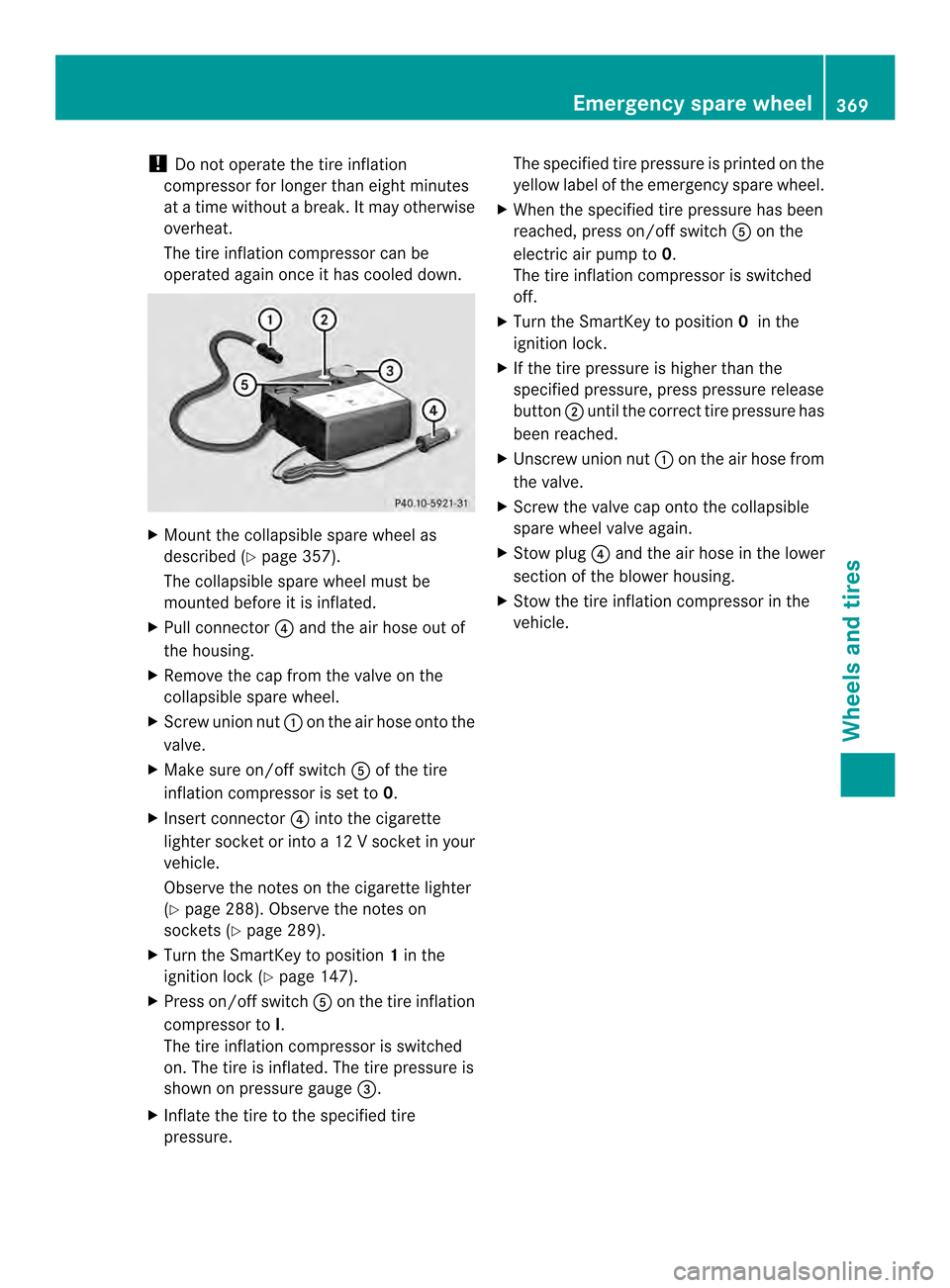
!
Do not operate the tire inflation
compressor for longer than eight minutes
at at ime without abreak. It may otherwise
overheat.
The tire inflation compressor can be
operated againo nce it hascoole ddown. X
Mount the collapsibl espare whee las
described (Y page 357).
The collapsible spare wheel must be
mounted before it is inflated.
X Pull connector 0021and the air hose out of
the housing.
X Remove the cap from the valve on the
collapsible spare wheel.
X Screw union nut 001Aon the air hose ont othe
valve.
X Make sure on/off switch 001Eof the tire
inflation compressor is set to 0.
X Insert connector 0021intot he cigarette
lighter socket or int oa12Vsocket in your
vehicle.
Observe the notes on the cigarett elighter
(Y page 288). Observe the notes on
socket s(Ypage 289).
X Turn the SmartKey to position 1in the
ignition lock (Y page 147).
X Press on/offs witch001Eon th etirei nflation
compressor to I.
The tir einflatio ncompressor is switched
on. The tire is inflated. The tire pressure is
shown on pressure gauge 0024.
X Inflate the tire to the specified tire
pressure. The specified tire pressure is printed on the
yellow label of the emergenc
yspare wheel.
X When the specified tire pressure has been
reached, press on/offs witch001Eon the
electric air pump to 0.
The tir einflatio ncompressor is switched
off.
X Turn the SmartKey to position 0in the
ignition lock.
X If the tire pressure is higher than the
specified pressure, press pressure release
button 0010until the correc ttire pressure has
been reached.
X Unscrew union nut 001Aon the air hose from
the valve.
X Screw the valve cap ont othe collapsible
spare wheel valve again.
X Stow plug 0021and the air hose in the lower
section of the blower housing.
X Stow the tire inflation compressor in the
vehicle. Emergency sparew
heel
369Wheels and tires Z
Page 375 of 382

Example: vehicl
eide ntification plate (Canada only)
0010 VIN
0024 Paint code
i The data shown on the vehicle
identificatio nplate is used only as an
example. This data is differen tfor every
vehicle and can deviate from the data
shown here. You can find the data
applicabl etoyour vehicle on the vehicle
identification plate. VIN
X
Slide the right-hand front seat to its
rearmost position.
X Fold floor covering 001Aupwards.
You will see VIN 0010.
The VIN can also be found in the following
locations:
R on the lower edge of the windshield
(Y page 373)
R on the vehicle identification plate
(Y page 372) Engine number
001A
Emission control information plate,
including the certification of both federal
and Californian emissions standards
0010 Engine number (stamped into the
crankcase)
0024 VIN (on the lower edge of the windshield) Service products and filling
capacities
Important safety notes
G
WARNING
Servic eproducts may be poisonous and
hazardous to health. There is arisk of injury.
Comply with instructions on the use, storage
and disposal of service products on the labels
of the respective original containers. Always
store service products sealed in their original
containers. Always keep service products out
of the reach of children. H
Environmental note
Dispose of service products in an
environmentally responsible manner.
Servic eproducts include the following:
R Fuels
R Lubricants (e.g. engine oil, transmission oil)
R Coolant
R Brake fluid
R Windshield washer fluid
R Climate control system refrigerant Service products and filling capacities
373Technical data Z
Page 376 of 382

Comply wit
hall valid regulation swithr espect
to handling, storing ,and disposin gofservice
fluids.
Components and servic eproduct smust be
matched. You should therefor eonly use
products tha thave been tested and approved
by Mercedes-Benz.
Information on tested and approved products
can be obtaine datanauthorized Mercedes-
Ben zCente roront heInternet at
http://bevo.mercedes-benz.co m.
You can recognize service products approved
by Mercedes-Ben zbythefollowing
inscription on th econtaine rs:
R MB-Freigabe (e.g. MB-Freigabe 229.51)
R MB Approval (e.g. MB Approval 229.51)
Other designation sorrecommendations
indicat ealevel of qualit yoras pecification in
accordance wit hanMBSheet number (e.g.
MB 229.5). The yhave no tnecessarily been
approved by Mercedes-Benz. Fuel
Important safet ynotes G
WARNING
Fuel is highly flammable. If you handle fuel
incorrectly, there is arisk of fire and
explosion.
You must avoid fire, open flames, creating
sparks and smoking. Switc hoff the engine
and, if applicable, the auxiliary heating before
refueling. G
WARNING
Fuel is poisonous and hazardous to health.
There is arisk of injury.
You must make sure that fuel does not come
into contact with your skin ,eyes or clothing
and that it is not swallowed. Do not inhale fuel
vapors. Keep fuel away from children. If you or other
scome into contact with fuel,
observe the following:
R Wash away fuel from skin immediately
using soap and water.
R If fuel comes into contact with your eyes,
immediately rinse them thoroughly with
clean water. Seek medical assistance
without delay.
R If fuel is swallowed, seek medical
assistanc ewithout delay. Do not induce
vomiting.
R Immediately change out of clothing which
has come into contact with fuel.
Tank capacity Model Total
capacity All models
21.1USg
al
(80. 0l) Model Of which
reserve All models (except for
AMG vehicles)
Approx.
2.4 US qt (9.0 l) All models (AMG vehicles)
Approx.
3.7 US gal (14. 0l) Gasoline
Fuel grade
!
Do not use diesel to refuel vehicles with a
gasoline engine. Do not switch on the
ignition if you accidentally refuel with the
wrong fuel. Otherwise, the fuel will enter
the fuel system. Even small amounts of the
wrong fuel could result in damage to the
fuel system and the engine. Notif ya
qualified specialist worksho pand have the
fuel tank and fuel lines drained completely. 374
Service products and filling capacitiesTechnical data