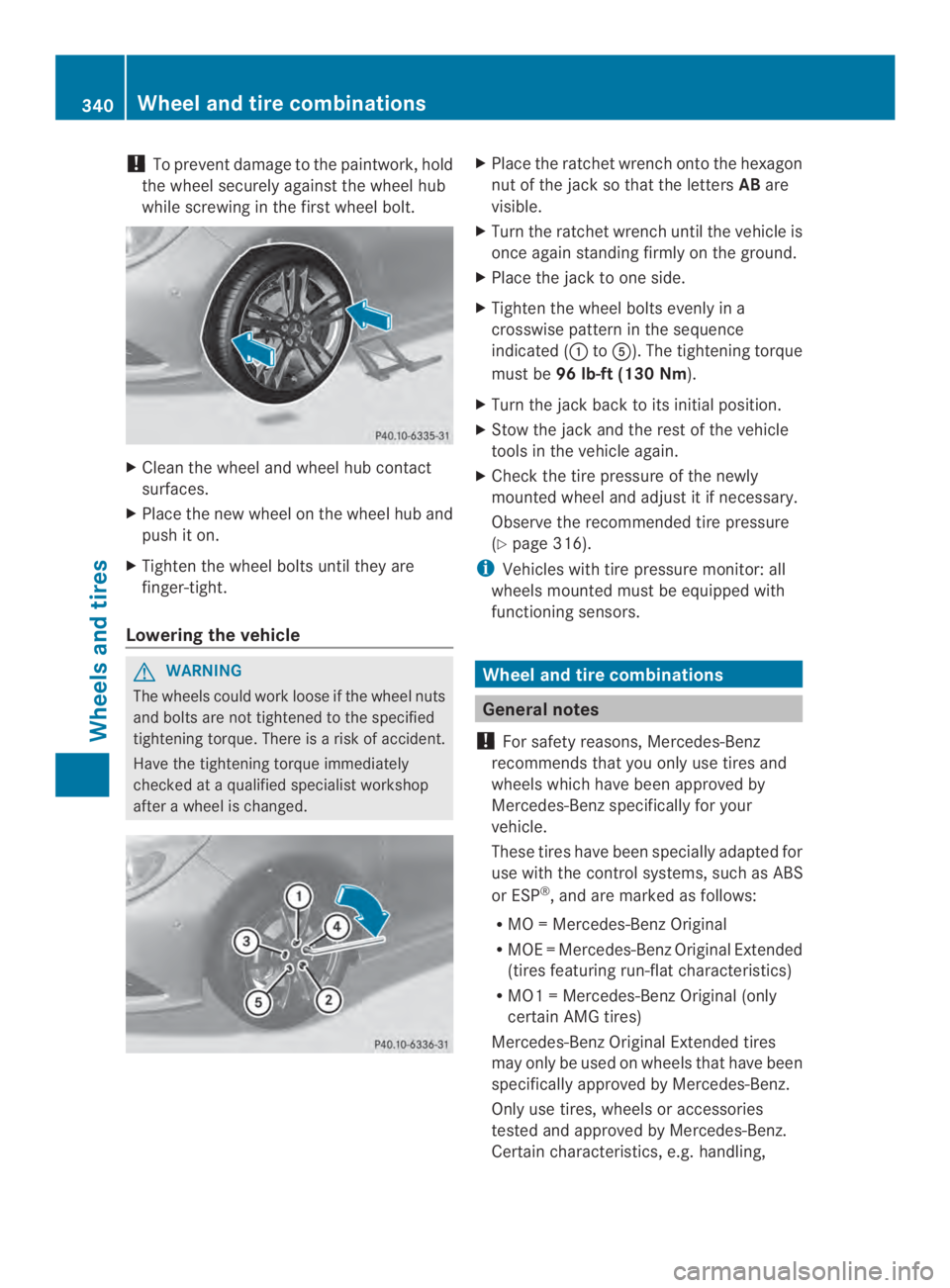
!To prevent damage to the paintwork, hold
the wheel securely against the wheel hub
while screwing in the first wheel bolt.
XCleanthe wheel and wheel hub contact
surfaces.
XPlace the new wheel on the wheel hub and
push it on.
XTighten the wheel bolts until they are
finger-tight.
Lowering the vehicle
GWARNING
The wheels could work loose if the wheel nuts
and bolts are not tightened to the specified
tightening torque. There is a risk of accident.
Have the tightening torque immediately
checked at a qualified specialist workshop
after a wheel is changed.
XPlace the ratchet wrench onto the hexagon
nut of the jack so that the lettersABare
visible.
XTurn the ratchet wrench until the vehicle is
once again standing firmly on the ground.
XPlace the jack to one side.
XTighten the wheel bolts evenly in a
crosswise pattern in the sequence
indicated (�to�). The tightening torque
must be96 lb-ft (130 Nm).
XTurn the jack back to its initial position.
XStow the jack and the rest of the vehicle
tools in the vehicle again.
XCheck the tire pressure of the newly
mounted wheel and adjust it if necessary.
Observe the recommended tire pressure
(Ypage 316).
iVehicles with tire pressure monitor: all
wheels mounted must be equipped with
functioning sensors.
Wheel and tire combinations
General notes
!For safety reasons, Mercedes-Benz
recommends that you only use tires and
wheels which have been approved by
Mercedes-Benzspecifically for your
vehicle.
These tires have been specially adapted for
use with the control systems, such as ABS
or ESP®, and are marked as follows:
RMO=Mercedes-BenzOriginal
RMOE=Mercedes-BenzOriginal Extended
(tires featuring run-flat characteristics)
RMO1=Mercedes-BenzOriginal (only
certain AMG tires)
Mercedes-Benz Original Extended tires
may only be used on wheels that have been
specifically approved by Mercedes-Benz.
Only use tires, wheels or accessories
tested and approved by Mercedes-Benz.
Certain characteristics, e.g. handling,
340Wheel and tire combinations
Wheels and tires