2014 MERCEDES-BENZ CLA-Class display
[x] Cancel search: displayPage 20 of 358
Tire pressure
Calling up (on-board computer) ..... 321
Checking manuall y........................ 320
Display message ............................ 237
Important safety notes .................. 321
Maximum ....................................... 320
Notes ............................................. 319
Not reached (TIREFIT) .................... 300
Reached (TIREFIT) .......................... 300
Recommended ............................... 317
Tire pressure monitoring system
Checking the tire pressure elec-
tronically ........................................ 322
Function/note s............................. 321
General notes ................................ 321
Important safety notes .................. 321
Restarting ...................................... 323
Warning lamp ................................. 254
Warning message .......................... 323
Tires
Aspect ratio (definition) ................. 334
Average weight of the vehicle
occupants (definition) .................... 333
Bar (definition) ............................... 333
Changing a whee l.......................... 335
Characteristics .............................. 333
Checking ........................................ 315
Curb weight (definition) ................. 334
Definition of terms ......................... 333
Direction of rotation ...................... 336
Display message ............................ 237
Distribution of the vehicle occu-
pants (definition) ............................ 335
DOT, Tire Identification Number
(TIN) ............................................... 332
DOT (Department of Transporta-
tion) (definition) ............................. 333
GAWR (Gross Axle Weight Rating)
(definition) ..................................... 333
GVW (Gross Vehicle Weight) (def-
inition) ........................................... 334
GVWR (Gross Vehicle Weight Rat-
ing) (definition) .............................. 334
Important safety notes .................. 314
Increased vehicle weight due to
optional equipment (definition) ...... 333
Kilopascal (kPa) (definition) ........... 334
Labeling (overview) ........................ 329 Load bearing index (definition) ...... 335
Load index ..................................... 332
Load index (definition) ................... 334
M+S tire
s....................................... 316
Maximum loaded vehicle weight
(definition) ..................................... 334
Maximum load on a tire (defini-
tion) ............................................... 334
Maximum permissible tire pres-
sure (definition) ............................. 334
Maximum tire load ......................... 327
Maximum tire load (definition) ....... 334
MOExtended tire s.......................... 316
Optional equipment weight (defi-
nition) ............................................ 335
PSI (pounds per square inch) (def-
inition) ........................................... 334
Replacing ....................................... 336
Service life ..................................... 316
Sidewall (definition) ....................... 335
Speed rating (definition) ................ 334
Storing ........................................... 336
Structure and characteristics
(definition) ..................................... 333
Summer tire s......................... 165, 316
Temperature .................................. 329
TIN (Tire Identification Number)
(definition) ..................................... 335
Tire bead (definition) ...................... 335
Tire pressure (definition) ................ 335
Tire pressures (recommended) ...... 333
Tire size (data) ............................... 340
Tire size designation, load-bearing capacity, speed rating .................... 330
Tire tread ....................................... 315
Tire tread (definition) ..................... 335
Total load limit (definition) ............. 335
Traction ......................................... 328
Traction (definition) ....................... 335
Tread wear ..................................... 328
Uniform Tire Quality Grading
Standards ...................................... 328
Uniform Tire Quality Grading
Standards (definition) .................... 333
Wear indicator (definition) ............. 335
Wheel and tire combination ........... 342
Wheel rim (definition) .................... 333
see Flat tire 18
Index
Page 21 of 358

Top Tether
............................................ 61
Towing Important safety guidelines ........... 307
Installing the towing eye ................ 308
Removing the towing eye ............... 309
Towing a trailer
ESP ®
(Electronic Stability Pro-
gram) .............................................. .71
Towing away
With both axles on the ground ....... 309
With front axle raised ..................... 309
Tow-starting
Emergency engine starting ............ 310
Important safety notes .................. 307
Installing the towing eye ................ 308
Removing the towing eye ............... 309
Transmission
see Automatic transmission
Transmission position display ......... 147
Transporting the vehicle .................. 309
Trim pieces (cleaning instruc-
tions) .................................................. 293
Trip computer (on-board com-
puter) .................................................. 199
Trip meter see Trip odometer
Trip odometer
Calling up ....................................... 199
Resetting (on-board computer) ...... 200
Trunk
Emergency release .......................... 86
Emergency release button ............... 86
Important safety notes .................... 84
Opening/closing (manually from
outside) ............................................ 84
Opening (automatically from out-
side) ................................................. 85
Opening automatically from
inside .............................................. .85
Trunk emergency release button ....... 86
Trunk lid Display message ............................ 241
Opening dimensions ...................... 353
Trunk load (maximum) ...................... 353
Turn signals Changing bulbs (front) ................... 117
Changing bulbs (rear ).................... 117 Display message ............................ 226
Switching on/of f........................... 110
Type identification plate
see Vehicle identification plate U
Unlocking Emergency unlocking ....................... 83
From inside the vehicle (central
unlocking button) ............................. 82 V
Vanity mirror (in the sun visor) ........ 264
Vehicle Correct use ...................................... 26
Equipment ....................................... 22
Individual settings .......................... 207
Limited Warranty ............................. 27
Loading .......................................... 324
Locking (in an emergency) ............... 83
Locking (SmartKey ).......................... 76
Lowering ........................................ 340
Maintenance .................................... 23
Parking for a long period ................ 160
Pulling away ................................... 142
Raising ........................................... 337
Reporting problems ......................... 26
Securing from rolling away ............ 337
Towing away .................................. 307
Tow-starting ................................... 307
Transporting .................................. 309
Unlocking (in an emergency) ........... 83
Unlocking (SmartKey )...................... 76
Vehicle data ................................... 353
Vehicle data ....................................... 353
Vehicle dimensions ........................... 353
Vehicle emergency locking ................ 83
Vehicle identification number see VIN
Vehicle identification plate .............. 346
Vehicle maintenance see ASSYST PLUS
Vehicle tool kit .................................. 296
Video (DVD) ........................................ 203
VIN ...................................................... 346 Index
19
Page 22 of 358

W
Warning and indicator lamps ABS ................................................ 245
Brakes .......................................... .245
Check Engine ................................. 251
Coolant .......................................... 251
Distance warning ........................... 253
DISTRONIC PLUS ........................... 253
ESP ®
.............................................. 247
ESP ®
OFF ....................................... 248
Fuel tank ........................................ 251
Overview .......................................... 32
PASSENGER AIR BAG OFF indica-
tor lamp .......................................... .47
Reserve fuel .................................. .251
Seat belt ........................................ 243
SPORT handling mode ................... 248
SRS ................................................ 250
Tire pressure monitor .................... 254
Warranty .............................................. 22
Washer fluid Display message ............................ 242
Wheel and tire combination
see Tires
Wheel bolt tightening torque ........... 340
Wheel chock ...................................... 337
Wheels Changing a wheel .......................... 335
Checking ........................................ 315
Cleaning ......................................... 289
Cleaning (warning) ......................... 336
Important safety notes .................. 314
Interchanging/changing ................ 336
Mounting a new wheel ................... 339
Mounting a wheel .......................... 336
Removing a wheel .......................... 339
Storing .......................................... .336
Tightening torque ........................... 340
Wheel size/tire size ....................... 340
Window curtain air bag
Display message ............................ 223
Operation ......................................... 47
Windows
see Side windows
Windshield
Defrosting ...................................... 133 Windshield washer system
Adding washer fluid ....................... 286
Notes ............................................. 352
Windshield wipers
Display message ............................ 242
Problem (malfunction) ................... 121
Replacing the wiper blades ............ 119
Switching on/off ........................... 118
Winter driving
Slippery road surfaces ................... 165
Snow chains .................................. 317
Winter operation
General notes ................................ 316
Winter tires
M+S tires ....................................... 316
Wiper blades
Cleaning ......................................... 290
Important safety notes .................. 119
Replacing (windshield )................... 119
Wooden trim (cleaning instruc-
tions) .................................................. 293
Workshop see Qualified specialist workshop Z
ZONE function Switching on/of f........................... 132 20
Index
Page 33 of 358
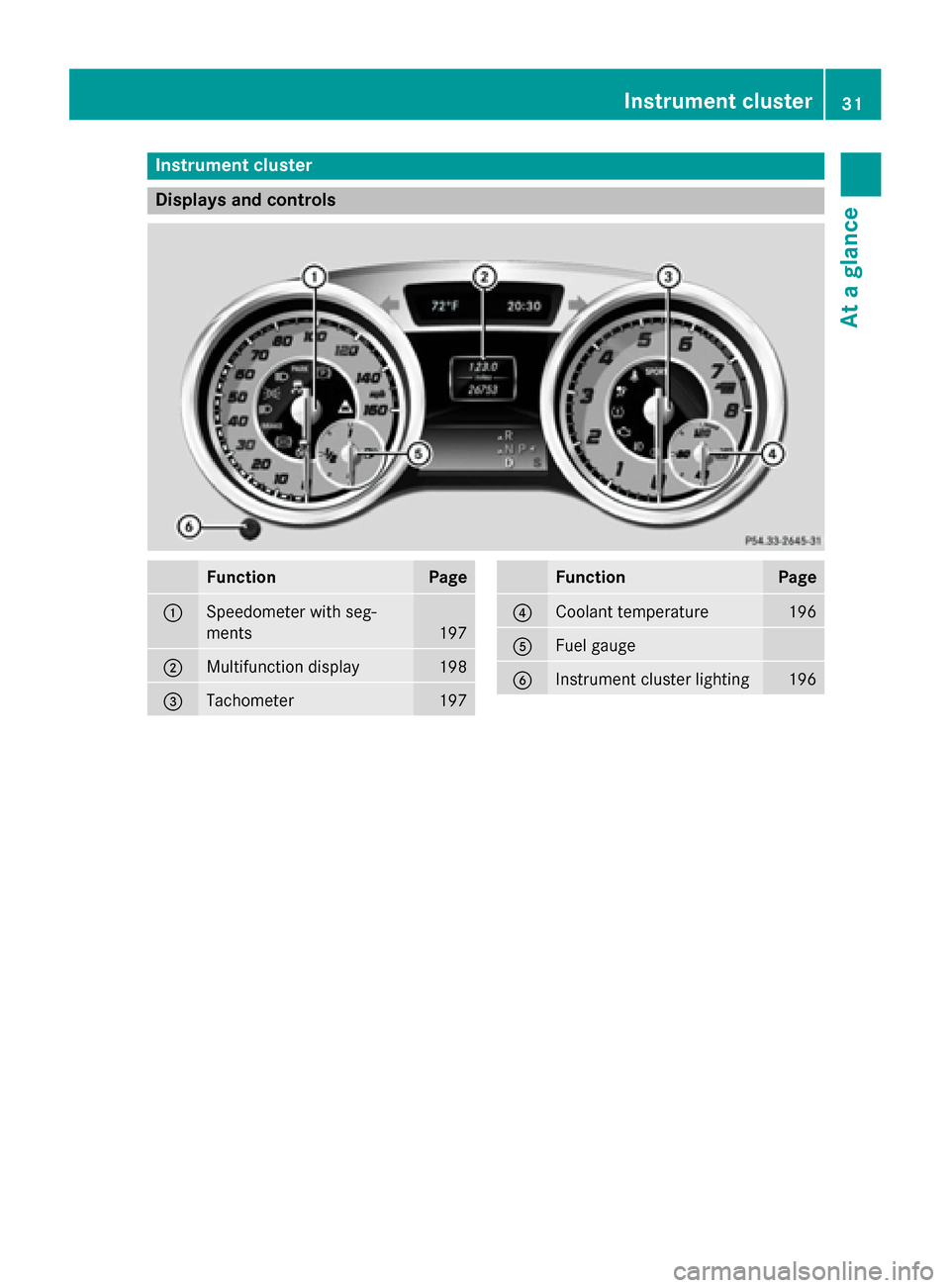
Instrument cluster
Displays and controls
Function Page
0043
Speedometer with seg-
ments
197
0044
Multifunction display 198
0087
Tachometer 197 Function Page
0085
Coolant temperature 196
0083
Fuel gauge
0084
Instrument cluster lighting 196Instrument cluster
31At a glance
Page 35 of 358
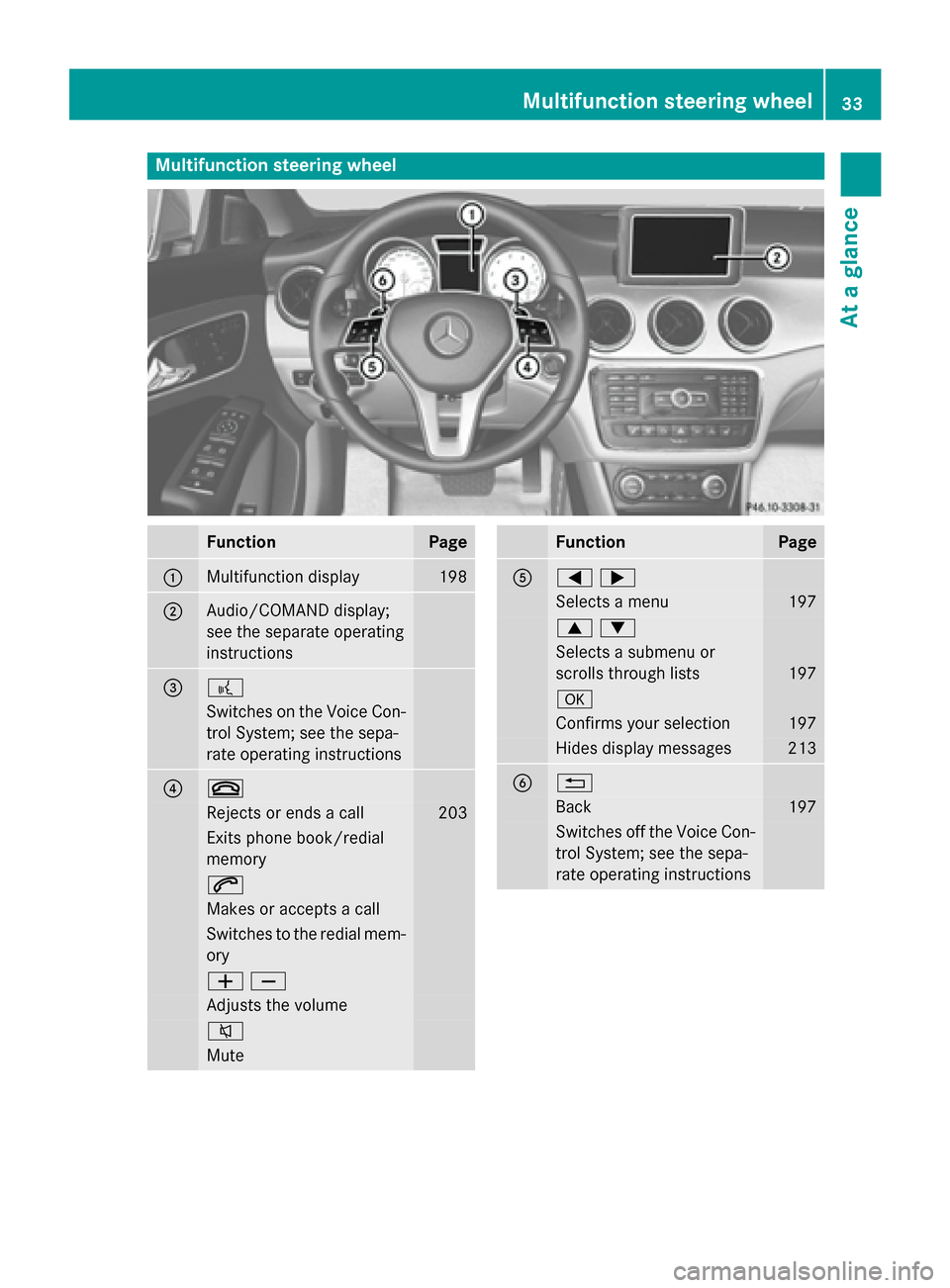
Multifunction steering wheel
Function Page
0043
Multifunction display 198
0044
Audio/COMAND display;
see the separate operating
instructions 0087 0059
Switches on the Voice Con-
trol System; see the sepa-
rate operating instructions 0085 0076
Rejects or ends a call 203
Exits phone book/redial
memory
0061
Makes or accepts a call
Switches to the redial mem-
ory 00810082
Adjusts the volume
0063
Mute Function Page
0083
00590065
Selects a menu 197
00630064
Selects a submenu or
scrolls through lists
197
0076
Confirms your selection 197
Hides display messages 213
0084 0038
Back 197
Switches off the Voice Con-
trol System; see the sepa-
rate operating instructions Multifunction steering wheel
33At a glance
Page 52 of 358

essary repair work carried out at a qualified
specialist workshop.
For safety reasons, Mercedes-Benz recom-
mends that you only use seat accessories
that have been approved by Mercedes-Benz.
Both the driver and the front passenger
should always observe the PASSENGER AIR
BAG OFF indicator lamp as an indication of
whether or not the front passenger is posi-
tioned correctly. Observe also the air bag dis- play messages that can be displayed in the
instrument cluster (Y page 225).
If the driver's air bag deploys, this does not
mean that the front-passenger front air bag
will also deploy.
The OCS may have detected that the seat:
R is empty or occupied by the weight of a
typical child up to twelve months old,
seated in a child restraint system.
R is occupied by a small individual, such as a
young teenager or a small adult.
R is occupied by a child in a child restraint
system whose weight is greater than that of
a typical twelve month old child.
These are examples of when the OCS deacti- vates the front-passenger front air bag. Deac-
tivation takes place although the collision ful- fills the criteria for deploying the driver's air
bag.
For further information, see "Air bag display
messages" (Y page 225).
System self-test G
WARNING
If the 00730074indicator lamp does not illu-
minate, the system is not functioning. You
must contact an authorized Mercedes-Benz
Center before seating any child on the front
passenger seat. G
WARNING
Never place anything between seat cushion
and child seat (e.g. a pillow), since it reduces the effectiveness of the OCS. The underside
and rear side child restraint system must be placed entirely on the seat cushion and the
backrest of the front-passenger seat back-
rest.
If necessary, adjust the tilt of the passenger
seat backrest.
An incorrectly mounted child seat could cause injuries to the child in case of an accident,
instead of increasing protection for the child.
Follow the manufacturer's instructions for
installation of child restraint systems.
The PASSENGER AIR BAG OFF indicator lamp
lights up:
R if you turn the SmartKey in the ignition lock
to position 1or 2
R if an adult is seated properly on the front-
passenger seat and the OCS classifies the
occupant as an adult
The PASSENGER AIR BAG OFF indicator lamp
goes out again after approximately six sec-
onds.
If the seat is not occupied and the OCS
detects that the front-passenger seat is
empty, the PASSENGER AIR BAG OFF indica- tor lamp will continue to light up. The
PASSENGER AIR BAG OFF indicator lamp will
not go out.
For further information, see "Problems with
the Occupant Classification System"
(Y page 51). 50
Occupant safetySafety
Page 53 of 358
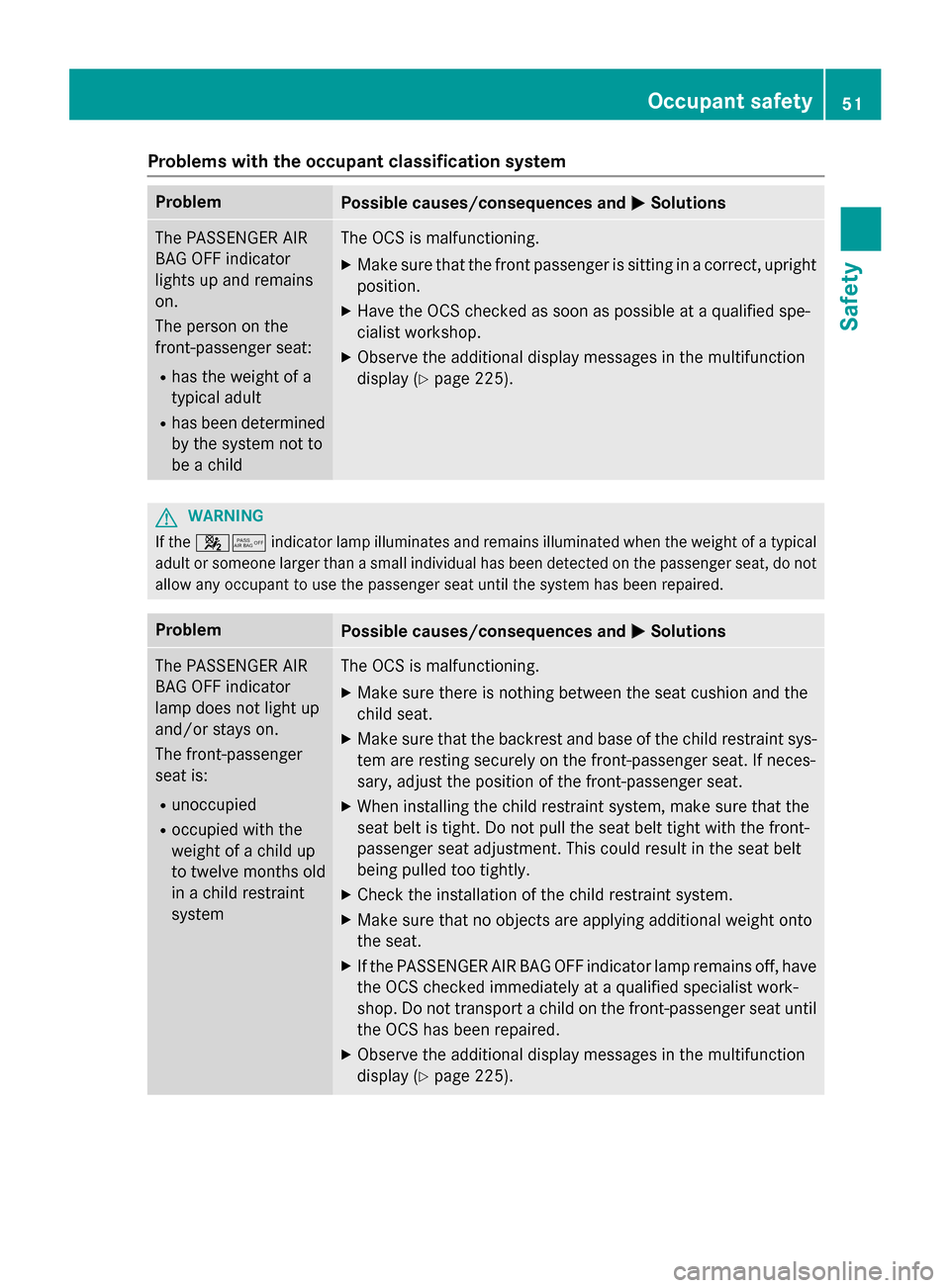
Problems with the occupant classification system
Problem
Possible causes/consequences and
0050
0050Solutions The PASSENGER AIR
BAG OFF indicator
lights up and remains
on.
The person on the
front-passenger seat:
R
has the weight of a
typical adult
R has been determined
by the system not to
be a child The OCS is malfunctioning.
X Make sure that the front passenger is sitting in a correct, upright
position.
X Have the OCS checked as soon as possible at a qualified spe-
cialist workshop.
X Observe the additional display messages in the multifunction
display (Y page 225). G
WARNING
If the 00730074 indicator lamp illuminates and remains illuminated when the weight of a typical
adult or someone larger than a small individual has been detected on the passenger seat, do not allow any occupant to use the passenger seat until the system has been repaired. Problem
Possible causes/consequences and
0050 0050Solutions The PASSENGER AIR
BAG OFF indicator
lamp does not light up
and/or stays on.
The front-passenger
seat is:
R unoccupied
R occupied with the
weight of a child up
to twelve months old
in a child restraint
system The OCS is malfunctioning.
X Make sure there is nothing between the seat cushion and the
child seat.
X Make sure that the backrest and base of the child restraint sys-
tem are resting securely on the front-passenger seat. If neces-
sary, adjust the position of the front-passenger seat.
X When installing the child restraint system, make sure that the
seat belt is tight. Do not pull the seat belt tight with the front-
passenger seat adjustment. This could result in the seat belt
being pulled too tightly.
X Check the installation of the child restraint system.
X Make sure that no objects are applying additional weight onto
the seat.
X If the PASSENGER AIR BAG OFF indicator lamp remains off, have
the OCS checked immediately at a qualified specialist work-
shop. Do not transport a child on the front-passenger seat until the OCS has been repaired.
X Observe the additional display messages in the multifunction
display (Y page 225). Occupant safety
51Safety Z
Page 66 of 358

This allows you to continue steering the vehi-
cle when braking.
The 0025 ABS warning lamp in the instrument
cluster lights up when the ignition is switched on. It goes out when the engine is running.
Important safety notes i
Observe the "Important safety notes" sec-
tion for driving safety systems (Y page 63).G
WARNING
If ABS is faulty, the wheels could lock when
braking. The steerability and braking charac-
teristics may be severely impaired. Addition-
ally, further driving safety systems are deac-
tivated. There is an increased danger of skid- ding and accidents.
Drive on carefully. Have ABS checked imme-
diately at a qualified specialist workshop.
When ABS is malfunctioning, other systems,
including driving safety systems, will also
become inoperative. Observe the information on the ABS warning lamp (Y page 245) and
display messages which may be shown in the
instrument cluster (Y page 214).
ABS works from a speed of about 5 mph
(8 km/h) , regardless of road-surface condi-
tions. ABS works on slippery roads, even if
you only brake gently.
Braking X
If ABS intervenes: continue to depress the
brake pedal vigorously until the braking sit- uation is over.
X To make a full brake application:
depress the brake pedal with full force.
If ABS intervenes when braking, you will feel a
pulsing in the brake pedal.
The pulsating brake pedal can be an indica-
tion of hazardous road conditions, and func-
tions as a reminder to take extra care while
driving. BAS (Brake Assist System)
General information BAS operates in emergency braking situa-
tions. If you depress the brake pedal quickly,
BAS automatically boosts the braking force,
thus shortening the stopping distance.
Important safety notes i
Observe the "Important safety notes" sec-
tion (Y page 63). G
WARNING
If BAS is malfunctioning, the braking distance
in an emergency braking situation is
increased. There is a risk of an accident.
In an emergency braking situation, depress
the brake pedal with full force. ABS prevents
the wheels from locking.
Braking X
Keep the brake pedal firmly depressed until
the emergency braking situation is over.
ABS prevents the wheels from locking.
The brakes will function as usual once you
release the brake pedal. BAS is deactivated. COLLISION PREVENTION ASSIST
General notes COLLISION PREVENTION ASSIST consists of
the Adaptive Brake Assist and the distance
warning function, which are described in the
following.
Distance warning function Important safety notes
i Observe the "Important safety notes" sec-
tion (Y page 63). 64
Driving safety systemsSafety