Page 279 of 468

AUTOMATIC
TRANSMISSION FLUID
CHECK
6F35/HF35 transmission (If
Equipped)
Note: Transmission fluid should be
checked by an authorized dealer. If
required, fluid should be added by an
authorized dealer.
The automatic transmission does not
have a transmission fluid dipstick.
Refer to your scheduled maintenance
information for scheduled intervals
for fluid checks and changes. Your
transmission does not consume fluid.
However, the fluid level should be
checked if the transmission is not
working properly, (For example: if the
transmission slips or shifts slowly) or
if you notice some sign of fluid
leakage. See Scheduled
Maintenance (page 436).
Do not use supplemental transmission
fluid additives, treatments or cleaning
agents. The use of these materials
may affect transmission operation
and result in damage to internal
transmission components.
6F50/6F55 Transmission (If
Equipped)
WARNINGS
The dipstick cap and surrounding
components may be hot; gloves
are recommended.
WARNINGS
Use gloves when moving the air
filter assembly. Components will
be hot.
Note: Automatic transmission fluid
expands when warmed. To obtain an
accurate fluid check, drive the vehicle
until it is warmed up (approximately
20 miles [30 kilometers]). If your
vehicle has been operated for an
extended period at high speeds, in city
traffic during hot weather or pulling a
trailer, the vehicle should be turned off
until normal operating temperatures
are reached to allow the fluid to cool
before checking. Depending on vehicle
use, cooling times could take up to 30
minutes or longer.
Refer to your scheduled maintenance
information for scheduled intervals
for fluid checks and changes. Your
transmission does not consume fluid.
However, the fluid level should be
checked if the transmission is not
working properly. For example, if the
transmission slips or shifts slowly or
if you notice some sign of fluid
leakage.
1. Drive the vehicle 20 miles (30 kilometers) or until it reaches
normal operating temperature
2. Park the vehicle on a level surface and engage the parking brake.
276
Maintenance
Page 282 of 468

High fluid level
E158844
If the fluid level is above the MAX
range of the dipstick, remove fluid to
reach the hashmark level.
Note:Fluid level above the MAX level
may cause shift or engagement
concerns or possible damage. High
fluid levels can be caused by an
overheating condition. If your vehicle
has been operated for an extended
period at high speeds, in city traffic
during hot weather or pulling a trailer,
the vehicle should be turned off until
normal operating temperatures are
reached. Depending on vehicle use,
cooling times could take up to 30
minutes or longer.
Adjusting Automatic Transmission
Fluid Levels
E158845
E158846
Before adding any fluid, make sure the
correct type is used. The type of fluid
used is normally indicated on the
dipstick and also in the Technical
Specifications section in this chapter.
Note: An overfill condition of
transmission fluid may cause shift or
engagement concerns or possible
damage.
Do not use supplemental transmission
fluid additives, treatments or cleaning
agents. The use of these materials
may affect transmission operation
and result in damage to internal
transmission components. Reinstall
the air filter assembly. After the fluid
level has been checked and adjusted
as necessary, do the following:
1. Shut the engine off.
2. Loosen the clamp holding the air filter assembly to the rubber hose.
3. Rotate the air filter assembly 90 degrees clockwise without
disconnecting the sensor.
4. Seat the air filter assembly back into the grommets by pushing
down on the air filter assembly.
5. Tighten the clamp.
6. Install and tighten two bolts that attach air filter assembly to the
front of the vehicle.
279
Maintenance
Page 336 of 468
Code
Description
A
Six-speed automatic transmission 6F50
W
Six-speed automatic transmission 6F35
333
Capacities and Specifications
Page 337 of 468

TECHNICAL SPECIFICATIONS
Ford part number /Ford specification
Ford part name or
equivalent
Capacity
Item
PM-20 / WSS-
M6C65-A2 and
ISO 4925 Class 6
Motorcraft™ DOT 4
LV High Perform-ance Brake Fluid
Between MIN
and MAX on reservoir
Brake fluid 1
Motorcraft XL-5
(aerosol) and/or
CRCSL3151ESB / ESB-M1C93-B
Multi-Purpose
Grease (lithium grease)
Not applicable
Hinges, latches,
striker plates and
rotors, seat tracks, fuel filler door
hinge and spring
XL-1 / None
Motorcraft Penet-
rating and Lock Lubricant
Not applicable
Lock cylinder
XT-10-QLV
MERCON LV
Motorcraft
MERCON™ LV ATF
9.0 qt (8.5 L)
6F35 automatic
transmission fluid
2, 3
11.6 qt (11 L)
6F50 automatic
transmission fluid
2, 3
XY-80W90-QL / WSP-M2C197-A
Motorcraft SAE
80W-90 Premium
Rear Axle Lubricant
2.4 pt (1.15 L)
Rear differential
(AWD) fluid
XY-75W140-QL /WSL-M2C192-A
Motorcraft SAE
75W-140 Synthetic
Rear Axle Lubricant
12 fl oz (0.35
L)
Power Transfer
Unit (PTU) fluid
(AWD)
4
XO-5W30-QSP
Motorcraft SAE 5W-
30 or equivalent motor oil
5.7 qt (5.4 L)
2.0L EcoBoost
engine oil 5, 6WSS-M2C946-A
XO-5W20-QSP
Motorcraft SAE 5W-
20 or equivalent motor oil
6 qt (5.7 L)
3.7L V6 engine oil
5,
6
WSS-M2C945-A
334
Capacities and Specifications
Page 339 of 468
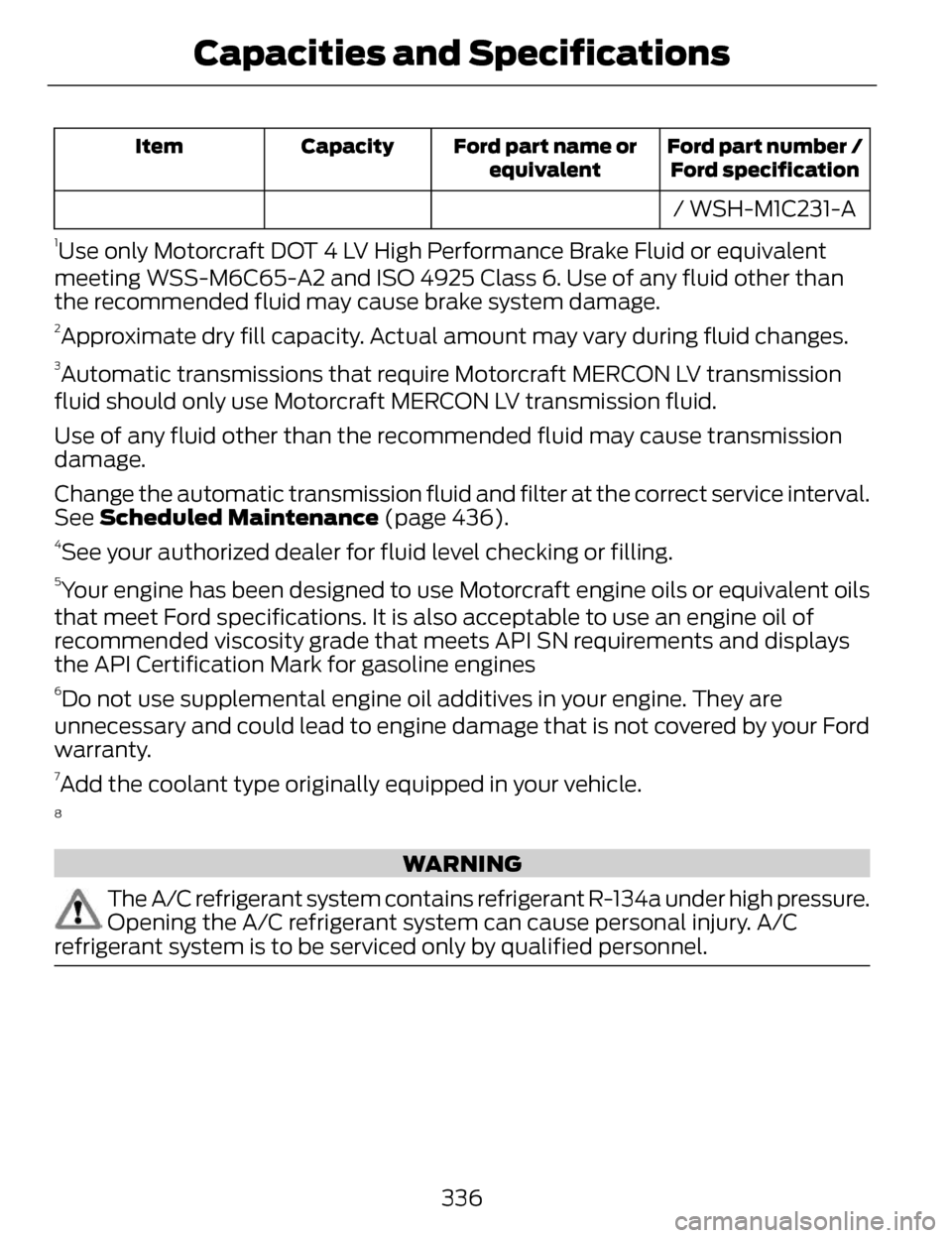
Ford part number /Ford specification
Ford part name or
equivalent
Capacity
Item
/ WSH-M1C231-A
1Use only Motorcraft DOT 4 LV High Performance Brake Fluid or equivalent
meeting WSS-M6C65-A2 and ISO 4925 Class 6. Use of any fluid other than
the recommended fluid may cause brake system damage.
2Approximate dry fill capacity. Actual amount may vary during fluid changes.
3Automatic transmissions that require Motorcraft MERCON LV transmission
fluid should only use Motorcraft MERCON LV transmission fluid.
Use of any fluid other than the recommended fluid may cause transmission
damage.
Change the automatic transmission fluid and filter at the correct service interval.
See Scheduled Maintenance (page 436).
4See your authorized dealer for fluid level checking or filling.
5Your engine has been designed to use Motorcraft engine oils or equivalent oils
that meet Ford specifications. It is also acceptable to use an engine oil of
recommended viscosity grade that meets API SN requirements and displays
the API Certification Mark for gasoline engines
6Do not use supplemental engine oil additives in your engine. They are
unnecessary and could lead to engine damage that is not covered by your Ford
warranty.
7Add the coolant type originally equipped in your vehicle.
8
WARNING
The A/C refrigerant system contains refrigerant R-134a under high pressure.
Opening the A/C refrigerant system can cause personal injury. A/C
refrigerant system is to be serviced only by qualified personnel.
336
Capacities and Specifications
Page 389 of 468

Phone
A
Quick Dial
B
Phonebook
C
History
D
Messaging
E
Settings
F
Hands-free calling is one of the main
features of SYNC. Once you pair your
phone, you can access many options
using the touchscreen or voice
commands. While the system
supports a variety of features, many
are dependent on your cellular
phone’s functionality.
At a minimum, most cellular phones
with Bluetooth wireless technology
support the following functions:
• Answering an incoming call
• Ending a call
• Using privacy mode
• Dialing a number
• Redialing
• Call waiting notification
• Caller ID.
Other features, such as text
messaging using Bluetooth and
automatic phonebook download, are
phone-dependent features. To check
your phone’s compatibility, see your
device’s manual and visit
www.SYNCMyRide.com,
www.SYNCMyRide.ca or
www.syncmaroute.ca.
Pairing Your Phone for the First
Time
WARNING
Driving while distracted can
result in loss of vehicle control,
crash and injury. We strongly
recommend that you use extreme
caution when using any device that
may take your focus off the road. Your
primary responsibility is the safe
operation of your vehicle. We
recommend against the use of any
hand-held device while driving and
encourage the use of voice-operated
systems when possible. Make sure you
are aware of all applicable local laws
that may affect the use of electronic
devices while driving
The first thing you must do to use the
phone features of SYNC is to pair your
Bluetooth-enabled cellular phone
with SYNC. This allows you to use
your phone in a hands-free manner.
Note: Put the transmission in position
P. Turn on your vehicle ignition and the
radio.
386
MyLincoln Touch™
Page 443 of 468

Multi-Point inspection
Windshield for cracks, chips or pits
For oil and fluid leaks
Washer spray and wiper operation
Half-shaft dust boots
* Brake, coolant recovery reservoir, automatic transmission and window washer
**If your vehicle is equipped with a temporary mobility kit, check the tire sealant
expiration Use By date on the canister. Replace as needed.
Be sure to ask your dealership service
advisor or technician about the
multi-point vehicle inspection. It is a
comprehensive way to perform a
thorough inspection of your vehicle.
Your checklist gives you immediate
feedback on the overall condition of
your vehicle.
NORMAL SCHEDULED
MAINTENANCE
Intelligent Oil-Life Monitor®
Your vehicle is equipped with an
Intelligent Oil-Life Monitor that
determines when you should change
the engine oil based on how your
vehicle is used. By using several
important factors in its calculations,
the monitor helps reduce the cost of
owning your vehicle and reduces
environmental waste at the same
time. This means you do not have to
remember to change the oil on a
mileage-based schedule. Your vehicle
lets you know when an oil change is
due by displaying ENGINE OIL
CHANGE DUE
or OIL CHANGE
REQUIRED in the information display.
The following table provides
examples of vehicle use and its
impact on oil change intervals. It is a
guideline only. Actual oil change
intervals depend on several factors
and generally decrease with severity
of use.
When to expect the OIL CHANGE REQUIRED message
Vehicle use and example
Miles (kilometers)
Normal
7500-10000
(12000-16000) Normal commuting with highway driving
440
Scheduled Maintenance
Page 444 of 468

When to expect the OIL CHANGE REQUIRED messageVehicle use and example
Miles (kilometers)
No, or moderate, load or towing
Flat to moderately hilly roads
No extended idling
Severe
5000-7499
(8000-11999) Moderate to heavy load or towing
Mountainous or off-road conditions
Extended idling
Extended hot or cold operation
Extreme
3000-4999
(4000-7999) Maximum load or towing
Extreme hot or cold operation
Maintenance Intervals
At every oil change interval as indicated by the information display*
Change engine oil and filter.**
Rotate the tires.
Perform a multi-point inspection (recommended).
Inspect the automatic transmission fluid level. Consult your dealer for
requirements.
Inspect the brake pads, shoes, rotors, drums, brake linings, hoses and parking
brake.
Inspect the engine cooling system strength and hoses.
Inspect the exhaust system and heat shields.
Inspect the rear axle and U-joints. Lubricate any areas with grease fittings (All-
wheel drive vehicles).
Inspect the half-shaft boots.
441
Scheduled Maintenance
