Page 494 of 573
4938-2. Steps to take in an emergency
8
When trouble arises
IS350/250_U (OM53758U)
CAUTION
■Avoiding battery fires or explosions
Observe the following precautions to prevent accidentally igniting the flammable gas
that may be emitted from the battery:
●Make sure each jumper cable is connected to the correct terminal and that it is not
unintentionally in contact with any other than the intended terminal.
●Do not allow the other end of the jumper cable connected to the “+” terminal to come
into contact with any other parts or metal surfaces in the area, such as brackets or
unpainted metal.
●Do not allow the + and - clamps of the jump er cables to come into contact with each
other.
●Do not smoke, use matches, cigarette lighters or allow open flame near the battery.
■Battery precautions
The battery contains poisonous and corrosive acidic electrolyte, while related parts
contain lead and lead comp ounds. Observe the following precautions when handling
the battery:
●When working with the battery, always wear safety glasses and take care not to allow
any battery fluids (acid) to come into contact with skin, clothing or the vehicle body.
●Do not lean over the battery.
●In the event that battery fluid comes into contact with the skin or eyes, immediately
wash the affected area with water and seek medical attention.
Place a wet sponge or cloth over the affected area until medical attention can be
received.
●Always wash your hands after handling the battery support, terminals, and other bat-
tery-related parts.
●Do not allow children near the battery.
NOTICE
■When handling jumper cables
When connecting the jumper cables, ensure th at they do not become entangled in the
cooling fans or engine drive belt.
Page 495 of 573
4948-2. Steps to take in an emergency
IS350/250_U (OM53758U)
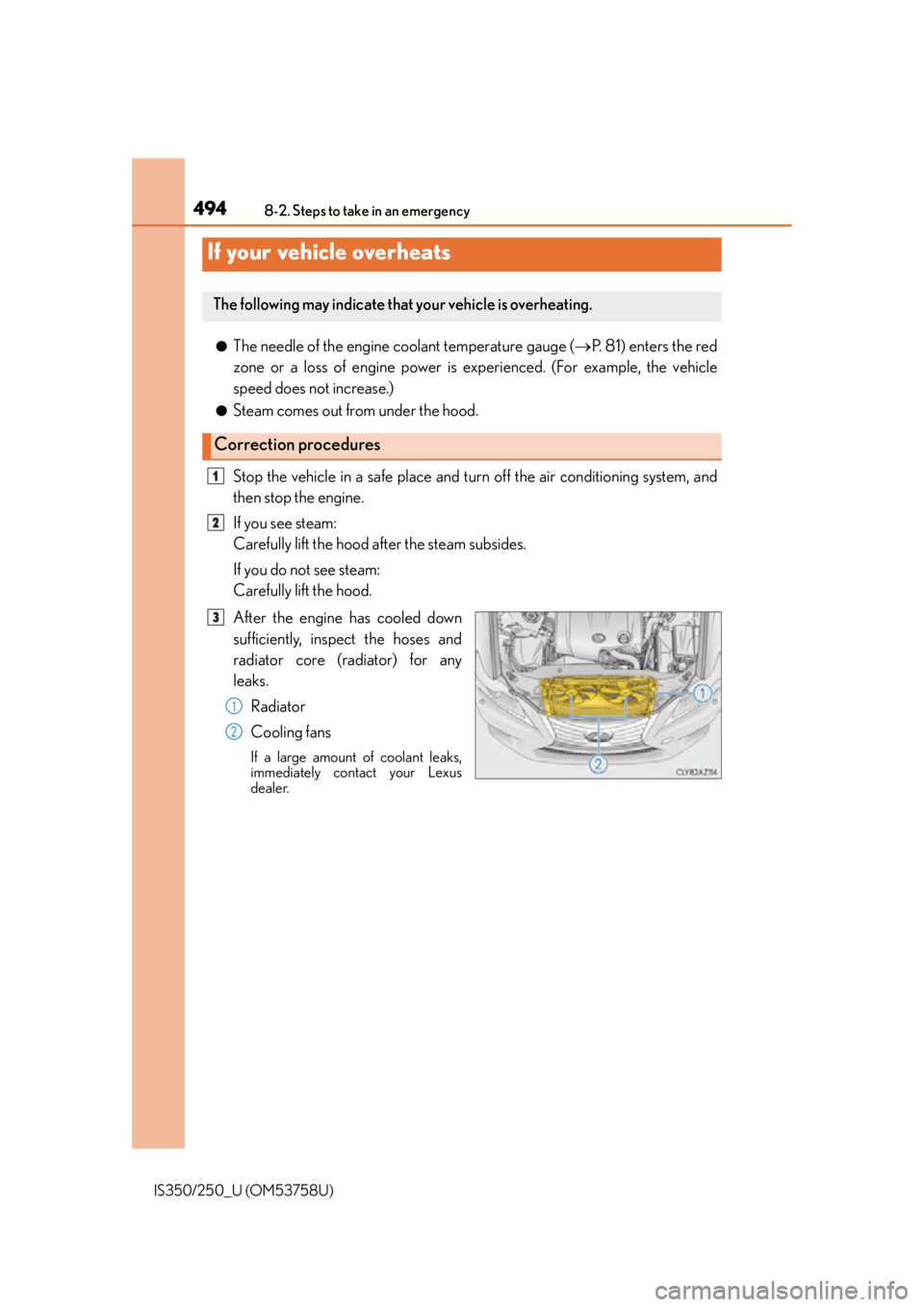
●The needle of the engine coolant temperature gauge (P. 81) enters the red
zone or a loss of engine power is experienced. (For example, the vehicle
speed does not increase.)
●Steam comes out from under the hood.
Stop the vehicle in a safe place and tu rn off the air conditioning system, and
then stop the engine.
If you see steam:
Carefully lift the hood after the steam subsides.
If you do not see steam:
Carefully lift the hood.
After the engine has cooled down
sufficiently, inspect the hoses and
radiator core (radiator) for any
leaks.
Radiator
Cooling fans
If a large amount of coolant leaks,
immediately contact your Lexus
dealer.
If your vehicle overheats
The following may indicate that your vehicle is overheating.
Correction procedures
1
2
3
1
2
Page 496 of 573
4958-2. Steps to take in an emergency
8
When trouble arises
IS350/250_U (OM53758U)
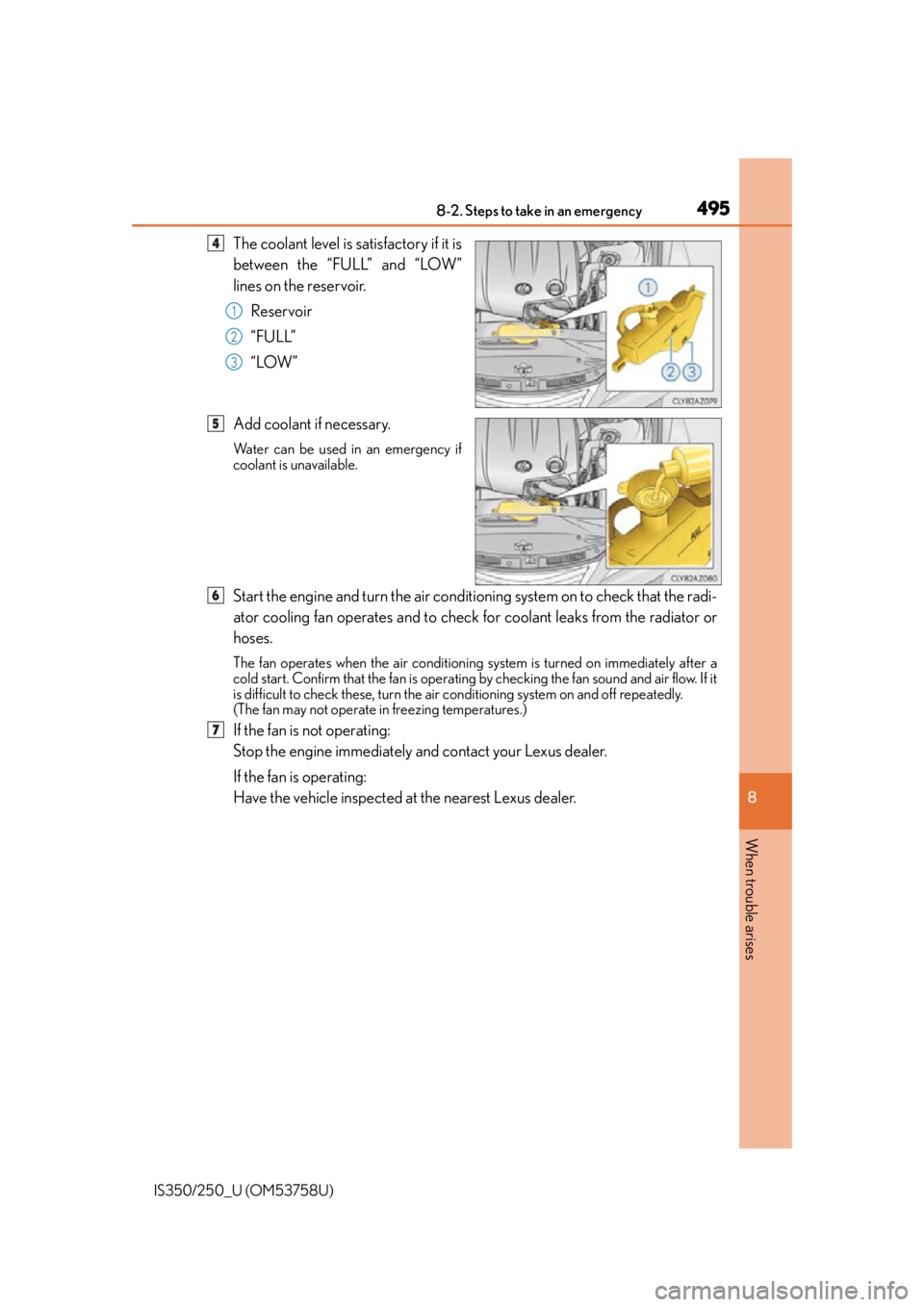
The coolant level is satisfactory if it is
between the “FULL” and “LOW”
lines on the reservoir.Reservoir
“FULL”
“LOW”
Add coolant if necessary.
Water can be used in an emergency if
coolant is unavailable.
Start the engine and turn the air conditioning system on to check that the radi-
ator cooling fan operates and to check for coolant leaks from the radiator or
hoses.
The fan operates when the air conditioning system is turned on immediately after a
cold start. Confirm that the fan is operating by checking the fan sound and air flow. If it
is difficult to check these, turn the air conditioning system on and off repeatedly.
(The fan may not operate in freezing temperatures.)
If the fan is not operating:
Stop the engine immediately and contact your Lexus dealer.
If the fan is operating:
Have the vehicle inspected at the nearest Lexus dealer.
4
1
2
3
5
6
7
Page 497 of 573
4968-2. Steps to take in an emergency
IS350/250_U (OM53758U)
CAUTION
■When inspecting under the hood of your vehicle
Observe the following precautions.
Failure to do so may result in serious injury such as burns.
●If steam is seen coming from under the hood, do not open the hood until the steam
has subsided. The engine compartment may be very hot.
●Keep hands and clothing (especially a tie, a scarf or a muffler) away from the fans and
belts. Failure to do so may cause the hands or clothing to be caught, resulting in seri-
ous injury.
NOTICE
■When adding engine coolant
Add coolant slowly after the engine has cooled down sufficiently. Adding cool coolant
to a hot engine too quickly can cause damage to the engine.
■To prevent damage to the cooling system
Observe the following precautions:
●Avoid contaminating the coolant with foreign matter (such as sand or dust etc.).
●Do not use commercially available coolant additives.
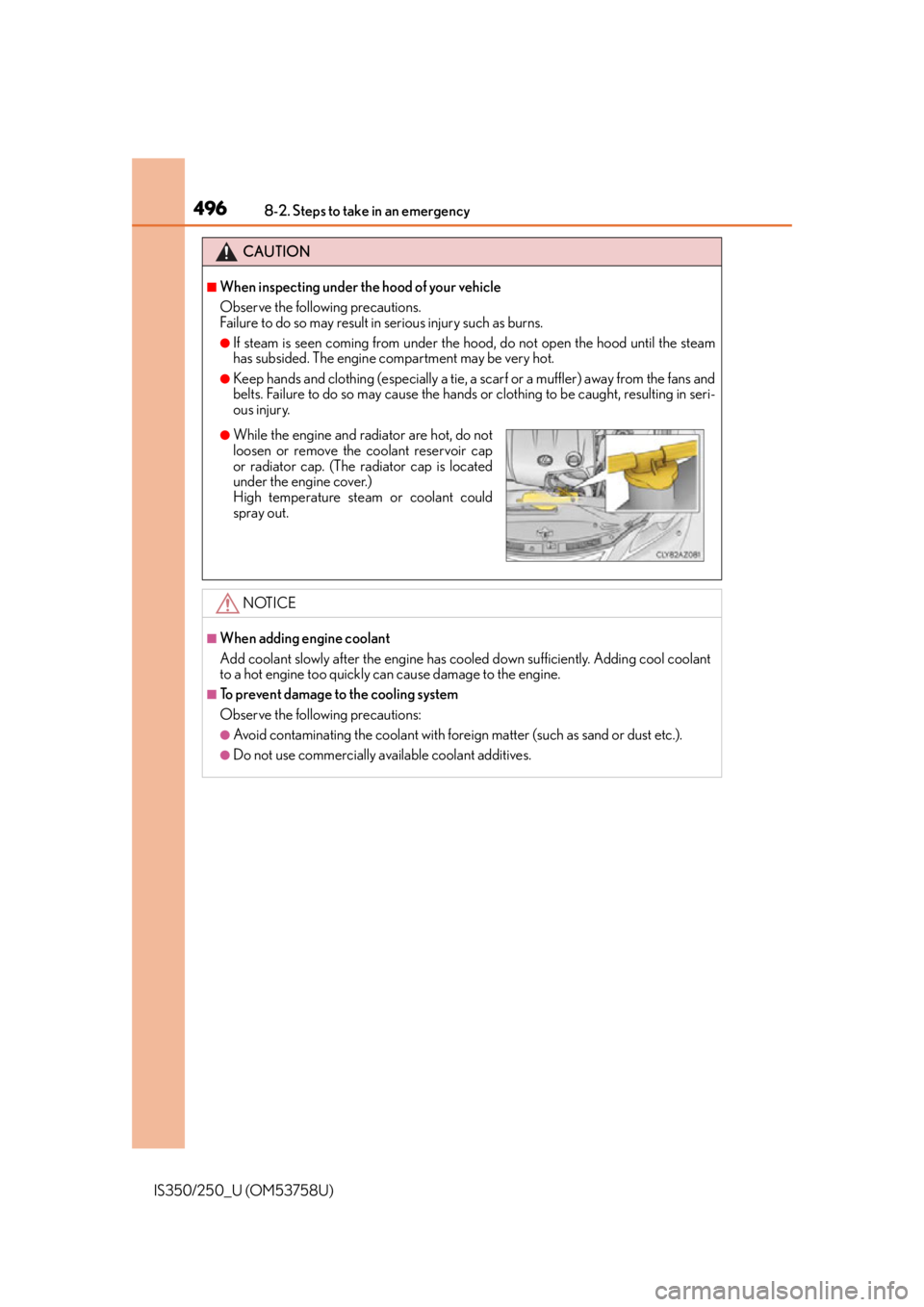
●While the engine and radiator are hot, do not
loosen or remove the coolant reservoir cap
or radiator cap. (The radiator cap is located
under the engine cover.)
High temperature steam or coolant could
spray out.
Page 498 of 573
4978-2. Steps to take in an emergency
8
When trouble arises
IS350/250_U (OM53758U)
Stop the engine. Set the parking brake and shift the shift lever to P.
Remove the mud, snow or sand from around the rear wheels.
Place wood, stones or some other material under the rear wheels to help pro-
vide traction.
Restart the engine.
Shift the shift lever to D or R and release the parking brake. Then, while exer-
cising caution, depress the accelerator pedal.
■When it is difficult to free the vehicle
If the vehicle becomes stuck
Carry out the following procedures if the tires spin or the vehicle becomes
stuck in mud, dirt or snow:
Press to turn off TRAC.
1
2
3
4
5
Page 499 of 573
4988-2. Steps to take in an emergency
IS350/250_U (OM53758U)
CAUTION
■When attempting to free a stuck vehicle
If you choose to push the vehicle back and forth to free it, make sure the surrounding
area is clear to avoid striking other vehicles, objects or people. The vehicle may also
lunge forward or lunge back suddenly as it becomes free. Use extreme caution.
■When shifting the shift lever
Be careful not to shift the shift lever with the accelerator pedal depressed.
This may lead to unexpected rapid accelerati on of the vehicle that may cause an acci-
dent resulting in death or serious injury.
NOTICE
■To avoid damaging the transmission and other components
●Avoid spinning the rear wheels and depressing the accelerator pedal more than nec-
essary.
●If the vehicle remains stuck even after th ese procedures are performed, the vehicle
may require towing to be freed.
Page 515 of 573

5149-1. Specifications
IS350/250_U (OM53758U)
Ti r e s i z e ( P. 5 1 6 )
TUBELESS or TUBE TYPE
A tubeless tire does not have a tube and air is directly put into the tire. A tube type tire
has a tube inside the tire and the tube maintains the air pressure.
Radial tires or bias-ply tires
A radial tire has “RADIAL” on the sidewall. A tire not marked “RADIAL” is a bias-ply
tire.
Summer tires or all season tires ( P. 4 1 5 )
An all season tire has “M+S” on the sidewall. A tire not marked “M+S” is a summer
tire.
Maximum cold tire inflation pressure ( P. 5 2 0 )
This means the pressure to which a tire may be inflated.
Load limit at maximum cold tire inflation pressure (P. 5 2 0 )
Tire ply composition and materials
Plies are layers of rubber-coated parallel co rds. Cords are the strands which form the
plies in a tire.
Uniform tire quality grading
For details, see “Uniform Tire Quality Grading” that follows.
DOT and Tire Identification Number (TIN) ( P. 5 1 5 )
Location of treadwear indicators (P. 4 1 1 )
“TEMPORARY USE ONLY”
A compact spare tire is identified by the phrase “TEMPORARY USE ONLY” molded
on its sidewall. This tire is design ed for temporary emergency use only.
1
2
3
4
5
6
7
8
9
10
11
Page 534 of 573

5339-2. Customization
9
Vehicle specifications
IS350/250_U (OM53758U)
■Vehicle customization
●When the smart access system with push-button start is off, the entry unlock function
cannot be customized.
●When the doors remain closed after unlocking the doors and the timer activated auto-
matic door lock function activates, signals will be generated in accordance with the
operation buzzer volume and operational si gnal (Emergency flashers) function set-
tings.
■When customizing using the Remote Touch or Lexus Display Audio controller
Stop the vehicle in a safe place, apply the parking brake, and shift the shift lever to P. Also,
to prevent battery discharge, leave the engi ne running while customizing the features.
CAUTION
■During customization
As the engine needs to be running during customization, ensure that the vehicle is
parked in a place with adequate ventilation. In a closed area such as a garage, exhaust
gases including harmful carbon monoxide (CO) may collect and enter the vehicle. This
may lead to death or a serious health hazard.
NOTICE
■During customization
To prevent battery discharge, ensure that the engine is running while customizing fea-
tures.