Page 695 of 918
694
ES350_300h_OM_OM33A60U_(U)
6-3. Do-it-yourself maintenance
■Adding distilled waterRemove the vent plug.
Add distilled water.
If the “UPPER LEVEL” line cannot
be seen, check the fluid level by
looking directly at the cell.
Put the vent plug back on and close it securely.
■Before recharging
When recharging, the 12-volt battery produces hydrogen gas which is flammable
and explosive. Therefore, observe the following before recharging:
●If recharging with the 12-volt battery installed on the vehicle, be sure to disconnect
the ground cable.
●Make sure the power switch on the charger is off when connecting and discon-
necting the charger cables to the 12-volt battery.
1
Low O.K.2
3
Page 703 of 918
702
ES350_300h_OM_OM33A60U_(U)
6-3. Do-it-yourself maintenance
Tires
New tread
Treadwear indicator
Worn tread
The location of treadwear indicators is
shown by the “TWI” or “∆” marks, etc.,
molded on the sidewall of each tire.
Check spare tire condition and pres-
sure if not rotated.
Rotate the tires in the order shown.
To equalize tire wear and extend tire life, Lexus recommends that tire rotation is
carried out at the same interval as tire inspection.
Do not fail to initialize the tire pressure warning system after tire rotation.
Replace or rotate tires in accord ance with maintenance schedules and
treadwear.
Checking tires
1
2
3
Tire rotation
XVehicles with compact spare tireXVehicles with full-size spare tire
FrontFront
Page 706 of 918

ES350_300h_OM_OM33A60U_(U)
7056-3. Do-it-yourself maintenance
6
Maintenance and care
◆Registering ID codes
The tire pressure warning valve and transmitter is equipped with a
unique ID code. When replacing a tire pressure warning valve and
transmitter, it is necessary to register the ID code. Have the ID code
registered by your Lexus dealer.
■When to replace your vehicle’s tires
Tires should be replaced if:
●You have tire damage such as cuts, splits, cracks deep enough to expose the fabric,
and bulges indicating internal damage
●A tire goes flat repeatedly or cannot be properly repaired due to the size or loca-
tion of a cut or other damage
If you are not sure, consult with your Lexus dealer.
■Replacing tires and wheels
If the ID code of the tire pressure warning valve and transmitter is not registered, the
tire pressure warning system will not work properly. After driving for about 20 min-
utes, the tire pressure warning light blinks for 1 minute and stays on to indicate a sys-
tem malfunction.
■Tire life
Any tire over 6 years old must be checked by a qualified technician even if it has sel-
dom or never been used or damage is not obvious.
■Routine tire inflation pressure checks
The tire pressure warning system does not replace routine tire inflation pressure
checks. Make sure to check tire inflation pressure as part of your routine of daily
vehicle checks.
■When rotating the tires
Make sure that the “START STOP ENGINE” <“POWER”> switch is off. If the tires are
rotated while the “START STOP ENGINE” <“POWER”> switch is in IGNITION ON
mode, the tire position information will not be updated.
If this accidentally occurs, either turn the “START STOP ENGINE” <“POWER”>
switch to off and then to IGNITION ON mode, or initialize the system after
checking that the tire pressure is properly adjusted.
Page 707 of 918

706
ES350_300h_OM_OM33A60U_(U)
6-3. Do-it-yourself maintenance
■Low profile tires (P225/45R18 tires)
Generally, low profile tires will wear more rapidly and tire grip performance will be
reduced on snowy and/or icy roads when compared to standard tires. Be sure to use
snow tires or tire chains on snowy and/or icy roads and drive carefully at a speed
appropriate for road and weather conditions.
■Maximum load of tire
Check that the maximum load of the replacement tire is greater than 1 /2 of the
Gross Axle Weight Ratings (GAWR) of either the front axle or the rear axle, which-
ever is greater.
■Tire types
●Summer tires
Summer tires are high-speed performance tires best suited to highway driving
under dry conditions. Since summer tires do not have the same traction perfor-
mance as snow tires, summer tires are inadequate for driving on snow-covered or
icy roads. For driving on snow-covered roads or icy roads, the use of snow tires is
recommended. When installing snow tires, be sure to replace all four tires.
●All season tires
All season tires are designed to provide better traction in snow and to be ade-
quate for driving in most winter conditions as well as for use year-round. All season
tires, however, do not have adequate traction performance compared with snow
tires in heavy or loose snow. Also, all season tires fall short in acceleration and han-
dling performance compared with summer tires in highway driving.
●Snow tires
For driving on snow-covered roads or icy roads, we recommend using snow tires.
If you need snow tires, select tires of the same size, construction and load capacity
as the originally installed tires. Since your vehicle has radial tires as original equip-
ment, make sure your snow tires also have radial construction. Do not install stud-
ded tires without first checking local regulations for possible restrictions. Snow
tires should be installed on all wheels. (→P. 3 3 0 )
For the GAWR, see the Certification Label.
For the maximum load of the tire, see the load
limit at maximum cold tire inflation pressure
mentioned on the sidewall of the tire.
(
→ P. 8 5 0 )
Page 714 of 918
ES350_300h_OM_OM33A60U_(U)
7136-3. Do-it-yourself maintenance
6
Maintenance and care
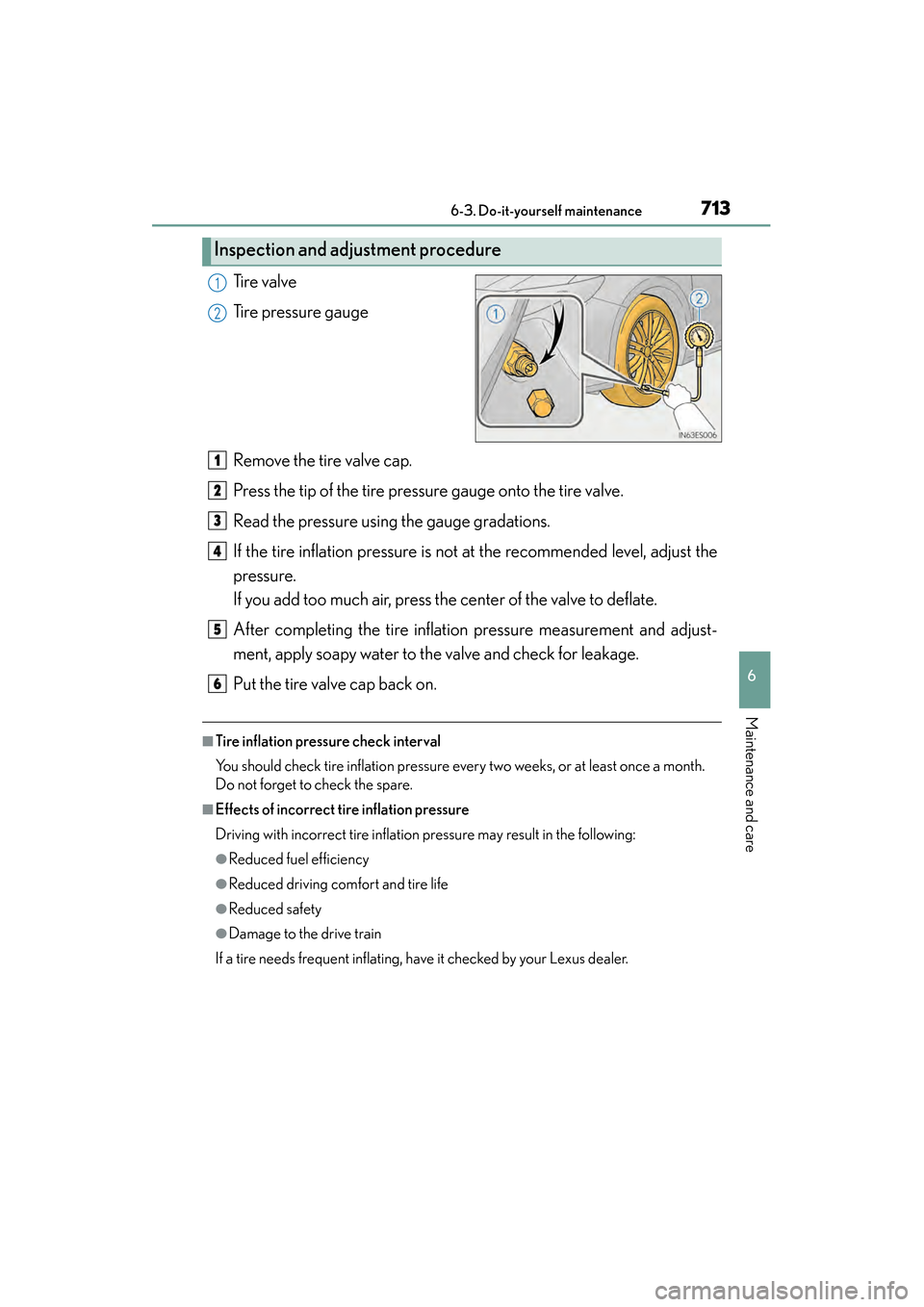
Ti r e v a l v e
Tire pressure gauge
Remove the tire valve cap.
Press the tip of the tire pressure gauge onto the tire valve.
Read the pressure using the gauge gradations.
If the tire inflation pressure is not at the recommended level, adjust the
pressure.
If you add too much air, press the center of the valve to deflate.
After completing the tire inflation pressure measurement and adjust-
ment, apply soapy water to the valve and check for leakage.
Put the tire valve cap back on.
■Tire inflation pressure check interval
You should check tire inflation pressure every two weeks, or at least once a month.
Do not forget to check the spare.
■Effects of incorrect tire inflation pressure
Driving with incorrect tire inflation pressure may result in the following:
●Reduced fuel efficiency
●Reduced driving comfort and tire life
●Reduced safety
●Damage to the drive train
If a tire needs frequent inflating, have it checked by your Lexus dealer.
Inspection and adjustment procedure
1
2
1
2
3
4
5
6
Page 715 of 918
714
ES350_300h_OM_OM33A60U_(U)
6-3. Do-it-yourself maintenance
■Instructions for checking tire inflation pressure
When checking tire inflation pressure, observe the following:
●Check only when the tires are cold.
If your vehicle has been parked for at least 3 hours or has not been driven for more
than 1 mile or 1.5 km, you will get an accurate cold tire inflation pressure reading.
●Always use a tire pressure gauge.
The appearance of the tire can be misleading. In addition, tire inflation pressure that
is even just a few pounds off can affect ride quality and handling.
●Do not reduce tire inflation pressure after driving. It is normal for tire inflation pres-
sure to be higher after driving.
●Never exceed the vehicle capacity weight.
Passengers and luggage weight should be placed so that the vehicle is balanced.
CAUTION
■Proper inflation is critical to save tire performance
Keep your tires properly inflated. Otherwise, the following conditions may occur
and result in an accident causing death or serious injury:
●Excessive wear
●Uneven wear
●Poor handling
●Possibility of blowouts resulting from overheated tires
●Poor sealing of the tire bead
●Wheel deformation and/or tire separation
●A greater possibility of tire damage from road hazards
NOTICE
■When inspecting and adjusting tire inflation pressure
Be sure to put the tire valve caps back on.
Without the valve caps, dirt or moisture could get into the valve and cause air leak-
age, which could result in an accident. If the caps are lost, replace them as soon as
possible.
Page 716 of 918

715
ES350_300h_OM_OM33A60U_(U)
6-3. Do-it-yourself maintenance
6
Maintenance and care
Wheels
When replacing wheels, care should be taken to ensure that they are
equivalent to those removed in load capacity, diameter, rim width and
inset
*.
Replacement wheels are available at your Lexus dealer.
*: Conventionally referred to as “offset”.
Lexus does not recommend using the following:
●Wheels of different sizes or types
●Used wheels
●Bent wheels that have been straightened
●Use only Lexus wheel nuts and wrenches designed for use with your
aluminum wheels.
●When rotating, repairing or changing your tires, check that the wheel
nuts are still tight after driving 1000 miles (1600 km).
●Be careful not to damage the aluminum wheels when using tire chains.
●Use only Lexus genuine balance weights or equivalent and a plastic or
rubber hammer when balancing your wheels.
If a wheel is bent, cracked or heavily corroded, it should be replaced.
Otherwise, the tire may separate from the wheel or cause a loss of han-
dling control.
Wheel selection
Aluminum wheel precautions
Page 719 of 918
718
ES350_300h_OM_OM33A60U_(U)
6-3. Do-it-yourself maintenance
Slide and pull out the filter.
Replace it with a new one.
The “↑UP” marks shown on the filter
should be pointing up.
■Changing interval
Inspect and replace the air conditioning filter according to the maintenance sched-
ule. In dusty areas or areas with heavy traffic flow, early replacement may be
required. (For scheduled maintenance information, please refer to the “Owner’s
Manual Supplement” or “Scheduled Maintenance”.)
■If air flow from the vents decreases dramatically
The filter may be clogged. Check the filter and replace if necessary.
5
NOTICE
■When using the air conditioning system
Make sure that a filter is always installed.
Using the air conditioning system without a filter may cause damage to the system.


