Page 20 of 457
35
Safety features of your vehicle
(Continued)
No passenger should ride inthe cargo area or sit or lie on
folded seatbacks while the
vehicle is moving. All passen-
gers must be properly seated
in seats and restrained prop-
erly while riding.
When resetting the seatback to the upright position, make
sure it is securely latched by
pushing it forward and back-
wards.
To avoid the possibility of burns, do not remove the car-
pet in the cargo area.
Emission control devices
beneath this floor generate
high temperatures.WARNING
After adjusting the seat, always
check that it is securely locked
into place by attempting to
move the seat forward or back-
ward without using the lock
release lever. Sudden or unex-
pected movement of the dri-
ver's seat could cause you to
lose control of the vehicle
resulting in an accident.
WARNING
Do not adjust the seat whilewearing seat belts. Moving the
seat cushion forward may
cause strong pressure on the
abdomen.
Use extreme caution so that hands or other objects are not
caught in the seat mecha-
nisms while the seat is mov-
ing.
Do not put a cigarette lighter on the floor or seat. When you
operate the seat, gas may
gush out of the lighter and
cause fire.
Page 28 of 457
313
Safety features of your vehicle
C010107AUN
Front seat heater (if equipped)
Type A
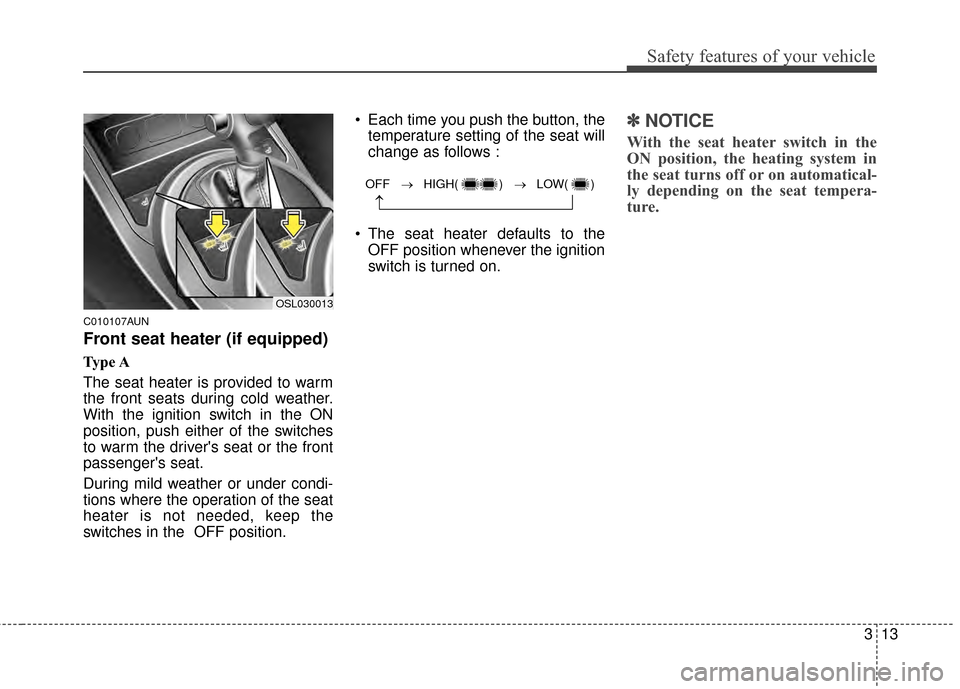
The seat heater is provided to warm
the front seats during cold weather.
With the ignition switch in the ON
position, push either of the switches
to warm the driver's seat or the front
passenger's seat.
During mild weather or under condi-
tions where the operation of the seat
heater is not needed, keep the
switches in the OFF position. Each time you push the button, the
temperature setting of the seat will
change as follows :
The seat heater defaults to the OFF position whenever the ignition
switch is turned on.
✽ ✽ NOTICE
With the seat heater switch in the
ON position, the heating system in
the seat turns off or on automatical-
ly depending on the seat tempera-
ture.
OSL030013
OFF → HIGH( ) → LOW( )
→
Page 29 of 457
Safety features of your vehicle
14
3
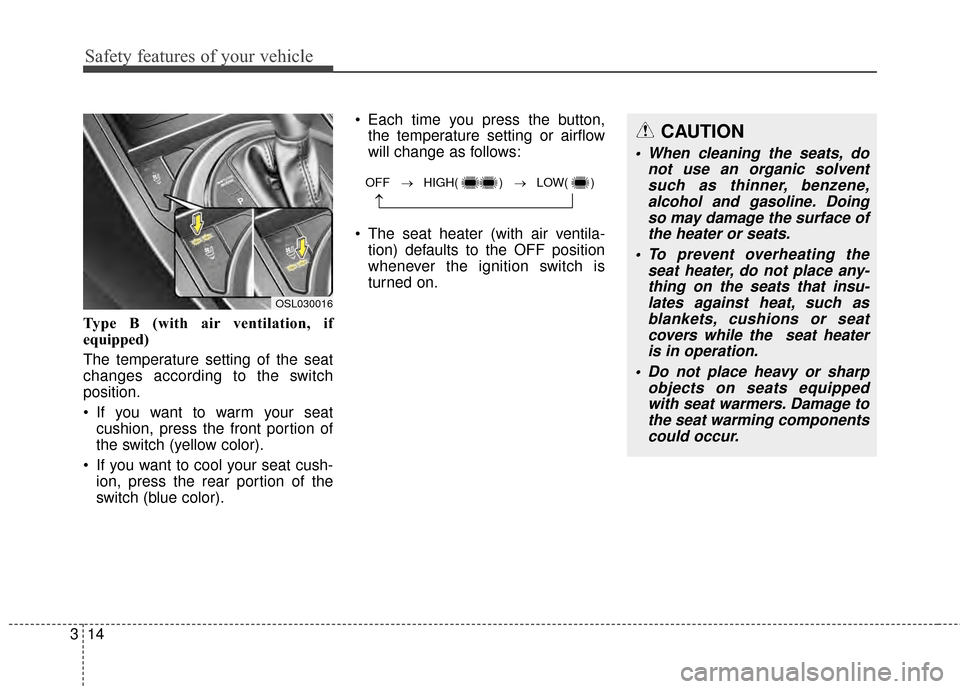
Type B (with air ventilation, if
equipped)
The temperature setting of the seat
changes according to the switch
position.
If you want to warm your seat
cushion, press the front portion of
the switch (yellow color).
If you want to cool your seat cush- ion, press the rear portion of the
switch (blue color). Each time you press the button,
the temperature setting or airflow
will change as follows:
The seat heater (with air ventila- tion) defaults to the OFF position
whenever the ignition switch is
turned on.
OSL030016
OFF → HIGH( ) → LOW( )
→
CAUTION
When cleaning the seats, do not use an organic solventsuch as thinner, benzene,alcohol and gasoline. Doingso may damage the surface ofthe heater or seats.
To prevent overheating the seat heater, do not place any-thing on the seats that insu-lates against heat, such asblankets, cushions or seatcovers while the seat heateris in operation.
Do not place heavy or sharp objects on seats equippedwith seat warmers. Damage tothe seat warming componentscould occur.
Page 30 of 457
315
Safety features of your vehicle
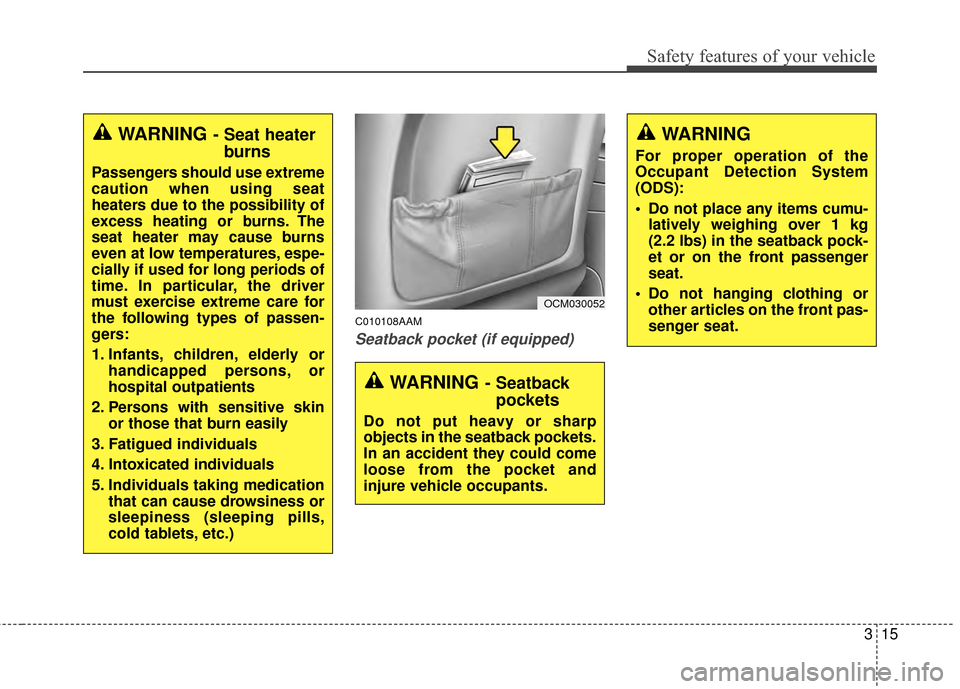
C010108AAM
Seatback pocket (if equipped)
OCM030052
WARNING- Seatbackpockets
Do not put heavy or sharp
objects in the seatback pockets.
In an accident they could come
loose from the pocket and
injure vehicle occupants.
WARNING- Seat heaterburns
Passengers should use extreme
caution when using seat
heaters due to the possibility of
excess heating or burns. The
seat heater may cause burns
even at low temperatures, espe-
cially if used for long periods of
time. In particular, the driver
must exercise extreme care for
the following types of passen-
gers:
1. Infants, children, elderly or
handicapped persons, or
hospital outpatients
2. Persons with sensitive skin or those that burn easily
3. Fatigued individuals
4. Intoxicated individuals
5. Individuals taking medication that can cause drowsiness or
sleepiness (sleeping pills,
cold tablets, etc.)
WARNING
For proper operation of the
Occupant Detection System
(ODS):
Do not place any items cumu-latively weighing over 1 kg
(2.2 lbs) in the seatback pock-
et or on the front passenger
seat.
Do not hanging clothing or other articles on the front pas-
senger seat.
Page 36 of 457
321
Safety features of your vehicle
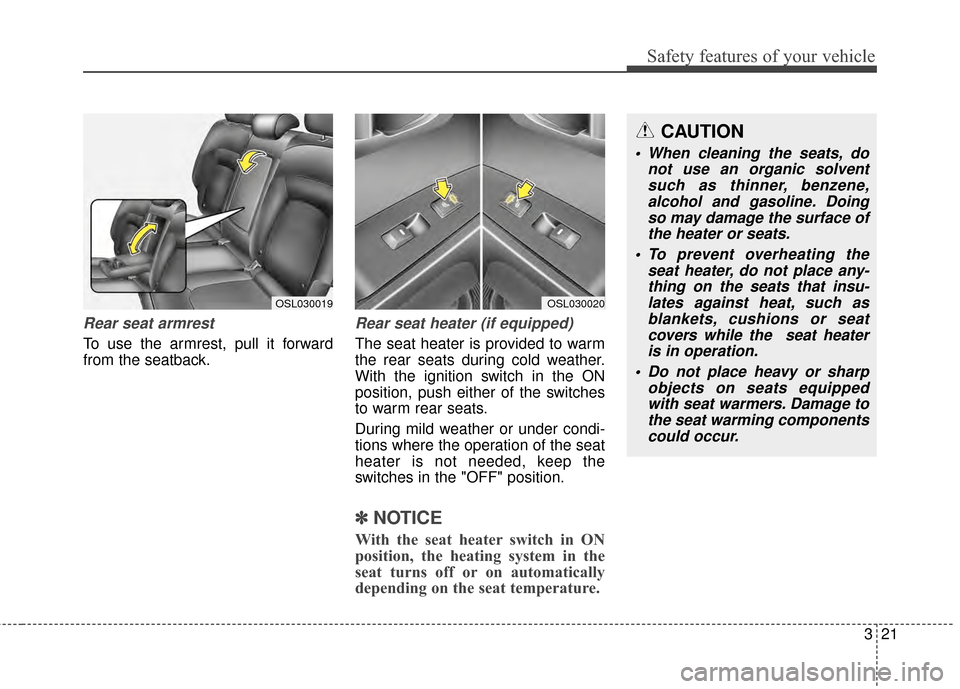
Rear seat armrest
To use the armrest, pull it forward
from the seatback.
Rear seat heater (if equipped)
The seat heater is provided to warm
the rear seats during cold weather.
With the ignition switch in the ON
position, push either of the switches
to warm rear seats.
During mild weather or under condi-
tions where the operation of the seat
heater is not needed, keep the
switches in the "OFF" position.
✽ ✽NOTICE
With the seat heater switch in ON
position, the heating system in the
seat turns off or on automatically
depending on the seat temperature.
CAUTION
When cleaning the seats, do
not use an organic solventsuch as thinner, benzene,alcohol and gasoline. Doingso may damage the surface ofthe heater or seats.
To prevent overheating the seat heater, do not place any-thing on the seats that insu-lates against heat, such asblankets, cushions or seatcovers while the seat heateris in operation.
Do not place heavy or sharp objects on seats equippedwith seat warmers. Damage tothe seat warming componentscould occur.
OSL030019OSL030020
Page 37 of 457
Safety features of your vehicle
22
3
WARNING- Seat heater
burns
Passengers should use extreme
caution when using seat
heaters due to the possibility of
excess heating or burns. The
seat heater may cause burns
even at low temperatures, espe-
cially if used for long periods of
time. In particular, the driver
must exercise extreme care for
the following types of passen-
gers:
1. Infants, children, elderly or
handicapped persons, or
hospital outpatients
2. Persons with sensitive skin or those that burn easily
3. Fatigued individuals
4. Intoxicated individuals
5. Individuals taking medication that can cause drowsiness or
sleepiness (sleeping pills,
cold tablets, etc.)
Page 54 of 457
339
Safety features of your vehicle
CHILD RESTRAINT SYSTEM
C030000AHM-EU
Children riding in the car should sit in
the rear seat and must always be
properly restrained to minimize the
risk of injury in an accident, sudden
stop or sudden maneuver. According
to accident statistics, children are
safer when properly restrained in the
rear seats than in the front seat.
Larger children not in a child restraint
should use one of the seat belts pro-
vided.
You should be aware of the specific
requirements in your country. Child
and/or infant safety seats must be
properly placed and installed in the
rear seat. You must use a commer-
cially available child restraint system
that meets the requirements of the
safety standards of your country.
Child restraint systems are designed
to be secured in vehicle seats by
seat belt, or by a tether anchor
and/or LATCH anchors (if equipped).Children could be injured or killed in
a crash if their restraints are not
properly secured. For small children
and babies, a child seat or infant seat
must be used. Before buying a par-
ticular child restraint system, make
sure it fits your car seat and seat
belts, and fits your child.
Follow all the instructions provided
by the manufacturer when installing
the child restraint system.
WARNING
A child restraint system must
be placed in the rear seat.
Never install a child or infant
seat on the front passenger's
seat. Should an accident
occur and cause the passen-
ger-side air bag to deploy, it
could severely injure or kill an
infant or child seated in an
infant or child seat. Thus only
use a child restraint in the
rear seat of your vehicle.
(Continued)
(Continued)
A seat belt or child restraintsystem can become very hot
if it is left in a closed vehicle
on a sunny day, even if the
outside temperature does not
feel hot. Be sure to check the
seat cover and buckles before
placing a child there.
When the child restraint sys- tem is not in use, store it in
the cargo area or fasten it with
a seat belt so that it will not be
thrown forward in case of a
sudden stop or an accident.
Children may be seriously injured or killed by an inflating
air bag. All children, even
those too large for child
restraints, must ride in the
rear seat.
Page 129 of 457
437
Features of your vehicle
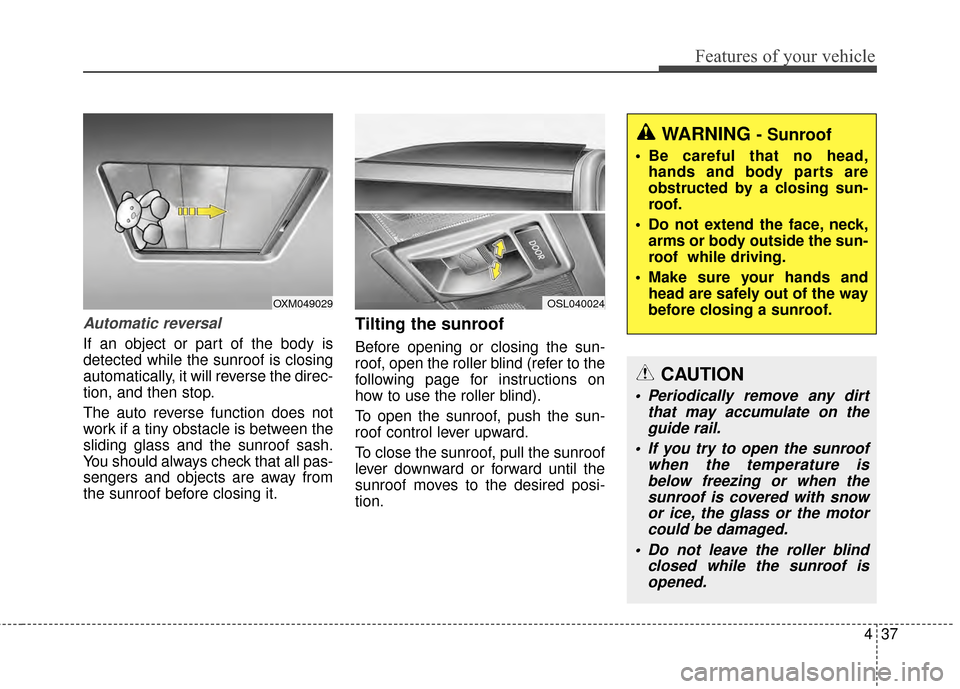
Automatic reversal
If an object or part of the body is
detected while the sunroof is closing
automatically, it will reverse the direc-
tion, and then stop.
The auto reverse function does not
work if a tiny obstacle is between the
sliding glass and the sunroof sash.
You should always check that all pas-
sengers and objects are away from
the sunroof before closing it.
Tilting the sunroof
Before opening or closing the sun-
roof, open the roller blind (refer to the
following page for instructions on
how to use the roller blind).
To open the sunroof, push the sun-
roof control lever upward.
To close the sunroof, pull the sunroof
lever downward or forward until the
sunroof moves to the desired posi-
tion.
OXM049029OSL040024
WARNING - Sunroof
Be careful that no head,hands and body parts are
obstructed by a closing sun-
roof.
Do not extend the face, neck, arms or body outside the sun-
roof while driving.
Make sure your hands and head are safely out of the way
before closing a sunroof.
CAUTION
Periodically remove any dirt that may accumulate on theguide rail.
If you try to open the sunroof when the temperature isbelow freezing or when thesunroof is covered with snowor ice, the glass or the motorcould be damaged.
Do not leave the roller blind closed while the sunroof isopened.