Page 25 of 457
Safety features of your vehicle
10
3
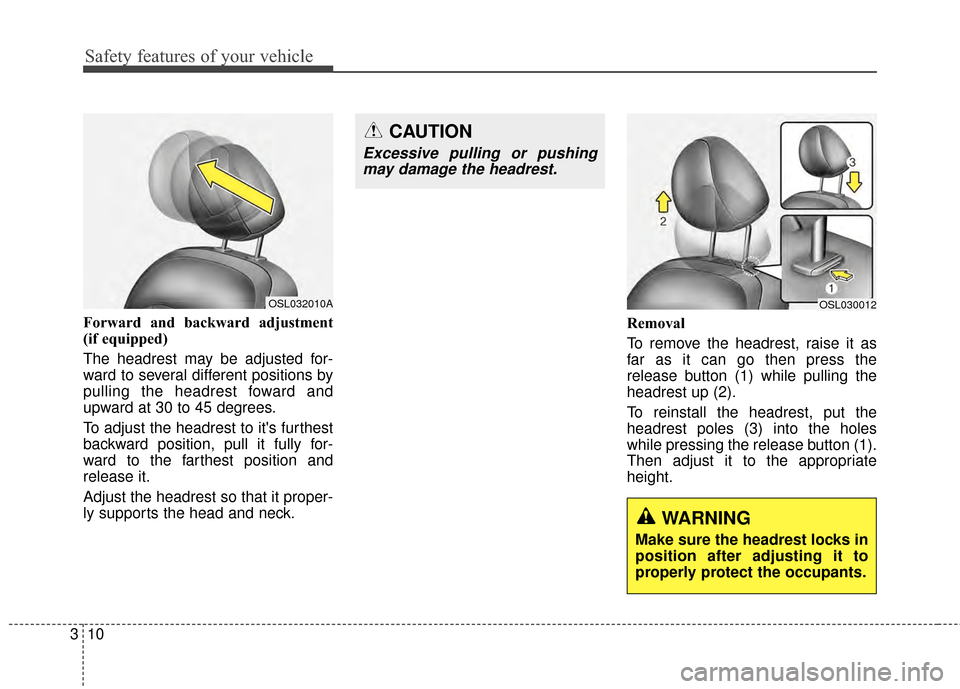
Forward and backward adjustment
(if equipped)
The headrest may be adjusted for-
ward to several different positions by
pulling the headrest foward and
upward at 30 to 45 degrees.
To adjust the headrest to it's furthest
backward position, pull it fully for-
ward to the farthest position and
release it.
Adjust the headrest so that it proper-
ly supports the head and neck. Removal
To remove the headrest, raise it as
far as it can go then press the
release button (1) while pulling the
headrest up (2).
To reinstall the headrest, put the
headrest poles (3) into the holes
while pressing the release button (1).
Then adjust it to the appropriate
height.
CAUTION
Excessive pulling or pushing
may damage the headrest.
WARNING
Make sure the headrest locks in
position after adjusting it to
properly protect the occupants.
OSL032010AOSL030012
Page 26 of 457
311
Safety features of your vehicle
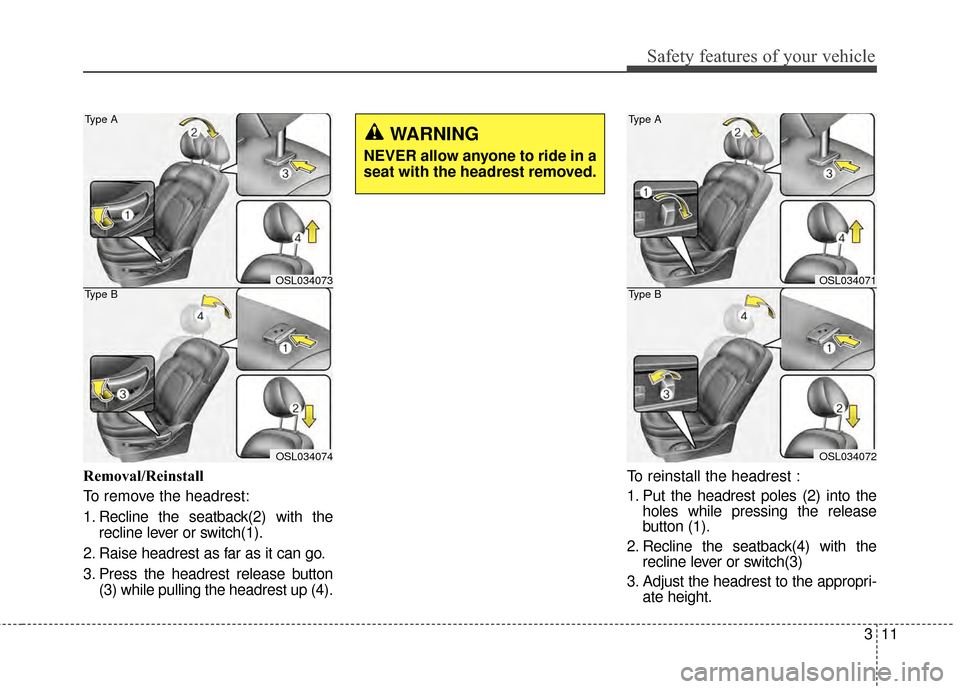
Removal/Reinstall
To remove the headrest:
1. Recline the seatback(2) with therecline lever or switch(1).
2. Raise headrest as far as it can go.
3. Press the headrest release button (3) while pulling the headrest up (4). To reinstall the headrest :
1. Put the headrest poles (2) into the
holes while pressing the release
button (1).
2. Recline the seatback(4) with the recline lever or switch(3)
3. Adjust the headrest to the appropri- ate height.
WARNING
NEVER allow anyone to ride in a
seat with the headrest removed.
OSL034073
OSL034074
Type A
Type BOSL034071
OSL034072
Type A
Type B
Page 27 of 457
Safety features of your vehicle
12
3
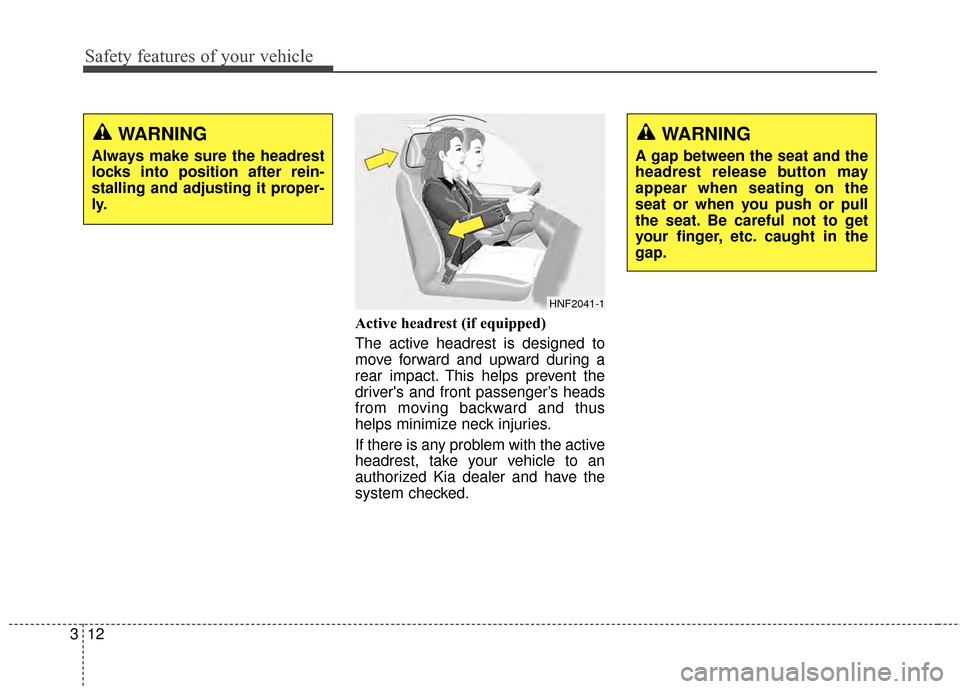
Active headrest (if equipped)
The active headrest is designed to
move forward and upward during a
rear impact. This helps prevent the
driver's and front passenger’s heads
from moving backward and thus
helps minimize neck injuries.
If there is any problem with the active
headrest, take your vehicle to an
authorized Kia dealer and have the
system checked.
HNF2041-1
WARNING
A gap between the seat and the
headrest release button may
appear when seating on the
seat or when you push or pull
the seat. Be careful not to get
your finger, etc. caught in the
gap.
WARNING
Always make sure the headrest
locks into position after rein-
stalling and adjusting it proper-
ly.
Page 30 of 457
315
Safety features of your vehicle
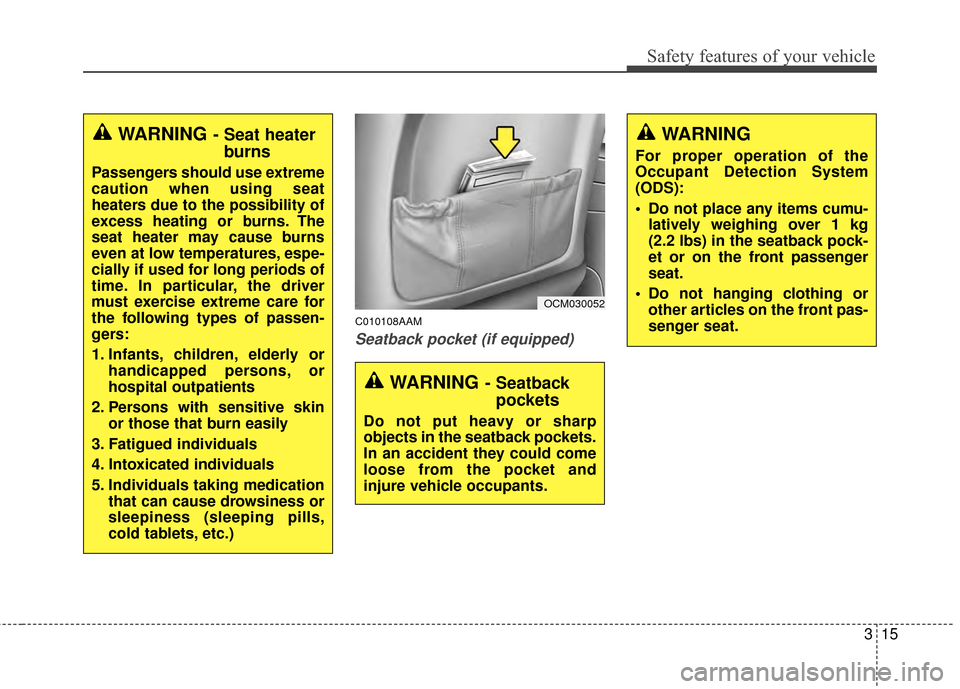
C010108AAM
Seatback pocket (if equipped)
OCM030052
WARNING- Seatbackpockets
Do not put heavy or sharp
objects in the seatback pockets.
In an accident they could come
loose from the pocket and
injure vehicle occupants.
WARNING- Seat heaterburns
Passengers should use extreme
caution when using seat
heaters due to the possibility of
excess heating or burns. The
seat heater may cause burns
even at low temperatures, espe-
cially if used for long periods of
time. In particular, the driver
must exercise extreme care for
the following types of passen-
gers:
1. Infants, children, elderly or
handicapped persons, or
hospital outpatients
2. Persons with sensitive skin or those that burn easily
3. Fatigued individuals
4. Intoxicated individuals
5. Individuals taking medication that can cause drowsiness or
sleepiness (sleeping pills,
cold tablets, etc.)
WARNING
For proper operation of the
Occupant Detection System
(ODS):
Do not place any items cumu-latively weighing over 1 kg
(2.2 lbs) in the seatback pock-
et or on the front passenger
seat.
Do not hanging clothing or other articles on the front pas-
senger seat.
Page 31 of 457
Safety features of your vehicle
16
3
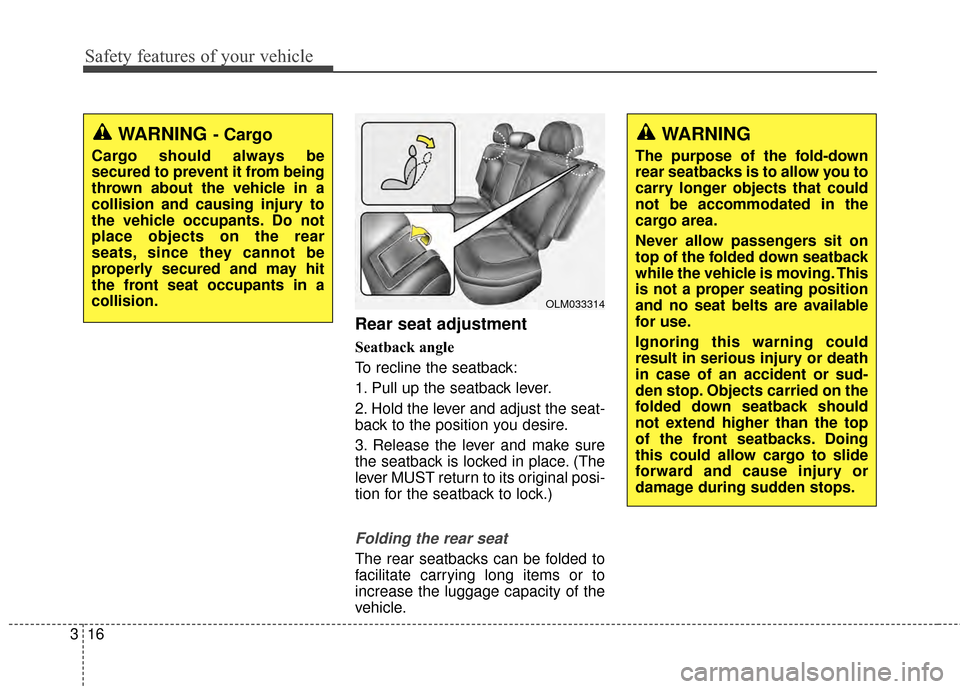
Rear seat adjustment
Seatback angle
To recline the seatback:
1. Pull up the seatback lever.
2. Hold the lever and adjust the seat-
back to the position you desire.
3. Release the lever and make sure
the seatback is locked in place. (The
lever MUST return to its original posi-
tion for the seatback to lock.)
Folding the rear seat
The rear seatbacks can be folded to
facilitate carrying long items or to
increase the luggage capacity of the
vehicle.
WARNING
The purpose of the fold-down
rear seatbacks is to allow you to
carry longer objects that could
not be accommodated in the
cargo area.
Never allow passengers sit on
top of the folded down seatback
while the vehicle is moving. This
is not a proper seating position
and no seat belts are available
for use.
Ignoring this warning could
result in serious injury or death
in case of an accident or sud-
den stop. Objects carried on the
folded down seatback should
not extend higher than the top
of the front seatbacks. Doing
this could allow cargo to slide
forward and cause injury or
damage during sudden stops.
WARNING- Cargo
Cargo should always be
secured to prevent it from being
thrown about the vehicle in a
collision and causing injury to
the vehicle occupants. Do not
place objects on the rear
seats, since they cannot be
properly secured and may hit
the front seat occupants in a
collision.
OLM033314
Page 33 of 457
Safety features of your vehicle
18
3
CAUTION- Rear seat
belts
When returning the rear seat-
backs to the upright position,remember to return the rearshoulder belts to their properposition. Routing the seat beltwebbing through the rear seatbelt guides will help keep thebelts from being trapped behindor under the seats.
CAUTION - Damaging
rear seat belt buckles
When you fold the rear seat-
back, insert the buckle in thepocket between the rear seat-back and cushion. Doing so canprevent the buckle from beingdamaged by the rear seatback.
WARNING- Uprighting seat
When you return the seatback
to its upright position, hold the
seatback and return it slowly
and be sure there are no other
occupants around the seat. If
the seatback is returned with-
out being held and controlled,
the back of the seat could move
forward or backward resulting
in accidental injury to a person
struck by the seatback.
WARNING
When you return the rear seat-
back to its upright position after
being folded down:
Be careful not to damage the
seat belt webbing or buckle. Do
not allow the seat belt webbing
or buckle to get caught or
pinched in the rear seat. Ensure
that the seatback is completely
locked into its upright position
by pushing on the top of the
seatback. Otherwise, in an acci-
dent or sudden stop, the seat
could fold down and allow
cargo to enter the passenger
compartment, which could
result in serious injury or death.
Page 34 of 457
319
Safety features of your vehicle
C010303AHM
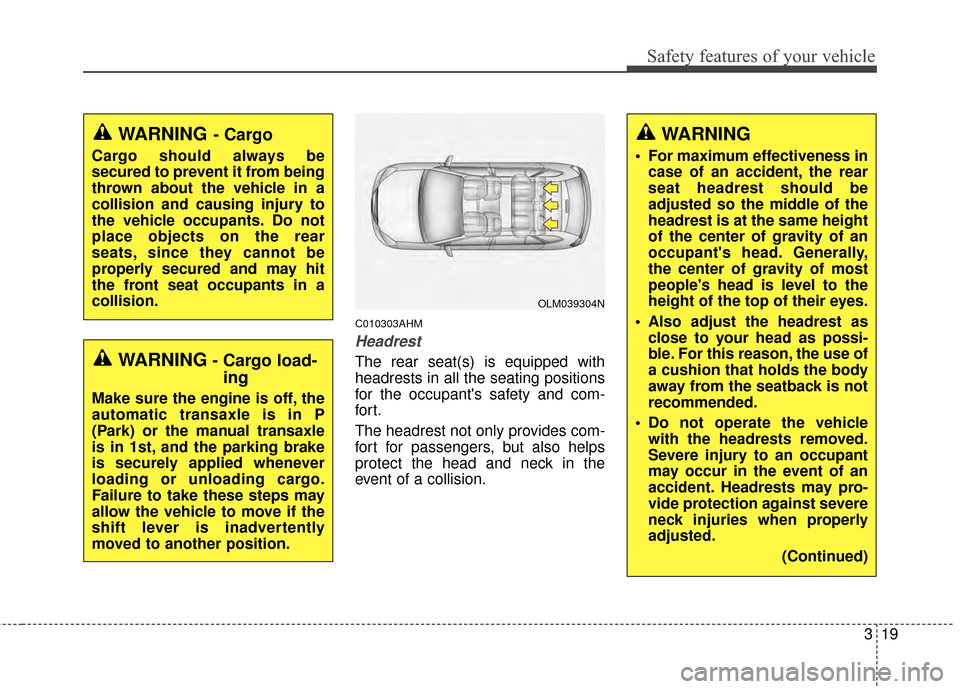
Headrest
The rear seat(s) is equipped with
headrests in all the seating positions
for the occupant's safety and com-
for t.
The headrest not only provides com-
fort for passengers, but also helps
protect the head and neck in the
event of a collision.
OLM039304N
WARNING
For maximum effectiveness incase of an accident, the rear
seat headrest should be
adjusted so the middle of the
headrest is at the same height
of the center of gravity of an
occupant's head. Generally,
the center of gravity of most
people's head is level to the
height of the top of their eyes.
Also adjust the headrest as close to your head as possi-
ble. For this reason, the use of
a cushion that holds the body
away from the seatback is not
recommended.
Do not operate the vehicle with the headrests removed.
Severe injury to an occupant
may occur in the event of an
accident. Headrests may pro-
vide protection against severe
neck injuries when properly
adjusted.
(Continued)
WARNING- Cargo load-ing
Make sure the engine is off, the
automatic transaxle is in P
(Park) or the manual transaxle
is in 1st, and the parking brake
is securely applied whenever
loading or unloading cargo.
Failure to take these steps may
allow the vehicle to move if the
shift lever is inadvertently
moved to another position.
WARNING- Cargo
Cargo should always be
secured to prevent it from being
thrown about the vehicle in a
collision and causing injury to
the vehicle occupants. Do not
place objects on the rear
seats, since they cannot be
properly secured and may hit
the front seat occupants in a
collision.
Page 37 of 457
Safety features of your vehicle
22
3
WARNING- Seat heater
burns
Passengers should use extreme
caution when using seat
heaters due to the possibility of
excess heating or burns. The
seat heater may cause burns
even at low temperatures, espe-
cially if used for long periods of
time. In particular, the driver
must exercise extreme care for
the following types of passen-
gers:
1. Infants, children, elderly or
handicapped persons, or
hospital outpatients
2. Persons with sensitive skin or those that burn easily
3. Fatigued individuals
4. Intoxicated individuals
5. Individuals taking medication that can cause drowsiness or
sleepiness (sleeping pills,
cold tablets, etc.)