2014 KIA Sorento service
[x] Cancel search: servicePage 413 of 508
79
Maintenance
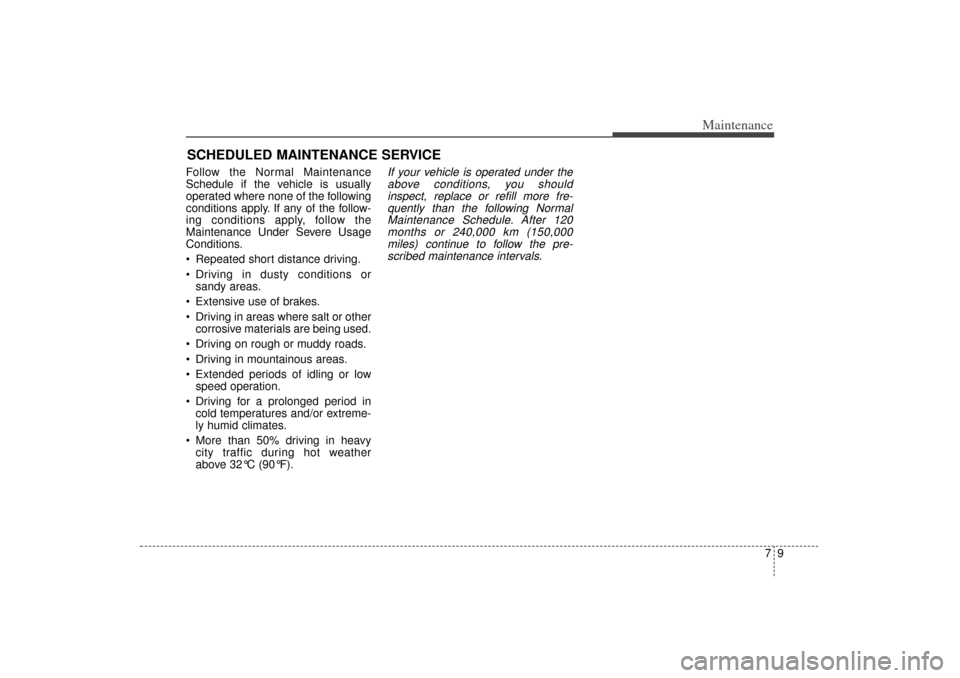
SCHEDULED MAINTENANCE SERVICEFollow the Normal Maintenance
Schedule if the vehicle is usually
operated where none of the following
conditions apply. If any of the follow-
ing conditions apply, follow the
Maintenance Under Severe Usage
Conditions.
Repeated short distance driving.
Driving in dusty conditions orsandy areas.
Extensive use of brakes.
Driving in areas where salt or other corrosive materials are being used.
Driving on rough or muddy roads.
Driving in mountainous areas.
Extended periods of idling or low speed operation.
Driving for a prolonged period in cold temperatures and/or extreme-
ly humid climates.
More than 50% driving in heavy city traffic during hot weather
above 32°C (90°F).
If your vehicle is operated under theabove conditions, you shouldinspect, replace or refill more fre-quently than the following NormalMaintenance Schedule. After 120months or 240,000 km (150,000miles) continue to follow the pre-scribed maintenance intervals.
XM(FL) CAN(ENG) 7.QXP 1/23/2013 3:35 PM Page 9
Page 414 of 508
Maintenance10
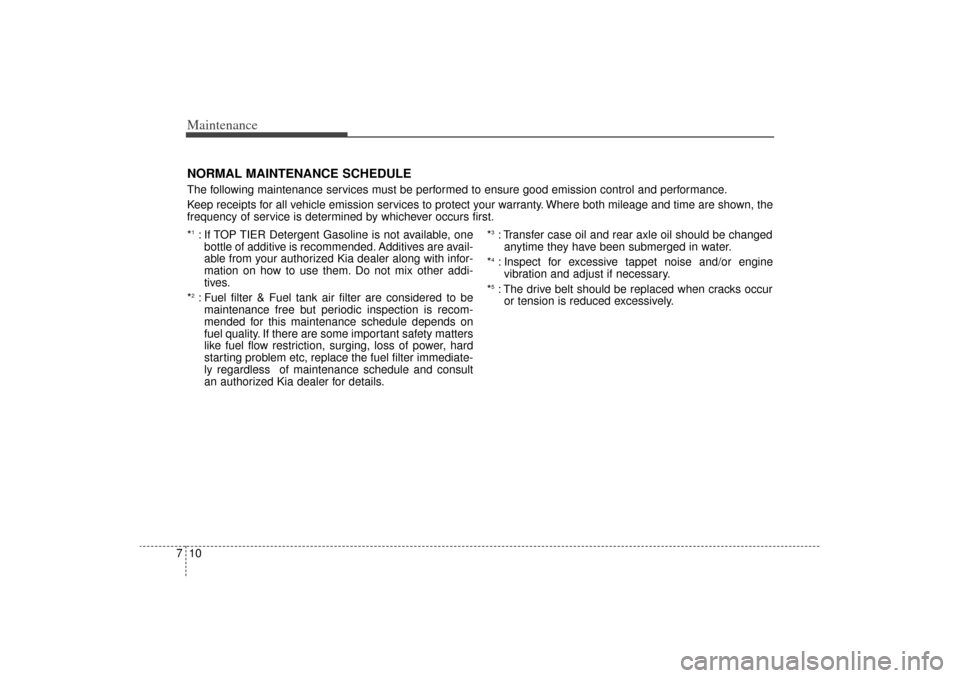
7NORMAL MAINTENANCE SCHEDULEThe following maintenance services must be performed to ensure good emission control and performance.
Keep receipts for all vehicle emission services to protect your warranty. Where both mileage and time are shown, the
frequency of service is determined by whichever occurs first.
*1: If TOP TIER Detergent Gasoline is not available, one
bottle of additive is recommended. Additives are avail-
able from your authorized Kia dealer along with infor-
mation on how to use them. Do not mix other addi-
tives.
*2: Fuel filter & Fuel tank air filter are considered to be maintenance free but periodic inspection is recom-
mended for this maintenance schedule depends on
fuel quality. If there are some important safety matters
like fuel flow restriction, surging, loss of power, hard
starting problem etc, replace the fuel filter immediate-
ly regardless of maintenance schedule and consult
an authorized Kia dealer for details. *
3: Transfer case oil and rear axle oil should be changed
anytime they have been submerged in water.
*4: Inspect for excessive tappet noise and/or engine vibration and adjust if necessary.
*5: The drive belt should be replaced when cracks occur or tension is reduced excessively.
XM(FL) CAN(ENG) 7.QXP 1/23/2013 3:35 PM Page 10
Page 428 of 508

Maintenance24
7NORMAL MAINTENANCE SCHEDULE
No check, No service required
❑ Automatic transaxle fluid (if equipped)
240,000 km (150,000 miles) or 120 months
❑Rotate tire
❑ Inspect battery condition
❑ Inspect vacuum hose
❑ Inspect air conditioning refrigerant
❑ Inspect brake hoses and lines
❑ Inspect drive shafts and boots
❑ Inspect exhaust pipe and muffler
❑ Inspect front brake disc/pads, calipers
❑ Inspect propeller shaft (AWD)
❑ Inspect rear brake disc/pads
❑ Inspect steering gear box, linkage & boots/lower arm ball
joint, upper arm ball joint
❑ Inspect suspension mounting bolts
❑ Inspect brake fluid
❑ Inspect fuel filter *
2
❑Inspect fuel lines, fuel hoses and connections
❑ Inspect fuel tank air filter (if equipped) *
2
❑Inspect parking brake
❑ Inspect vapor hose and fuel filler cap, fuel tank
❑ Inspect rear axle oil (AWD) *
3
❑Inspect transfer case oil (AWD) *
3
(Continued)
(Continued)❑Inspect manual transaxle fluid
(Every 40,000 miles or 48 months)
❑ Inspect drive belts
(First, 96,000 km (60,000 miles) or 72 months
after every 24,000 km (15,000 miles) or 24 months) *
5
❑ Replace climate control air filter
(for evaporator and blower unit)
❑ Replace air cleaner filter
❑ Replace engine oil and filter
(240,000 km (150,000 miles) or 240 months)
❑ Replace coolant
(First, 96,000 km (60,000 miles) or 60 months
after every 48,000 km (30,000 miles) or 24 months)
❑ Add fuel additive *
1
(240,000 km (150,000 miles) or 240 months)
❑ Inspect cooling system hoses and connections
❑ Inspect brake pedal free play
❑ Inspect all latch, hinges and locks
❈ Inspect : Inspect and if necessary, adjust, correct, clean or
replace.
XM(FL) CAN(ENG) 7.QXP 2/13/2013 9:55 AM Page 24
Page 429 of 508

725
Maintenance
MAINTENANCE UNDER SEVERE USAGE CONDITIONSThe following items must be serviced more frequently on cars normally used under severe driving conditions. Refer
to the chart below for the appropriate maintenance intervals.
R : Replace I : Inspect and, after inspection, clean, adjust, repair or replace if neces\
sary
MAINTENANCE ITEM
MAINTENANCEOPERATION
MAINTENANCE INTERVALS
DRIVING CONDI- TION
ENGINE OIL AND FILTER
R
EVERY 6,000 KM (3,750 MILES) OR 6 MONTHS
A, B, C, D, E, F, G,H, I, J, K
AIR CLEANER FILTER
R
MORE FREQUENTLY
C, E
SPARK PLUGS
R
MORE FREQUENTLY
A, B, H, I, K
AUTOMATIC TRANSAXLE FLUID
R
EVERY 96,000 KM (60,000 MILES)
A, C, E, F, G, I
MANUAL TRANSAXLE FLUID
R
EVERY 120,000 KM (80,000 MILES)
C, E, F, G, I, J
FRONT BRAKE DISC/PADS, CALIPERS
I
MORE FREQUENTLY
C, D, G, H
REAR BRAKE DISC/PADS
I
MORE FREQUENTLY
C, D, G, H
PARKING BRAKE
I
MORE FREQUENTLY
C, D, G, H
STEERING GEAR BOX, LINKAGE &
BOOTS/LOWER ARM BALL JOINT,
UPPER ARM BALL JOINT
I
MORE FREQUENTLY
C, D, E, F, G, H, I
XM(FL) CAN(ENG) 7.QXP 2/13/2013 9:55 AM Page 25
Page 451 of 508
747
Maintenance
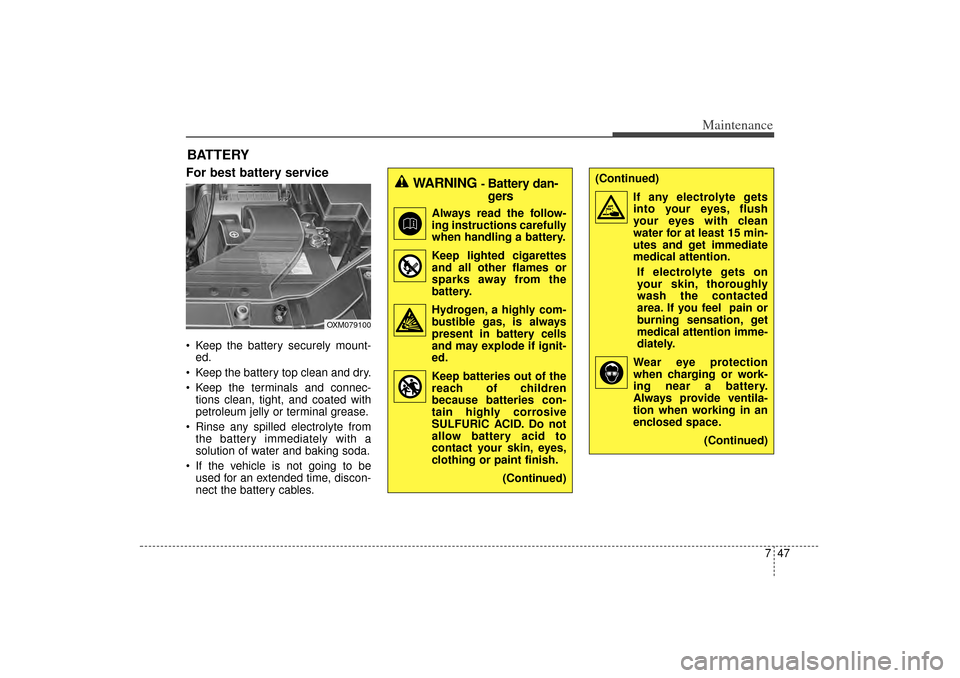
BATTERYFor best battery service Keep the battery securely mount-ed.
Keep the battery top clean and dry.
Keep the terminals and connec- tions clean, tight, and coated with
petroleum jelly or terminal grease.
Rinse any spilled electrolyte from the battery immediately with a
solution of water and baking soda.
If the vehicle is not going to be used for an extended time, discon-
nect the battery cables.
WARNING
- Battery dan-
gers
Always read the follow-
ing instructions carefully
when handling a battery.
Keep lighted cigarettes and all other flames or
sparks away from the
battery.
Hydrogen, a highly com- bustible gas, is always
present in battery cells
and may explode if ignit-
ed.
Keep batteries out of the reach of children
because batteries con-
tain highly corrosive
SULFURIC ACID. Do not
allow battery acid to
contact your skin, eyes,
clothing or paint finish.
(Continued)
(Continued)If any electrolyte getsinto your eyes, flush
your eyes with clean
water for at least 15 min-
utes and get immediate
medical attention.
If electrolyte gets on
your skin, thoroughly
wash the contacted
area. If you feel pain or
burning sensation, get
medical attention imme-
diately.
Wear eye protection when charging or work-
ing near a battery.
Always provide ventila-
tion when working in an
enclosed space.
(Continued)
OXM079100
XM(FL) CAN(ENG) 7.QXP 1/23/2013 3:37 PM Page 47
Page 461 of 508
757
Maintenance
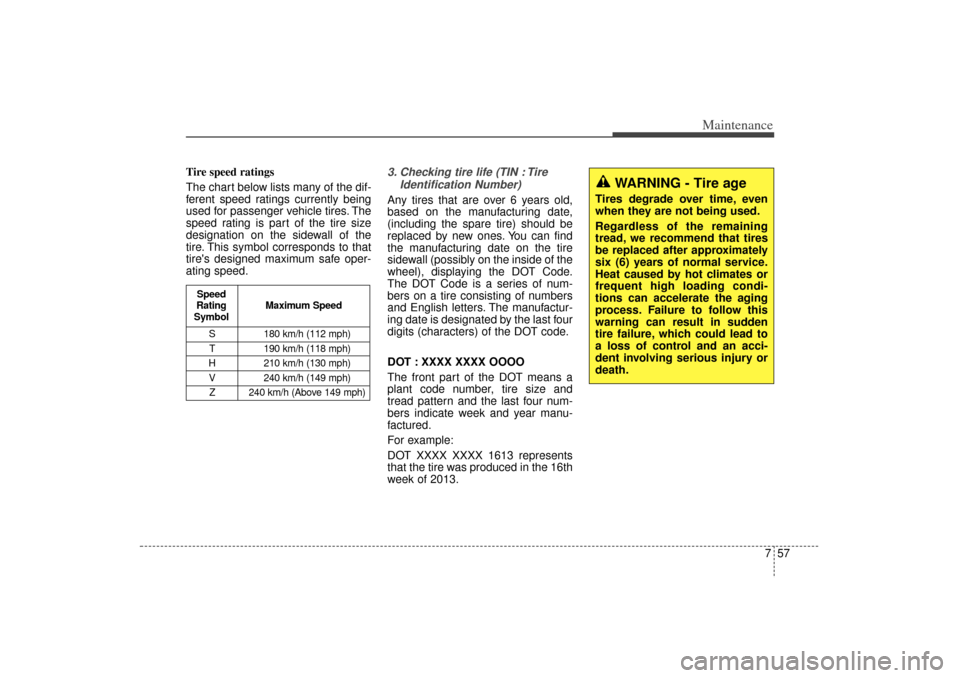
Tire speed ratings
The chart below lists many of the dif-
ferent speed ratings currently being
used for passenger vehicle tires. The
speed rating is part of the tire size
designation on the sidewall of the
tire. This symbol corresponds to that
tire's designed maximum safe oper-
ating speed.
3. Checking tire life (TIN : TireIdentification Number) Any tires that are over 6 years old,
based on the manufacturing date,
(including the spare tire) should be
replaced by new ones. You can find
the manufacturing date on the tire
sidewall (possibly on the inside of the
wheel), displaying the DOT Code.
The DOT Code is a series of num-
bers on a tire consisting of numbers
and English letters. The manufactur-
ing date is designated by the last four
digits (characters) of the DOT code.
DOT : XXXX XXXX OOOO
The front part of the DOT means a
plant code number, tire size and
tread pattern and the last four num-
bers indicate week and year manu-
factured.
For example:
DOT XXXX XXXX 1613 represents
that the tire was produced in the 16th
week of 2013.
WARNING - Tire age
Tires degrade over time, even
when they are not being used.
Regardless of the remaining
tread, we recommend that tires
be replaced after approximately
six (6) years of normal service.
Heat caused by hot climates or
frequent high loading condi-
tions can accelerate the aging
process. Failure to follow this
warning can result in sudden
tire failure, which could lead to
a loss of control and an acci-
dent involving serious injury or
death.
S 180 km/h (112 mph)
T 190 km/h (118 mph)
H 210 km/h (130 mph) V 240 km/h (149 mph)Z 240 km/h (Above 149 mph)
Maximum Speed
Speed
Rating
Symbol
XM(FL) CAN(ENG) 7.QXP 1/23/2013 3:37 PM Page 57
Page 462 of 508

Maintenance58
74. Tire ply composition and mate-
rialThe number of layers or plies of rub-
ber-coated fabric in the tire. Tire
manufacturers also must indicate the
materials in the tire, which include
steel, nylon, polyester, and others.
The letter "R" means radial ply con-
struction; the letter "D" means diago-
nal or bias ply construction; and the
letter "B" means belted-bias ply con-
struction.5. Maximum permissible inflationpressureThis number is the greatest amount
of air pressure that should be put in
the tire. Do not exceed the maximum
permissible inflation pressure. Refer
to the Tire and Loading Information
label for recommended inflation
pressure.
6. Maximum load ratingThis number indicates the maximum
load in kilograms and pounds that
can be carried by the tire. When
replacing the tires on the vehicle,
always use a tire that has the same
load rating as the factory installed
tire.7. Uniform tire quality gradingQuality grades can be found where
applicable on the tire sidewall
between tread shoulder and maxi-
mum section width.
For example:
TREADWEAR 200
TRACTION AA
TEMPERATURE A Tread wear
The tread wear grade is a compara-
tive rating based on the wear rate of
the tire when tested under controlled
conditions on a specified govern-
ment test course. For example, a tire
graded 150 would wear one-and-a-
half times (1½) as well on the gov-
ernment course as a tire graded 100.
The relative performance of tires
depends upon the actual conditions
of their use, however, and may
depart significantly from the norm
due to variations in driving habits,
service practices and differences in
road characteristics and climate.
These grades are molded on the
side-walls of passenger vehicle tires.
The tires available as standard or
optional equipment on your vehicle
may vary with respect to grade.
XM(FL) CAN(ENG) 7.QXP 1/23/2013 3:37 PM Page 58
Page 494 of 508
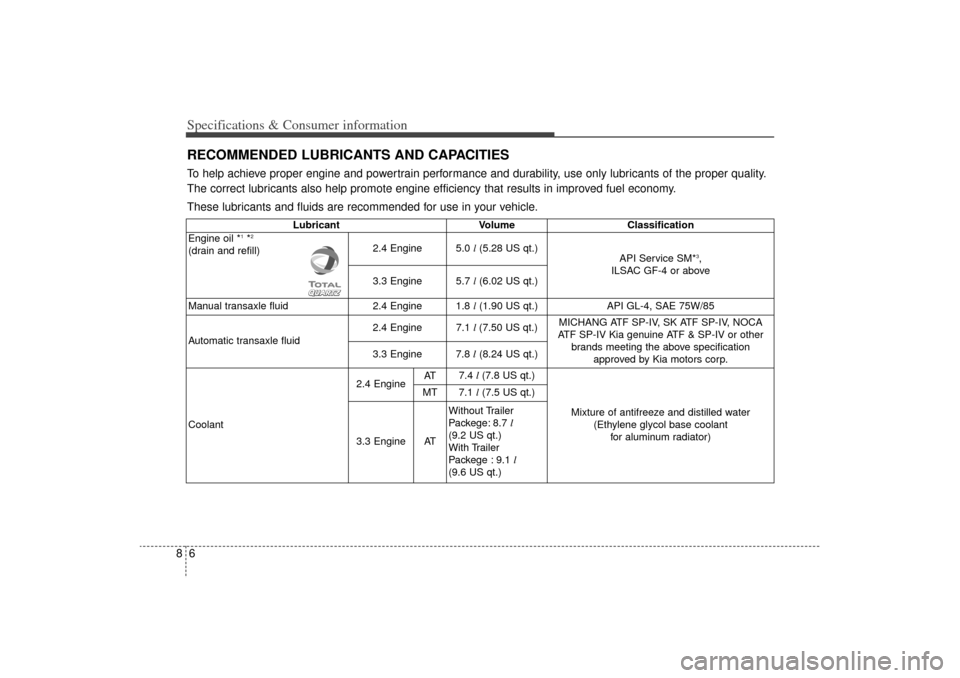
Specifications & Consumer information68RECOMMENDED LUBRICANTS AND CAPACITIES To help achieve proper engine and powertrain performance and durability, use only lubricants of the proper quality.
The correct lubricants also help promote engine efficiency that results in improved fuel economy.
These lubricants and fluids are recommended for use in your vehicle.
LubricantVolume Classification
Engine oil *
1*2
(drain and refill) 2.4 Engine
5.0
l(5.28 US qt.)
API Service SM*
3,
ILSAC GF-4 or above
3.3 Engine 5.7
l(6.02 US qt.)
Manual transaxle fluid 2.4 Engine 1.8
l(1.90 US qt.)
API GL-4, SAE 75W/85
Automatic transaxle fluid 2.4 Engine
7.1
l (7.50 US qt.) MICHANG ATF SP-IV, SK ATF SP-IV, NOCA
ATF SP-IV Kia genuine ATF & SP-IV or other brands meeting the above specification approved by Kia motors corp.
3.3 Engine
7.8
l(8.24 US qt.)
Coolant 2.4 Engine
AT
7.4
l (7.8 US qt.)
Mixture of antifreeze and distilled water(Ethylene glycol base coolant for aluminum radiator)
MT
7.1 l(7.5 US qt.)
3.3 Engine AT Without Trailer
Packege: 8.7
l
(9.2 US qt.)
With Trailer
Packege : 9.1 l
(9.6 US qt.)
XM(FL) CAN(ENG) 8.QXP 1/23/2013 4:01 PM Page 6