2014 KIA Sorento seats
[x] Cancel search: seatsPage 28 of 508
Safety features of your vehicle14
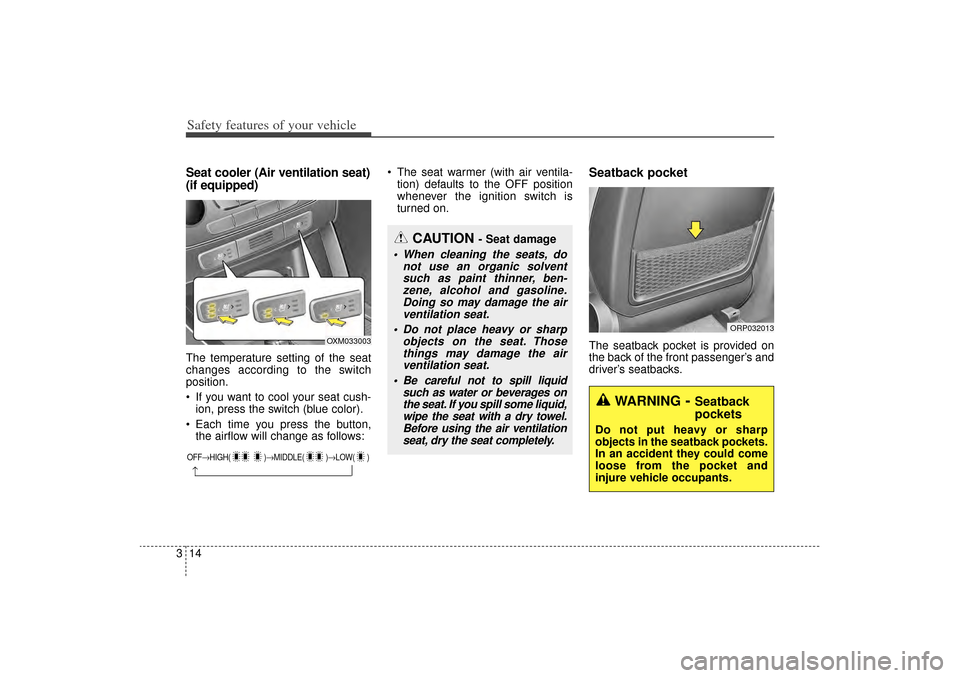
3Seat cooler (Air ventilation seat)
(if equipped)The temperature setting of the seat
changes according to the switch
position.
If you want to cool your seat cush-
ion, press the switch (blue color).
Each time you press the button, the airflow will change as follows: The seat warmer (with air ventila-
tion) defaults to the OFF position
whenever the ignition switch is
turned on.
Seatback pocketThe seatback pocket is provided on
the back of the front passenger’s and
driver’s seatbacks.
OXM033003
OFF→ HIGH( )→ MIDDLE( )→LOW( )→
ORP032013
WARNING
- Seatback
pockets
Do not put heavy or sharp
objects in the seatback pockets.
In an accident they could come
loose from the pocket and
injure vehicle occupants.
CAUTION
- Seat damage
When cleaning the seats, do
not use an organic solventsuch as paint thinner, ben-zene, alcohol and gasoline.Doing so may damage the airventilation seat.
Do not place heavy or sharp objects on the seat. Thosethings may damage the airventilation seat.
Be careful not to spill liquid such as water or beverages onthe seat. If you spill some liquid,wipe the seat with a dry towel.Before using the air ventilationseat, dry the seat completely.
XM(FL) CAN(ENG) 3.QXP 1/23/2013 3:23 PM Page 14
Page 33 of 508

319
Safety features of your vehicle
To fold down the rear center seat-back (for 2nd row seat)1. Lower the rear headrests to the lowest position.
2. Push the center seatback folding lever up, then fold the seat toward
the front of the vehicle.
When you return the seatback to its
upright position, always be sure it
has locked into position by pushing
on the top of the seatback.
ODM032033
WARNING
- 2nd row cen-
ter seat folding
Do not fold the 2nd row center seat, if there are occupants in
the 3rd row seats, as this may
result in injury to occupants if
the seat moves during a colli-
sion. If occupants in the 3rd
row seats, fix the 2nd row cen-
ter seat in its upright and
locked position.
The 2nd row center seat back does not lock into position
when it is folded toward the
front of the vehicle. If you use
the 2nd row center seat back
folding function to carry long
objects, you should fix the
long object to prevent it from
being thrown about the vehi-
cle in a collision and causing
injury to vehicle occupants.
WARNING -
Uprighting
seat
When you return the seatback
to its upright position, hold the
seatback and return it slowly. If
the seatback is returned with-
out holding it, the back of the
seat could spring forward
resulting in injury caused by
being struck by the seatback.
CAUTION -
Damaging
rear seat belt buckles
When you fold the rear (2nd and/or 3rd row) seatback, insertthe buckle in the pocket betweenthe rear seatback and cushion.Doing so can prevent the bucklefrom being damaged by the rearseatback.
XM(FL) CAN(ENG) 3.QXP 1/23/2013 3:24 PM Page 19
Page 34 of 508

Safety features of your vehicle20
3
CAUTION
- Rear seat belts
When returning the rear (2nd
and/or 3rd row) seatbacks to theupright position, remember toreturn the rear shoulder belts totheir proper position. Routing theseat belt webbing through therear seat belt guides will helpkeep the belts from being trappedbehind or under the seats.
OUN026140
WARNING
- 3rd row seat
3rd row occupants should
always remain in the center of
the seat cushion so the occu-
pants head is protected by the
headrest.
If not, the tailgate may hit the
occupant's head, which could
cause injury.
WARNING
- Cargo
Cargo should always be
secured to prevent it from being
thrown about the vehicle in a
collision and causing injury to
the vehicle occupants. Do not
place objects in the rear (2nd
and/or 3rd row) seats, since they
cannot be properly secured and
may hit the front seat occupants
in a collision.
WARNING -
Cargo loading
Make sure the engine is off, the
automatic transaxle is in P (Park)
or the manual transaxle is in R
(Reverse) or 1st, and the parking
brake is securely applied when-
ever loading or unloading cargo.
Failure to take these steps may
allow the vehicle to move if the
shift lever is inadvertently
moved to another position.
XM(FL) CAN(ENG) 3.QXP 1/23/2013 3:24 PM Page 20
Page 35 of 508
321
Safety features of your vehicle
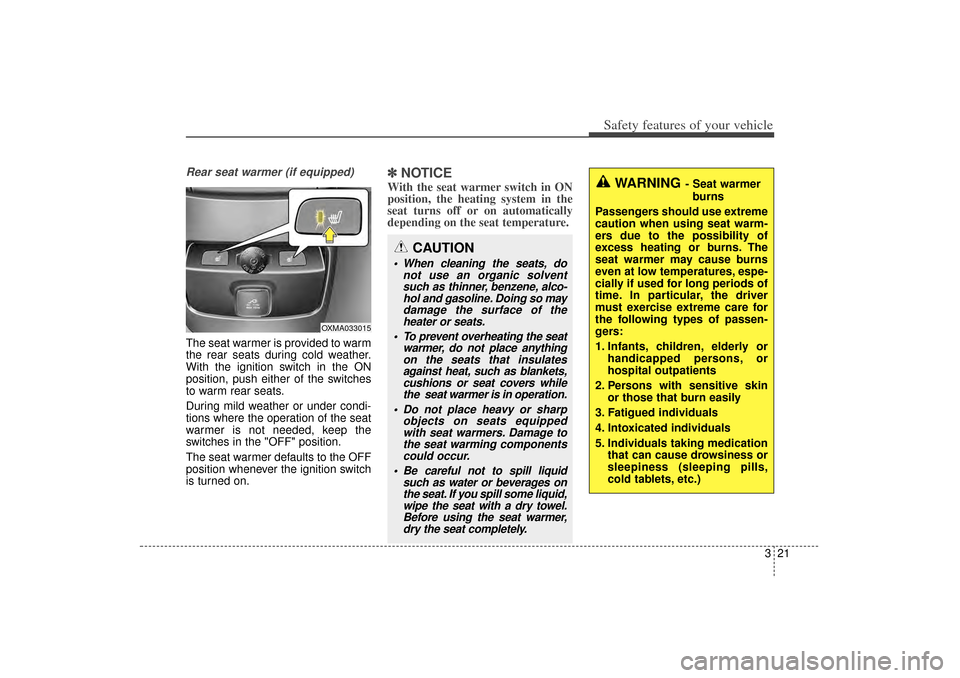
Rear seat warmer (if equipped)The seat warmer is provided to warm
the rear seats during cold weather.
With the ignition switch in the ON
position, push either of the switches
to warm rear seats.
During mild weather or under condi-
tions where the operation of the seat
warmer is not needed, keep the
switches in the "OFF" position.
The seat warmer defaults to the OFF
position whenever the ignition switch
is turned on.
✽ ✽NOTICEWith the seat warmer switch in ON
position, the heating system in the
seat turns off or on automatically
depending on the seat temperature.
CAUTION
When cleaning the seats, do
not use an organic solventsuch as thinner, benzene, alco-hol and gasoline. Doing so maydamage the surface of theheater or seats.
To prevent overheating the seat warmer, do not place anythingon the seats that insulatesagainst heat, such as blankets,cushions or seat covers whilethe seat warmer is in operation.
Do not place heavy or sharp objects on seats equippedwith seat warmers. Damage tothe seat warming componentscould occur.
Be careful not to spill liquid such as water or beverages onthe seat. If you spill some liquid,wipe the seat with a dry towel.Before using the seat warmer,dry the seat completely.
WARNING
- Seat warmer
burns
Passengers should use extreme
caution when using seat warm-
ers due to the possibility of
excess heating or burns. The
seat warmer may cause burns
even at low temperatures, espe-
cially if used for long periods of
time. In particular, the driver
must exercise extreme care for
the following types of passen-
gers:
1. Infants, children, elderly or handicapped persons, or
hospital outpatients
2. Persons with sensitive skin or those that burn easily
3. Fatigued individuals
4. Intoxicated individuals
5. Individuals taking medication that can cause drowsiness or
sleepiness (sleeping pills,
cold tablets, etc.)
OXMA033015
XM(FL) CAN(ENG) 3.QXP 1/23/2013 3:24 PM Page 21
Page 37 of 508

323
Safety features of your vehicle
Adjusting the height up and down(for 2nd row seats)To raise the headrest :
1. Pull it up to the desired position (1). To lower the headrest :
1. Push and hold the release button
(2) on the headrest support
2. Lower the headrest to the desired position (3).
Removal and installation
(for 2nd row seats)To remove the headrest :
1. Raise it as far as it can go then press the release button (1) while
pulling the headrest up (2).
To reinstall the headrest :
1. Put the headrest poles (3) into the holes while pressing the release
button (1).
2. Adjust it to the appropriate height.
OXMA033107
OXMA033108
■Outside■ Center
OXMA033018
XM(FL) CAN(ENG) 3.QXP 1/23/2013 3:24 PM Page 23
Page 45 of 508
331
Safety features of your vehicle
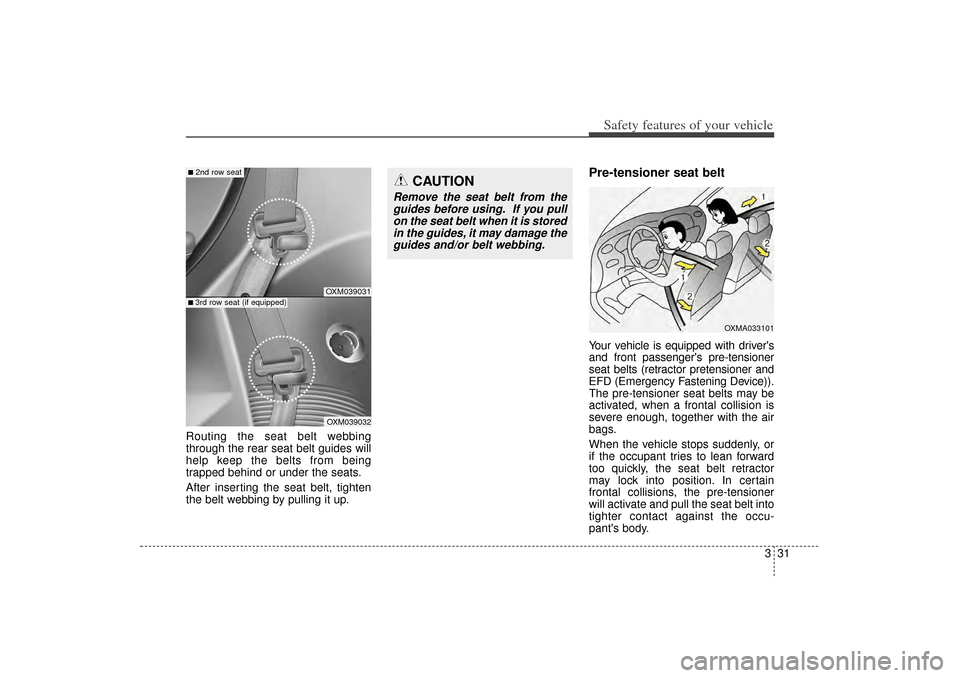
Routing the seat belt webbing
through the rear seat belt guides will
help keep the belts from being
trapped behind or under the seats.
After inserting the seat belt, tighten
the belt webbing by pulling it up.
Pre-tensioner seat belt Your vehicle is equipped with driver's
and front passenger's pre-tensioner
seat belts (retractor pretensioner and
EFD (Emergency Fastening Device)).
The pre-tensioner seat belts may be
activated, when a frontal collision is
severe enough, together with the air
bags.
When the vehicle stops suddenly, or
if the occupant tries to lean forward
too quickly, the seat belt retractor
may lock into position. In certain
frontal collisions, the pre-tensioner
will activate and pull the seat belt into
tighter contact against the occu-
pant's body.
CAUTION
Remove the seat belt from theguides before using. If you pullon the seat belt when it is storedin the guides, it may damage theguides and/or belt webbing.
OXM039031OXM039032
■2nd row seat ■ 3rd row seat (if equipped)
OXMA033101
XM(FL) CAN(ENG) 3.QXP 1/23/2013 3:25 PM Page 31
Page 49 of 508
335
Safety features of your vehicle
Infant or small childYou should be aware of the specific
requirements in your state. Child
and/or infant seats must be properly
placed and installed in the rear coun-
try. For more information about the
use of these restraints, refer to “Child
restraint system” in this section.
✽ ✽NOTICESmall children are best protected
from injury in an accident when
properly restrained in the rear seat
by a child restraint system that
meets the requirements of the safety
standards of your country. Before
buying any child restraint system,
make sure that it has a label certify-
ing that it meets safety standards of
your country. The restraint must be
appropriate for your child's height
and weight. Check the label on the
child restraint for this information.
Refer to “Child restraint system” in
this section.
Larger childrenChildren who are too large for child
restraint systems should always
occupy the rear seat and use the
available lap/shoulder belts. The lap
portion should be fastened and
snugged on the hips and as low as
possible. Check if the belt fits period-
ically. A child's squirming could put
the belt out of position. Children are
given the most safety in the event of
an accident when they are restrained
by a proper restraint system in the
rear seat. If a larger child (over age
12) must be seated in the front seat,
the child should be securely
restrained by the available lap/shoul-
der belt and the seat should be
placed in the rearmost position.
Children age 12 and under should be
restrained securely in the rear seat.
NEVER place a child age 12 and
under in the front seat. NEVER place
a rear facing child seat in the front
seat of a vehicle.
WARNING
Every person in your vehicle
needs to be properly restrained
at all times, including infants
and children. Never hold a child
in your arms or lap when riding
in a vehicle. The violent forces
created during a crash will tear
the child from your arms and
throw the child against the inte-
rior. Always use a child restraint
appropriate for your child's
height and weight.
XM(FL) CAN(ENG) 3.QXP 1/23/2013 3:25 PM Page 35
Page 50 of 508
Safety features of your vehicle36
3If the shoulder belt portion slightly
touches the child’s neck or face, try
placing the child closer to the center of
the vehicle. If the shoulder belt still
touches their face or neck they need to
be returned to a child restraint system.
Restraint of pregnant women Pregnant women should wear
lap/shoulder belt assemblies when-
ever possible according to specific
recommendations by their doctors.
The lap portion of the belt should be
worn AS SECURELY AND LOW AS
POSSIBLE.
Injured personA seat belt should be used when an
injured person is being transported.
When this is necessary, you should
consult a physician for recommenda-
tions.One person per beltTwo people (including children)
should never attempt to use a single
seat belt. This could increase the
severity of injuries in case of an acci-
dent.Do not lie downTo reduce the chance of injuries in
the event of an accident and to
achieve maximum effectiveness of
the restraint system, all passengers
should be sitting up and the front and
rear seats should be in an upright
position when the vehicle is moving.
A seat belt cannot provide proper
protection if the person is lying down
in the rear seat or if the front and rear
seats are in a reclined position.
WARNING
- Pregnant
women
Pregnant women must never
place the lap portion of the
safety belt over the area of the
abdomen where the fetus is
located or above the abdomen
where the belt could crush the
fetus during an impact.
WARNING
- Shoulder
belts on small children
Do not allow small children to ride in the vehicle without an
appropriate child restrain sys-
tem.
Never allow a shoulder belt to be in contact with a child’s
neck or face while the vehicle
is in motion.
If seat belts are not properly worn and adjusted on chil-
dren, there is a risk of death or
serious injury.
XM(FL) CAN(ENG) 3.QXP 1/23/2013 3:25 PM Page 36