2014 KIA Sorento flat tire
[x] Cancel search: flat tirePage 387 of 508
What to do in an emergencyRoad warning . . . . . . . . . . . . . . . . . . . . . . . . . . . . . . 6-2• Hazard warning flasher . . . . . . . . . . . . . . . . . . . . . . . . 6-2In case of an emergency while driving . . . . . . . . . . 6-3• If the engine stalls at a crossroad or crossing. . . . . . . 6-3
• If you have a flat tire while driving . . . . . . . . . . . . . . . 6-3
• If engine stalls while driving . . . . . . . . . . . . . . . . . . . . 6-3If the engine does not start . . . . . . . . . . . . . . . . . . . 6-4• If engine doesn’t turn over or turns over slowly . . . . 6-4
• If engine turns over normally but does not start . . . . 6-4Emergency starting . . . . . . . . . . . . . . . . . . . . . . . . . 6-5• Jump starting . . . . . . . . . . . . . . . . . . . . . . . . . . . . . . . . . 6-5
• Push-starting . . . . . . . . . . . . . . . . . . . . . . . . . . . . . . . . . 6-6If the engine overheats . . . . . . . . . . . . . . . . . . . . . . . 6-7
If you have a flat tire . . . . . . . . . . . . . . . . . . . . . . . . 6-8• Jack and tools . . . . . . . . . . . . . . . . . . . . . . . . . . . . . . . . 6-8
• Removing and storing the spare tire . . . . . . . . . . . . . . 6-9
• Changing tires . . . . . . . . . . . . . . . . . . . . . . . . . . . . . . . 6-11
• Use of temporary compact spare tire . . . . . . . . . . . . 6-15Towing . . . . . . . . . . . . . . . . . . . . . . . . . . . . . . . . . . . 6-\
17• Towing service . . . . . . . . . . . . . . . . . . . . . . . . . . . . . . . 6-17
6
XM(FL) CAN(ENG) 6.QXP 1/23/2013 3:33 PM Page 1
Page 389 of 508

63
What to do in an emergency
If the engine stalls at a cross-
road or crossingIf the engine stalls at a crossroad or
crossing, set the shift lever in the N
(Neutral) position and then push the
vehicle to a safe place.If you have a flat tire while
drivingIf a tire goes flat while you are driv-
ing:
1.Take your foot off the acceleratorpedal and let the vehicle slow
down while driving straight ahead.
Do not apply the brakes immedi-
ately or attempt to pull off the road
as this may cause a loss of control.
When the vehicle has slowed to
such a speed that it is safe to do
so, brake carefully and pull off the
road. Drive off the road as far as
possible and park on a firm level
ground. If you are on a divided
highway, do not park in the median
area between the two traffic lanes. 2.When the vehicle is stopped, turn
on your emergency hazard flash-
ers, set the parking brake and put
the transaxle in P (Park, automatic
transaxle) or reverse (manual
transaxle).
3.Have all passengers get out of the vehicle. Be sure they all get out on
the side of the vehicle that is away
from traffic.
4.When changing a flat tire, follow the instruction provided later in this
section.
If the engine stalls while driv-
ing1.Reduce your speed gradually,keeping a straight line. Move cau-
tiously off the road to a safe place.
2.Turn on your emergency flashers.
3.Try to start the engine again. If your vehicle will not start, contact an
authorized Kia dealer or seek other
qualified assistance.✽ ✽ NOTICEIf there was a check engine light and
loss of power or stall and if safe to do
so to wait at least 10 seconds to
restart the vehicle after it stalls. This
may reset the car so it will no longer
run at low power (limp home) condi-
tion.
IN CASE OF AN EMERGENCY WHILE DRIVING
XM(FL) CAN(ENG) 6.QXP 1/23/2013 3:33 PM Page 3
Page 394 of 508

What to do in an emergency86IF YOU HAVE A FLAT TIREJack and toolsThe jack, jack handle, wheel lug nut
wrench are stored in the luggage
compartment.
Pull up the luggage box cover to
reach this equipment.
(1) Jack handle
(2) Jack
(3) Wheel lug nut wrench
(4) Socket
Jacking instructions The jack is provided for emergency
tire changing only.
To prevent the jack from “rattling”
while the vehicle is in motion, store it
properly.
Follow jacking instructions to reduce
the possibility of personal injury.
WARNING
- Changingtires
Never attempt vehicle repairs
in the traffic lanes of a public
road or highway.
Always move the vehicle com- pletely off the road and onto
the shoulder before trying to
change a tire. The jack should
be used on a firm level
ground. If you cannot find a
firm, level place off the road,
call a towing service company
for assistance.
Be sure to use the correct front and rear jacking posi-
tions on the vehicle; never
use the bumpers or any other
part of the vehicle for jack
support.
(Continued)
OXM063003
XM(FL) CAN(ENG) 6.QXP 1/23/2013 3:33 PM Page 8
Page 399 of 508
613
What to do in an emergency
9.Loosen the wheel nuts and removethem with your fingers. Slide the
wheel off the studs and lay it flat so
it cannot roll away. To put the wheel
on the hub, pick up the spare tire,
line up the holes with the studs and
slide the wheel onto them. If this is
difficult, tip the wheel slightly and
get the top hole in the wheel lined
up with the top stud. Then jiggle the
wheel back and forth until the
wheel can slide over the other
studs. 10. To install the wheel, hold it on the
studs, put the wheel nuts on the
studs and tighten them finger
tight. Jiggle the tire to be sure it is
completely seated, then tighten
the nuts as much as possible
with your fingers again.
11. Insert the wrench into the jack and lower the vehicle to the
ground by turning the wheel nut
wrench counterclockwise.
WARNING
Wheels may have sharp edges.
Handle them carefully to avoid
possible severe injury. Before
putting the wheel into place, be
sure that there is nothing on the
hub or wheel (such as mud, tar,
gravel, etc.) that prevents the
wheel from fitting solidly
against the hub.
If there is, remove it. If the con-
tact of the mounting surface
between the wheel and hub is
not good, the wheel nuts could
come loose and cause the loss
of a wheel. Loss of a wheel may
result in loss of control of the
vehicle. This may cause serious
injury or death.
XM(FL) CAN(ENG) 6.QXP 1/23/2013 3:34 PM Page 13
Page 400 of 508
What to do in an emergency14
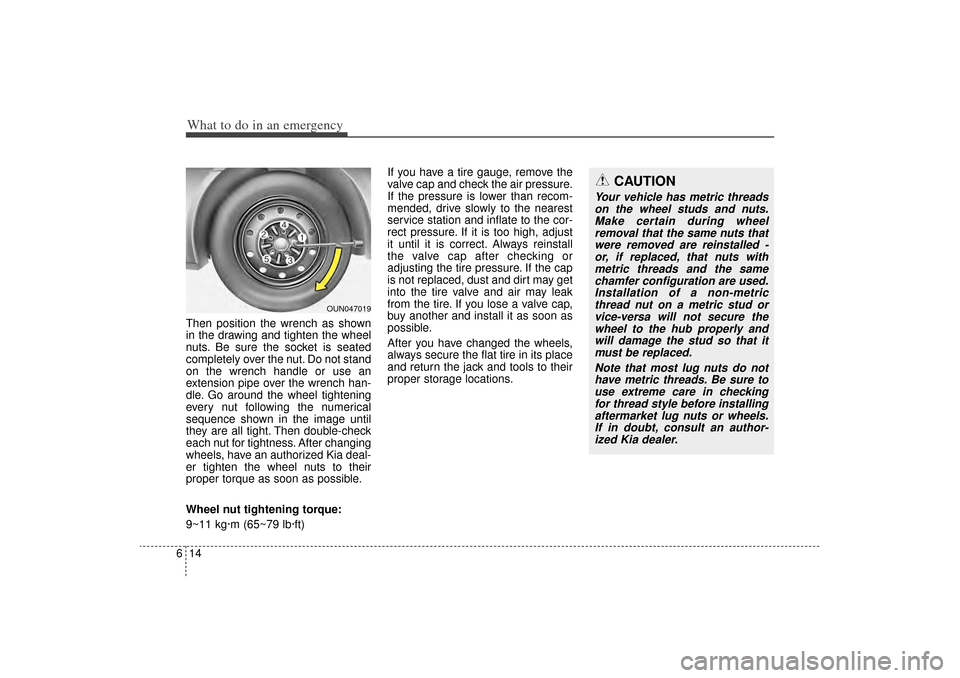
6Then position the wrench as shown
in the drawing and tighten the wheel
nuts. Be sure the socket is seated
completely over the nut. Do not stand
on the wrench handle or use an
extension pipe over the wrench han-
dle. Go around the wheel tightening
every nut following the numerical
sequence shown in the image until
they are all tight. Then double-check
each nut for tightness. After changing
wheels, have an authorized Kia deal-
er tighten the wheel nuts to their
proper torque as soon as possible.
Wheel nut tightening torque:
9~11 kg·m (65~79 lb·ft) If you have a tire gauge, remove the
valve cap and check the air pressure.
If the pressure is lower than recom-
mended, drive slowly to the nearest
service station and inflate to the cor-
rect pressure. If it is too high, adjust
it until it is correct. Always reinstall
the valve cap after checking or
adjusting the tire pressure. If the cap
is not replaced, dust and dirt may get
into the tire valve and air may leak
from the tire. If you lose a valve cap,
buy another and install it as soon as
possible.
After you have changed the wheels,
always secure the flat tire in its place
and return the jack and tools to their
proper storage locations.
CAUTION
Your vehicle has metric threads
on the wheel studs and nuts.Make certain during wheelremoval that the same nuts thatwere removed are reinstalled -or, if replaced, that nuts withmetric threads and the samechamfer configuration are used.Installation of a non-metricthread nut on a metric stud orvice-versa will not secure thewheel to the hub properly andwill damage the stud so that itmust be replaced.
Note that most lug nuts do nothave metric threads. Be sure touse extreme care in checkingfor thread style before installingaftermarket lug nuts or wheels.If in doubt, consult an author-ized Kia dealer.
OUN047019
XM(FL) CAN(ENG) 6.QXP 1/23/2013 3:34 PM Page 14
Page 401 of 508
615
What to do in an emergency
To prevent the jack, jack handle,
wheel lug nut wrench and spare tire
from rattling while the vehicle is in
motion, store them properly.
Important - use of compact sparetire (if equipped)Your vehicle is equipped with a com-
pact spare tire. This compact spare
tire takes up less space than a regu-
lar-size tire. This tire is smaller than a
conventional tire and is designed for
temporary use only.
The compact spare should be inflat-
ed to 420 kPa (60 psi).
✽ ✽NOTICECheck the inflation pressure after
installing the spare tire. Adjust it to
the specified pressure, as necessary.
CAUTION
You should drive carefully
when the compact spare is inuse. The compact spareshould be replaced by theproper conventional tire andrim at the first opportunity.
The operation of this vehicle is not recommended withmore than one compact sparetire in use at the same time.
WARNING
The compact spare tire is for
emergency use only. Do not
operate your vehicle on this
compact spare at speeds over
80 km/h (50 mph). The original
tire should be repaired or
replaced as soon as possible to
avoid failure of the spare possi-
bly leading to personal injury or
death.
WARNING
- Wheel studs
If the studs are damaged, they
may lose their ability to retain
the wheel. This could lead to the
loss of the wheel and a collision
resulting in serious injuries.
WARNING
- Inadequate
spare tire pressure
Check the inflation pressures
as soon as possible after
installing the spare tire. Adjust
it to the specified pressure, if
necessary. Refer to “Tires and
wheels” in section 8.
XM(FL) CAN(ENG) 6.QXP 1/23/2013 3:34 PM Page 15
Page 405 of 508

MaintenanceEngine compartment . . . . . . . . . . . . . . . . . . . . . . . . 7-3
Maintenance services . . . . . . . . . . . . . . . . . . . . . . . . 7-5• Owner’s responsibility . . . . . . . . . . . . . . . . . . . . . . . . . 7-5
• Owner maintenance precautions . . . . . . . . . . . . . . . . . 7-6Owner maintenance . . . . . . . . . . . . . . . . . . . . . . . . . 7-7• Owner maintenance schedule. . . . . . . . . . . . . . . . . . . . 7-7Scheduled maintenance service. . . . . . . . . . . . . . . . 7-9
Explanation of scheduled maintenance items . . . 7-27
Engine oil. . . . . . . . . . . . . . . . . . . . . . . . . . . . . . . . . 7-31• Checking the engine oil level . . . . . . . . . . . . . . . . . . . 7-31
• Changing the engine oil and filter . . . . . . . . . . . . . . . 7-32Engine coolant . . . . . . . . . . . . . . . . . . . . . . . . . . . . 7-33• Checking the coolant level . . . . . . . . . . . . . . . . . . . . . 7-33
• Changing the coolant . . . . . . . . . . . . . . . . . . . . . . . . . 7-35Brake/clutch fluid . . . . . . . . . . . . . . . . . . . . . . . . . . 7-36• Checking the brake/clutch fluid level . . . . . . . . . . . . 7-36Washer fluid . . . . . . . . . . . . . . . . . . . . . . . . . . . . . . 7-37• Checking the washer fluid level . . . . . . . . . . . . . . . . . 7-37Parking brake . . . . . . . . . . . . . . . . . . . . . . . . . . . . . 7-38• Checking the parking brake. . . . . . . . . . . . . . . . . . . . 7-38Air cleaner. . . . . . . . . . . . . . . . . . . . . . . . . . . . . . . . 7-39• Filter replacement . . . . . . . . . . . . . . . . . . . . . . . . . . . . 7-39
Climate control air filter . . . . . . . . . . . . . . . . . . . . 7-41• Filter inspection . . . . . . . . . . . . . . . . . . . . . . . . . . . . . . 7-41Wiper blades . . . . . . . . . . . . . . . . . . . . . . . . . . . . . . 7-43• Blade inspection . . . . . . . . . . . . . . . . . . . . . . . . . . . . . . 7-43
• Blade replacement . . . . . . . . . . . . . . . . . . . . . . . . . . . . 7-43Battery . . . . . . . . . . . . . . . . . . . . . . . . . . . . . . . . . . . 7-\
47• For best battery service . . . . . . . . . . . . . . . . . . . . . . . 7-47
• Battery recharging . . . . . . . . . . . . . . . . . . . . . . . . . . . 7-48
• Reset items . . . . . . . . . . . . . . . . . . . . . . . . . . . . . . . . . . 7-49\
Tires and wheels . . . . . . . . . . . . . . . . . . . . . . . . . . . 7-50• Tire care . . . . . . . . . . . . . . . . . . . . . . . . . . . . . . . . . . . . \
7-50
• Recommended cold tire inflation pressures . . . . . . . 7-50
• Checking tire inflation pressure. . . . . . . . . . . . . . . . . 7-51
• Tire rotation . . . . . . . . . . . . . . . . . . . . . . . . . . . . . . . . . 7-52
• Wheel alignment and tire balance . . . . . . . . . . . . . . . 7-53
• Tire replacement . . . . . . . . . . . . . . . . . . . . . . . . . . . . . 7-54
• Wheel replacement . . . . . . . . . . . . . . . . . . . . . . . . . . . 7-55
• Tire traction . . . . . . . . . . . . . . . . . . . . . . . . . . . . . . . . . 7-55
• Tire maintenance . . . . . . . . . . . . . . . . . . . . . . . . . . . . . 7-55
• Tire sidewall labeling . . . . . . . . . . . . . . . . . . . . . . . . . 7-56
7
XM(FL) CAN(ENG) 7.QXP 1/23/2013 3:35 PM Page 1
Page 411 of 508

77
Maintenance
OWNER MAINTENANCE The following lists are vehicle checks
and inspections that should be per-
formed by the owner or an author-
ized Kia dealer at the frequencies
indicated to help ensure safe,
dependable operation of your vehi-
cle.
Any adverse conditions should be
brought to the attention of your deal-
er as soon as possible.
These Owner Maintenance Checks
are generally not covered by war-
ranties and you may be charged for
labor, parts and lubricants used.
Owner maintenance schedule When you stop for fuel: Check the engine oil level.
Check the coolant level in thecoolant reservoir.
Check the windshield washer fluid level.
Look for low or under-inflated tires.
While operating your vehicle: Note any changes in the sound of the exhaust or any smell of
exhaust fumes in the vehicle.
Check for vibrations in the steering wheel. Notice any increased steer-
ing effort or looseness in the steer-
ing wheel, or change in its straight-
ahead position.
Notice if your vehicle constantly turns slightly or “pulls” to one side
when traveling on smooth, level
road.
When stopping, listen and check for unusual sounds, pulling to one
side, increased brake pedal travel
or “hard-to-push” brake pedal.
If any slipping or changes in the operation of your transaxle occurs,
check the transaxle fluid level.
Check the automatic transaxle P (Park) function.
Check the parking brake.
Check for fluid leaks under your vehicle (water dripping from the air
conditioning system during or after
use is normal).
WARNING
Be careful when checking your
engine coolant level when the
engine is hot. Scalding hot
coolant and steam may blow
out under pressure. This could
cause burns or other serious
injury.
XM(FL) CAN(ENG) 7.QXP 1/23/2013 3:35 PM Page 7