2014 KIA RIO HATCHBACK engine oil
[x] Cancel search: engine oilPage 386 of 446

Maintenance
56
7
FUSES
A vehicle’s electrical system is pro-
tected from electrical overload dam-
age by fuses. This vehicle has 2 fuse panels, one
located in the driver’s side panel bol-
ster, the other in the engine compart-
ment near the battery.
If any of your vehicle’s lights, acces-
sories, or controls do not work, check
the appropriate circuit fuse. If a fuse
has blown, the element inside the
fuse will melt.
If the electrical system does not
work, first check the driver’s side
fuse panel.
Before replacing a blown fuse, move
to safe place, turn off the engine and
all electric devices, and then discon-
nect the negative battery cable.
Always replace a blown fuse with
one of the same rating.
If the replacement fuse blows, this
indicates an electrical problem. Avoid
using the system involved and imme-
diately consult an authorized Kia
dealer.Three kinds of fuses are used: blade
type for lower amperage rating, car-tridge type, and multi fuse for higheramperage ratings.
✽ ✽ NOTICE
The actual fuse/relay panel label
may differ from equipped items.
WARNING - Fuse
replacement
Never replace a fuse with any-
thing but another fuse of the
same rating.
A higher capacity fuse could cause damage and possibly a
fire.
Never install a wire or alu- minum foil instead of the
proper fuse - even as a tem-
porary repair. It may cause
extensive wiring damage and
a possible fire.
OTA070039
Blade type
Cartridge type
Fusible link B B
B
B
l
l
l
l
o
o
o
o
w
w
w
w
n
n
n
n
B
B
B
B
l
l
l
l
o
o
o
o
w
w
w
w
n
n
n
n
B
B
B
B
l
l
l
l
o
o
o
o
w
w
w
w
n
n
n
n
CAUTION - Fuse
replacement
Do not use a screwdriver or any
other metal object to removefuses because it may cause ashort circuit and damage thesystem.
Page 396 of 446

Maintenance
66
7
Engine compartment main fuse panel
Fuse Name Fuse rating Circuit Protected
IG2 40APCB Fuse & Relay Box (Start Relay), W/O Smart Key - Ignition Switch,
With Smart Key - PDM Relay Box (ESCL (IG2) Relay)
ECU1 30A PCB Fuse & Relay Box (Engine Control Relay, ECU2 10A)
ECU3 10A Not Used
BLOWER 40A PCB Fuse & Relay Box (Blower Relay)
C/FAN 40A PCB Fuse & Relay Box (Cooling Fan (Low) Relay, Cooling Fan (Hi) Relay)
F/PUMP 20A PCB Fuse & Relay Box (Fuel Pump #1 Relay)
H/LAMP HI 20A PCB Fuse & Relay Box (Head Lamp (HI) Relay)
H/LAMP 20A PCB Fuse & Relay Box (Head Lamp (LO) Relay)
HORN 10A PCB Fuse & Relay Box (Horn Relay, Burglar Alarm Horn Relay)
ECU2 10A M/T - ECM, A/T - E/R Junction Box (ECU_VM 10A)
B/UP LAMP 10A A/T - PCM, Transaxle Range Switch
WIPER 10A ECM/PCM, Rain Sensor
ECU4 20A ECM/PCM
INJECTOR 15A ECM/PCM, PCB Fuse & Relay Box (Fuel Pump #1 Relay)
H/LAMP LH 10A Head Lamp LH
SENSOR1 10APurge Control Solenoid Valve, Variable Intake Solenoid Valve, Canister Close Valve,
PCB Fuse & Relay Box (Cooling Fan (Low) Relay, Cooling Fan (Hi) Relay)
SENSOR2 10A Oil Control Valve #1/#2, Oxygen Sensor (Up/Down)
H/LAMP RH 10A Head Lamp RH
Page 399 of 446

769
Maintenance
Always handle them carefully, and
avoid scratches and abrasions. If the
bulbs are lit, avoid contact with liq-
uids. Never touch the glass with bare
hands. Residual oil may cause the
bulb to overheat and burst when lit. A
bulb should be operated only when
installed in a headlight.
If a bulb becomes damaged or
cracked, replace it immediately and
carefully dispose of it.
Wear eye protection when changing
a bulb. Allow the bulb to cool down
before handling it.1.Turn off the engine and open the
hood.
2.Remove the front bumper upper cover.
3.Remove the headlight assembly from the body of the vehicle. If you
can reach the bulb without remov-
ing the headlight assembly, you do
not need to do step 2 and 3.
4.Disconnect the power connector(s) from the back of the headlight
assembly. Headlight(High/Low)
4 door
5.Remove the headlight bulb cover by turning it counterclockwise.
6.Unsnap the headlight bulb retain- ing wire by depressing the end and
pushing it right ward.
7.Pull the bulb out of the socket.
8.Insert a new bulb into the socket.
9.Install the socket in the assembly by aligning the shape on the bulb
housing in the assembly. Pushing
the spring holder in to the slot.
10. Install the headlight bulb cover by turning it clockwise
OUB071073
Page 412 of 446
Maintenance
82
7
Waxing
Wax the vehicle when water will no
longer bead on the paint.
Always wash and dry the vehicle
before waxing. Use a good quality
liquid or paste wax, and follow the
manufacturer’s instructions. Wax all
metal trim to protect it and to main-
tain its luster.
Removing oil, tar, and similar materi-
als with a spot remover will usually
strip the wax from the finish. Be sure
to re-wax these areas even if the rest
of the vehicle does not yet need wax-
ing.
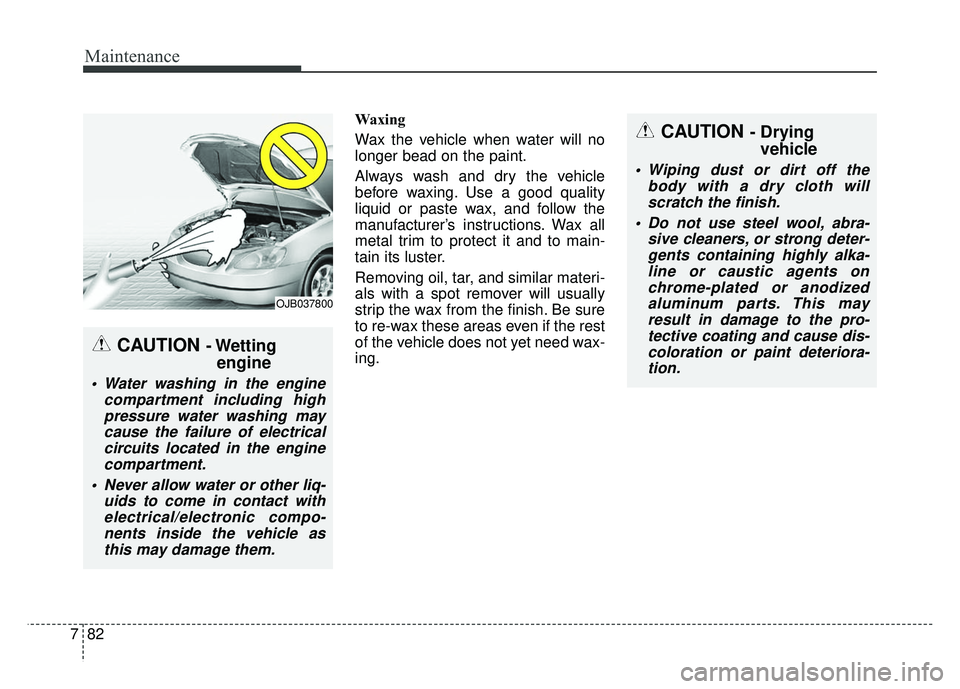
CAUTION - Wetting
engine
Water washing in the engine
compartment including highpressure water washing maycause the failure of electricalcircuits located in the enginecompartment.
Never allow water or other liq- uids to come in contact withelectrical/electronic compo-nents inside the vehicle asthis may damage them.
OJB037800
CAUTION - Drying vehicle
Wiping dust or dirt off the
body with a dry cloth willscratch the finish.
Do not use steel wool, abra- sive cleaners, or strong deter-gents containing highly alka-line or caustic agents onchrome-plated or anodizedaluminum parts. This mayresult in damage to the pro-tective coating and cause dis-coloration or paint deteriora-tion.
Page 427 of 446

Specifications, Consumer information, Reporting safety defects
68
RECOMMENDED LUBRICANTS AND CAPACITIES
To help achieve proper engine and powertrain performance and durability, use only lubricants of the proper quality.
The correct lubricants also help promote engine efficiency that results in improved fuel economy.
These lubricants and fluids are recommended for use in your vehicle.
*1Refer to the recommended SAE viscosity numbers on the next page.
*2Engine oils labeled Energy Conserving Oil are now available. Along with other additional benefits, they contribute
to fuel economy by reducing the amount of fuel necessary to overcome engine friction. Often, these improvements
are difficult to measure in everyday driving, but in a year’s time, they can offer significant cost and energy savings.
*
3If the API service SM engine oil is not available in your country, you are able to use API service SL.
Lubricant Volume Classification
Engine oil *1 *2 (drain and refill)
recommended (or equivalent) 3.8 US qt. (3.6 l)
Manual transaxle fluid 1.9 ~ 2.01 US qt.
API GL-4, SAE 75W/85
(1.8 ~ 1.9 l) approved by Kia Motors Corp.
MICHANG ATF SP-IV, SK ATF SP-IV
Automatic transaxle 1.6 Engine 7.71 US qt. (7.3 l) NOCA ATF SP-IV, Kia genuine ATF SP-IV or
fluid other brands meeting the above specification
approved by Kia Motor Co.,
Coolant Automatic transaxle 5.6 US qt. (5.5 l) Mixture of antifreeze and distilled water
Manual transaxle 5.8 US qt. (5.3 l) (Ethylene glycol base coolant for aluminum radiator)
Brake/Clutch fluid 0.7~0.8 US qt.
FMVSS116 DOT-3 or DOT-4
(0.7~0.8 l)
Fuel 11.3 US gal. (43 l) Refer to “Fuel requirements” in s
ection 1
API Service SM*3,
ILSAC GF-4 or above
Page 428 of 446

87
Specifications, Consumer information, Reporting safety defects
Recommended SAE viscosity
number
Always be sure to clean the area
around any filler plug, drain plug, or
dipstick before checking or draining
any lubricant. This is especially
important in dusty or sandy areas
and when the vehicle is used on
unpaved roads. Cleaning the plug
and dipstick areas will prevent dirt
and grit from entering the engine and
other mechanisms that could be
damaged.Engine oil viscosity (thickness) has
an effect on fuel economy and cold
weather operation (engine start and
engine oil flowability). Lower viscosi-
ty engine oils can provide better fuel
economy and cold weather perform-
ance, however, higher viscosity
engine oils are required for satisfac-
tory lubrication in hot weather. Using
oils of any viscosity other than those
recommended could result in engine
damage.
When choosing an oil, consider the
range of temperature your vehicle
will be operated in before the next oil
change. Proceed to select the rec-
ommended oil viscosity from the
chart.
Temperature Range for SAE Viscosity Numbers
Temperature
Gasoline
Engine Oil *1
°C
(°F)-30 -20 -10 0 10 20 30 40 50
-10 0 20 40 60 80 100 120
*1For better fuel economy, it is recommended to use the
engine oil of a viscosity grade SAE 5W-20 (API SM /
ILSAC GF-4). However, if the engine oil is not avail-
able in your country, select the proper engine oil using
the engine oil viscosity chart.
10W-30
5W-20, 5W-30
Page 430 of 446
89
Specifications, Consumer information, Reporting safety defects
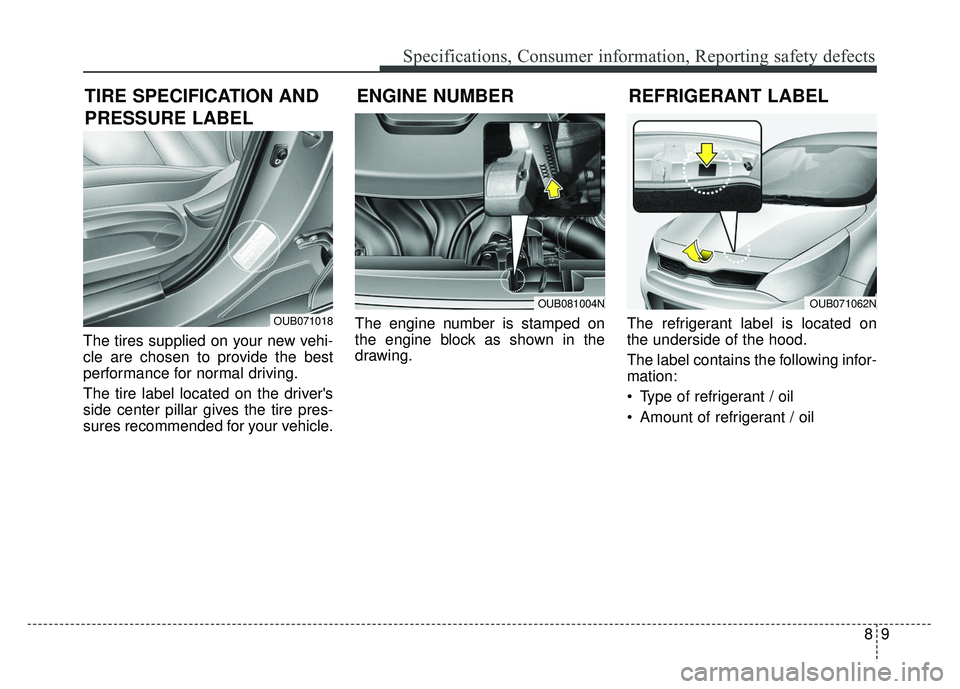
The tires supplied on your new vehi-
cle are chosen to provide the best
performance for normal driving.
The tire label located on the driver's
side center pillar gives the tire pres-
sures recommended for your vehicle.The engine number is stamped on
the engine block as shown in the
drawing.
The refrigerant label is located on
the underside of the hood.
The label contains the following infor-
mation:
Type of refrigerant / oil
Amount of refrigerant / oil
OUB081004N
ENGINE NUMBER
REFRIGERANT LABELTIRE SPECIFICATION AND
PRESSURE LABEL
OUB071018
OUB071062N
Page 439 of 446

Index
4I
Economical operation ··················\
··················\
················5-46
Electric power steering ··················\
··················\
··············4-39
Electronic stability program (ESC) ··················\
·············5-27
Emergency starting ··················\
··················\
··················\
····6-5Jump starting ··················\
··················\
··················\
···········6-5
Push starting ··················\
··················\
··················\
············6-7
Emergency while driving ··················\
··················\
·············6-3
Emission control system ··················\
··················\
············7-88 Crankcase emission control system··················\
···········7-88
Evaporative emission control System ··················\
·······7-88
Exhaust emission control system ··················\
··············7-89
Engine ··················\
··················\
··················\
··················\
······8-2
Engine compartment ··················\
··················\
··················\
··2-6
Engine compartment panel fuse ··················\
··················\
7-58
Engine coolant ··················\
··················\
··················\
·········7-27
Engine coolcant temperature gauge··················\
·············4-47
Engine number ··················\
··················\
··················\
···········8-9
Engine oil ··················\
··················\
··················\
·················7-26\
Engine overheats ··················\
··················\
··················\
········6-8
Engine start/stop button ··················\
··················\
···············5-7
Engine will not start··················\
··················\
··················\
···6-4
Evaporative emission control System ··················\
··········7-88
Exhaust emission control system··················\
·················7-89\
Explanation of scheduled maintenance items ···············7-23
Exterior care··················\
··················\
··················\
·············7-81 Flat tire (with spare tire) ··················\
··················\
············6-14
Jack and tools ··················\
··················\
··················\
········6-14
Changing tires··················\
··················\
··················\
········6-15
Compact spare tire ··················\
··················\
··················\
·6-20
Removing and storing the spare tire···········\
·················6-15\
Flat tire (with tire mobility kit) ··················\
··················\
·6-22
Floor mat anchor(s) ··················\
··················\
·················4-10\
7
Fluid Automatic transaxle fluid ··················\
··················\
········7-31
Brakes/clutch fluid··················\
··················\
··················\
·7-30
Washer fluid··················\
··················\
··················\
···········7-31
Folding the outside rearviwe mirror ··················\
············4-44
Folding the rear seat ··················\
··················\
··················\
3-10
Front passenger and rear seat belt ··················\
···············3-17
Front seat adjustment ··················\
··················\
··················\
·3-4
Fuel filler lid ··················\
··················\
··················\
············4-32
Fuel gauge··················\
··················\
··················\
················4-47
Fuel requirements ··················\
··················\
··················\
······1-3
Fuses ··················\
··················\
··················\
··················\
······7-56 Engine compartment panel fuse ··················\
················7-58
Fuse/relay panel description ··················\
··················\
····7-59
Instrument panel fuse ··················\
··················\
··············7-57
Memory fuse··················\
··················\
··················\
··········7-58
Multi fuse ··················\
··················\
··················\
··············7-59
FE