2014 KIA MOHAVE length
[x] Cancel search: lengthPage 39 of 417
Safety features of your vehicle
22
3
C020101AEN-EE
Seat belt warning
As a reminder to the driver, the seat belt
warning light will blink for approximately
6 seconds each time you turn the ignition
switch ON regardless of belt fastening.
If the driver’s seat belt is unfastened after
the ignition switch is ON, the seat belt
warning light blinks again for approxi-
mately 6 seconds.
If the driver's seat belt is not fastened
when the ignition switch is turned ON or
if it is unfastened after the ignition switch
is ON, the seat belt warning chime will
sound for approximately 6 seconds. At
this time, if the seat belt is fastened, the
chime will stop at once. C020102BHM
Lap/shoulder belt
To fasten your seat belt:
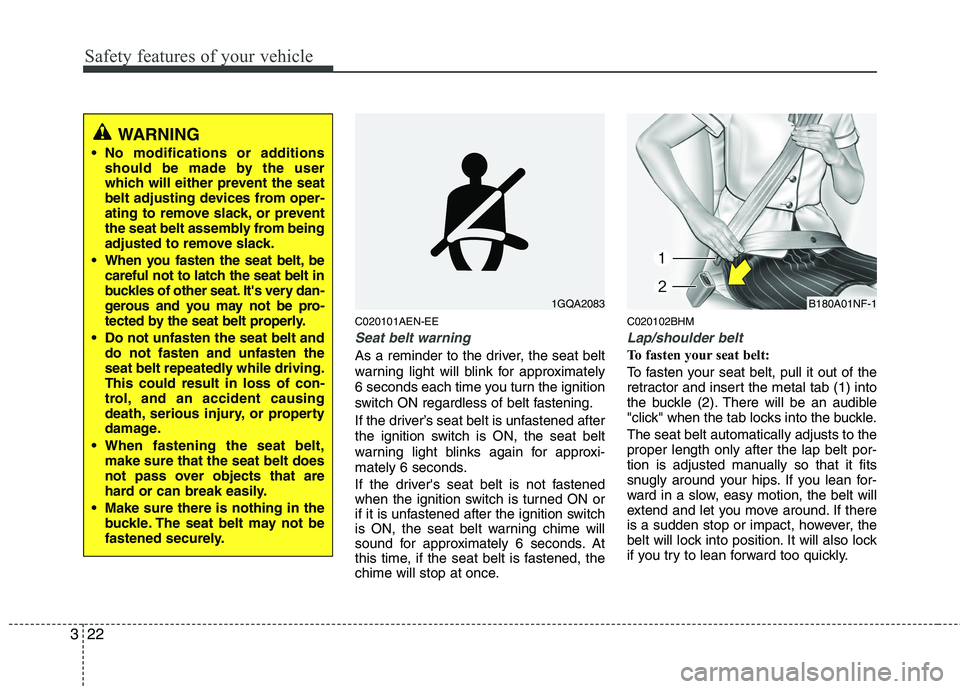
To fasten your seat belt, pull it out of the
retractor and insert the metal tab (1) into
the buckle (2). There will be an audible
"click" when the tab locks into the buckle. The seat belt automatically adjusts to the proper length only after the lap belt por-
tion is adjusted manually so that it fits
snugly around your hips. If you lean for-
ward in a slow, easy motion, the belt will
extend and let you move around. If there
is a sudden stop or impact, however, the
belt will lock into position. It will also lock
if you try to lean forward too quickly.
1GQA2083B180A01NF-1
WARNING
No modifications or additions should be made by the user
which will either prevent the seat
belt adjusting devices from oper-
ating to remove slack, or prevent
the seat belt assembly from being
adjusted to remove slack.
When you fasten the seat belt, be careful not to latch the seat belt in
buckles of other seat. It's very dan-
gerous and you may not be pro-
tected by the seat belt properly.
Do not unfasten the seat belt and do not fasten and unfasten the
seat belt repeatedly while driving.This could result in loss of con-
trol, and an accident causing
death, serious injury, or property
damage.
When fastening the seat belt, make sure that the seat belt does
not pass over objects that are
hard or can break easily.
Make sure there is nothing in the buckle. The seat belt may not be
fastened securely.
Page 42 of 417
325
Safety features of your vehicle
C020103AHM
Lap belt (if equipped)
To fasten your seat belt:
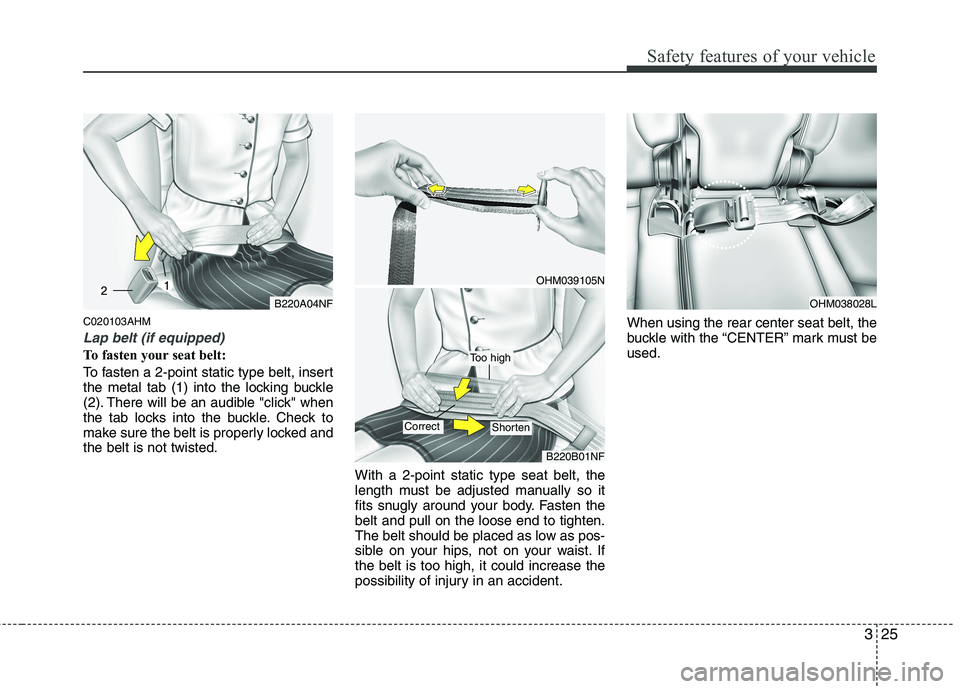
To fasten a 2-point static type belt, insert
the metal tab (1) into the locking buckle
(2). There will be an audible "click" when
the tab locks into the buckle. Check to
make sure the belt is properly locked andthe belt is not twisted.With a 2-point static type seat belt, the
length must be adjusted manually so it
fits snugly around your body. Fasten thebelt and pull on the loose end to tighten.
The belt should be placed as low as pos-
sible on your hips, not on your waist. Ifthe belt is too high, it could increase the
possibility of injury in an accident.When using the rear center seat belt, the
buckle with the “CENTER” mark must beused.
B220A04NFOHM038028L
OHM039105N
B220B01NF
Too high
ShortenCorrect
Page 201 of 417

Features of your vehicle
124
4
D290100AHM
Roof rack (if equipped)
If the vehicle has a roof rack, you can load
cargo on top of your vehicle. Crossbars and fixing components needed
to install the roof rack on your vehicle may
be obtained from an authorized Kia dealer.
✽✽
NOTICE
The crossbars (if equipped) should be placed in the proper load carrying posi-
tions prior to placing items onto the roof
rack.
If the vehicle is equipped with a sunroof, be sure not to position cargo onto the
roof rack in such a way that it
could
interfere with sunroof operation.
When the roof rack is not being used to carry cargo, the crossbars may need to be
repositioned if wind noise is detected.
EXTERIOR FEATURES
OHM048140
CAUTION
When carrying cargo on the roof
rack, take the necessary precau-tions to make sure the cargo does
not damage the roof of the vehicle.
When carrying large objects on the roof rack, make sure they donot exceed the overall roof lengthor width.
WARNING
The following specification is the maximum weight that can be
loaded onto the roof rack.
Distribute the load as evenly as
possible across the crossbars (if
equipped) and roof rack and
secure the load firmly.
Loading cargo or luggage in
excess of the specified weight
limit on the roof rack may dam-
age your vehicle.
The vehicle center of gravity will be higher when items are loaded
onto the roof rack. Avoid sudden
starts, braking, sharp turns,
abrupt maneuvers or high speeds
that may result in loss of vehicle
control or rollover resulting in anaccident.
(Continued)
ROOF 100 kg (220 lbs.)
RACK EVENLY DISTRIBUTED
Page 301 of 417

Driving your vehicle
60
5
Trailer brakes
If your trailer is equipped with a braking
system, make sure it conforms to your
country’s regulations and that it is prop-
erly installed and operating correctly.
If your trailer weighs more than the max-
imum trailer weight without trailer brakes
loaded, then it needs its own brakes and
they must be adequate. Be sure to read
and follow the instructions for the trailer
brakes so you’ll be able to install, adjust
and maintain them properly.
Do not tap into your vehicle's brake
system. Driving with a trailer
Towing a trailer requires a certain
amount of experience. Before setting out
for the open road, you must get to know
your trailer. Acquaint yourself with the
feel of handling and braking with the
added weight of the trailer. And always
keep in mind that the vehicle you are
driving is now a good deal longer and not
nearly so responsive as your vehicle is
by itself.
Before you start, check the trailer hitch
and platform, safety chains, electrical
connector(s), lights, tires and mirror
adjustment. If the trailer has electric
brakes, start your vehicle and trailer mov-
ing and then apply the trailer brake con-
troller by hand to be sure the brakes are
working. This lets you check your electri-
cal connection at the same time.
During your trip, check occasionally to be
sure that the load is secure, and that the
lights and trailer brakes are still working.Following distance
Stay at least twice as far behind the vehi-
cle ahead as you would when driving
your vehicle without a trailer. This can
help you avoid situations that require
heavy braking and sudden turns.
Passing
You’ll need more passing distance up
ahead when you’re towing a trailer. And,
because of the increased vehicle length,
you’ll need to go much farther beyond the
passed vehicle before you can return to
your lane.
Backing up
Hold the bottom of the steering wheel
with one hand. Then, to move the trailer
to the left, just move your hand to the left.
To move the trailer to the right, move your
hand to the right. Always back up slowly
and, if possible, have someone guide
you.WARNING
- Trailer brakes
Do not use a trailer with its own
brakes unless you are absolutely
certain that you have properly set
up the brake system. This is not a
task for amateurs. Use an experi-
enced, competent trailer shop for
this work.
Page 400 of 417

Specifications & Consumer information
2
8
Item mm (in)
Overall length 4880 (192.1)
Overall width 1915 (75.4)
Overall height 1765 (69.5) / 1810 (71.3)* 1
Front tread 1630 (64.2)* 2
/ 1615 (63.6)* 3
Rear tread 1640 (64.6)* 2
/ 1625 (64.0)* 3
Wheelbase 2895 (114)
DIMENSIONS
Light Bulb Wattage
Headlights (Low) 55 or 35 (HID)
Headlights (High) 55
Front turn signal lights 21
Position lights 5
Side repeater lights* LED
Front fog lights* 27
Rear fog light* 21
Stop and tail lights Except Middle East 21/5 or LED
For Middle East 27/8 or LED
Tail light* 5 or LED
Rear turn signal lights Except Middle East 21 or 27
For Middle East 27
Back-up lights 16
High mounted stop light* LED
License plate lights 5Map lamps 6
Room lamps 10
Luggage lamp* 5
Glove box lamp* 5
Vanity mirror lamps* 5
Door courtesy lamps* 5
BULB WATTAGE
* : If equipped
*
1
: with roof rack
* 2
: with 245/70R17 tire
* 3
: with 265/60R18 tire
I010000BHM-EE
I030000AHM-EE