2014 KIA MOHAVE height
[x] Cancel search: heightPage 272 of 417
531
Driving your vehicle
E070300AHM-EE
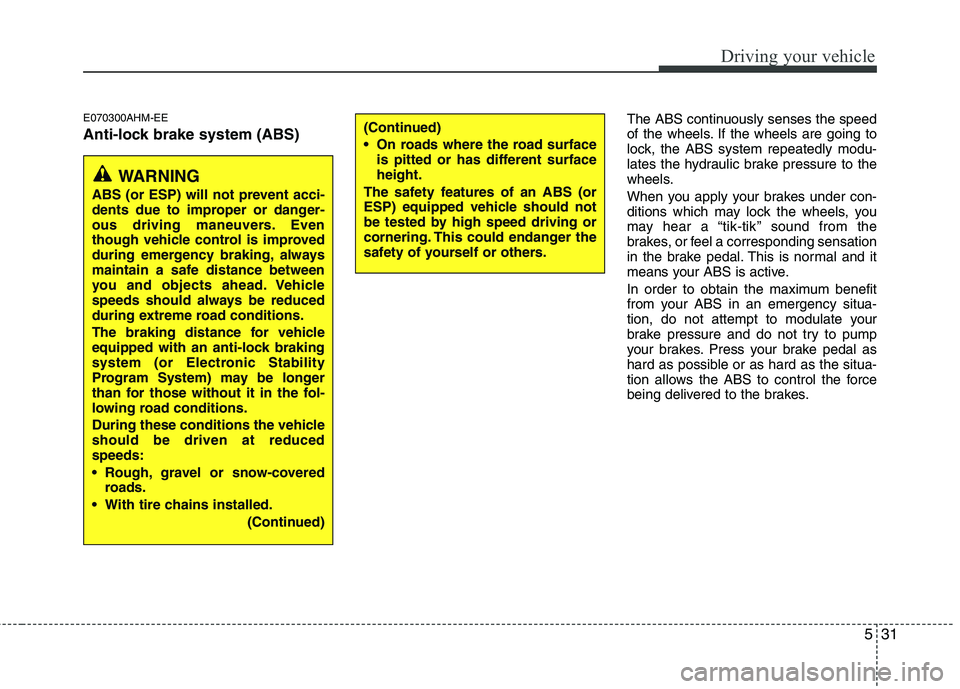
Anti-lock brake system (ABS)The ABS continuously senses the speed
of the wheels. If the wheels are going to
lock, the ABS system repeatedly modu-
lates the hydraulic brake pressure to the
wheels.
When you apply your brakes under con-
ditions which may lock the wheels, you
may hear a “tik-tik’’ sound from the
brakes, or feel a corresponding sensation
in the brake pedal. This is normal and it
means your ABS is active.
In order to obtain the maximum benefit
from your ABS in an emergency situa-
tion, do not attempt to modulate your
brake pressure and do not try to pump
your brakes. Press your brake pedal as
hard as possible or as hard as the situa-
tion allows the ABS to control the force
being delivered to the brakes.
WARNING
ABS (or ESP) will not prevent acci-
dents due to improper or danger-
ous driving maneuvers. Even
though vehicle control is improved
during emergency braking, always
maintain a safe distance between
you and objects ahead. Vehicle
speeds should always be reduced
during extreme road conditions.
The braking distance for vehicle
equipped with an anti-lock braking
system (or Electronic Stability
Program System) may be longer
than for those without it in the fol-
lowing road conditions.
During these conditions the vehicle should be driven at reducedspeeds:
Rough, gravel or snow-covered roads.
With tire chains installed. (Continued)
(Continued)
On roads where the road surfaceis pitted or has different surface height.
The safety features of an ABS (or
ESP) equipped vehicle should not
be tested by high speed driving or
cornering. This could endanger the
safety of yourself or others.
Page 282 of 417

541
Driving your vehicle
E180000AHM
The Air Leveling System improves driv-
ing stability and riding comfort with con-
tinuous maintenance of vehicle height
regardless of the load and number of
passengers. The rear height is controlled
automatically and manually into three
modes; Ordinary driving mode (N), Off
road driving mode (HI) and Loadingmode (LO).E180100AHM
N (Normal) - Ordinary driving mode
The normal height of the vehicle is main- tained. The indicator on the cluster will illuminate
at N (Normal).
E180200AHM
HI (High) - Off road driving mode
The rear part of the vehicle is lifted to
drive on rough roads such as off-roads.
With the engine running press the top
part of the switch. The HI (High) mode
activates only when the vehicle is not
moving or the speed is less than 35 km/h
(22mph). The indicator blinks when thesystem is adjusting itself to the HI (High)
mode. When the adjustment is complet-
ed (about 40mm (2 in.) raised) the indi-cator on the cluster will illuminate at HI(High).
AIR LEVELING SYSTEM (ALS) (IF EQUIPPED)
OHM058025OHM058026OHM058027
Page 283 of 417

Driving your vehicle
42
5
To go to the N (Normal) mode, press the
bottom part of the switch. Also, if the
vehicle speed is over 60 km/h (38mph) or
drives over 10 seconds at the speed of
about 45 km/h (28mph), the vehicle will
lower itself to the N (Normal) mode.
E180200AHM
LO (Low) - Loading mode
The rear part of the vehicle is lowered to
make it easy to load or unload cargo.
With the engine running press the bottom
part of the switch. The LO (Low) mode
activates only when the vehicle is not
moving. The indicator blinks when the
system is adjusting itself to the LO (Low)
mode. When the adjustment is complet-
ed (about 40mm (2 in.) lowered) the indi-cator on the cluster will illuminate at LO
(Low).
To go to the N (Normal) mode, press the
top part of the switch. Also, if the vehicle
speed is over 2 km/h (1 mph), the vehicle
will lift itself to the N (Normal) mode.✽✽NOTICE
The ALS will adjust the rear height of
the vehicle according to the load and
number of passengers when the ignition
switch is in the ON position or when the
engine is on.
OHM058028
Page 284 of 417

543
Driving your vehicle
CAUTION
Always check if there is anythingunder the rear part of the vehicle
before adjusting the ALS.
There may be noise heard while the ALS is adjusting the height toa mode.
Do not turn off the engine or press the switch to another modewhile the ALS is adjusting to themode selected.
Do not activate the ALS when the air filter of the compressor has
been submerged.
Inspect or replace the ALS air fil- ter and air spring according to themaintenance schedule.
Do not drive the vehicle when the air spring is damaged or airless.Have the vehicle towed with allthe wheels lifted from the ground.
(Continued)
(Continued) Have the vehicle checked by an authorized Kia dealer if all thelights of the ALS indicator is illu-minated.
All the lights of the ALS indicator can be illuminated when the vehi-cle was parked with one side ofthe vehicle lifted or when one
side of the vehicle was lifted witha jack. When this happens, takethe vehicle to a level ground, and turn off the engine. The ALS will
operate normally when the engineis turned on again.
Page 367 of 417

Maintenance
40
7
G200601AUN
Compact spare tire replacement
(if equipped)
A compact spare tire has a shorter
tread life than a regular size tire.
Replace it when you can see the
tread wear indicator bars on the tire.The replacement compact spare tire
should be the same size and design
tire as the one provided with your
new vehicle and should be mountedon the same compact spare tire
wheel. The compact spare tire is notdesigned to be mounted on a regular
size wheel, and the compact spare
tire wheel is not designed for mount-
ing a regular size tire. G200700AUN Wheel replacement
When replacing the metal wheels for
any reason, make sure the new
wheels are equivalent to the original
factory units in diameter, rim widthand offset.
G200800AHM Tire traction
Tire traction can be reduced if you
drive on worn tires, tires that are
improperly inflated or on slippery
road surfaces. Tires should be
replaced when tread wear indicators
appear. Slow down whenever there
is rain, snow or ice on the road toreduce the possibility of losing con-
trol of the vehicle.
G200900AUN Tire maintenance In addition to proper inflation, correct wheel alignment helps to decrease
tire wear. If you find a tire is worn
unevenly, have your dealer check thewheel alignment.
When you have new tires installed,
make sure they are balanced. This
will increase vehicle ride comfort and
tire life. Additionally, a tire should
always be rebalanced if it is removedfrom the wheel.
WARNING
A wheel that is not the correct
size may adversely affect wheel
and bearing life, braking and
stopping abilities, handling char-
acteristics, ground clearance,
body-to-tire clearance, snow
chain clearance, speedometer
and odometer calibration, head-
light aim and bumper height.
Page 368 of 417

741
Maintenance
G201000AUN
Tire sidewall labeling
This information identifies and
describes the fundamental charac-
teristics of the tire and also provides
the tire identification number (TIN)
for safety standard certification. TheTIN can be used to identify the tire incase of a recall.
G201001AUN
1. Manufacturer or brand name
Manufacturer or Brand name is
shown.G201002AHM
2. Tire size designation
A tire’s sidewall is marked with a tire
size designation. You will need this
information when selecting replace-
ment tires for your vehicle. The follow-
ing explains what the letters and num-
bers in the tire size designation mean.
Example tire size designation:
(These numbers are provided as an
example only; your tire size designator
could vary depending on your vehicle.) P245/70R17 108T
P - Applicable vehicle type (tires
marked with the prefix “P’’ are
intended for use on passenger
vehicles or light trucks; however,
not all tires have this marking).
245 - Tire width in millimeters.
70 - Aspect ratio. The tire’s section height as a percentage of its width.
R - Tire construction code (Radial).
17 - Rim diameter in inches.
108 - Load Index, a numerical code associated with the maximum
load the tire can carry. T - Speed Rating Symbol. See the
speed rating chart in this section
for additional information.
Wheel size designation
Wheels are also marked with impor-
tant information that you need if you
ever have to replace one. The follow-
ing explains what the letters and
numbers in the wheel size designa-tion mean.
Example wheel size designation: 7.0JX17
7.0 - Rim width in inches. J - Rim contour designation.
17 - Rim diameter in inches.
Tire speed ratings
The chart below lists many of the dif-
ferent speed ratings currently being
used for passenger car tires. The
speed rating is part of the tire size
designation on the sidewall of the
tire. This symbol corresponds to that
tire's designed maximum safe oper-ating speed.
I030B04JM
1
1
23
4
5,6
7
Page 400 of 417

Specifications & Consumer information
2
8
Item mm (in)
Overall length 4880 (192.1)
Overall width 1915 (75.4)
Overall height 1765 (69.5) / 1810 (71.3)* 1
Front tread 1630 (64.2)* 2
/ 1615 (63.6)* 3
Rear tread 1640 (64.6)* 2
/ 1625 (64.0)* 3
Wheelbase 2895 (114)
DIMENSIONS
Light Bulb Wattage
Headlights (Low) 55 or 35 (HID)
Headlights (High) 55
Front turn signal lights 21
Position lights 5
Side repeater lights* LED
Front fog lights* 27
Rear fog light* 21
Stop and tail lights Except Middle East 21/5 or LED
For Middle East 27/8 or LED
Tail light* 5 or LED
Rear turn signal lights Except Middle East 21 or 27
For Middle East 27
Back-up lights 16
High mounted stop light* LED
License plate lights 5Map lamps 6
Room lamps 10
Luggage lamp* 5
Glove box lamp* 5
Vanity mirror lamps* 5
Door courtesy lamps* 5
BULB WATTAGE
* : If equipped
*
1
: with roof rack
* 2
: with 245/70R17 tire
* 3
: with 265/60R18 tire
I010000BHM-EE
I030000AHM-EE