2014 KIA MOHAVE roof
[x] Cancel search: roofPage 109 of 417
Features of your vehicle
32
4
D110500AHM-EE
Resetting the sunroof
Whenever the vehicle battery is discon-
nected or discharged, you must reset
your sunroof system as follows:
1. Turn the ignition switch to the ON
position.
2. According to the position of the sun- roof, do the following.
1) In case the sunroof is closed com-pletely or tilted:
Push the sunroof control lever
upward until the sunroof tilts com-
pletely upward.
2) In case the sunroof is open: Push the sunroof control lever for-
ward until the sunroof closes com-
pletely. Push the sunroof control
lever upward until the sunroof tilts
completely upward.
3. Release the sunroof control lever.
4. Push the sunroof control lever upward (about 10 seconds) until the sunroof
has returned to the original tilt posi-
tion after it is raised a little higher than
the maximum tilt position. Then,
release the lever. 5. Push the sunroof control lever upward
(about 6 seconds) until the sunroof
operates as follows;
TILT DOWN SLIDE OPEN
SLIDE CLOSE
Then, release the lever.
When this is complete, the sunroof sys- tem has been reset.
Page 120 of 417

443
Features of your vehicle
4. When the compass heading displaynormally, press and hold the button (2)
again for about 6~7 seconds until the
"CAL" appears and release the button.
5. Drive your vehicle in a complete circle for at least 2~3 times (either clock-
wise or counterclockwise) at less than5 mph (8 km/h) until the "CAL" disap-
pears, and the compass heading
appears. Then the calibration will be
complete. If the compass mirror does not recog-
nize the terrestrial magnetism correct-
ly depending on the external circum-
stances, the calibration procedure
may be delayed.
6. If the vehicle's compass headings become inaccurate again, repeat the
above steps. Setting the compass zone
This compass must be set to compen-
sate for the variation between true north
and magnetic north. To set variation:
1. Find your current location and vari-
ance zone number on the zone map.
2. Press and hold the COMPASS button (2) for about 3 seconds until the
"ZONE" appears in the display, and
release the button. Then the zone
number will appear in the display.
3. Press the button (2) repeatedly until the correct zone number for your loca-
tion appears in the display. 4. If the desired zone number is selected,
release the button (2). After about 3
seconds, the "ZONE" will disappear
and a compass direction will show in
the display.
5. If the new compass zone is set, per- form the "Calibration procedure".
✽✽ NOTICE
Do not install a ski rack, antenna, etc. that is attached to the vehicle using a
magnet. Anything attached to the roof
of the vehicle with a magnet will effect
the compass operation.
If the compass deviates from the cor-
rect indication after repeating the
adjustment, have the compass
checked by an authorized dealer.
The compass may not indicate the
correct compass point in tunnels or
while driving up or down a steep hill.
(The compass returns to the correct
compass point when the vehicle moves
to an area where the geomagnetism is
stabilized.)
OHM048163LOHM048162L
Page 201 of 417

Features of your vehicle
124
4
D290100AHM
Roof rack (if equipped)
If the vehicle has a roof rack, you can load
cargo on top of your vehicle. Crossbars and fixing components needed
to install the roof rack on your vehicle may
be obtained from an authorized Kia dealer.
✽✽
NOTICE
The crossbars (if equipped) should be placed in the proper load carrying posi-
tions prior to placing items onto the roof
rack.
If the vehicle is equipped with a sunroof, be sure not to position cargo onto the
roof rack in such a way that it
could
interfere with sunroof operation.
When the roof rack is not being used to carry cargo, the crossbars may need to be
repositioned if wind noise is detected.
EXTERIOR FEATURES
OHM048140
CAUTION
When carrying cargo on the roof
rack, take the necessary precau-tions to make sure the cargo does
not damage the roof of the vehicle.
When carrying large objects on the roof rack, make sure they donot exceed the overall roof lengthor width.
WARNING
The following specification is the maximum weight that can be
loaded onto the roof rack.
Distribute the load as evenly as
possible across the crossbars (if
equipped) and roof rack and
secure the load firmly.
Loading cargo or luggage in
excess of the specified weight
limit on the roof rack may dam-
age your vehicle.
The vehicle center of gravity will be higher when items are loaded
onto the roof rack. Avoid sudden
starts, braking, sharp turns,
abrupt maneuvers or high speeds
that may result in loss of vehicle
control or rollover resulting in anaccident.
(Continued)
ROOF 100 kg (220 lbs.)
RACK EVENLY DISTRIBUTED
Page 202 of 417
4125
Features of your vehicle
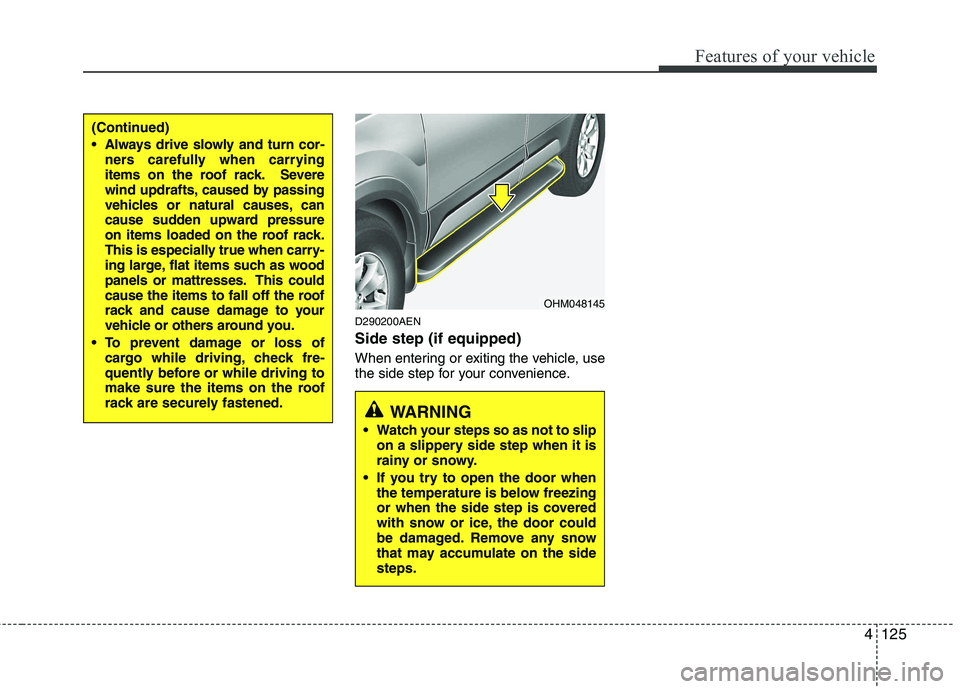
D290200AEN Side step (if equipped)
When entering or exiting the vehicle, use
the side step for your convenience.
(Continued)
Always drive slowly and turn cor-ners carefully when carrying
items on the roof rack. Severe
wind updrafts, caused by passing
vehicles or natural causes, can
cause sudden upward pressure
on items loaded on the roof rack.
This is especially true when carry-
ing large, flat items such as wood
panels or mattresses. This could
cause the items to fall off the roof
rack and cause damage to your
vehicle or others around you.
To prevent damage or loss of cargo while driving, check fre-
quently before or while driving to
make sure the items on the roof
rack are securely fastened.
OHM048145
WARNING
Watch your steps so as not to slip on a slippery side step when it is
rainy or snowy.
If you try to open the door when the temperature is below freezing
or when the side step is covered
with snow or ice, the door could
be damaged. Remove any snow
that may accumulate on the sidesteps.
Page 266 of 417

525
Driving your vehicle
✽✽NOTICE
Do not drive in water if the level is higher than the bottom of the vehicle.
Check your brake condition once you
are out of mud or water. Press the
brake pedal several times as you move
slowly until you feel normal braking
forces return.
Shorten your scheduled maintenance interval if you drive in off-road condi-
tions such as sand, mud or water (see
“Maintenance under severe usage
conditions” in section 7). Always wash
your vehicle thoroughly after off road
use, especially cleaning the bottom of
the vehicle.
Since the driving torque is always applied to the 4 wheels the perform-
ance of the 4WD vehicle is greatly
affected by the condition of the tires.
Be sure to equip the vehicle with four
tires of the same size and type.
A full time four wheel drive vehicle cannot be towed by an ordinary tow
truck. Make sure that the vehicle is
placed on a flat bed truck for moving.E170800AHM
Reducing the risk of a rollover
This multi-purpose passenger vehicle is
defined as a Sports Utility Vehicle (SUV).
SUV’s have higher ground clearance and
a narrower track to make them capable
of performing in a wide variety of off-road
applications. Specific design characteris-
tics give them a higher center of gravity
than ordinary vehicles. An advantage of
the higher ground clearance is a better
view of the road, which allows you to
anticipate problems. They are not
designed for cornering at the same
speeds as conventional passenger vehi-
cles, any more than low-slung sports
vehicles are designed to perform satis-
factorily in off-road conditions. Due to this
risk, driver and passengers are strongly
recommended to buckle their seat belts.
In a rollover crash, an unbelted person is
more likely to die than a person wearing
a seat belt. There are steps that a driver
can make to reduce the risk of a rollover.
If at all possible, avoid sharp turns or
abrupt maneuvers, do not load your roof
rack with heavy cargo, and never modify
your vehicle in any way.
CAUTION - Mud or snow
If one of the front or rear wheels
begins to spin in mud, snow, etc.
the vehicle can sometimes be driv-en out by depressing the accelera-tor pedal further; however avoid running the engine continuously at
high rpm because doing so coulddamage the 4WD system.
Page 341 of 417

Maintenance
14
7
Severe driving conditions
A : Repeatedly driving short distance of less than 8 km (5 miles)
in normal temperature or less than 16 km (10 miles) in freez-
ing temperature.
B : Extensive engine idling or low speed driving for long dis-
tances.
C : Driving on rough, dusty, muddy, unpaved, graveled or salt- spread roads.
D : Driving in areas using salt or other corrosive materials or in very cold weather E : Driving in sandy areas
F : More than 50 % driving in heavy city traffic during hot
weather above 32°C (90°F)
G : Driving on uphill, downhill, or mountain roads.
H : Towing a trailer or using a camper on roof rack.I:
Driving for patrol car, taxi, commercial car or vehicle towing
J : Driving over 170 km/h (106 mile/h)
K : Frequently driving in stop and go condition
Disc brakes and pads, calipers and rotors I C, D, E, G, H
Parking brake I C, D, G, H
Driveshaft and boots I C, D, E, F, H
Climate control air filter (if equipped) R C, E
Automatic transmission For Europe REvery 90,000 km (56,250 miles)
A, C, E, F, G, I
fluid Except Europe Every 100,000 km (60,000 miles)
MAINTENANCE ITEM Maintenance
operation Maintenance intervals
Driving condition
Inspect more frequently
depending on the condition
Inspect more frequently
depending on the condition
Inspect more frequently
depending on the condition
Replace more frequently
depending on the condition
Page 361 of 417

Maintenance
34
7
G190200AUN
Battery recharging
Your vehicle has a maintenance-free,
calcium-based battery.
If the battery becomes discharged in a
short time (because, for example, the
headlights or interior lights were left on
while the vehicle was not in use),
recharge it by slow charging (trickle)
for 10 hours.
If the battery gradually discharges because of high electric load while the
vehicle is being used, recharge it at 20-
30A for two hours. G190300AHM Reset items
Items should be reset after the battery
has been discharged or the battery hasbeen disconnected.
Auto up/down window (See section 4)
Sunroof (See section 4)
Driver position memory system
(See section 4)
Trip computer (See section 4)
Climate control system (See section 4)
Clock (See section 4)
Audio (See section 4)(Continued)
Watch the battery during charg- ing, and stop or reduce the charg-
ing rate if the battery cells begin
gassing (boiling) violently or if
the temperature of the electrolyte
of any cell exceeds 49°C (120°F).
Wear eye protection when check- ing the battery during charging.
Disconnect the battery charger in the following order.
1. Turn off the battery charger main switch.
2. Unhook the negative clamp from the negative battery terminal.
3. Unhook the positive clamp from the positive battery terminal.
WARNING - Recharging
battery
When recharging the battery,
observe the following precautions:
The battery must be removed from the vehicle and placed in an area with good ventilation.
Do not allow cigarettes, sparks, or flame near the battery.
(Continued)
WARNING
Before performing maintenance or recharging the battery, turn off all accessories and stop the
engine.
The negative battery cable must be removed first and installed
last when the battery is discon-nected.
Page 377 of 417

Maintenance
50
7
Inner fuse panel (Instrument panel)
Description Fuse rating Protected component
AUDIO 15A Audio, Rear Monitor
MEMORY 7.5A Front A/C Control Module, Rear A/C Control Module, Instrument Cluster(IND.), RF Receiver, FAM, RAM, Driver Door Module, Assistant Door Module, Tilt & Telescopic Module, IMS Control Module
S/TILT & TELE 20A Tilt & Telescopic Module
IG2-1 7.5A Front A/C Control Module, Incar Temperature Sensor, PDM, Multifunction Switch(Wiper/Washer), Driver/Passenger Seat Warmer Module, Front Blower Relay, Electronic Chrome Mirror, Rear Blower Relay
IG2-2 7.5A Rear A/C Control Module, Driver Door Module, FAM, Assistant Door Module, Tilt & Telescopic Module, IMS Control Module
SMART KEY 7.5A Start Stop Button Switch, PDM, Smart Key Control Module, Fob Holder
ROOM 7.5A Electronic Chrome Mirror, Map Lamp, Vanity Lamp Switch LH/RH, Front/Rear A/C Control Module, Center Room Lamp, Rear Room Lamp
KEY LOCK 7.5A Sport Mode Switch
ILLUMI 7.5A IPM
RR S/WARMER 20A Rear Seat Warmer Relay
FRT S/WARMER 20A Driver Seat Warmer Module, Passenger Seat Warmer Module
SUNROOF 25A Sunroof Module
PEDAL 15A Adjustable Pedal Relay
F/PWR OUTLET 15A Front Power Outlet
PASS P/SEAT 20A Passenger Power Seat Switch
DRIVER P/SEAT 30A Driver Power Seat Switch, Lumbar Support Switch, IMS Control Module
ACC 7.5A Audio, Front A/C Control Module, Smart Key Control Module, PDM
TPMS 7.5A Data Link Connector, Multipurpose Check Connector