Page 424 of 678
After Starting
The idle speed is controlled automatically and it will
decrease as the engine warms up.
ENGINE BLOCK HEATER — IF EQUIPPED
The engine block heater warms the engine, and permits
quicker starts in cold weather. Connect the cord to a
standard 110-115 Volt AC electrical outlet with a
grounded, three-wire extension cord.
The engine block heater must be plugged in at least one
hour to have an adequate warming effect on the engine.
The engine block heater cord is found under the hood
bundled in front of the battery tray.
WARNING!
Remember to disconnect the engine block heater
cord before driving. Damage to the 110-115 Volt AC
electrical cord could cause electrocution.
MANUAL TRANSMISSION — IF EQUIPPED
WARNING!
You or others could be injured if you leave the
vehicle unattended without having the parking
brake fully applied. The parking brake should al-
ways be applied when the driver is not in the vehicle,
especially on an incline.
422 STARTING AND OPERATING
Page 426 of 678
Recommended Vehicle Shift Speeds
To utilize your manual transmission efficiently for both
fuel economy and performance, it should be upshifted as
listed in recommended shift speed chart. Shift at the
vehicle speeds listed for acceleration. When heavily
loaded or pulling a trailer these recommended up-shift
speeds may not apply.
Manual Transmission Shift Speeds in MPH (KM/H)
Engine Speeds 1 to 2 2 to 3 3 to 4 4 to 5 5 to 6 3.6L Accel. 15 (24) 24 (39) 34 (55) 47 (76) 56 (90)
Cruise 10 (16) 19 (31) 27 (43) 37 (60) 41 (66)
NOTE: Vehicle speeds shown in the chart above are for
2H and 4H only, vehicle speeds in 4L would be signifi-
cantly less.
424 STARTING AND OPERATING
Page 428 of 678
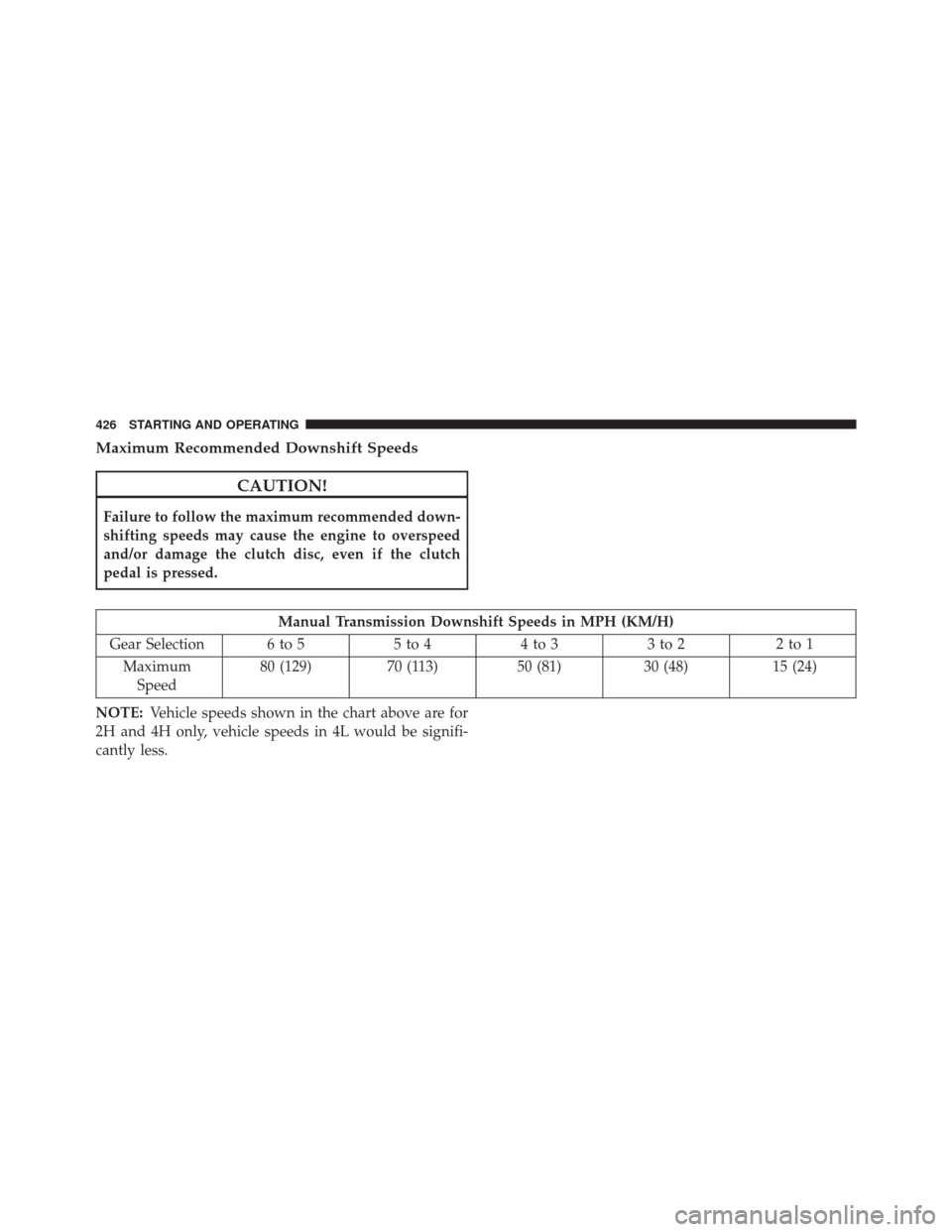
Maximum Recommended Downshift Speeds
CAUTION!
Failure to follow the maximum recommended down-
shifting speeds may cause the engine to overspeed
and/or damage the clutch disc, even if the clutch
pedal is pressed.
Manual Transmission Downshift Speeds in MPH (KM/H)
Gear Selection 6 to 5 5 to 44 to 33 to 2 2 to 1
Maximum Speed 80 (129)
70 (113) 50 (81)30 (48) 15 (24)
NOTE: Vehicle speeds shown in the chart above are for
2H and 4H only, vehicle speeds in 4L would be signifi-
cantly less.
426 STARTING AND OPERATING
Page 432 of 678

out of PARK (refer to “Brake/Transmission Shift Inter-
lock System” in this section). To drive, move the shift
lever from PARK or NEUTRAL to the DRIVE position.
The electronically-controlled transmission provides a
precise shift schedule. The transmission electronics are
self-calibrating; therefore, the first few shifts on a new
vehicle may be somewhat abrupt. This is a normal
condition, and precision shifts will develop within a few
hundred miles (kilometers).
Only shift from DRIVE to PARK or REVERSE when the
accelerator pedal is released and the vehicle is stopped.
Be sure to keep your foot on the brake pedal when
shifting between these gears.
The transmission shift lever has only PARK, REVERSE,
NEUTRAL, and DRIVE shift positions. Manual shifts can
be made using the Autostick® shift control (refer to
�AutoStick®�in this section). Moving the shift lever to the
left or right (-/+) while in the DRIVE position will manually select the transmission gear and will display
the current gear in the instrument cluster as 5, 4, 3, 2, 1.
Gear Ranges
DO NOT race the engine when shifting from PARK or
NEUTRAL into another gear range.
Shift Lever
430 STARTING AND OPERATING
Page 439 of 678

AUTOSTICK®
AutoStick® is a driver-interactive transmission feature
providing manual shift control, giving you more control
of the vehicle. AutoStick® allows you to maximize en-
gine braking, eliminate undesirable upshifts and down-
shifts, and improve overall vehicle performance.
This system can also provide you with more control
during passing, city driving, cold slippery conditions,
mountain driving, trailer towing, and many other situa-
tions.
Operation
When the shift lever is in the DRIVE position, the
transmission will operate automatically, shifting between
the five available gears. To engage AutoStick®, simply
tap the shift lever to the right or left (+/-) while in the
DRIVE position. Tapping (-) to enter AutoStick® mode
will downshift the transmission to the next lower gear,
while using (+) to enter AutoStick® mode will retain thecurrent gear. When AutoStick® is active, the current
transmission gear is displayed in the instrument cluster.
In AutoStick® mode, the transmission will shift up or
down when (+/-) is manually selected by the driver,
unless an engine lugging or overspeed condition would
result. It will remain in the selected gear until another
upshift or downshift is chosen, except as described
below.
•
The transmission will automatically upshift when nec-
essary to prevent engine over-speed.
• Heavily pressing the accelerator pedal will generate an
automatic downshift (for improved acceleration) when
reasonable.
• The transmission will automatically downshift as the
vehicle slows (to prevent engine lugging) and will
display the current gear.
5
STARTING AND OPERATING 437
Page 440 of 678

•The transmission will automatically downshift to first
gear when coming to a stop. After a stop, the driver
should manually upshift (+) the transmission as the
vehicle is accelerated.
• You can start out, from a stop, in first or second gear.
Tapping (+) (at a stop) will allow starting in second
gear. Starting out in second gear is helpful in snowy or
icy conditions.
• The system will ignore attempts to upshift at too low
of a vehicle speed.
• Avoid using speed control when AutoStick® is en-
gaged.
• Transmission shifting will be more noticeable when
AutoStick® is engaged. NOTE:
When the transfer case is in the 4L (Low) range,
the transmission will shift automatically (but no higher
than the displayed gear).
To disengage AutoStick® mode, hold the shift lever to the
right (+) until �D�is once again displayed in the instru-
ment cluster. You can shift in or out of the AutoStick®
mode at any time without taking your foot off the
accelerator pedal.
WARNING!
Do not downshift for additional engine braking on a
slippery surface. The drive wheels could lose their
grip and the vehicle could skid, causing a collision or
personal injury.
438 STARTING AND OPERATING
Page 444 of 678

The “4WD Indicator Light” (located in the instrument
cluster) will illuminate when the transfer case is shifted
into the 4L position.
NOTE:When in 4WD, the “ESC Off Indicator Light” will
display in the instrument cluster.
Shifting Procedure
2H to 4H or 4H to 2H
Shifting between 2H and 4H can be made with the
vehicle stopped or in motion. With the vehicle in motion,
the transfer case will engage/disengage faster if you
momentarily release the accelerator pedal after complet-
ing the shift. Apply a constant force when shifting the
transfer case lever.
4H to 4L or 4L to 4H
With the vehicle rolling at 2 to 3 mph (3 to 5 km/h), shift
an automatic transmission into NEUTRAL (N), or press
the clutch pedal on a manual transmission. While the vehicle is coasting at 2 to 3 mph (3 to 5 km/h), shift the
transfer case lever firmly to the desired position. Do not
pause with the transfer case in N (Neutral). Once the shift
is completed, place the automatic transmission into
DRIVE or release the clutch pedal on a manual transmis-
sion.
NOTE:
Shifting into or out of 4L is possible with the
vehicle completely stopped; however, difficulty may oc-
cur due to the mating teeth not being properly aligned.
Several attempts may be required for clutch teeth align-
ment and shift completion to occur. The preferred
method is with the vehicle rolling at 2 to 3 mph (3 to
5 km/h). Avoid attempting to engage or disengage 4L
with the vehicle moving faster than 2 to 3 mph (3 to
5 km/h).
442 STARTING AND OPERATING
Page 453 of 678

Mud
Deep mud creates a great deal of suction around the tires
and is very difficult to get through. You should use
second gear (manual transmission), or DRIVE (automatic
transmission), with the transfer case in the 4L (Low)
position to maintain your momentum. If you start to slow
to a stop, try turning your steering wheel no more than a
1/4 turn quickly back and forth for additional traction.
Mud holes pose an increased threat of vehicle damage
and getting stuck. They are normally full of debris from
previous vehicles getting stuck. As a good practice before
entering any mud hole, get out and determine how deep
it is, if there are any hidden obstacles and if the vehicle
can be safely recovered if stuck.
Sand
Soft sand is very difficult to travel through with full tire
pressure. When crossing soft, sandy spots in a trail,
maintain your vehicle’s momentum and do not stop. Thekey to driving in soft sand is using the appropriate tire
pressure, accelerating slowly, avoiding abrupt maneu-
vers and maintaining the vehicle’s momentum. If you are
going to be driving on large soft sandy areas or dunes,
reduce your tire pressure to a minimum of 15 psi
(103 kPa) to allow for a greater tire surface area. Reduced
tire pressure will drastically improve your traction and
handling while driving on the soft sand, but you must
return the tires to normal air pressure before driving on
pavement or other hard surfaces. Be sure you have a way
to reinflate the tires prior to reducing the pressure.
CAUTION!
Reduced tire pressures may cause tire unseating and
total loss of air pressure. To reduce the risk of tire
unseating, while at a reduced tire pressure, reduce
your speed and avoid sharp turns or abrupt maneu-
vers.
5
STARTING AND OPERATING 451