2014 JEEP RENEGADE steering
[x] Cancel search: steeringPage 137 of 212

WARNING
136)If the fuse blows again contact a Jeep
Dealership.
137)Never replace a fuse with another with
a higher amp rating; DANGER OF FIRE.
138)If a general protection fuse (MAXI-
FUSE, MEGA-FUSE, MIDI-FUSE) blows,
contact a Jeep Dealership.
139)Before replacing a fuse, make sure
that the ignition device has been taken to
STOP, that the ignition key, if mechanical,
has been removed and that all the other
services are switched off and/or
deactivated.
140)Contact a Jeep Dealership if a safety
system (airbags, brakes), power unit
system (engine, gearbox) or steering
system general protection fuse blows.
WARNING
53)Never replace a fuse with metal wires
or anything else.
54)If it is necessary to wash the engine
compartment, take care not to directly hit
the junction unit and the window wiper
motors with the water jet.
CHANGING A WHEEL
141) 142) 143) 144) 145) 146) 147) 148)
CHANGING PROCEDURE
Proceed as follows:
❒stop the vehicle in a position that is
not dangerous for oncoming traffic
where you can change the wheel safely,
as far as possible from the side of the
road. The ground should be flat if
possible, and sufficiently firm;
❒engage the hazard warning lights and
the electric parking brake;
❒engage first gear or reverse or, for
versions with automatic transmission,
move the lever to position P (Park);
❒stop the engine and put on the
reflective safety jacket (for your own
safety and in compliance with national
laws) before getting out of the vehicle.
The engine must stay off while the
vehicle is raised from the ground.
The spare wheel or, depending on the
version, space-saver wheel is located
under the luggage compartment carpet
fig. 130.
To access the wheel or space-saver
wheel, proceed as follows:
❒open the tailgate, grip handle A fig.
131 and raise load platform B, holding
it with one hand;❒pull tab C fig. 132 and lift the carpet;
130J0A0223C
131J0A0086C
132J0A0090C
135
Page 140 of 212

❒Raising the vehicle any more than
necessary may lower its stability: the
jack may slip and injure those nearby.
Do not raise the vehicle any more
than required for the removal of the
wheel.
❒Tyres with unidirectional tread can be
recognised by arrows on the side of
the tyre which indicate the direction of
rotation. This must of necessity be
complied with. Only in this way can the
tyres maintain their characteristics in
terms of grip, noise, resistance to wear
and drainage on wet surfaces.
❒If, after a puncture, it is necessary to
fit such a tyre the wrong way round,
it will be necessary to continue driving
with great care, since the tyre’s
performance is limited in these
conditions. This precaution must be
borne in mind above all when the road
surface is wet.
❒In order to benefit completely from
the unidirectional tread, it is advisable to
restore all wheels to the correct
direction of rotation as soon as
possible.
❒Make sure that the spare wheel is
fitted with the valve facing outwards.
The wheel may be damaged if fitted
incorrectly.❒If the vehicle has a hub cap or wheel
cover, do not attempt to fit it on the
spare wheel.
❒To prevent injury to persons, the
complete tightening of the bolts must
only be carried out when all of the
vehicle’s wheels are on the ground, to
prevent the vehicle falling from the jack.
❒After having travelled for about
40 km, stop and check that the bolts
are tightened correctly.
WARNING
141)If left in the passenger compartment,
the punctured wheel and jack constitute
a serious risk to the safety of occupants in
the event of accidents or sharp braking.
Therefore, always place both the jack and
punctured wheel in the dedicated housing
in the luggage compartment.
142)It is extremely dangerous to attempt
to change a wheel on the side of the
vehicle next to the driving lane: make sure
that the vehicle is at a sufficient distance
from the road, to avoid being run over.
143)Indicate the presence of the stationary
vehicle in accordance with current
regulations: hazard warning lights, warning
triangle, etc. Those on board should get
out of the vehicle, particularly if it is heavily
laden, and wait for the wheel to be
changed away from the threat posed by
the traffic. On slopes or on unsurfaced
roads, chock the wheels with the chocks
provided.144)The vehicle's driving characteristics
will be modified with the space-saver wheel
fitted. Avoid violent acceleration and
braking, abrupt steering and fast cornering.
The overall duration of the space-saver
wheel is of about 3000 km, after which the
relevant tyre must be replaced with another
one of the same type. Never install a
standard tyre on a rim that is designed for
use with a space-saver wheel. Have the
wheel repaired and refitted as soon as
possible. Using two or more space-saver
wheels at the same time is forbidden.
Do not grease the threads of the bolts
before fitting them: they might slip out
when driving!
145)The space-saver wheel (where
provided) is specific to your vehicle: do not
use it on other models, or use the
space-saver wheel of other models on your
vehicle. The space-saver wheel must only
be used in the event of emergency. It
must only be used for the distance
necessary to reach a service point and the
vehicle speed must not exceed 80 km/h.
The space-saver wheel has an orange label
that summarises the main cautions for
use and limitations. Never remove or cover
the label. Never apply a hub cap on a
space-saver wheel.
138
IN AN EMERGENCY
Page 146 of 212

EMERGENCY REMOVAL
OF THE IGNITION KEY
57)
The ignition key (versions with
mechanical key) can be removed only if
the gear lever is in position P (Park).
If the vehicle battery is flat and the key
is engaged, the latter is locked in
position.
To remove the key manually, proceed
as follows:
❒stop the vehicle in safety conditions,
engage a gear and the electric parking
brake;
❒using the wrench A fig. 142 (located
in the casing containing the on-board
documents), undo the fixing screws
B fig. 143 for the lower cover C;
❒remove the lower steering wheel
cover C by releasing it from its housing;❒pull tab D fig. 144 downwards using
one hand and with the other one
remove the key, sliding it outwards;
❒once the key has been removed, refit
lower cover C, make sure it locks
correctly and tighten the fixing screws B
firmly.
WARNING
57)It is advisable to contact a Jeep
Dealership to have the refitting procedure
carried out. If you would like to proceed
autonomously, special attention must
be paid to the correct coupling of
the retaining clips. Otherwise, noise might
be heard due to an incorrect fastening
of the lower cover with the upper cover.
141J0A0344C142J0A0393C
143J0A0247C144J0A0251C
144
IN AN EMERGENCY
Page 147 of 212

TOWING THE
VEHICLE
ATTACHING THE TOW
HOOK
161) 162) 163)
The tow hook provided with the vehicle
is located in the tool box inside the
luggage compartment.
Front
Release plug A fig. 145 by pressing the
lower part, take tow hook B from its
housing in the tool support and tighten
it securely on the front threaded pin.
Rear
Remove plug A fig. 146, take tow hook
B from its housing in the tool support
and tighten it securely on the rear
threaded pin.
Trailhawk versions: tow hook A fig. 147,
fixed type, is secured to the vehicle
body.
WARNING
161)For versions with mechanical key,
before towing, turn the ignition key to MAR
and then to STOP without removing it.
The steering column will automatically lock
when the key is removed and the wheels
cannot be steered. Also check that the
gearbox is in neutral (on versions equipped
with automatic transmission, check that
the gear lever is in N position). For versions
with electronic key, bring the ignition
device to MAR and then to STOP, without
opening the door.
162)The brake servo and the
electromechanical power steering will not
work while the vehicle is being towed.
You will therefore need to apply more force
on the brake pedal and steering wheel.
Do not use flexible ropes when towing, and
avoid jerky movements. While towing,
make sure that the trailer hitch does not
damage any components it is touching.
When towing the vehicle, you must comply
with all specific traffic regulations and
adopt an appropriate driving behaviour. Do
not start the engine while towing the
vehicle. Before tightening the ring, clean
the threaded housing thoroughly. Make
sure that the ring is fully fastened in the
housing before towing the vehicle.
145J0A0160C
146J0A0163C
147J0A0161C
145
Page 160 of 212

ENGINE OIL
Check that the oil level is between the
MIN and MAX references on the
dipstick A. If the oil level is near or even
under the MIN line, add oil using the
filler B to reach the MAX line.
166)59)
Take out the engine oil dipstick A, clean
it with a lint-free cloth and reinsert it.
Extract it again and check that the level
is between the MIN and MAX marks
on the dipstick.
Engine oil consumption
60)4)
The maximum engine oil consumption
is usually 400 grams every 1,000 km.
During the initial period of use the
engine oil consumption conditions
should be considered as having
stabilised after the first 5000 - 6000
km.
ENGINE COOLANT
If the level is too low, unscrew the cap
of reservoir C and add the fluid
described in the "Technical
Specifications" section.
167)61)
WINDSCREEN/REAR
WINDOW WASHER FLUID
If the level is too low, lift reservoir cap D
and add the fluid described in the
chapter "Technical Specifications".
168) 169)
IMPORTANT The headlight washer
system will not operate when the fluid
level is low, even though the
windscreen/rear window washer
continues to operate. On some
versions there is a reference notch on
the dipstick: ONLY the windscreen/rear
window washer operates with the
level below this reference.
BRAKE FLUID
Check that the fluid is at the max. level.
If the fluid level in the reservoir is too
low, undo reservoir cap E and add the
fluid described in the chapter "Technical
Specifications".
170) 171)62)
AUTOMATIC
TRANSMISSION
ACTIVATION SYSTEM OIL
The transmission control oil level should
only be checked at a Jeep Dealership.
5)
BATTERY
172) 173) 174) 175)6)
The battery does not require the
electrolyte to be topped up with distilled
water. A periodic check carried out at
a Jeep Dealership is, however,
necessary to check efficiency.
IMPORTANT After the battery is
disconnected, the steering must be
initialised. The
warning light on the
instrument panel switches on to
indicate this. To carry out this
procedure turn the steering wheel all
the way from one end to the other
or drive in a straight line for about a
hundred metres.
IMPORTANT If the charge level remains
under 50% for a long time, the battery
is damaged by sulphation, reducing
its capacity and efficiency at start-up.
CLIMATE CONTROL
SYSTEM MAINTENANCE
In winter, the climate control system
must be turned on at least once a
month for about 10 minutes. Have the
system inspected at a Jeep Dealership
before the summer.
158
SERVICING AND MAINTENANCE
Page 165 of 212

LIFTING THE
VEHICLE
If the vehicle is to be lifted, go to a Jeep
Dealership which is equipped with the
arm lift or workshop lift.
WHEELS AND TYRES
SUGGESTIONS ABOUT
THE ROTATION OF THE
TYRES
179)72) 73) 74) 75)The front and rear tyres are subject to
different loads and stress due to
steering, manoeuvres and braking. For
this reason they are subject to uneven
wear.
To resolve this problem, tyres should be
rotated at the appropriate time. This
operation is recommended for tyres
with a deep tread pattern, suitable both
for on-road and off-road driving.
Tyre rotation contributes to the
preservation of the grip and traction
performance on wet, muddy or snowy
roads, guaranteeing optimal driveability
of the vehicle.
In the case of irregular wear of the
tyres, the reason must be identified and
corrected before rotating them.
WARNING
179)Do not cross switch the tyres if they
are "unidirectional" type. In this case,
always take care not to fit the tyres with a
direction of rotation that is opposite to that
indicated: you would risk losing grip and
control of the vehicle.
WARNING
72)Road holding depends also on the
correct tyre inflating pressure.
73)If the pressure is too low the tyre
overheats and this can cause it serious
damage.
74)Do not cross switch the tyres, moving
them from the right of the vehicle to the left
and vice versa.
75)Never submit alloy rims to repainting
treatments requiring the use of
temperatures exceeding 150°C. The
mechanical properties of the wheels could
be impaired.
163
Page 187 of 212
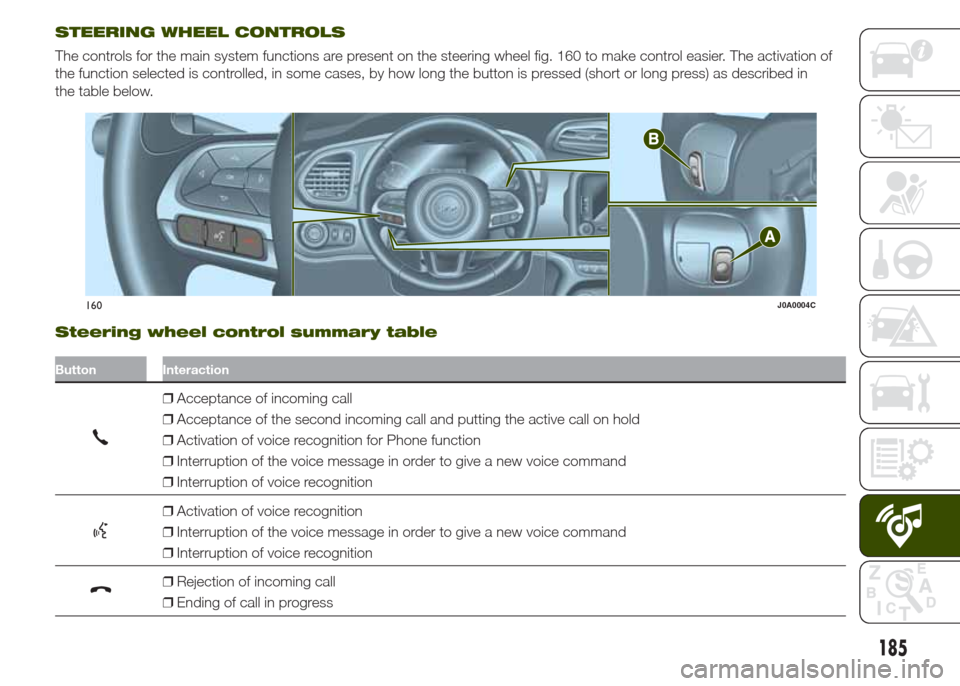
STEERING WHEEL CONTROLS
The controls for the main system functions are present on the steering wheel fig. 160 to make control easier. The activation of
the function selected is controlled, in some cases, by how long the button is pressed (short or long press) as described in
the table below.
Steering wheel control summary table
Button Interaction
❒Acceptance of incoming call
❒Acceptance of the second incoming call and putting the active call on hold
❒Activation of voice recognition for Phone function
❒Interruption of the voice message in order to give a new voice command
❒Interruption of voice recognition
❒Activation of voice recognition
❒Interruption of the voice message in order to give a new voice command
❒Interruption of voice recognition
❒Rejection of incoming call
❒Ending of call in progress
160J0A0004C
185
Page 188 of 212

Controls behind the steering wheel
Buttons Interaction
Button A (steering wheel left side)
Upper button
❒Brief button press: search for next radio station or selection of USB/iPod
next track.
❒Long button press: scan of higher frequencies until released/fast forward
of USB/iPod track.
Central buttonWith each press it scrolls through sources AM, FM, USB/iPod, AUX. Only the available
sources will be selected.
Lower button
❒Brief button press: search for previous radio station or selection of USB/
iPod next track.
❒Long button press: scan of lower frequencies until released/fast forward of
USB/iPod track.
Button B (steering wheel right side)
Upper buttonIncrease volume
❒Brief button press: single volume increase
❒Long button press: fast volume increase
Central button Activation/deactivation of Mute function
Lower buttonDecrease volume
❒Brief button press: single volume decrease
❒Long button press: fast volume decrease
186
MULTIMEDIA