2014 JEEP RENEGADE warning lights
[x] Cancel search: warning lightsPage 46 of 212

Warning light What it means
EBD FAILURE
The simultaneous switching on of the
(red) and(amber) warning lights with the engine on
indicates either a fault of the EBD system or that the system is not available. In this case, the rear wheels
may suddenly lock and the vehicle may swerve when braking sharply. The display shows the dedicated
message.
Drive very carefully to the nearest Jeep Dealership to have the system inspected immediately.
POWER STEERING FAILURE
If the warning light remains on, you could not have steering assistance and the effort required to operate
the steering wheel could be increased; steering is, however, possible.
On some versions, the display shows the dedicated message.
Contact a Jeep Dealership as soon as possible.
44
KNOWING THE INSTRUMENT PANEL
Page 49 of 212

Amber warning lights
Warning light What it means
TPMS SYSTEM
TPMS failure
The warning light switches on when a failure is detected in the TPMS. In this case, contact a Jeep
Dealership as soon as possible. Should one or more wheels be fitted without sensors, the display will show
a warning message until initial conditions are restored.
IMPORTANT Do not continue driving with one or more flat tyres as handling may be compromised. Stop
the vehicle, avoiding sharp braking and steering. Repair immediately using the dedicated tyre repair kit and
contact the dedicated Jeep Dealership as soon as possible.
Tyre pressure low
The warning light switches on and a message is displayed to indicate that the tyre pressure is lower than
the recommended value and/or that slow pressure loss is occurring. In these cases, optimal tyre duration
and fuel consumption may not be guaranteed.
Should two or more tyres be in the condition mentioned above, the display will show the indications
corresponding to each tyre in sequence.
In any situation in which the message on the display is "See manual", it is ESSENTIAL to refer to the
contents of the "Wheels" paragraph in the "Technical data" chapter, strictly complying with the indications
that you find there.
ABS FAILURE
The warning light switches on to indicate an ABS fault. In this case the braking system will work as normal,
but without the extra performance offered by the ABS. The display shows the dedicated message. Drive
carefully and contact a Jeep Dealership as soon as possible.
47
Page 53 of 212

Green warning lights
Warning light What it means
SIDE LIGHTS AND DIPPED BEAM HEADLIGHTS
The warning light switches on when side lights or dipped beam headlights are turned on.
This function allows the headlights to remain on for 30, 60 or 90 seconds after the ignition device was
placed in STOP position ("Follow me" function).
AUTOMATIC MAIN BEAM HEADLIGHTS
This warning light comes on when the automatic main beam headlights turned on.
FOG LIGHTS
The warning light switches on when the fog lights are turned on.
LEFT-HAND DIRECTION INDICATOR
The warning light switches on when the direction indicator control stalk is moved downwards or, together
with the right indicator, when the hazard warning light button is pressed.
RIGHT-HAND DIRECTION INDICATOR
The warning light switches on when the direction indicator control stalk is moved upwards or, together with
the left indicator, when the hazard warning light button is pressed.
STOP/START SYSTEM INTERVENTION
The warning light comes on in the event of Stop/Start system intervention (engine switching off). Restarting
the engine, the warning light switches off.
51
Page 54 of 212

Blue warning lights
Warning light What it means
MAIN BEAM HEADLIGHTS
The warning light switches on when the main beam headlights are turned on.
SYMBOLS ON THE DISPLAY
Red symbols on the display
Symbol What it means
LOW ENGINE OIL PRESSURE
The symbol switches on, together with a message on the display, if there is insufficient engine oil pressure.
16)
IMPORTANT Do not use the vehicle until the failure has been solved. The switching on of the symbol does
not show the quantity of oil in the engine: the oil level must be checked manually.
AIRBAG FAILURE
If the symbol switches on constantly, this indicates a failure in the airbag system. The display shows the
dedicated message. Contact a Jeep Dealership as soon as possible.
ALTERNATOR FAILURE
The switching on of the symbol with engine on corresponds to an alternator failure. Contact a Jeep
Dealership as soon as possible.
WARNING
16)If thesymbol switches on when driving, stop the engine immediately and contact a Jeep Dealership.
52
KNOWING THE INSTRUMENT PANEL
Page 61 of 212
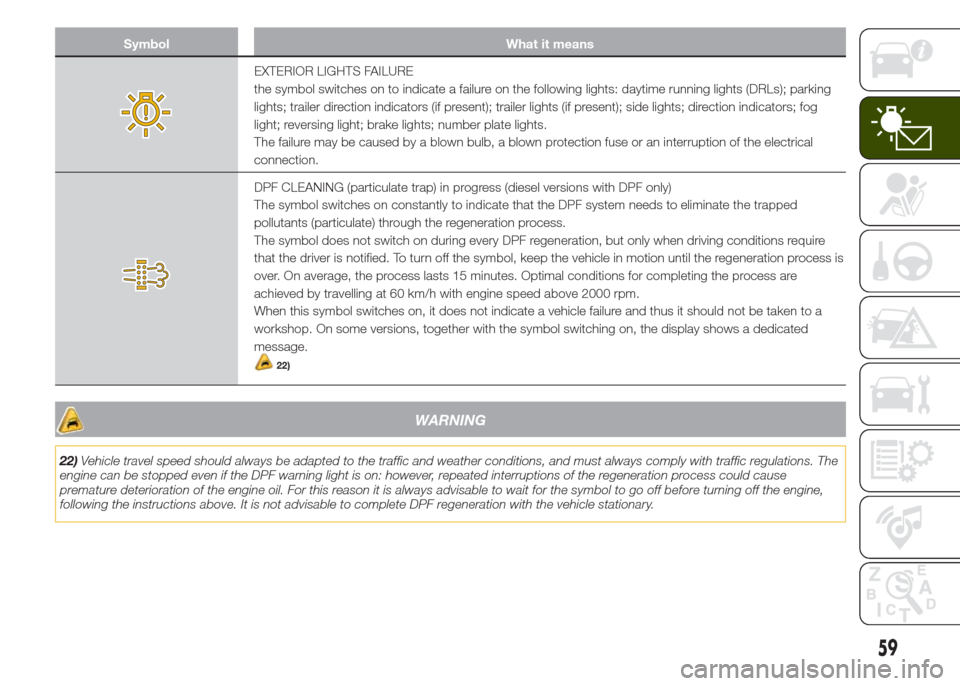
Symbol What it means
EXTERIOR LIGHTS FAILURE
the symbol switches on to indicate a failure on the following lights: daytime running lights (DRLs); parking
lights; trailer direction indicators (if present); trailer lights (if present); side lights; direction indicators; fog
light; reversing light; brake lights; number plate lights.
The failure may be caused by a blown bulb, a blown protection fuse or an interruption of the electrical
connection.
DPF CLEANING (particulate trap) in progress (diesel versions with DPF only)
The symbol switches on constantly to indicate that the DPF system needs to eliminate the trapped
pollutants (particulate) through the regeneration process.
The symbol does not switch on during every DPF regeneration, but only when driving conditions require
that the driver is notified. To turn off the symbol, keep the vehicle in motion until the regeneration process is
over. On average, the process lasts 15 minutes. Optimal conditions for completing the process are
achieved by travelling at 60 km/h with engine speed above 2000 rpm.
When this symbol switches on, it does not indicate a vehicle failure and thus it should not be taken to a
workshop. On some versions, together with the symbol switching on, the display shows a dedicated
message.
22)
WARNING
22)Vehicle travel speed should always be adapted to the traffic and weather conditions, and must always comply with traffic regulations. The
engine can be stopped even if the DPF warning light is on: however, repeated interruptions of the regeneration process could cause
premature deterioration of the engine oil. For this reason it is always advisable to wait for the symbol to go off before turning off the engine,
following the instructions above. It is not advisable to complete DPF regeneration with the vehicle stationary.
59
Page 70 of 212

42)ESC performance features must not
induce the driver to take unnecessary
or unfounded risks. Your driving style must
always be suited to the road conditions,
visibility and traffic. The driver is, in any
case, responsible for safe driving.
43)For the correct operation of the TC
system, the tyres must of necessity be the
same make and type on all wheels, in
perfect condition and, above all, of the
prescribed type and size.
44)TC performance features must not
induce the driver to take unnecessary or
unfounded risks. Your driving style must
always be suited to the road conditions,
visibility and traffic. The driver is, in any
case, responsible for safe driving.
45)The TC system can’t overrule the
natural laws of physics, and can’t increase
the grip available according to the
condition of the road.
46)The TC system cannot prevent
accidents, including those due to excessive
speed on corners, driving on low-grip
surfaces or aquaplaning.
47)The capability of the TC must never be
tested irresponsibly and dangerously, in
such a way as to compromise personal
safety and the safety of others.
48)The PBA system can’t overrule the
natural laws of physics, and can’t increase
the grip available according to the
condition of the road.
49)The PBA system cannot prevent
accidents, including those due to excessive
speed on corners, driving on low-grip
surfaces or aquaplaning.50)The capability of the PBA system must
never be tested irresponsibly and
dangerously, in such a way as to
compromise the safety of the driver, the
other occupants of the vehicle or any other
road user.
51)The Hill Start Assist system is not a
parking brake; therefore, never leave the
vehicle without having engaged the electric
parking brake, turned the engine off and
engaged first gear, so that it is parked
in safe conditions (for further information
read the "Parking" paragraph in the
"Starting and driving" chapter).
52)There may be situations on small
gradients (less than 8%), with vehicle
laden, in which the Hill Start Assist system
may not activate, causing a slight reversing
motion and increasing the risk of collision
with another vehicle or object. The driver is,
in any case, responsible for safe driving.
53)DST is an aid for driving and does not
relieve the driver of responsibility for driving
the vehicle.
54)The performance of a vehicle with ERM
must never be tested in imprudent or
dangerous ways, with the possibility of
putting the safety of the driver or other
people at risk.
55)When towing trailers, the utmost
caution at the wheel is advised. Never
exceed the maximum permitted loads (see
the description in the "Weights" paragraph
in the "Technical Specifications" chapter).56)The TSC system cannot prevent
swerving for all trailers. If the system
activates during driving, reduce the speed,
stop the vehicle in a safe place and arrange
the load correctly to prevent the trailer
from swerving.
57)Prolonged use of the system may
overheat the braking system. If the brakes
overheat, the HDC system, when active,
will be gradually deactivated after suitably
informing the driver (LED on button off):
it can be reactivated only when the brakes
have cooled sufficiently. The distance
that can be covered depends on the
temperature of the brakes and therefore on
the gradient, load and speed of the
vehicle.
58)The performance of a vehicle with HDC
must never be tested in imprudent or
dangerous ways, with the possibility of
putting the safety of the driver or other
people at risk.
59)When "Systems partially disabled"
mode is selected, the intervention of the
TC function is limited to braking action on
the individual drive wheels and the
warning lights switches on in the
instrument panel. In "systems partially
disabled" mode, the engine torque value
that the ESC system may require will
not be guaranteed and the stability of the
vehicle will therefore be reduced.
60)With "Systems partially disabled" mode
selected, the TSC (Trailer Sway Control)
system is disabled.
61)Your driving style must always be
suited to the road conditions, visibility and
traffic. The driver is, in any case,
responsible for safe driving.
68
SAFETY
Page 72 of 212

The detection area of the system
covers about a lane on both sides of
the vehicle (around 3 metres). This area
begins from the door mirror and
extends for about 6 metres towards the
rear part of the vehicle.
When the sensors are active the system
monitors the detection areas on both
sides of the vehicle and warns the
driver about the possible presence of
vehicles in these areas.
While driving the system monitors the
detection area from three different input
points (side, rear and front) to check
whether a signal needs to be sent
to the driver. The system can detect the
presence of a vehicle in one of these
three areas.
Important
63)The system does not signal the
presence of fixed object (e.g. safety
barriers, poles, walls, etc.). However, in
some circumstances, the system may
activate in the presence of these
objects. This is normal and does not
indicate a system malfunction.
The system does not warn the driver
about the presence of vehicles coming
from the opposite direction, in the
adjacent lanes.
If a trailer is hitched to the vehicle, the
system automatically deactivates.The rear bumper area where the radar
sensors are located must stay free from
snow, ice and dirt gathered from the
road surface for the system to operate
correctly.
Do not cover the rear bumper area
where the radar sensors are located
with any object (e.g. adhesives, bike
rack, etc.).
Rear view: the system detects vehicles
approaching to the rear part of your
vehicle on both sides and entering the
rear detection area with a speed delta
lower than 50 km/h with respect to your
vehicle.
Overtaking vehicles: if another vehicle
is overtaken slowly (with a speed delta
lower than about 25 km/h) and this
stays in the blind spot for about 1.5
seconds, the warning light on the door
mirror of the corresponding side lights
up. If the speed delta between the
two vehicles is higher than about 25
km/h, the warning light does not light
up.
RCP (Rear Cross Path
detection) system
This system helps the driver during
reverse manoeuvres in the case of
reduced visibility. During "RCP"
operating mode, the system emits
acoustic and visual warnings if
the presence of an object is detected.
When an acoustic warning is sent,
theUconnect™volume is lowered.
The system can be activated/
deactivated through the display Menu
or theUconnect™system.
The system monitors the rear detection
areas on both sides of the vehicle, to
detect objects moving towards the
sides of the vehicle at a minimum
speed comprised between about 1
km/h and 3 km/h and objects moving
at a maximum speed of 35 km/h, as
generally happens in the parking areas.
The system activation is signalled to
the driver by means of a visual and
acoustic warning.
IMPORTANT If the sensors are covered
by objects or vehicles, the system will
not warn the driver.
70
SAFETY
Page 77 of 212

70)Should one or more wheels be fitted
without sensors (e.g. if the spare wheel
is fitted), the system will no longer be
available for the replaced wheel and a
warning message will be shown on the
display, until the wheels with sensors are
fitted again.
71)The TPMS cannot indicate sudden tyre
pressure drops (e.g. if a tyre bursts). In
this case, stop the vehicle, braking with
care and avoiding sharp steering actions.
72)Replacing the normal tyres with winter
tyres and vice versa requires an inspection
of the TPMS, which should be carried
out only by a Jeep Dealership.
73)Changes in outside temperature may
cause tyre pressures to vary. The system
may temporarily indicate insufficient
pressure. In this case check the tyre
inflation pressure with the tyres cold and, if
necessary top up the inflation pressure.
74)When a tyre is removed, it is advisable
to replace the rubber gasket for the valve:
go to a Jeep Dealership. The fitting/
removal of the tyres and/or rims require
special care. To avoid damaging or fitting
the sensors incorrectly, tyre and/or rim
fitting/removal operations should only be
carried out by specialised staff. Go to a
Jeep Dealership.
WARNING
23)The system may have limited or absent
operation due to weather conditions such
as: heavy rain, hail, thick fog, heavy snow.
24)The section of the bumper before
the sensor must not be covered with
adhesives, auxiliary headlights or any other
object.
25)System intervention might be
unexpected or delayed when other vehicles
transport loads projecting from the side,
above or from the rear, with respect to the
normal size of the vehicle.
26)Operation can be adversely affected by
any structural change made to the vehicle,
such as a modification to the front
geometry, tyre change, or a heavier load
than the standard load of the vehicle.
27)Incorrect repairs made on the front part
of the vehicle (e.g. bumper, chassis) may
alter the position of the radar sensor,
and adversely affect its operation. Go to a
Jeep Dealership for any operation of this
type.
28)Do not tamper nor carry out any
intervention on the radar sensor or on the
camera on the windscreen. In the event
of a sensor failure, contact a Jeep
Dealership.
29)When towing a trailer (with modules
installed after purchasing the vehicle),
a vehicle or during loading manoeuvres on
a vehicle transporter (or in vehicle for
transport), the system must be deactivated
via theUconnect™system.30)Do not wash with high-pressure jets in
the bumper lower area: in particular do
not operate on the system's electrical
connector.
31)Be careful in the case of repairs and
new paintings in the area around the
sensor (panel covering the sensor on the
left side of the bumper). In the event of
a frontal impact the sensor may
automatically deactivate and display a
warning to indicate that the sensor needs
to be repaired. Even without a malfunction
warning, deactivate the system operation
if you think that the position of the radar
sensor has changed (e.g. due to
low-speed frontal impact as during parking
manoeuvres). In these cases, go to a
Jeep Dealership to have the radar sensor
realigned or replaced.
32)The tyre quick repair kit (TireKit),
provided with the vehicle, is compatible
with the TPMS sensors. Using sealants
different from that in the original kit may
compromise its operation. If sealants not
equivalent with the original one are used, it
is recommended to have the TPMS sensor
operation checked by a qualified repair
centre.
75