Page 230 of 568

30. 4WD! Warning LightThis light monitors the 4-Wheel Drive (4WD)
system. The light will come on, for a bulb
check, when the ignition key is turned to the
ON/RUN position and may stay on for as long
as three seconds.
When lit solid: There is an 4WD system fault. 4WD
performance will be at a reduced level . Service the 4WD
system soon.
When blinking: The 4WD system is temporarily dis-
abled due to overload condition.
31. Electronic Vehicle Information Center (EVIC)
Display — If Equipped
When the appropriate conditions exist, this display
shows the Electronic Vehicle Information Center (EVIC)
messages. For further information, refer to “Electronic Vehicle In-
formation Center (EVIC)”.
MINI-TRIP COMPUTER — IF EQUIPPED
The Mini-Trip Computer is located in the instrument
cluster and features a driver-interactive trip information
and temperature display.
NOTE:
The system will display the last known outside
temperature when starting the vehicle and may need to
be driven several minutes before the updated tempera-
ture is displayed. Engine temperature can also affect the
displayed temperature; therefore, temperature readings
are not updated when the vehicle is not moving.
228 UNDERSTANDING YOUR INSTRUMENT PANEL
Page 363 of 568

WARNING!(Continued)
•The ABS cannot prevent collisions, including those
resulting from excessive speed in turns, following
another vehicle too closely, or hydroplaning.
• The capabilities of an ABS-equipped vehicle must
never be exploited in a reckless or dangerous
manner which could jeopardize the user’s safety or
the safety of others.
The “ABS Warning Light” monitors the ABS
System. The light will come on when the
ignition switch is turned to the ON position
and may stay on for as long as four seconds.
If the “ABS Warning Light” remains on or comes on while
driving, it indicates that the anti-lock portion of the brake
system is not functioning and that service is required.
However, the conventional brake system will continue to
operate normally if the “Brake Warning Light” is not on.
If the “ABS Warning Light” is on, the brake system should
be serviced as soon as possible to restore the benefits of
anti-lock brakes. If the “ABS Warning Light” does not come
on when the ignition switch is turned to the ON position,
have the bulb repaired as soon as possible.
If both the “Brake Warning Light” and the “ABS Warning
Light” remain on, the ABS and Electronic Brake Force
Distribution (EBD) systems are not functioning. Immedi-
ate repair to the ABS is required.
When the vehicle is driven over 7 mph (11 km/h), you
may also hear a slight clicking sound as well as some
related motor noises. These noises are the system per-
forming its self-check cycle to ensure that the ABS
working properly. This self-check occurs each time the
vehicle is started and accelerated past 7 mph (11 km/h).
5
STARTING AND OPERATING 361
Page 474 of 568

▫Automatic Transmission (Six-Speed) —
If Equipped ........................ .500
▫ Automatic Transmission (CVT) —
If Equipped ........................ .502
▫ Manual Transmission — If Equipped .......504
▫ Rear Drive Assembly (RDA) — AWD/4WD
Models Only ....................... .505
▫ Power Transfer Unit (PTU) — AWD/4WD
Models Only ....................... .505
▫ Appearance Care And Protection From
Corrosion .......................... .506
� FUSES ............................. .512
▫ Integrated Power Module ...............513
� VEHICLE STORAGE ....................517 �
REPLACEMENT BULBS .................517
� BULB REPLACEMENT ..................519
▫ Headlamps ........................ .519
▫ Fog Lamps ......................... .519
▫ Rear Tail, Turn Signal And Backup Lamps . . .520
▫ License Lamps ...................... .520
▫ Center High-Mounted Stoplamp ..........520
� FLUID CAPACITIES ....................521
� FLUIDS, LUBRICANTS AND
GENUINE PARTS ..................... .522
▫ Engine ............................ .522
▫ Chassis ........................... .523
472 MAINTAINING YOUR VEHICLE
Page 478 of 568

persists, the message will appear the next time the
vehicle is started. This might indicate a damaged cap. If
the problem is detected twice in a row, the system will
turn on the MIL. Resolving the problem will turn the MIL
light off.
EMISSIONS INSPECTION AND MAINTENANCE
PROGRAMS
In some localities, it may be a legal requirement to pass
an inspection of your vehicle’s emissions control system.
Failure to pass could prevent vehicle registration.For states that require an Inspection and Mainte-
nance (I/M), this check verifies the “Malfunction
Indicator Light (MIL)” is functioning and is not
on when the engine is running, and that the OBD II
system is ready for testing. Normally, the OBD II system will be ready. The OBD II
system may
notbe ready if your vehicle was recently
serviced, recently had a dead battery or a battery replace-
ment. If the OBD II system should be determined not
ready for the I/M test, your vehicle may fail the test.
Your vehicle has a simple ignition actuated test, which
you can use prior to going to the test station. To check if
your vehicle’s OBD II system is ready, you must do the
following:
1. Cycle the ignition switch to the ON position, but do not crank or start the engine.
NOTE: If you crank or start the engine, you will have to
start this test over.
2. As soon as you cycle the ignition switch to the ON position, you will see the MIL symbol come on as part
of a normal bulb check.
476 MAINTAINING YOUR VEHICLE
Page 519 of 568

CAUTION!
•When installing the IPM cover, it is important to
ensure the cover is properly positioned and fully
latched. Failure to do so may allow water to get into
the IPM, and possibly result in an electrical system
failure.
• When replacing a blown fuse, it is important to use
only a fuse having the correct amperage rating. The
use of a fuse with a rating other than indicated may
result in a dangerous electrical system overload. If
a properly rated fuse continues to blow, it indicates
a problem in the circuit that must be corrected.
VEHICLE STORAGE
If you will not be using your vehicle for more than 21
days, you may want to take steps to preserve your
battery. •
Disengage the mini-fuse in the Power Distribution
Center labeled IOD (Ignition Off-Draw).
• Or disconnect the negative cable from the battery.
• Anytime you store your vehicle, or keep it out of
service (i.e., vacation) for two weeks or more, run the
air conditioning system at idle for about five minutes
in the fresh air and high blower setting. This will
ensure adequate system lubrication to minimize the
possibility of compressor damage when the system is
started again.
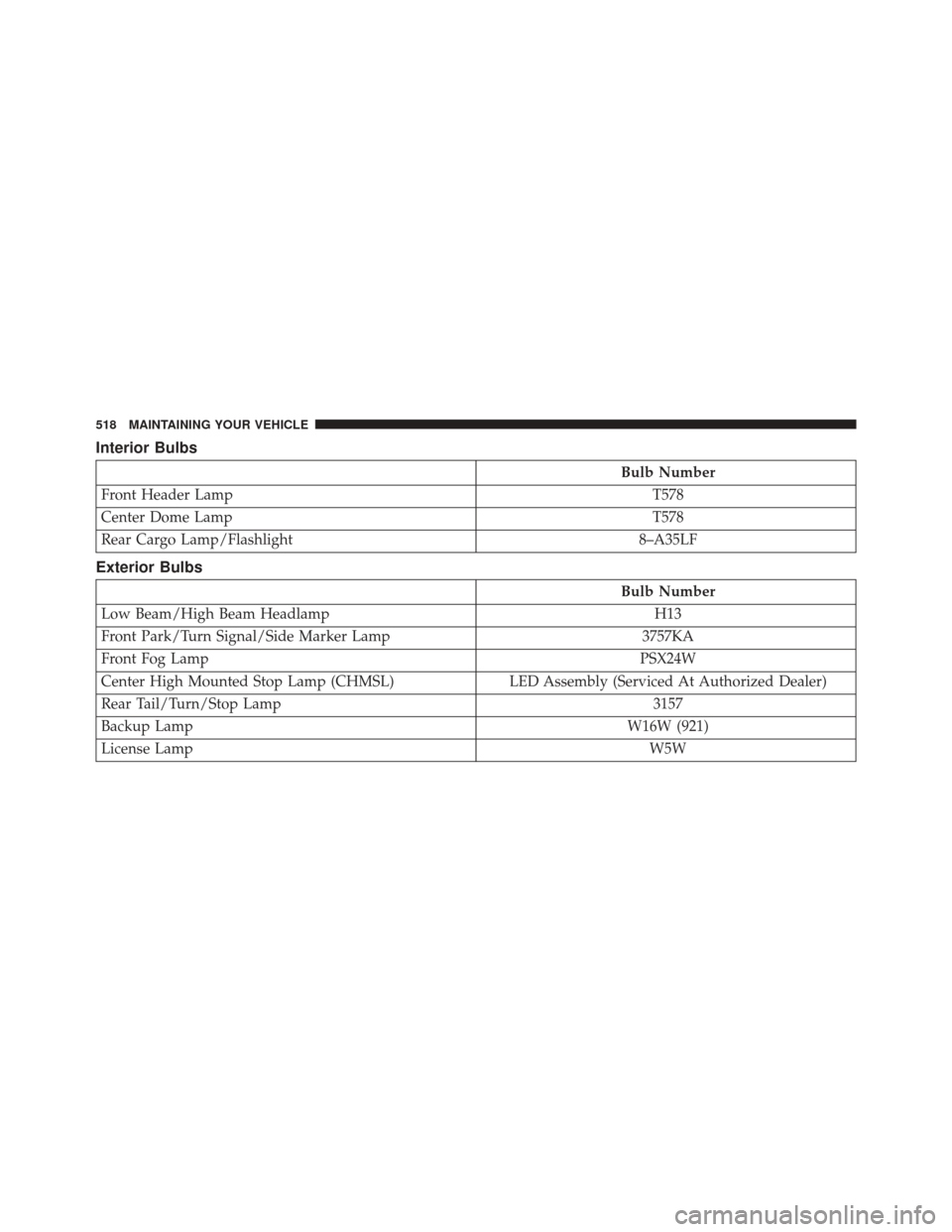
REPLACEMENT BULBS
All the inside bulbs are brass or glass wedge base.
Aluminum base bulbs are not approved and should not
be used for replacement7
MAINTAINING YOUR VEHICLE 517
Page 520 of 568
Interior Bulbs
Bulb Number
Front Header Lamp T578
Center Dome Lamp T578
Rear Cargo Lamp/Flashlight 8–A35LF
Exterior Bulbs
Bulb Number
Low Beam/High Beam Headlamp H13
Front Park/Turn Signal/Side Marker Lamp 3757KA
Front Fog Lamp PSX24W
Center High Mounted Stop Lamp (CHMSL) LED Assembly (Serviced At Authorized Dealer)
Rear Tail/Turn/Stop Lamp 3157
Backup Lamp W16W (921)
License Lamp W5W
518 MAINTAINING YOUR VEHICLE
Page 521 of 568

BULB REPLACEMENT
NOTE:Lens fogging can occur under certain atmo-
spheric conditions. This will usually clear as atmospheric
conditions change to allow the condensation to change
back into a vapor. Turning the lamps on will usually
accelerate the clearing process.
Headlamps
1. Raise the hood and locate the connector behind the headlamp.
2. Reach into engine compartment and pull red lock out at connector.
3. Remove the green connector from the back of the bulb by pulling straight back.
4. Twist the bulb to the left.
5. Pull bulb outward from assembly. NOTE:
These are halogen bulbs. Take care not to touch
the bulb with your fingers. Body oils from your fingers
could cause excessive heat buildup which reduces bulb
life.
Fog Lamps
1. Access lamp through the lower fascia cutout.
2. Remove electrical connector from bulb.
3. Remove bulb from housing.
CAUTION!
Do not touch the new bulb with your fingers. Oil
contamination will severely shorten bulb life. If the
bulb comes in contact with any oily surface, clean the
bulb with rubbing alcohol.7
MAINTAINING YOUR VEHICLE 519
Page 522 of 568
Rear Tail, Turn Signal And Backup Lamps
1. Raise the liftgate.
2. Remove the two push-pins from the taillamp housing.
3. Grasp the taillamp and pull firmly to disengage thelight from the aperture panel.
4. Twist and remove socket from the light.
5. Remove bulb from socket and replace.
License Lamps
1. Use a screw driver to gently pry against the side of the snap tab to remove the lamp from the liftgate.
2. Rotate the socket 1/4 turn counterclockwise.
3. Pull the bulb from the socket.
Center High-Mounted Stoplamp
This light is an LED assembly. See your authorized dealer
for replacement.
520 MAINTAINING YOUR VEHICLE