Page 476 of 615
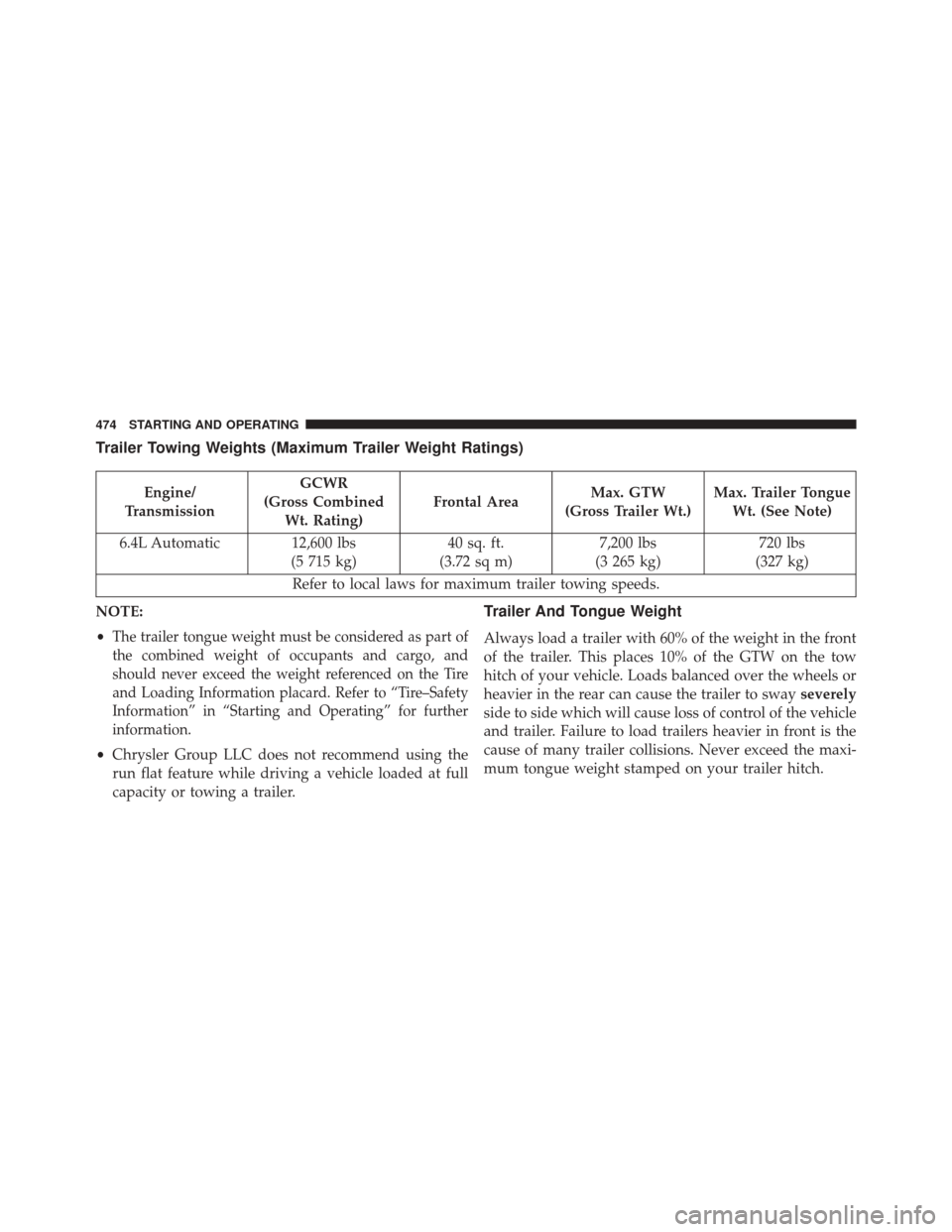
Trailer Towing Weights (Maximum Trailer Weight Ratings)
Engine/
Transmission GCWR
(Gross Combined Wt. Rating) Frontal Area
Max. GTW
(Gross Trailer Wt.) Max. Trailer Tongue
Wt. (See Note)
6.4L Automatic 12,600 lbs (5 715 kg)40 sq. ft.
(3.72 sq m) 7,200 lbs
(3 265 kg) 720 lbs
(327 kg)
Refer to local laws for maximum trailer towing speeds.
NOTE:
•
The trailer tongue weight must be considered as part of
the combined weight of occupants and cargo, and
should never exceed the weight referenced on the Tire
and Loading Information placard. Refer to “Tire–Safety
Information” in “Starting and Operating” for further
information.
• Chrysler Group LLC does not recommend using the
run flat feature while driving a vehicle loaded at full
capacity or towing a trailer.
Trailer And Tongue Weight
Always load a trailer with 60% of the weight in the front
of the trailer. This places 10% of the GTW on the tow
hitch of your vehicle. Loads balanced over the wheels or
heavier in the rear can cause the trailer to sway severely
side to side which will cause loss of control of the vehicle
and trailer. Failure to load trailers heavier in front is the
cause of many trailer collisions. Never exceed the maxi-
mum tongue weight stamped on your trailer hitch.
474 STARTING AND OPERATING
Page 485 of 615
WHAT TO DO IN EMERGENCIES
CONTENTS
�HAZARD WARNING FLASHERS ...........484
� IF YOUR ENGINE OVERHEATS ............484
� WHEEL AND TIRE TORQUE
SPECIFICATIONS ..................... .485
▫ Torque Specifications ...................485
� JACKING AND TIRE CHANGING ..........487
▫ Run Flat Tires ....................... .488
▫ Jack Location ....................... .489
▫ Spare Tire Stowage ....................489
▫ Preparations For Jacking ................490 ▫
Jacking Instructions ...................491
▫ Road Tire Installation ...................498
� JUMP-STARTING ..................... .498
▫ Preparations For Jump-Start ..............499
▫ Jump-Starting Procedure ................501
� FREEING A STUCK VEHICLE .............503
�
EMERGENCY TOW HOOKS — IF EQUIPPED . . .504
� MANUAL PARK RELEASE ................505
� TOWING A DISABLED VEHICLE ...........508
6
Page 490 of 615
Run Flat Tires
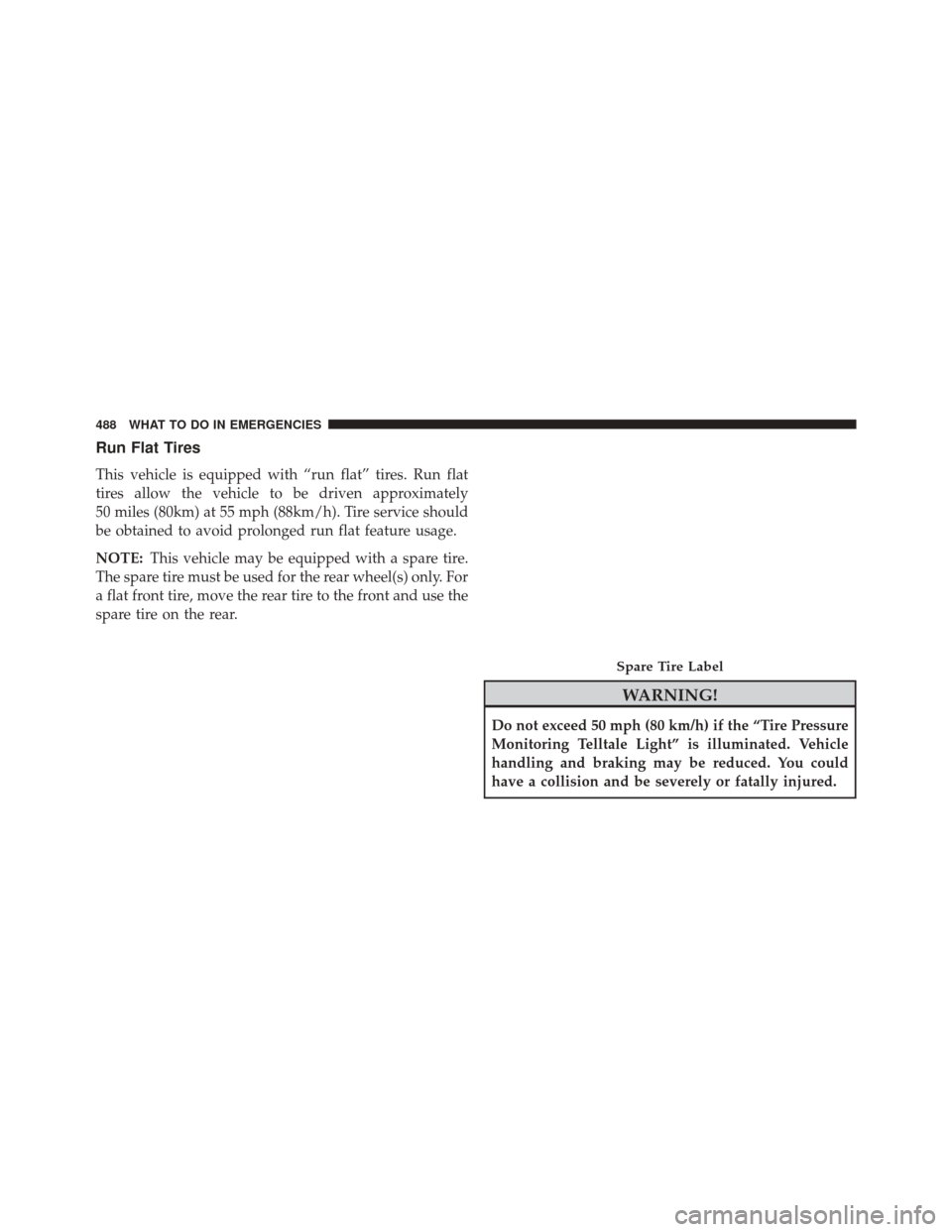
This vehicle is equipped with “run flat” tires. Run flat
tires allow the vehicle to be driven approximately
50 miles (80km) at 55 mph (88km/h). Tire service should
be obtained to avoid prolonged run flat feature usage.
NOTE:This vehicle may be equipped with a spare tire.
The spare tire must be used for the rear wheel(s) only. For
a flat front tire, move the rear tire to the front and use the
spare tire on the rear.
WARNING!
Do not exceed 50 mph (80 km/h) if the “Tire Pressure
Monitoring Telltale Light” is illuminated. Vehicle
handling and braking may be reduced. You could
have a collision and be severely or fatally injured.
Spare Tire Label
488 WHAT TO DO IN EMERGENCIES
Page 493 of 615

Jacking Instructions
WARNING!
Carefully follow these tire changing warnings to
help prevent personal injury or damage to your
vehicle:
•Always park on a firm, level surface as far from the
edge of the roadway as possible before raising the
vehicle.
• Turn on the Hazard Warning flasher.
• Block the wheel diagonally opposite the wheel to
be raised.
• Set the parking brake firmly and set an automatic
transmission in PARK.
• Never start or run the engine with the vehicle on a
jack.
(Continued)
WARNING! (Continued)
•Do not let anyone sit in the vehicle when it is on a
jack.
• Do not get under the vehicle when it is on a jack. If
you need to get under a raised vehicle, take it to a
service center where it can be raised on a lift.
• Only use the jack in the positions indicated and for
lifting this vehicle during a tire change.
• If working on or near a roadway, be extremely
careful of motor traffic.
• To assure that spare tires, flat or inflated, are
securely stowed, spares must be stowed with the
valve stem facing the ground.
6
WHAT TO DO IN EMERGENCIES 491