2014 JEEP GRAND CHEROKEE coolant level
[x] Cancel search: coolant levelPage 9 of 118
WARNING!
•Do not start or run an engine in a closed garage or
confined area. Exhaust gas contains Carbon Mon-
oxide (CO) which is odorless and colorless. Carbon
Monoxide is poisonous and can cause serious in-
jury or death when inhaled.
• Keep Remote Keyless Entry (RKE) transmitters
away from children. Operation of the Remote Start
System, windows, door locks or other controls
could cause serious injury or death.
ENGINE BREAK-IN RECOMMENDATIONS
The diesel engine does not require a break-in period due
to its construction. Normal operation is allowed, provid-
ing the following recommendations are followed:
• Warm up the engine before placing it under load.
•
Do not operate the engine at idle for prolonged periods.
• Use the appropriate transmission gear to prevent
engine lugging.
•
Observe vehicle oil pressure and temperature indicators.
• Check the coolant and oil levels frequently.
• Vary throttle position at highway speeds when carry-
ing or towing significant weight.
NOTE: Light duty operation such as light trailer towing
or no load operation will extend the time before the
engine is at full efficiency. Reduced fuel economy and
power may be seen at this time.
The engine oil installed in the engine at the factory is a
high-quality energy conserving type lubricant. Oil changes
should be consistent with anticipated climate conditions
under which vehicle operations will occur. The recom-
mended viscosity and quality grades are shown under
“Fluids, Lubricants and Genuine Parts”, under “Maintain-
ing Your Vehicle” in this manual. NON-DETERGENT OR
STRAIGHT MINERAL OILS MUST NEVER BE USED.
2
THINGS TO KNOW BEFORE STARTING YOUR VEHICLE 7
Page 89 of 118

Adding Coolant
Your vehicle has been built with an improved engine
coolant (OAT coolant conforming to MS-12106) that allows
extended maintenance intervals. This engine coolant (anti-
freeze) can be used up to ten years or 150,000 miles
(240,000 km) before replacement. To prevent reducing this
extended maintenance period, it is important that you use
the same engine coolant (OAT coolant conforming to
MS-12106) throughout the life of your vehicle.
Please review these recommendations for using Organic
Additive Technology (OAT) engine coolant (antifreeze)
that meets the requirements of Chrysler Material Stan-
dard MS-12106. When adding engine coolant (antifreeze):
•We recommend using MOPAR® Antifreeze/Coolant
10 Year/150,000 Mile Formula OAT (Organic Additive
Technology) that meets the requirements of Chrysler
Material Standard MS-12106. •
Mix a minimum solution of 50% OAT engine coolant
that meets the requirements of Chrysler Material Stan-
dard MS-12106 and distilled water. Use higher concen-
trations (not to exceed 70%) if temperatures below
34° F (37° C) are anticipated.
• Use only high purity water such as distilled or deion-
ized water when mixing the water/engine coolant
(antifreeze) solution. The use of lower quality water
will reduce the amount of corrosion protection in the
engine cooling system.
Please note that it is the owner’s responsibility to main-
tain the proper level of protection against freezing ac-
cording to the temperatures occurring in the area where
the vehicle is operated.5
MAINTAINING YOUR VEHICLE 87
Page 103 of 118
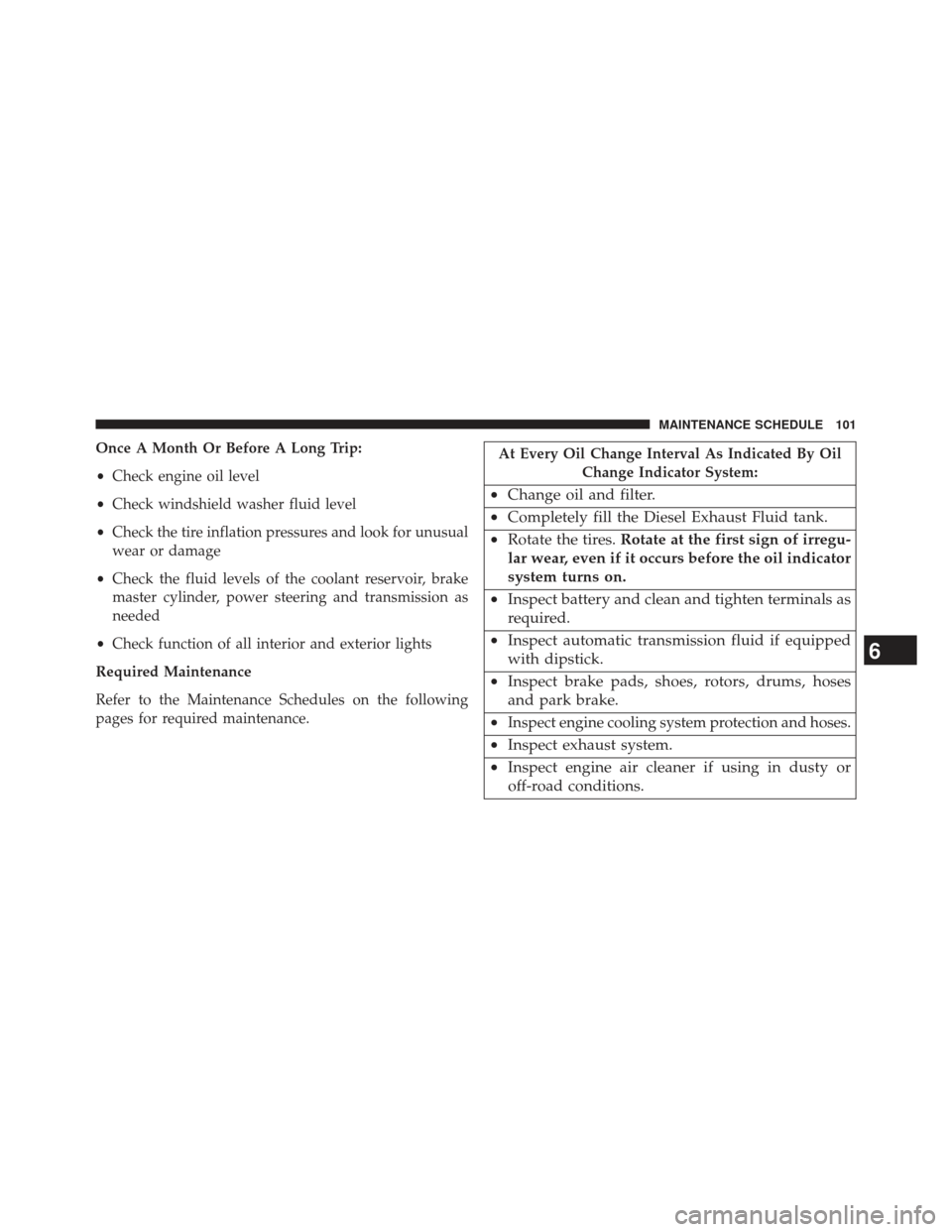
Once A Month Or Before A Long Trip:
•Check engine oil level
• Check windshield washer fluid level
• Check the tire inflation pressures and look for unusual
wear or damage
• Check the fluid levels of the coolant reservoir, brake
master cylinder, power steering and transmission as
needed
• Check function of all interior and exterior lights
Required Maintenance
Refer to the Maintenance Schedules on the following
pages for required maintenance.At Every Oil Change Interval As Indicated By Oil Change Indicator System:
•Change oil and filter.
• Completely fill the Diesel Exhaust Fluid tank.
• Rotate the tires. Rotate at the first sign of irregu-
lar wear, even if it occurs before the oil indicator
system turns on.
• Inspect battery and clean and tighten terminals as
required.
• Inspect automatic transmission fluid if equipped
with dipstick.
• Inspect brake pads, shoes, rotors, drums, hoses
and park brake.
•
Inspect engine cooling system protection and hoses.
• Inspect exhaust system.
• Inspect engine air cleaner if using in dusty or
off-road conditions.
6
MAINTENANCE SCHEDULE 101
Page 107 of 118
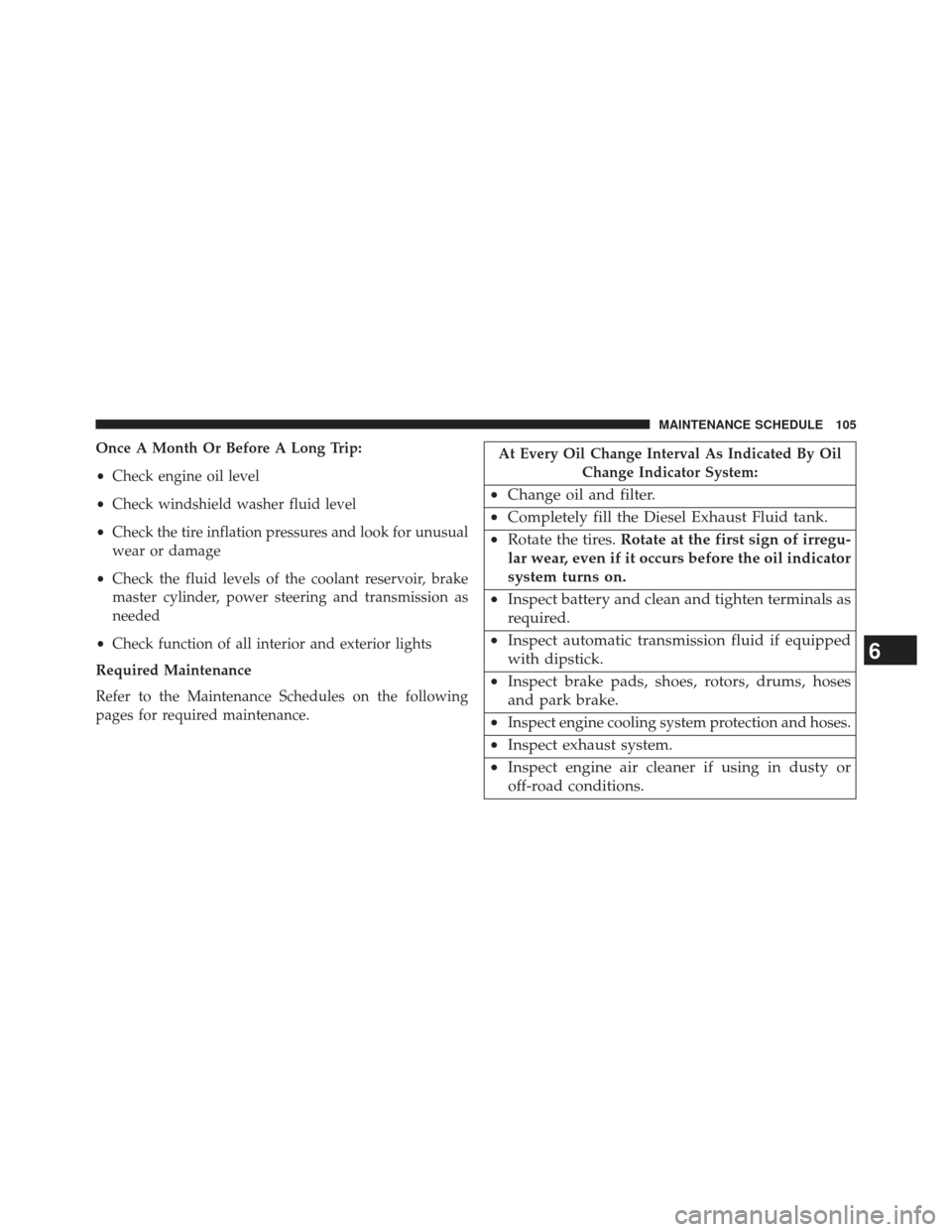
Once A Month Or Before A Long Trip:
•Check engine oil level
• Check windshield washer fluid level
• Check the tire inflation pressures and look for unusual
wear or damage
• Check the fluid levels of the coolant reservoir, brake
master cylinder, power steering and transmission as
needed
• Check function of all interior and exterior lights
Required Maintenance
Refer to the Maintenance Schedules on the following
pages for required maintenance.At Every Oil Change Interval As Indicated By Oil Change Indicator System:
•Change oil and filter.
• Completely fill the Diesel Exhaust Fluid tank.
• Rotate the tires. Rotate at the first sign of irregu-
lar wear, even if it occurs before the oil indicator
system turns on.
• Inspect battery and clean and tighten terminals as
required.
• Inspect automatic transmission fluid if equipped
with dipstick.
• Inspect brake pads, shoes, rotors, drums, hoses
and park brake.
•
Inspect engine cooling system protection and hoses.
• Inspect exhaust system.
• Inspect engine air cleaner if using in dusty or
off-road conditions.
6
MAINTENANCE SCHEDULE 105
Page 112 of 118
Adding Engine Coolant (Antifreeze).............87
Adding Fuel ..............................63
Airbag Light .............................19
Air Cleaner, Engine (Engine Air Cleaner Filter) .....77
Antifreeze (Engine Coolant) ...................86
Capacities .............................93
Disposal ..............................89
Anti-Lock Warning Light .....................11
Automatic Transmission Fluid Type .............................96
Axle Fluid ...............................96
Battery .................................84
Brake Fluid ..............................96
Brake System .............................91
Fluid Check ............................91
Master Cylinder .........................91
Warning Light ..........................15 Capacities, Antifreeze (Engine Coolant)
...........93
Capacities, Fluid ...........................93
Caps, Filler Oil (Engine) ............................75
Radiator (Coolant Pressure) .................88
Charge Air Cooler .........................90
Coolant Pressure Cap (Radiator Cap) ............88
Cooling System ...........................84
Adding Coolant (Antifreeze) ................87
Coolant Capacity ........................93
Coolant Level ...........................85
Disposal of Used Coolant ..................89
Drain, Flush, and Refill ....................85
Points to Remember ......................89
Pressure Cap ...........................88
Radiator Cap ...........................88
Selection of Coolant (Antifreeze) .............86
110 INDEX
Page 113 of 118
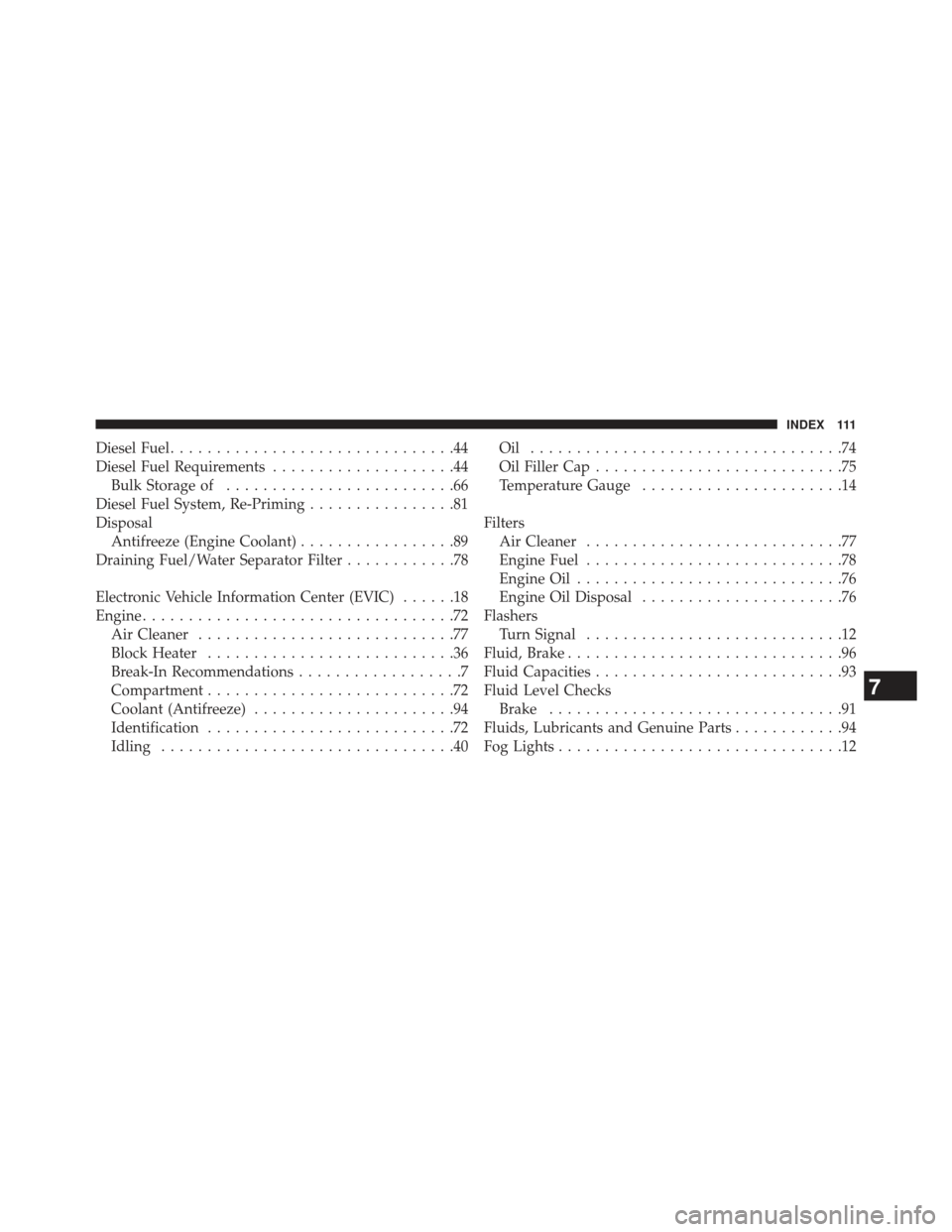
Diesel Fuel...............................44
Diesel Fuel Requirements ....................44
Bulk Storage of .........................66
Diesel Fuel System, Re-Priming ................81
Disposal Antifreeze (Engine Coolant) .................89
Draining Fuel/Water Separator Filter ............78
Electronic Vehicle Information Center (EVIC) ......18
Engine ..................................72
Air Cleaner ............................77
Block Heater ...........................36
Break-In Recommendations ..................7
Compartment ...........................72
Coolant (Antifreeze) ......................94
Identification ...........................72
Idling ................................40 Oil ..................................74
Oil Filler Cap
...........................75
Temperature Gauge ......................14
Filters Air Cleaner ............................77
Engine Fuel ............................78
Engine Oil .............................76
Engine Oil Disposal ......................76
Flashers Turn Signal ............................12
Fluid, Brake ..............................96
Fluid Capacities ...........................93
Fluid Level Checks Brake ................................91
Fluids, Lubricants and Genuine Parts ............94
Fog Lights ...............................12
7
INDEX 111