Page 473 of 572

and REVERSE (with automatic transmission) or 2nd gear
and REVERSE (with manual transmission), while gently
pressing the accelerator. Use the least amount of accel-
erator pedal pressure that will maintain the rocking
motion, without spinning the wheels, or racing the
engine.
CAUTION!
Racing the engine or spinning the wheels may lead to
transmission overheating and failure. Allow the en-
gine to idle with the transmission in NEUTRAL for at
least one minute after every five rocking-motion
cycles. This will minimize overheating and reduce
the risk of transmission failure during prolonged
efforts to free a stuck vehicle.NOTE:
Press the �ESC Off� switch, to place the Electronic
Stability Control (ESC) system in �Partial Off�mode,
before rocking the vehicle. Refer to “Electronic Brake
Control” in “Starting And Operating” for further infor-
mation. Once the vehicle has been freed, press the �ESC
Off� switch again to restore �ESC On�mode.
CAUTION!
•When “rocking” a stuck vehicle by shifting be-
tween DRIVE/2nd gear and REVERSE, do not spin
the wheels faster than 15 mph (24 km/h), or drive-
train damage may result.
• Revving the engine or spinning the wheels too fast
may lead to transmission overheating and failure.
It can also damage the tires. Do not spin the wheels
above 30 mph (48 km/h) while in gear (no trans-
mission shifting occurring).
6
WHAT TO DO IN EMERGENCIES 471
Page 476 of 572
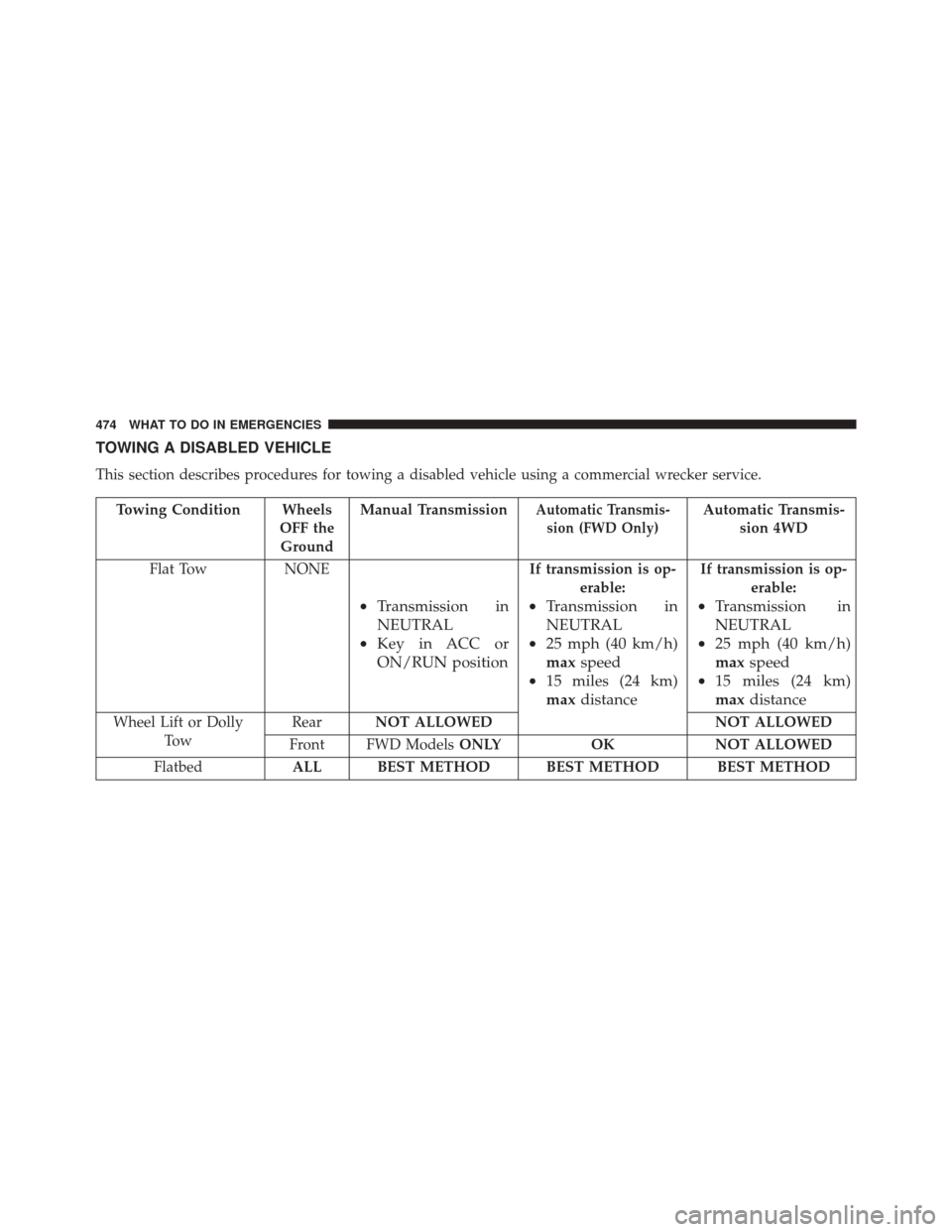
TOWING A DISABLED VEHICLE
This section describes procedures for towing a disabled vehicle using a commercial wrecker service.
Towing Condition WheelsOFF theGround Manual TransmissionAutomatic Transmis-
sion (FWD Only)Automatic Transmis- sion 4WD
Flat Tow NONE
•Transmission in
NEUTRAL
• Key in ACC or
ON/RUN position
If transmission is op-
erable:
•Transmission in
NEUTRAL
• 25 mph (40 km/h)
max speed
• 15 miles (24 km)
max distance
If transmission is op-
erable:
•Transmission in
NEUTRAL
• 25 mph (40 km/h)
max speed
• 15 miles (24 km)
max distance
Wheel Lift or Dolly
To w Rear
NOT ALLOWED NOT ALLOWED
Front FWD Models ONLYOKNOT ALLOWED
Flatbed ALL BEST METHOD BEST METHOD BEST METHOD
474 WHAT TO DO IN EMERGENCIES
Page 477 of 572

With Ignition Key
Automatic Transmission
•Front Wheel Drive (FWD) vehicles can be towed with
the front wheels elevated, or on a flatbed truck (all four
wheels OFFthe ground).
• Four-Wheel Drive (4WD) vehicles can be towed on a
flatbed truck (all four wheels OFFthe ground).
If the transmission is operable, this vehicle may be flat
towed (with all four wheels on the ground) under the
following conditions:
• The transmission must be in NEUTRAL.
• The towing speed must not exceed 25 mph (40 km/h).
• The towing distance must not exceed 15 miles (24 km). Front Wheel Drive (FWD) models may also be towed
(under the same limitations shown above) with the rear
wheels elevated.
CAUTION!
•
Towing this vehicle using any other method could
result in extensive damage to the transfer case
and/or transmission.
• Damage from improper towing is not covered un-
der the New Vehicle Limited Warranty.
If the vehicle’s battery is discharged, refer to “Shift Lever
Override” in this section for instructions on shifting the
automatic transmission out of PARK for towing.
Manual Transmission
• Front Wheel Drive (FWD) or Four-Wheel Drive (4WD)
vehicles can be flat towed (all four wheels on the
ground) with the transmission in NEUTRAL.
6
WHAT TO DO IN EMERGENCIES 475
Page 480 of 572

▫Automatic Transmission (Six-Speed) — If
Equipped .......................... .506
▫ Automatic Transmission (CVT) —
If Equipped ........................ .508
▫ Manual Transmission — If Equipped .......510
▫ Rear Drive Assembly (RDA) — AWD/4WD
Models Only ....................... .510
▫ Power Transfer Unit (PTU) — AWD/4WD Models
Only ..............................511
▫ Appearance Care And Protection
From Corrosion ......................511
� FUSES ............................. .518
▫ Integrated Power Module ...............519
� VEHICLE STORAGE ....................524 �
REPLACEMENT BULBS .................524
� BULB REPLACEMENT ..................525
▫ Headlamps ........................ .525
▫ Fog Lamps ......................... .526
▫ Rear Turn Signal And Backup Lamp ........526
▫ License Lamps ...................... .527
▫ Center High-Mounted Stoplamp ..........527
� FLUID CAPACITIES ....................527
�
FLUIDS, LUBRICANTS AND GENUINE PARTS . .528
▫ Engine ............................ .528
▫ Chassis ........................... .529
478 MAINTAINING YOUR VEHICLE
Page 483 of 572

ONBOARD DIAGNOSTIC SYSTEM — OBD II
Your vehicle is equipped with a sophisticated onboard
diagnostic system called OBD II. This system monitors
the performance of the emissions, engine, and automatic
transmission control systems. When these systems are
operating properly, your vehicle will provide excellent
performance and fuel economy, as well as engine emis-
sions well within current government regulations.
If any of these systems require service, the OBD II system
will turn on the “Malfunction Indicator Light” (MIL). It
will also store diagnostic codes and other information to
assist your service technician in making repairs. Al-
though your vehicle will usually be drivable and not
need towing, see your authorized dealer for service as
soon as possible.
CAUTION!
•Prolonged driving with the MIL on could cause
further damage to the emission control system. It
could also affect fuel economy and driveability.
The vehicle must be serviced before any emissions
tests can be performed.
• If the MIL is flashing while the engine is running,
severe catalytic converter damage and power loss
will soon occur. Immediate service is required.
Loose Fuel Filler Cap Message
After fuel is added, the vehicle diagnostic system can
determine if the fuel filler cap is possibly loose or
improperly installed. A “gASCAP” message will be dis-
played in the instrument cluster. Tighten the gas cap until
a �clicking� sound is heard. This is an indication that the
gas cap is properly tightened. Press the trip odometer
RESET button to turn off the message. If the problem7
MAINTAINING YOUR VEHICLE 481
Page 508 of 572

Automatic Transmission (Six-Speed) — If
Equipped
Selection Of Lubricant (Six-Speed Transmission)
It is important to use the proper transmission fluid to
ensure optimum transmission performance and life. Use
only the manufacturer ’s recommended transmission
fluid. Refer to “Fluids, Lubricants, and Genuine Parts” in
this section for fluid specifications. It is important to
maintain the transmission fluid at the correct level using
the recommended fluid.
No chemical flushes should be used in any transmission;
only the approved lubricant should be used.
CAUTION!
Using a transmission fluid other than the manufac-
turer ’s recommended fluid may cause deterioration
(Continued)
CAUTION!(Continued)
in transmission shift quality, and will require more
frequent fluid and filter changes. Refer to “Fluids,
Lubricants, and Genuine Parts” in this section for
fluid specifications.
Special Additives
The manufacturer strongly recommends against using
any special additives in the transmission.
Automatic transmission fluid is an engineered product
and its performance may be impaired by supplemental
additives. Therefore, do not add any fluid additives to
the transmission. The only exception to this policy is the
use of special dyes for diagnosing fluid leaks. Avoid
using transmission sealers as they may adversely affect
seals.
506 MAINTAINING YOUR VEHICLE
Page 510 of 572

Automatic Transmission (CVT) — If Equipped
Selection Of Lubricant (CVT)
It is important to use the proper transmission fluid to
ensure optimum transmission performance and life. Use
only the manufacturer’s recommended transmission
fluid which has the special friction coefficient additives
necessary for proper steel belt traction on the drive and
driven pulleys. Refer to “Fluids, Lubricants, and Genuine
Parts” in this section for fluid specifications. It is impor-
tant to maintain the transmission fluid at the correct level
using the recommended fluid.
No chemical flushes should be used in any transmission;
only the approved lubricant should be used.
CAUTION!
•Do not use chemical flushes in your transmission
as the chemicals can damage your transmission
components. Such damage is not covered by the
New Vehicle Limited Warranty.
• Using a transmission fluid other than the manufac-
turer’s recommended fluid will cause belt slip and
result in a complete transmission failure! Refer to
“Fluids, Lubricants, and Genuine Parts” in “Main-
taining Your Vehicle” for fluid specifications.
Special Additives
The manufacturer strongly recommends against using
any special additives in the transmission.
Automatic transmission fluid is an engineered product
and its performance may be impaired by supplemental
additives. Therefore, do not add any fluid additives to
the transmission. The only exception to this policy is the
508 MAINTAINING YOUR VEHICLE
Page 531 of 572
Chassis
ComponentFluid, Lubricant, or Genuine Part
Automatic Transmission (CVT) — If Equipped We recommend you use MOPAR® CVTF+4® Continu-
ously Variable Transmission Fluid.
Automatic Transmission (Six-Speed) — If Equipped We recommend you use SK Energy ATF SP-4 Transmis- sion Fluid.
Manual Transmission — If Equipped We recommend you use MOPAR® ATF+4® Automatic
Transmission Fluid.
Rear Drive Assembly (RDA) We recommend you use MOPAR® Gear & Axle Lubri-
cant SAE 80W-90 API GL 5.
Power Transfer Unit (PTU) We recommend you use MOPAR® Gear & Axle Lubri-
cant SAE 80W-90 API GL 5.
Brake Master Cylinder We recommend you use MOPAR® DOT 3, SAE J1703
should be used. If DOT 3, SAE J1703 brake fluid is not
available, then DOT 4 is acceptable.
Power Steering Reservoir We recommend you use MOPAR® Power Steering Fluid
+4, MOPAR® ATF+4® Automatic Transmission Fluid.
7
MAINTAINING YOUR VEHICLE 529