Page 436 of 572
Towing Tips
Before setting out on a trip, practice turning, stopping,
and backing up the trailer in an area located away from
heavy traffic.
Manual Transmission — If Equipped
If using a manual transmission vehicle for trailer towing,
all starts must be in first gear to avoid excessive clutch
slippage.
Automatic Transmission
The DRIVE range can be selected when towing. How-
ever, if frequent shifting or changes in engine speed occur
while in this range, use the AutoStick® shift control (if
equipped) to select a lower gear ratio.Seven-Pin Connector
1 — Battery5 — Ground
2 — Backup Lamps 6 — Left Stop/Turn
3 — Right Stop/Turn 7 — Running Lamps
4 — Electric Brakes 434 STARTING AND OPERATING
Page 478 of 572

•FWD vehicles can be towed with the front wheels
elevated.
• FWD or 4WD vehicles can be towed on a flatbed truck
(all wheels OFFthe ground).
CAUTION!
•DO NOT flat tow any disabled vehicle if condition
is related to a clutch, transmission or driveline
component. Damage to the drivetrain could result.
• Towing this vehicle in violation of the above re-
quirements can cause severe transmission damage.
Damage from improper towing is not covered un-
der the New Vehicle Limited Warranty.
All Transmissions
If you must use the accessories (wipers, defroster, etc.)
while being towed, the key must be in the ON/RUN position, not the ACC position. Make certain the trans-
mission remains in NEUTRAL.
CAUTION!
•
DO NOT use sling-type equipment when towing.
Vehicle damage may occur.
• When securing the vehicle to a flatbed truck, do not
attach to front or rear suspension components.
Damage to your vehicle may result from improper
towing.
Without The Ignition Key
Special care must be taken when the vehicle is towed
with the ignition in the LOCK position. The only ap-
proved method of towing without the ignition key is
with a flatbed truck. Proper towing equipment is neces-
sary to prevent damage to the vehicle.
476 WHAT TO DO IN EMERGENCIES
Page 506 of 572

NOTE:If your vehicle is equipped with a manual trans-
mission, the brake fluid reservoir supplies fluid to both
the brake system and the clutch release system. The two
systems are separated in the reservoir, and a leak in one
system will not affect the other system. The manual
transmission clutch release system should not require
fluid replacement during the life of the vehicle. If the
brake fluid reservoir is low and the brake system does
not indicate any leaks or other problems, it may be a
result of a leak in the hydraulic clutch release system. See
your local authorized dealer for service.
Use only manufacturer’s recommended brake fluid. Re-
fer to “Fluids, Lubricants, and Genuine Parts” in “Main-
taining Your Vehicle” for further information.WARNING!
• Use only manufacturer’s recommended brake
fluid. Refer to “Fluids, Lubricants, and Genuine
Parts” in “Maintaining Your Vehicle” for further
information. Using the wrong type of brake fluid
can severely damage your brake system and/or
impair its performance. The proper type of brake
fluid for your vehicle is also identified on the
original factory installed hydraulic master cylinder
reservoir.
(Continued)
504 MAINTAINING YOUR VEHICLE
Page 507 of 572

WARNING!(Continued)
•To avoid contamination from foreign matter or
moisture, use only new brake fluid or fluid that has
been in a tightly closed container. Keep the master
cylinder reservoir cap secured at all times. Brake
fluid in a open container absorbs moisture from the
air resulting in a lower boiling point. This may
cause it to boil unexpectedly during hard or pro-
longed braking, resulting in sudden brake failure.
This could result in a collision.
• Overfilling the brake fluid reservoir can result in
spilling brake fluid on hot engine parts, causing
the brake fluid to catch fire. Brake fluid can also
damage painted and vinyl surfaces, care should be
taken to avoid its contact with these surfaces.
(Continued)
WARNING! (Continued)
•Do not allow petroleum based fluid to contaminate
the brake fluid. Brake seal components could be
damaged, causing partial or complete brake failure.
This could result in a collision.
CAUTION!
Use of improper brake fluids will affect overall
clutch system performance. Improper brake fluids
may damage the clutch system resulting in loss of
clutch function and the ability to shift the transmis-
sion.
7
MAINTAINING YOUR VEHICLE 505
Page 554 of 572
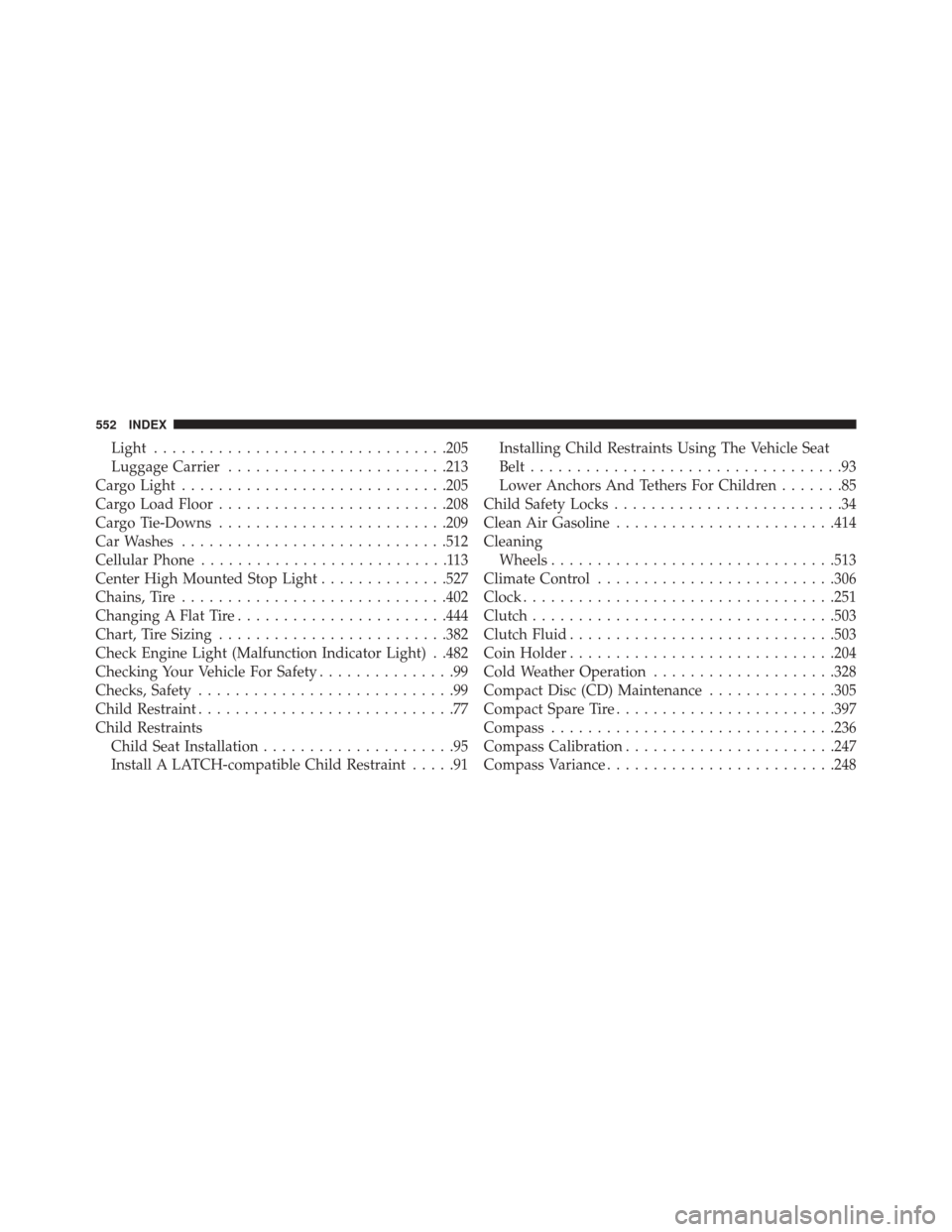
Light............................... .205
Luggage Carrier ....................... .213
Cargo Light ............................ .205
Cargo Load Floor ........................ .208
Cargo Tie-Downs ........................ .209
Car Washes ............................ .512
Cellular Phone ...........................113
Center High Mounted Stop Light ..............527
Chains, Tire ............................ .402
Changing A Flat Tire ...................... .444
Chart, Tire Sizing ........................ .382
Check Engine Light (Malfunction Indicator Light) . .482
Checking Your Vehicle For Safety ...............99
Checks, Safety ............................99
Child Restraint ............................77
Child Restraints Child Seat Installation .....................95
Install A LATCH-compatible Child Restraint .....91Installing Child Restraints Using The Vehicle Seat
Belt
..................................93
Lower Anchors And Tethers For Children .......85
Child Safety Locks .........................34
Clean Air Gasoline ....................... .414
Cleaning Wheels .............................. .513
Climate Control ......................... .306
Clock ................................. .251
Clutch ................................ .503
Clutch Fluid ............................ .503
Coin Holder ............................ .204
Cold Weather Operation ....................328
Compact Disc (CD) Maintenance ..............305
Compact Spare Tire ....................... .397
Compass .............................. .236
Compass Calibration ...................... .247
Compass Variance ........................ .248
552 INDEX
