Page 357 of 572
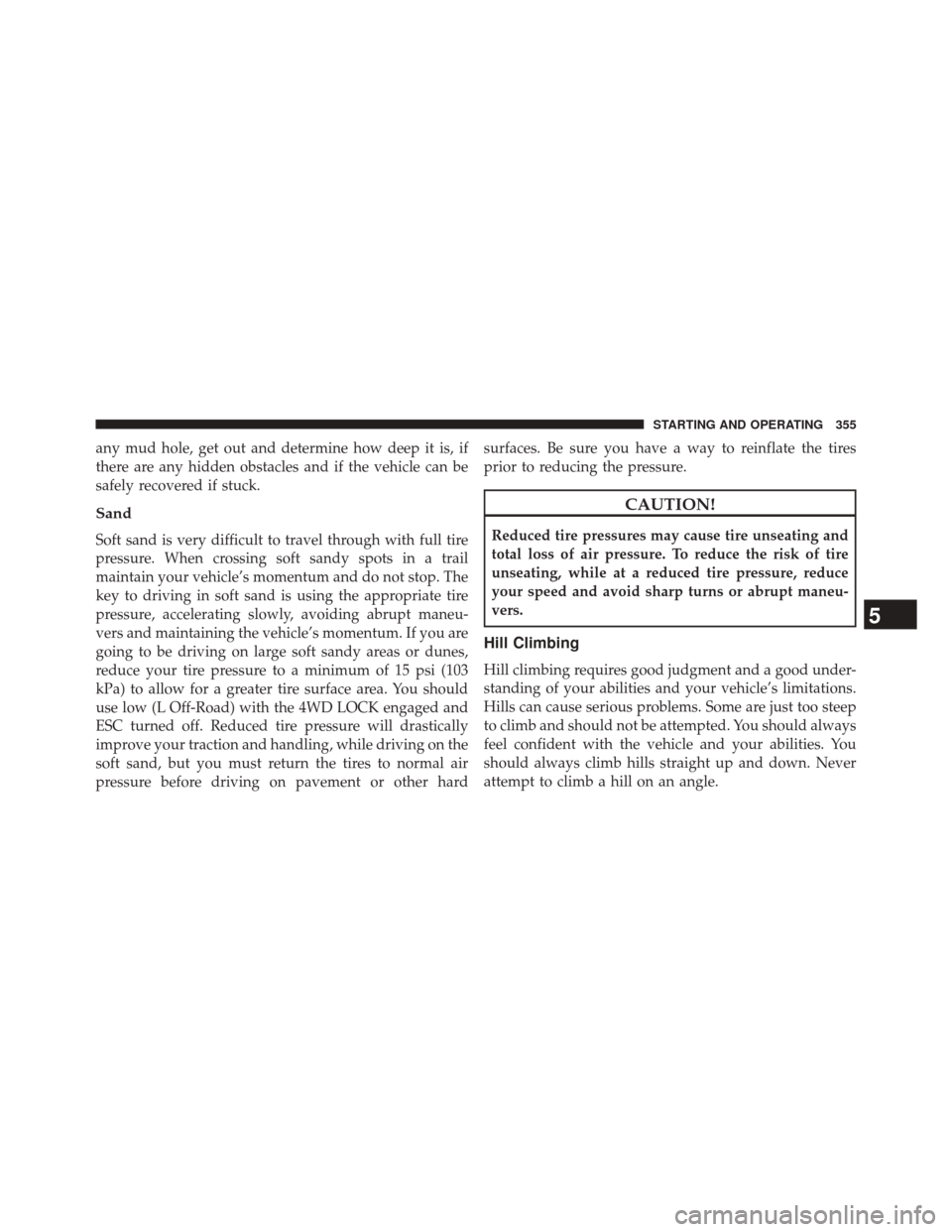
any mud hole, get out and determine how deep it is, if
there are any hidden obstacles and if the vehicle can be
safely recovered if stuck.
Sand
Soft sand is very difficult to travel through with full tire
pressure. When crossing soft sandy spots in a trail
maintain your vehicle’s momentum and do not stop. The
key to driving in soft sand is using the appropriate tire
pressure, accelerating slowly, avoiding abrupt maneu-
vers and maintaining the vehicle’s momentum. If you are
going to be driving on large soft sandy areas or dunes,
reduce your tire pressure to a minimum of 15 psi (103
kPa) to allow for a greater tire surface area. You should
use low (L Off-Road) with the 4WD LOCK engaged and
ESC turned off. Reduced tire pressure will drastically
improve your traction and handling, while driving on the
soft sand, but you must return the tires to normal air
pressure before driving on pavement or other hardsurfaces. Be sure you have a way to reinflate the tires
prior to reducing the pressure.
CAUTION!
Reduced tire pressures may cause tire unseating and
total loss of air pressure. To reduce the risk of tire
unseating, while at a reduced tire pressure, reduce
your speed and avoid sharp turns or abrupt maneu-
vers.
Hill Climbing
Hill climbing requires good judgment and a good under-
standing of your abilities and your vehicle’s limitations.
Hills can cause serious problems. Some are just too steep
to climb and should not be attempted. You should always
feel confident with the vehicle and your abilities. You
should always climb hills straight up and down. Never
attempt to climb a hill on an angle.
5
STARTING AND OPERATING 355
Page 358 of 572

Before Climbing A Steep Hill
As you approach a hill consider its grade or steepness.
Determine if it is too steep. Look to see what the traction
is on the hill side trail. Is the trail straight up and down?
What is on top and the other side? Are there ruts, rocks,
branches or other obstacles on the path? Can you safely
recover the vehicle if something goes wrong? If every-
thing looks good and you feel confident, then you should
use low (L Off-Road) with the 4WD LOCK engaged and
proceed with caution maintaining your momentum as
you climb the hill.
Driving Up Hill
Once you have determined your ability to proceed and
have shifted into the appropriate gear, line your vehicle
up for the straightest possible run. Accelerate with an
easy constant throttle and apply more power as you start
up the hill. Do not race forward into a steep grade; the
abrupt change of grade could cause you to lose control. Ifthe front end begins to bounce, ease off the throttle
slightly to bring all four tires back on the ground. As you
approach the crest of the hill, ease off the throttle and
slowly proceed over the top. If the wheels start to slip as
you approach the crest of a hill, ease off the accelerator
and maintain headway by turning the steering wheel no
more than a 1/4 turn quickly back and forth. This will
provide a fresh
�bite�into the surface and will usually
provide enough traction to complete the climb. If you do
not make it to the top, place the vehicle in REVERSE and
back straight down the grade using engine resistance
along with the vehicle brakes.WARNING!
Never attempt to climb a hill at an angle or turn
around on a steep grade. Driving across an incline
increases the risk of a rollover, which may result in
severe injury.
356 STARTING AND OPERATING
Page 359 of 572

Driving Down Hill
Before driving down a steep hill you need to determine if
it is too steep for a safe descent. What is the surface
traction? Is the grade too steep to maintain a slow
controlled descent? Are there obstacles? Is it a straight
descent? Is there plenty of distance at the base of the hill
to regain control if the vehicle descends to fast? If you feel
confident in your ability to proceed then make sure you
are in low (L Off-Road) with the 4WD LOCK engaged
and proceed with caution. Allow engine and hill descent
braking to control the descent and apply your brakes if
necessary, but do not allow the tires to lock.
WARNING!
Do not descend a steep grade in NEUTRAL. Use
vehicle brakes in conjunction with engine braking.
Descending a grade too fast could cause you to lose
control and be seriously injured or killed.
Driving Across An Incline
If at all possible avoid driving across an incline. If it is
necessary, know your vehicle’s abilities. Driving across
an incline places more weight on the down-hill wheels,
which increases the possibilities of a down-hill slide or
rollover. Make sure the surface has good traction with
firm and stable soils. If possible transverse the incline at
an angle heading slightly up or down.
WARNING!
Driving across an incline increases the risk of a
rollover , which may result in severe injury.
If You Stall Or Begin To Lose Headway
If you stall or begin to lose headway while climbing a
steep hill, allow your vehicle to come to a stop and
immediately apply the brake. Restart the engine and shift
to REVERSE. Back slowly down the hill allowing engine
5
STARTING AND OPERATING 357
Page 360 of 572

and hill descent braking to control the descent and apply
your brakes if necessary, but do not allow the tires to lock.
WARNING!
If the engine stalls or you lose headway or cannot
make it to the top of a steep hill or grade, never
attempt to turn around. To do so may result in
tipping and rolling the vehicle, which may result in
severe injury. Always back carefully straight down a
hill in REVERSE gear. Never back down a hill in
NEUTRAL using only the vehicle brakes. Never
drive diagonally across a hill, always drive straight
up or down.
Driving Through Water
Extreme care should be taken crossing any type of water.
Water crossings should be avoided if possible, and onlybe attempted when necessary in a safe responsible man-
ner. You should only drive through areas which are
designated and approved. You should tread lightly and
avoid damage to the environment. You should know
your vehicles abilities and be able to recover it if some-
thing goes wrong. You should never stop or shut a
vehicle off when crossing deep water unless you ingested
water into the engine air intake. If the engine stalls, do
not attempt to restart it. Determine if it has ingested
water first. The key to any crossing is low and slow. You
want to use low (L Off-Road) with the 4WD LOCK
engaged and proceed very slowly with a constant slow
speed (3-5 mph [5–8 km/h] maximum) and light throttle.
Keep the vehicle moving; do not try to accelerate through
the crossing. After crossing any water higher than the
bottom of the axle differentials, you should inspect all of
the vehicle fluids for signs of water ingestion.
358 STARTING AND OPERATING
Page 440 of 572
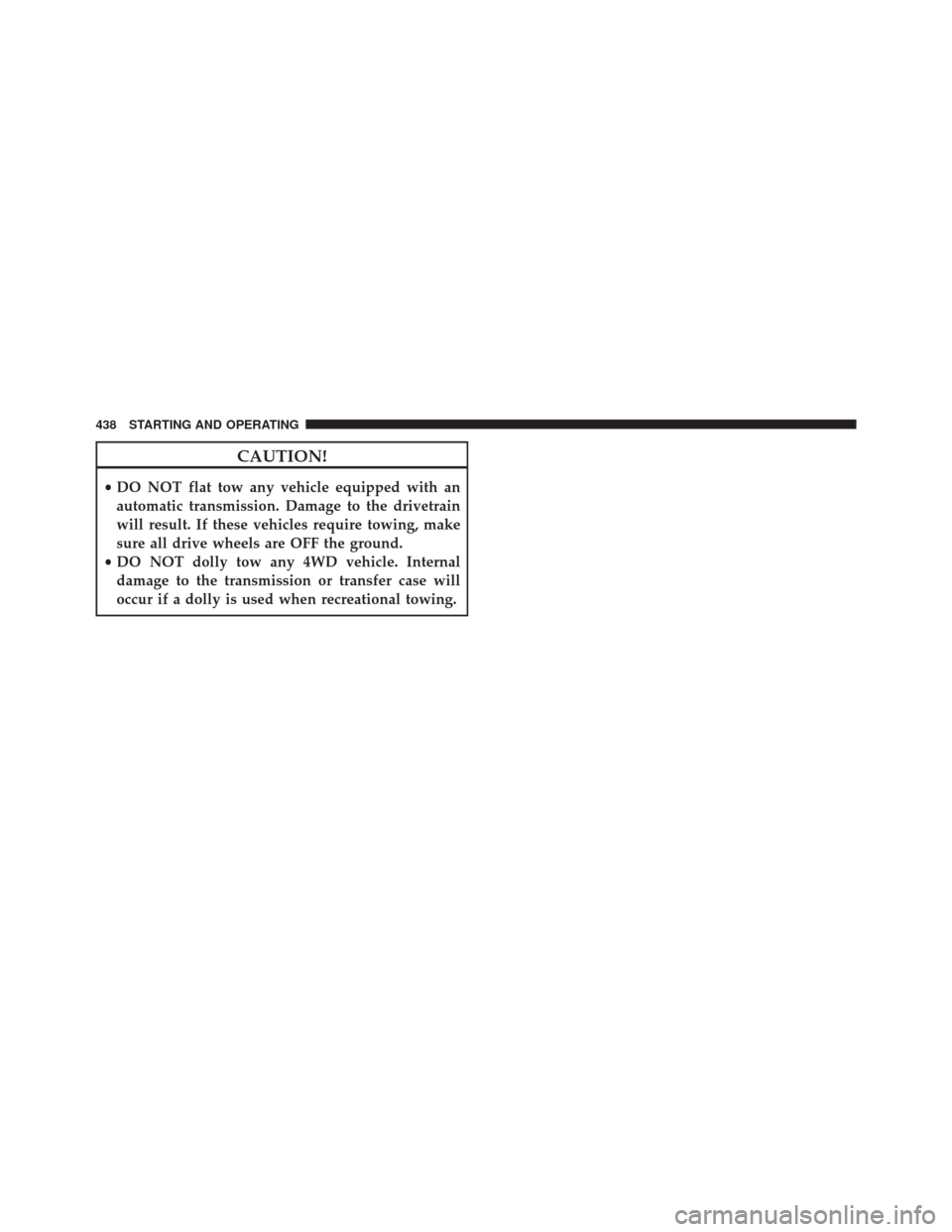
CAUTION!
•DO NOT flat tow any vehicle equipped with an
automatic transmission. Damage to the drivetrain
will result. If these vehicles require towing, make
sure all drive wheels are OFF the ground.
• DO NOT dolly tow any 4WD vehicle. Internal
damage to the transmission or transfer case will
occur if a dolly is used when recreational towing.
438 STARTING AND OPERATING
Page 476 of 572
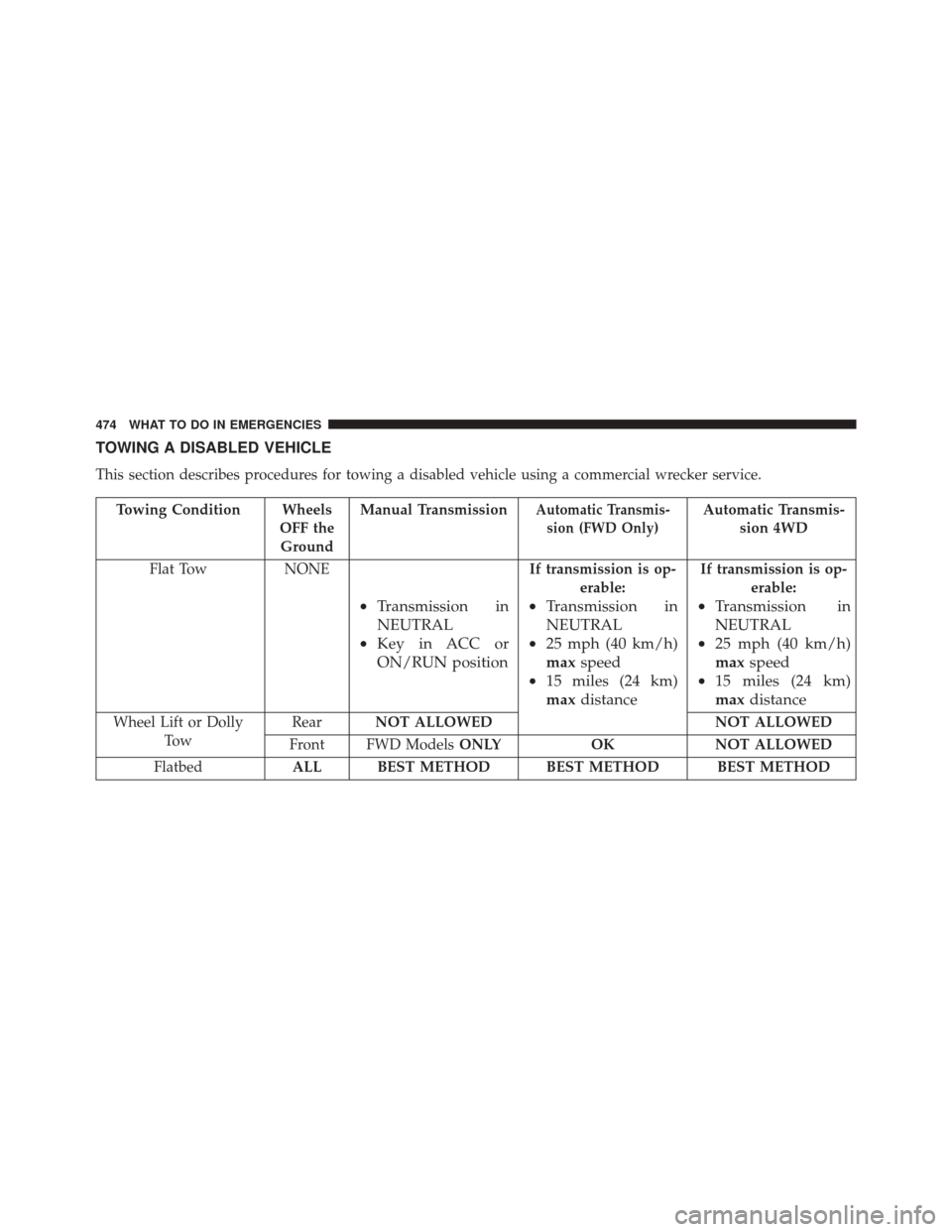
TOWING A DISABLED VEHICLE
This section describes procedures for towing a disabled vehicle using a commercial wrecker service.
Towing Condition WheelsOFF theGround Manual TransmissionAutomatic Transmis-
sion (FWD Only)Automatic Transmis- sion 4WD
Flat Tow NONE
•Transmission in
NEUTRAL
• Key in ACC or
ON/RUN position
If transmission is op-
erable:
•Transmission in
NEUTRAL
• 25 mph (40 km/h)
max speed
• 15 miles (24 km)
max distance
If transmission is op-
erable:
•Transmission in
NEUTRAL
• 25 mph (40 km/h)
max speed
• 15 miles (24 km)
max distance
Wheel Lift or Dolly
To w Rear
NOT ALLOWED NOT ALLOWED
Front FWD Models ONLYOKNOT ALLOWED
Flatbed ALL BEST METHOD BEST METHOD BEST METHOD
474 WHAT TO DO IN EMERGENCIES
Page 477 of 572

With Ignition Key
Automatic Transmission
•Front Wheel Drive (FWD) vehicles can be towed with
the front wheels elevated, or on a flatbed truck (all four
wheels OFFthe ground).
• Four-Wheel Drive (4WD) vehicles can be towed on a
flatbed truck (all four wheels OFFthe ground).
If the transmission is operable, this vehicle may be flat
towed (with all four wheels on the ground) under the
following conditions:
• The transmission must be in NEUTRAL.
• The towing speed must not exceed 25 mph (40 km/h).
• The towing distance must not exceed 15 miles (24 km). Front Wheel Drive (FWD) models may also be towed
(under the same limitations shown above) with the rear
wheels elevated.
CAUTION!
•
Towing this vehicle using any other method could
result in extensive damage to the transfer case
and/or transmission.
• Damage from improper towing is not covered un-
der the New Vehicle Limited Warranty.
If the vehicle’s battery is discharged, refer to “Shift Lever
Override” in this section for instructions on shifting the
automatic transmission out of PARK for towing.
Manual Transmission
• Front Wheel Drive (FWD) or Four-Wheel Drive (4WD)
vehicles can be flat towed (all four wheels on the
ground) with the transmission in NEUTRAL.
6
WHAT TO DO IN EMERGENCIES 475
Page 478 of 572

•FWD vehicles can be towed with the front wheels
elevated.
• FWD or 4WD vehicles can be towed on a flatbed truck
(all wheels OFFthe ground).
CAUTION!
•DO NOT flat tow any disabled vehicle if condition
is related to a clutch, transmission or driveline
component. Damage to the drivetrain could result.
• Towing this vehicle in violation of the above re-
quirements can cause severe transmission damage.
Damage from improper towing is not covered un-
der the New Vehicle Limited Warranty.
All Transmissions
If you must use the accessories (wipers, defroster, etc.)
while being towed, the key must be in the ON/RUN position, not the ACC position. Make certain the trans-
mission remains in NEUTRAL.
CAUTION!
•
DO NOT use sling-type equipment when towing.
Vehicle damage may occur.
• When securing the vehicle to a flatbed truck, do not
attach to front or rear suspension components.
Damage to your vehicle may result from improper
towing.
Without The Ignition Key
Special care must be taken when the vehicle is towed
with the ignition in the LOCK position. The only ap-
proved method of towing without the ignition key is
with a flatbed truck. Proper towing equipment is neces-
sary to prevent damage to the vehicle.
476 WHAT TO DO IN EMERGENCIES