Page 479 of 690

The “ESC Off” button is located in the lower switch bank
above the climate control panel. To enter “Full Off”
mode, press and hold the “ESC Off” button for five
seconds while the vehicle is stopped with the engine
running. After five seconds, the�ESC Off�indicator light
will illuminate and an “ESC Off” message will appear in
the odometer.
In this mode, ESC and TCS are turned off (except for the
“limited slip” feature described in the TCS section) until
the vehicle reaches a speed of 40 mph (64 km/h). At
speeds over 40 mph (64 km/h), the system automatically
switches to “Partial Off” mode, described above. When
the vehicle speed returns to less than 35 mph (56 km/h),
the ESC system will return to “Full Off” mode. The �ESC
OFF� indicator light is always illuminated when ESC is
off. To turn ESC on again, momentarily press the “ESC
Off” button. This will restore the normal “ESC On” mode
of operation.WARNING!
With the ESC switched off, the enhanced vehicle
stability offered by ESC is unavailable. In an emer-
gency evasive maneuver, the ESC system will not
engage to assist in maintaining stability. “Full Off”
mode is only intended for off-highway or off-road use.
NOTE:
• “Full Off” is the only operating mode for ESC in 4WD
LOW range. The ESC system will be in this mode
whenever the vehicle is started in 4WD LOW range or
the power transfer unit is shifted into 4WD LOW
range.
• The “ESC OFF” message will display and a chime will
sound when the shift lever is moved from any position
to the PARK position and then moved out of the PARK
position. This will occur even if the message was
cleared previously.
5
STARTING AND OPERATING 477
Page 506 of 690

TIRE CHAINS (TRACTION DEVICES)
Use of traction devices require sufficient tire-to-body
clearance. Follow these recommendations to guard
against damage.
•Traction device must be of proper size for the tire, as
recommended by the traction device manufacturer
• Use on Front Tires Only
• Due to limited clearance, the following traction de-
vices are recommended:
Front Wheel Drive (FWD) Models
• Original equipment 225/60R17 and 225/55R18 tire
sizes are not chainable.
• The use of 7mm snow chains is permitted with the use
of 215/60R17 tires on size 17 x 7.0 ET41 wheels. Four Wheel Drive (4WD) Non-Trailhawk Models with-
out a Two-Speed Power Takeoff Unit
•
Original equipment 225/65R17 and 225/60R18 tire
sizes are not chainable.
• The use of 9mm snow chains is permitted with the use
of 215/60R17 tires on size 17 x 7.0 ET41 wheels.
Four Wheel Drive (4WD) Non-Trailhawk Models with a
Two-Speed Power Takeoff Unit
• The use of 7mm snow chains is permitted with 225/
65R17 and 225/60R18 tires.
Four Wheel Drive (4WD) Trailhawk Models
• The use of 9mm snow chains is permitted with the use
of 225/65R17 tires on size 17 x 7.5 ET31 wheels.
504 STARTING AND OPERATING
Page 507 of 690

CAUTION!
•Use on Front Tires Only
• Damage to Front Wheel Drive (FWD) Models may
result if tire chains or traction devices are used with
original equipment size tires.
• Damage to Four Wheel Drive (4WD) Models with-
out a Two-Speed Power Takeoff Unit may result if
tire chains or traction devices are used with origi-
nal equipment size tires.
• Damage to Four Wheel Drive (4WD) Trailhawk
Models may result if tire chains or traction devices
are used with original equipment size tires.
WARNING!
Using tires of different size and type (M+S, Snow)
between front and rear axles can cause unpredictable
handling. You could lose control and have a collision.
CAUTION!
To avoid damage to your vehicle or tires, observe the
following precautions:
• Because of restricted traction device clearance be-
tween tires and other suspension components, it is
important that only traction devices in good condi-
tion are used. Broken devices can cause serious
damage. Stop the vehicle immediately if noise
occurs that could indicate device breakage. Remove
the damaged parts of the device before further use.
• Install device as tightly as possible and then re-
tighten after driving about ½ mile (0.8 km).
• Do not exceed 30 mph (48 km/h).
• Drive cautiously and avoid severe turns and large
bumps, especially with a loaded vehicle.
• Do not drive for a prolonged period on dry pave-
ment.
(Continued)
5
STARTING AND OPERATING 505
Page 509 of 690
The suggested Four Wheel Drive (4WD) Tire rotation
method is the “forward-cross” shown in the following
diagram.CAUTION!
Proper operation of four-wheel drive vehicles de-
pends on tires of equal size, type and circumference
on each wheel. Any difference in tire size can cause
(Continued)
Front Wheel Drive (FWD) Tire RotationFour Wheel Drive (4WD) Tire Rotation
5
STARTING AND OPERATING 507
Page 537 of 690
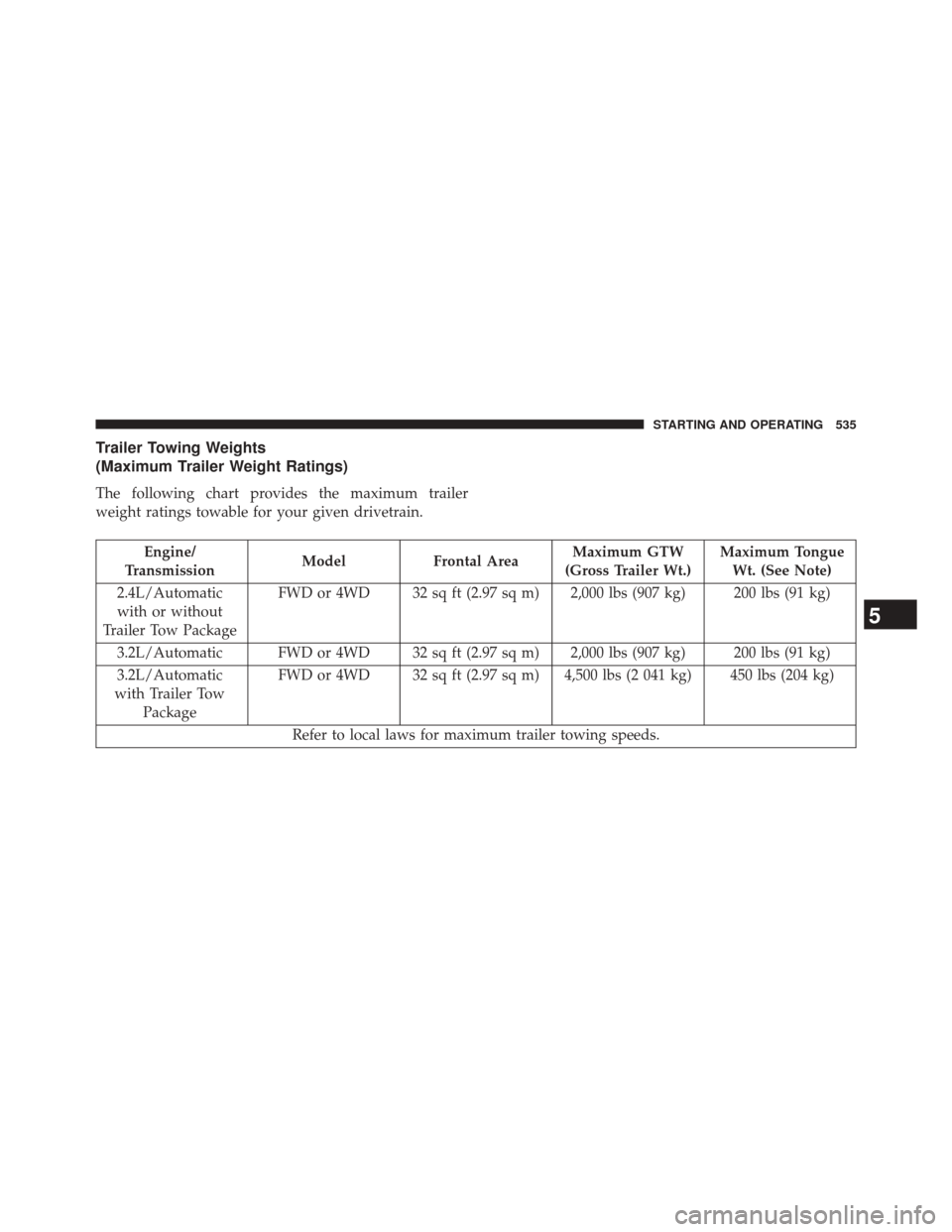
Trailer Towing Weights
(Maximum Trailer Weight Ratings)
The following chart provides the maximum trailer
weight ratings towable for your given drivetrain.
Engine/
Transmission Model
Frontal Area Maximum GTW
(Gross Trailer Wt.) Maximum Tongue
Wt. (See Note)
2.4L/Automatic with or without
Trailer Tow Package FWD or 4WD 32 sq ft (2.97 sq m) 2,000 lbs (907 kg) 200 lbs (91 kg)
3.2L/Automatic FWD or 4WD 32 sq ft (2.97 sq m) 2,000 lbs (907 kg) 200 lbs (91 kg)
3.2L/Automatic
with Trailer Tow Package FWD or 4WD 32 sq ft (2.97 sq m) 4,500 lbs (2 041 kg) 450 lbs (204 kg)
Refer to local laws for maximum trailer towing speeds.
5
STARTING AND OPERATING 535
Page 545 of 690
RECREATIONAL TOWING (BEHIND MOTORHOME, ETC.)
Towing This Vehicle Behind Another Vehicle
4WD Models
Towing
Condition Wheel OFF
the Ground Front-Wheel Drive
(FWD) Models 1-Speed Power
Transfer Unit 2-Speed Power
Transfer Unit
Flat Tow NONE NOT ALLOWED NOT ALLOWED See Instructions:
•Transmission in PARK
• Power transfer unit in
NEUTRAL (N)
• To w i n forward direction
Dolly Tow Front OKNOT ALLOWED NOT ALLOWED
Rear NOT ALLOWED NOT ALLOWED NOT ALLOWED
On Trailer ALL OKOK OK
5
STARTING AND OPERATING 543
Page 547 of 690

Recreational Towing — 4WD Models With
1-Speed Power Transfer Unit
Recreational towing is not allowed. These models do
not have a NEUTRAL (N) position in the power transfer
unit.
NOTE:This vehicle may be towed on a flatbed or vehicle
trailer provided all four wheels are OFF the ground.
CAUTION!
Towing this vehicle with ANY of its wheels on the
ground can cause severe transmission and/or power
transfer unit damage. Damage from improper towing
is not covered under the New Vehicle Limited War-
ranty.
Recreational Towing — 4WD Models With
2-Speed Power Transfer Unit
The power transfer unit must be shifted into NEUTRAL
(N) and the transmission must be in PARK for recre-
ational towing. The NEUTRAL (N) selection button is
adjacent to the power transfer unit selector switch. Shifts
into and out of NEUTRAL (N) can take place with the
selector switch in any mode position.
CAUTION!
•DO NOT dolly tow any 4WD vehicle. Internal dam-
age to the transmission or power transfer unit will
occur if a dolly is used when recreational towing.
•Tow only in a forward direction. Towing this vehicle
backwards can cause severe damage to the power
transfer unit.
(Continued)
5
STARTING AND OPERATING 545
Page 554 of 690
�SHIFT LEVER OVERRIDE ................585
� TOWING A DISABLED VEHICLE ...........585
▫ Front-Wheel Drive (FWD) Models .........587▫
Four-Wheel Drive (4WD) Models With 1–Speed
Power Transfer Unit ....................588
▫ Four-Wheel Drive (4WD) Models With 2–Speed
Power Transfer Unit ....................589
552 WHAT TO DO IN EMERGENCIES