2014 Hyundai Sonata check engine
[x] Cancel search: check enginePage 595 of 665

7-38
Maintenance
4. Replace the air cleaner filter. 5. Pull up the lever(1) to the LOCK
position.
6. Install the cover and make sure
the inner hooks(2) to be inserted
to holes(3).
7. Check if the cover is firmly
installed.
Information
If the vehicle is operated in
extremely dusty or sandy areas,
replace the element more often
than the usual recommended
intervals (refer to “Maintenance
Under Severe Usage Conditions”
in this chapter).
•Do not drive with the air cleaner
filter removed. This will result in
excessive engine wear.
•When removing the air cleaner
filter, be careful that dust or dirt
does not enter the air intake, or
damage may result.
•Use HYUNDAI genuine parts,
use of non-genuine parts could
damage the air flow sensor.
NOTICE
i
OLF074013OLF074101K
Page 615 of 665
7-58
Maintenance
FUSES
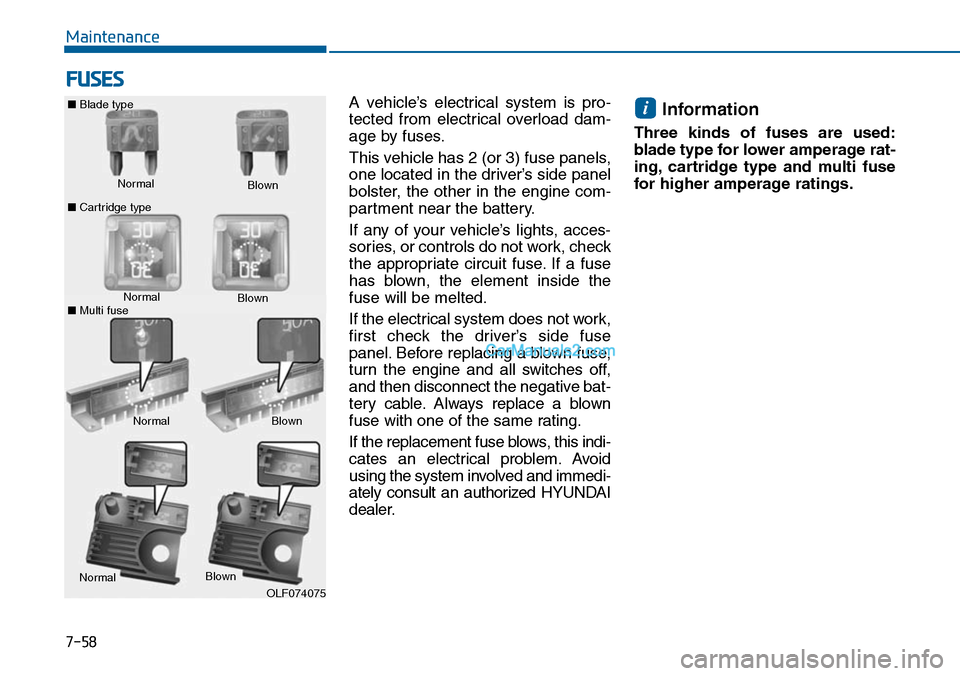
A vehicle’s electrical system is pro-
tected from electrical overload dam-
age by fuses.
This vehicle has 2 (or 3) fuse panels,
one located in the driver’s side panel
bolster, the other in the engine com-
partment near the battery.
If any of your vehicle’s lights, acces-
sories, or controls do not work, check
the appropriate circuit fuse. If a fuse
has blown, the element inside the
fuse will be melted.
If the electrical system does not work,
first check the driver’s side fuse
panel. Before replacing a blown fuse,
turn the engine and all switches off,
and then disconnect the negative bat-
tery cable. Always replace a blown
fuse with one of the same rating.
If the replacement fuse blows, this indi-
cates an electrical problem. Avoid
using the system involved and immedi-
ately consult an authorized HYUNDAI
dealer.
Information
Three kinds of fuses are used:
blade type for lower amperage rat-
ing, cartridge type and multi fuse
for higher amperage ratings.
i
Normal
■Blade type
■Cartridge type
Blown
NormalBlown
NormalBlown
OLF074075
NormalBlown■Multi fuse
Page 617 of 665
7-60
Maintenance
Inner panel fuse replacement
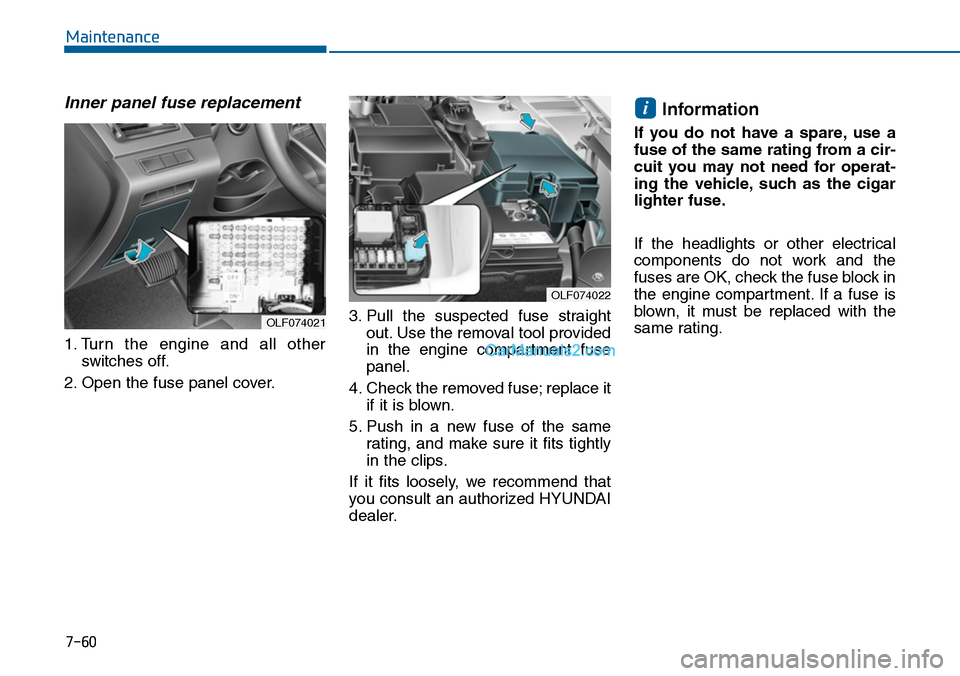
1. Turn the engine and all other
switches off.
2. Open the fuse panel cover.
3. Pull the suspected fuse straight
out. Use the removal tool provided
in the engine compartment fuse
panel.
4. Check the removed fuse; replace it
if it is blown.
5. Push in a new fuse of the same
rating, and make sure it fits tightly
in the clips.
If it fits loosely, we recommend that
you consult an authorized HYUNDAI
dealer.
Information
If you do not have a spare, use a
fuse of the same rating from a cir-
cuit you may not need for operat-
ing the vehicle, such as the cigar
lighter fuse.
If the headlights or other electrical
components do not work and the
fuses are OK, check the fuse block in
the engine compartment. If a fuse is
blown, it must be replaced with the
same rating.
i
OLF074022
OLF074021
Page 619 of 665
7-62
Maintenance
Engine compartment panel fuse
replacement
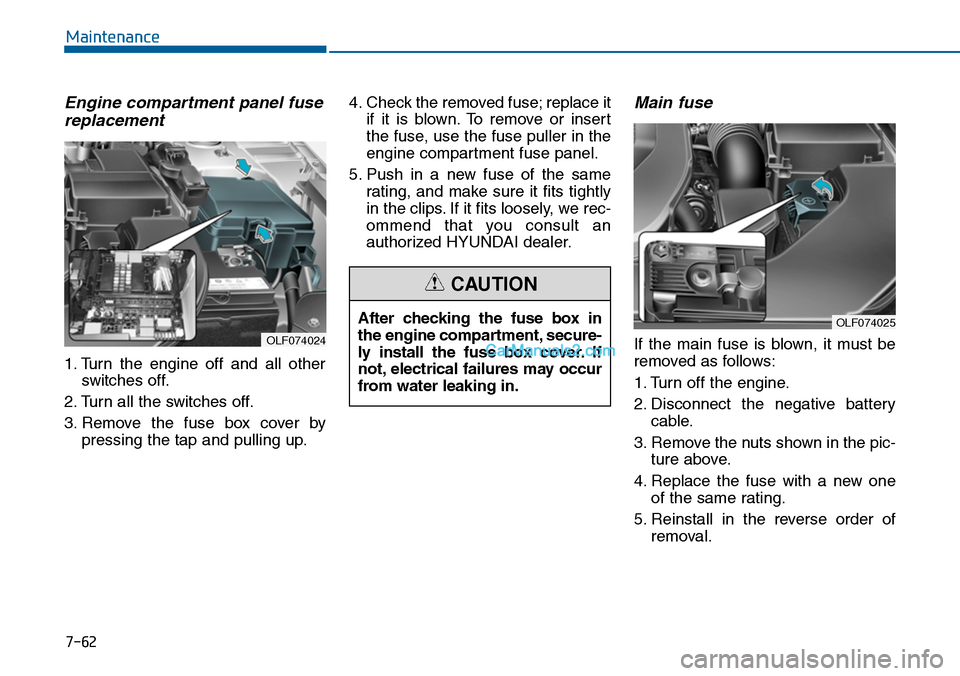
1. Turn the engine off and all other
switches off.
2. Turn all the switches off.
3. Remove the fuse box cover by
pressing the tap and pulling up.
4. Check the removed fuse; replace it
if it is blown. To remove or insert
the fuse, use the fuse puller in the
engine compartment fuse panel.
5. Push in a new fuse of the same
rating, and make sure it fits tightly
in the clips. If it fits loosely, we rec-
ommend that you consult an
authorized HYUNDAI dealer.
Main fuse
If the main fuse is blown, it must be
removed as follows:
1. Turn off the engine.
2. Disconnect the negative battery
cable.
3. Remove the nuts shown in the pic-
ture above.
4. Replace the fuse with a new one
of the same rating.
5. Reinstall in the reverse order of
removal.
OLF074025After checking the fuse box in
the engine compartment, secure-
ly install the fuse box cover. If
not, electrical failures may occur
from water leaking in.
CAUTION
OLF074024
Page 627 of 665
![Hyundai Sonata 2014 Owners Manual 7-70
Maintenance
Fuse NameSymbolFuse ratingCircuit Protected
IG230A[W/O Smart Key] RLY. 8 (Start Relay), Ignition Switch, [With Smart Key] RLY. 8 (StartRelay), PCB Block (IG2 Relay)
BLOWER40ARLY. 3 (B](/manual-img/35/16805/w960_16805-626.png "Hyundai Sonata 2014 Owners Manual 7-70
Maintenance
Fuse NameSymbolFuse ratingCircuit Protected
IG230A[W/O Smart Key] RLY. 8 (Start Relay), Ignition Switch, [With Smart Key] RLY. 8 (StartRelay), PCB Block (IG2 Relay)
BLOWER40ARLY. 3 (B")
7-70
Maintenance
Fuse NameSymbolFuse ratingCircuit Protected
IG230A[W/O Smart Key] RLY. 8 (Start Relay), Ignition Switch, [With Smart Key] RLY. 8 (StartRelay), PCB Block (IG2 Relay)
BLOWER40ARLY. 3 (Blower Relay)
ABS 140AABS Control Module, ESP Control Module
REARHEATED50ARLY. 1 (Rear Heated Relay)
B+ 350ASmart Junction Block (IPS2 (4CH), IPS3 (4CH), Fuse - F28/F29)
COOLING FAN 150A[W/O G4KE / Middle East] RLY.11 (Cooling Fan Relay), RLY.12 (Cooling Fan Relay)
COOLING FAN 260A[With G4KE / Middle East] RLY.11 (Cooling Fan Relay), RLY.12 (Cooling Fan Relay)
MDPS 180AMDPS Unit
ABS 230AABS Control Module, ESP Control Module, Multipurpose Check Connector
IG140A[W/O Smart Key] Ignition Switch, [With Smart Key] PCB Block (IG1/ACC Relay)
POWEROUTLET 340ARLY. 5 (Power Outlet Relay)
B+ 250ASmart Junction Block (IPS1 (4CH), IPS4 (4CH), IPS5 (4CH), Fuse - F36/F42)
B+ 560APCB Block (Engine Control Relay, Fuse - F4/F5/F6/F13/F14/F22)
Engine compartment main fuse panel
Page 629 of 665
7-72
Maintenance
LIGHT BULBS
Use only the bulbs of the specified
wattage.
After heavy driving, rain or wash-
ing, headlamp and tail lamp lens-
es could appear frosty. This condi-
tion is caused by the temperature
difference between the lamp
inside and outside. This is similar
to the condensation on your win-
dows inside your vehicle during
the rain and doesn’t indicate a
problem with your vehicle. If the
water leaks into the lamp bulb cir-
cuitry, we recommend that the
system be checked by an author-
ized HYUNDAI dealer.
❈Traffic Change (For Europe)
The low beam light distribution is
asymmetric. If you go abroad to a
country with opposite traffic direc-
tion, this asymmetric part will dazzle
oncoming car driver. To prevent daz-
zle, ECE regulation demand several
technical solutions (ex. automatic
change system, adhesive sheet,
down aiming). These headlamps are
designed not to dazzle opposite driv-
ers. So, you need not change your
headlamps in a country with oppo-
site traffic direction.
NOTICE
Be sure to replace the burned-
out bulb with one of the same
wattage rating. Otherwise, it
may cause damage to the fuse
or electric wiring system.
CAUTION
If you don’t have necessary
tools, the correct bulbs and the
expertise, consult an authorized
HYUNDAI dealer. In many cases,
it is difficult to replace vehicle
light bulbs because other parts
of the vehicle must be removed
before you can get to the bulb.
This is especially true if you
have to remove the headlamp
assembly to get to the bulb(s).
Removing/installing the head-
lamp assembly can result in
damage to the vehicle.
CAUTION
Working on the lights
Prior to working on the light, firm-
ly apply the parking brake,
ensure that the Engine Start/Stop
button is turned to the OFF posi-
tion and turn off the lights to
avoid sudden movement of the
vehicle and burning your fingers
or receiving an electric shock.
WARNING
Page 653 of 665
7-96
Maintenance
Canister
Fuel vapors generated inside the fuel
tank are absorbed and stored in the
onboard canister. When the engine is
running, the fuel vapors absorbed in
the canister are drawn into the surge
tank through the purge control sole-
noid valve.
Purge Control Solenoid Valve
(PCSV)
The purge control solenoid valve is
controlled by the Engine Control
Module (ECM); when the engine
coolant temperature is low during
idling, the PCSV closes so that evap-
orated fuel is not taken into the
engine. After the engine warms-up
during ordinary driving, the PCSV
opens to introduce evaporated fuel to
the engine.
3. Exhaust emission control
system
The Exhaust Emission Control
System is a highly effective system
which controls exhaust emissions
while maintaining good vehicle per-
formance.
Vehicle modifications
This vehicle should not be modified.
Modification of your vehicle could
affect its performance, safety or
durability and may even violate gov-
ernmental safety and emissions reg-
ulations.
In addition, damage or performance
problems resulting from any modifi-
cation may not be covered under
warranty.
•If you use unauthorized electronic
devices, it may cause the vehicle to
operate abnormally, wire damage,
battery discharge and fire. For your
safety, do not use unauthorized
electronic devices.
Engine exhaust gas precautions
(carbon monoxide)
•Carbon monoxide can be present
with other exhaust fumes.
Therefore, if you smell exhaust
fumes of any kind inside your vehi-
cle, have it inspected and repaired
immediately. If you ever suspect
exhaust fumes are coming into
your vehicle, drive it only with all
the windows fully open. Have your
vehicle checked and repaired
immediately.
Page 663 of 665
8-8
Specifications & Consumer information
Recommended SAE viscosity
number
Engine oil viscosity (thickness) has
an effect on fuel economy and cold
weather operating (engine start and
engine oil flowability). Lower viscosi-
ty engine oils can provide better fuel
economy and cold weather perform-
ance, however, higher viscosity
engine oils are required for satisfac-
tory lubrication in hot weather. Using
oils of any viscosity other than those
recommended could result in engine
damage.
Always be sure to clean the area
around any filler plug, drain
plug, or dipstick before check-
ing or draining any lubricant.
This is especially important in
dusty or sandy areas and when
the vehicle is used on unpaved
roads. Cleaning the plug and
dipstick areas will prevent dirt
and grit from entering the
engine and other mechanisms
that could be damaged.
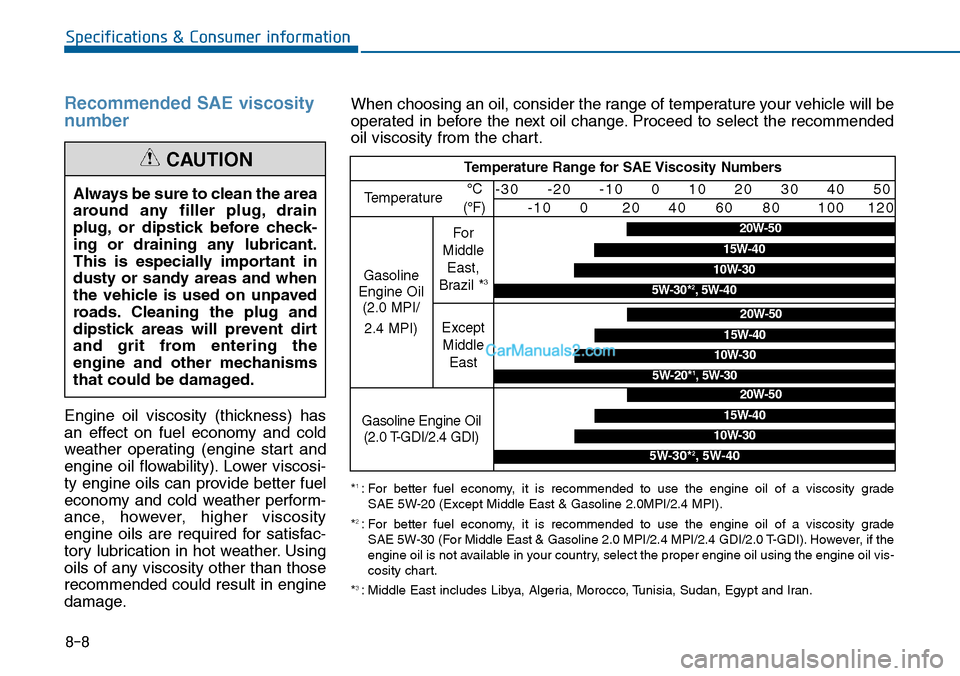
CAUTIONTemperature Range for SAE Viscosity Numbers
Temperature
Gasoline Engine Oil(2.0 MPI/
2.4 MPI)
°C
(°F)
-30 -20 -10 0 10 20 30 40 50
-10 0 20 40 60 80 100 120
*1 :For better fuel economy, it is recommended to use the engine oil of a viscosity grade SAE 5W-20 (Except Middle East & Gasoline 2.0MPI/2.4 MPI).
*2 :For better fuel economy, it is recommended to use the engine oil of a viscosity grade SAE 5W-30 (For Middle East & Gasoline 2.0 MPI/2.4 MPI/2.4 GDI/2.0 T-GDI). However, if theengine oil is not available in your country, select the proper engine oil using the engine oil vis-cosity chart.
*3:Middle East includes Libya, Algeria, Morocco, Tunisia, Sudan, Egypt and Iran.
20W-50
10W-30
15W-40
5W-30*2,5W-40
Gasoline Engine Oil(2.0 T-GDI/2.4 GDI)
For
Middle
East,
Brazil *3
20W-50
10W-30
15W-40
5W-20*1,5W-30
Except
Middle
East
20W-50
10W-30
15W-40
5W-30*2,5W-40
When choosing an oil, consider the range of temperature your vehicle will be
operated in before the next oil change. Proceed to select the recommended
oil viscosity from the chart.