Page 532 of 665
5-83
Driving your vehicle
5
6. Reapply the brakes and parking
brakes.
7. Move the shift lever to P (Park, for
automatic transaxle vehicle) or 1st
gear when the vehicle is parked
on a uphill grade and in R
(Reverse) on a downhill (for man-
ual transaxle vehicle).
8. Shut off the vehicle and release
the vehicle brakes but leave the
parking brake set.
Ready to leave after parking on
a hill
1. With the shift lever to P (Park, for
automatic transaxle vehicle) or
neutral (for manual transaxle vehi-
cle), apply your brakes and hold
the brake pedal down while you:
• Start your engine;
• Shift into gear; and
• Release the parking brake.
2. Slowly remove your foot from the
brake pedal.
3. Drive slowly until the trailer is clear
of the chocks.
4. Stop and have someone pick up
and store the chocks.
Maintenance when towing a
trailer
Yo u r v e h i c l e w i l l n e e d s e r v i c e m o r e
often when you regularly pull a trail-
er. Important items to pay particular
attention to include engine oil, auto-
matic transaxle fluid, axle lubricant
and cooling system fluid. Brake con-
dition is another important item to
frequently check. If you’re trailering,
it’s a good idea to review these items
before you start your trip. Don’t forget
to also maintain your trailer and
hitch. Follow the maintenance sched-
ule that accompanied your trailer and
check it periodically. Preferably, con-
duct the check at the start of each
day’s driving. Most importantly, all
hitch nuts and bolts should be tight.
To p r e v e n t s e r i o u s o r f a t a l
injury:
Do not get out of the vehicle
without the parking brake firmly
set. If you have left the engine
running, the vehicle can move
suddenly. You and others could
be seriously or fatally injured.
WARNING
Page 537 of 665
6-3
What to do in an emergency
If the engine stalls at a cross-
road or crossing
If the engine stalls at a crossroad or
crossing, if safe to do so, move the
shift lever to the N (Neutral) position
and then push the vehicle to a safe
location.
If you have a flat tire while
driving
If a tire goes flat while you are driv-
ing:
•Take your foot off the accelerator
pedal and let the vehicle slow
down while driving straight ahead.
Do not apply the brakes immedi-
ately or attempt to pull off the road
as this may cause loss of vehicle
control resulting in an accident.
When the vehicle has slowed to
such a speed that it is safe to do
so, brake carefully and pull off the
road. Drive off the road as far as
possible and park on firm, level
ground. If you are on a divided
highway, do not park in the median
area between the two traffic lanes.
•When the vehicle is stopped, press
the hazard warning flasher button,
move the shift lever into P (Park,
for automatic transaxle vehicle) or
neutral (for manual transaxle vehi-
cle), apply the parking brake, and
place the ignition switch in the
LOCK/OFF position.
•Have all passengers get out of the
vehicle. Be sure they all get out on
the side of the vehicle that is away
from traffic.
•When changing a flat tire, follow
the instructions provided later in
this chapter.
6
Page 540 of 665
6-6
What to do in an emergency
To prevent damage to your vehi-
cle:
•Only use a 12-volt power supply
(battery or jumper system) to
jump start your vehicle.
•Do not attempt to jump start
your vehicle by push-starting.
Information
An inappropriately disposed
battery can be harmful to the
environment and human
health. Dispose the battery
according to your local law(s)
or regulations.
Jump starting procedure
1. Position the vehicles close enough
that the jumper cables will reach,
but do not allow the vehicles to
touch.
2. Avoid fans or any moving parts in
the engine compartment at all
times, even when the vehicles are
turned off.
3. Turn off all electrical devices such
as radios, lights, air conditioning,
etc. Put the vehicles in P (Park, for
automatic transaxle vehicle) or
neutral (for manual transaxle vehi-
cle), and set the parking brakes.
Turn both vehicles OFF.
iNOTICE
Pb
Page 555 of 665
6-21
What to do in an emergency
6
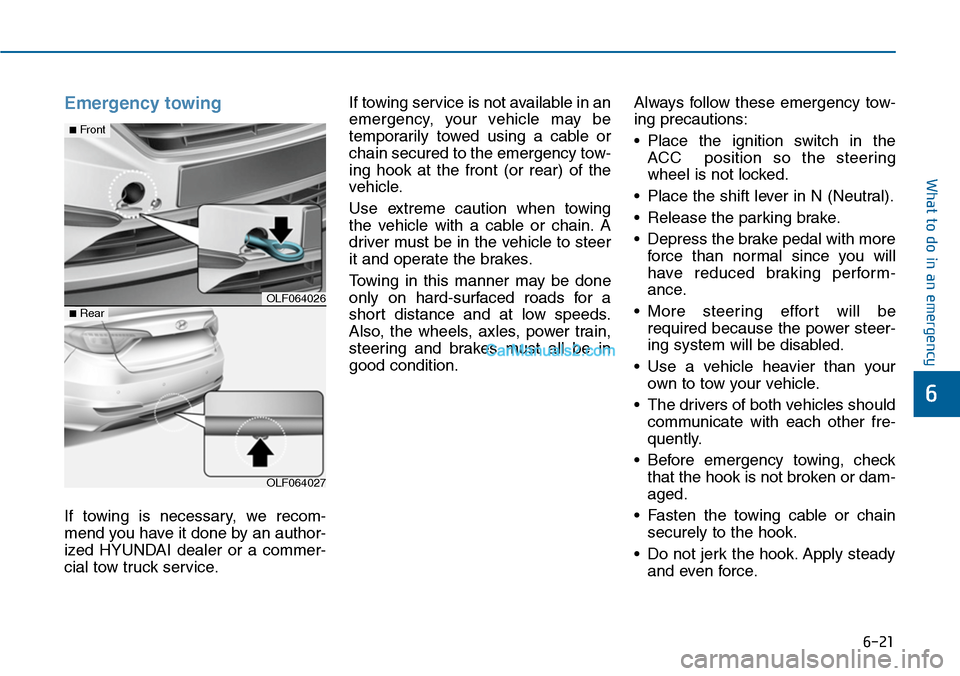
Emergency towing
If towing is necessary, we recom-
mend you have it done by an author-
ized HYUNDAI dealer or a commer-
cial tow truck service.
If towing service is not available in an
emergency, your vehicle may be
temporarily towed using a cable or
chain secured to the emergency tow-
ing hook at the front (or rear) of the
vehicle.
Use extreme caution when towing
the vehicle with a cable or chain. A
driver must be in the vehicle to steer
it and operate the brakes.
Towing in this manner may be done
only on hard-surfaced roads for a
short distance and at low speeds.
Also, the wheels, axles, power train,
steering and brakes must all be in
good condition.
Always follow these emergency tow-
ing precautions:
•Place the ignition switch in the
ACC position so the steering
wheel is not locked.
•Place the shift lever in N (Neutral).
•Release the parking brake.
•Depress the brake pedal with more
force than normal since you will
have reduced braking perform-
ance.
•More steering effort will be
required because the power steer-
ing system will be disabled.
•Use a vehicle heavier than your
own to tow your vehicle.
•The drivers of both vehicles should
communicate with each other fre-
quently.
•Before emergency towing, check
that the hook is not broken or dam-
aged.
•Fasten the towing cable or chain
securely to the hook.
•Do not jerk the hook.Apply steady
and even force.
OLF064026
OLF064027
■Front
■Rear
Page 567 of 665

7-10
Maintenance
SCHEDULED MAINTENANCE SERVICES
Follow Nor mal Maintenance Schedule if the vehicle is usually operated where none of the following conditions apply.
If any of the following conditions apply, you must follow the Maintenance Under Severe Usage Conditions.
•Repeated short distance driving.
•Driving in dusty conditions or sandy areas.
•Extensive use of brakes.
•Driving in areas where salt or other corrosive materials are used.
•Driving on rough or muddy roads.
•Driving in mountainous areas.
•Extended periods of idling or low speed operation.
•Driving for a prolonged period in cold temperatures and/or extremely humid climates.
•More than 50% driving in heavy city traffic during hot weather above 32°C (90°F).
If your vehicle is operated under the above conditions, you should inspect, replace or refill more frequently than the
following Normal Maintenance Schedule. After the periods or distance shown in the chart, continue to follow the pre-
scribed maintenanec intervals.
Page 570 of 665
7-13
7
Maintenance
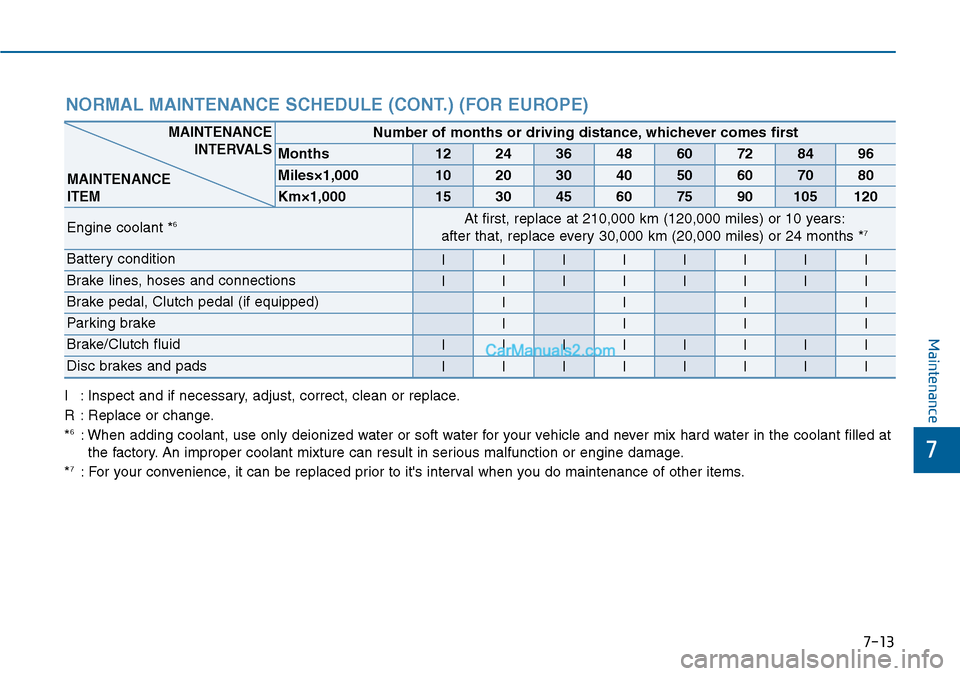
NORMAL MAINTENANCE SCHEDULE (CONT.) (FOR EUROPE)
I:Inspect and if necessary, adjust, correct, clean or replace.
R:Replace or change.
*6:When adding coolant, use only deionized water or soft water for your vehicle and never mix hard water in the coolant filled at
the factory. An improper coolant mixture can result in serious malfunction or engine damage.
*7:For your convenience, it can be replaced prior to it's interval when you do maintenance of other items.
Number of months or driving distance, whichever comes first
Months1224364860728496
Miles×1,0001020304050607080
Km×1,000153045607590105120
Engine coolant *6At first, replace at 210,000 km (120,000 miles) or 10 years:
after that, replace every 30,000 km (20,000 miles) or 24 months *7
Battery conditionIIIIIIII
Brake lines, hoses and connectionsIIIIIIII
Brake pedal, Clutch pedal (if equipped)IIII
Par king brakeIIII
Brake/Clutch fluidIIIIIIII
Disc brakes and padsIIIIIIII
MAINTENANCE
INTERVALS
MAINTENANCE
ITEM
Page 572 of 665

7-15
7
Maintenance
MAINTENANCE UNDER SEVERE USAGE AND LOW MILEAGE CONDITIONS (FOR EUROPE)
The following items must be serviced more frequently on cars mainly used under severe and low mileage driving con-
ditions.
Refer to the chart below for the appropriate maintenance intervals.
R : Replace I : Inspect and if necessary, adjust, correct, clean or replace
Maintenance itemMaintenance
operationMaintenance intervalsDriving condition
Engine oil and
engine oil filter
Nu 2.0 MPI
REvery 7,500 km (9,300 miles) or 6 monthsA, B, C, D, E,
F, G , H , I , J , K
Theta 2.4 MPI
Theta 2.4 GDI
Theta 2.0 T-GDIREvery 5,000 km (3,000 miles) or 3 months
Air cleaner filterRReplace more frequently
depending on the conditionC, E
Spark plugs RReplace more frequently
depending on the conditionA, B, H, I
Steering gear rack, linkage and bootsIInspect more frequently
depending on the conditionC, D, E, F, G
Front suspension ball jointsIInspect more frequently
depending on the conditionC, D, E, F, G
Disc brakes and pads, calipers and rotorsIInspect more frequently
depending on the conditionC, D, E, G, H
Par king brakeIInspect more frequently
depending on the conditionC, D, G, H
Page 576 of 665
7-19
7
Maintenance
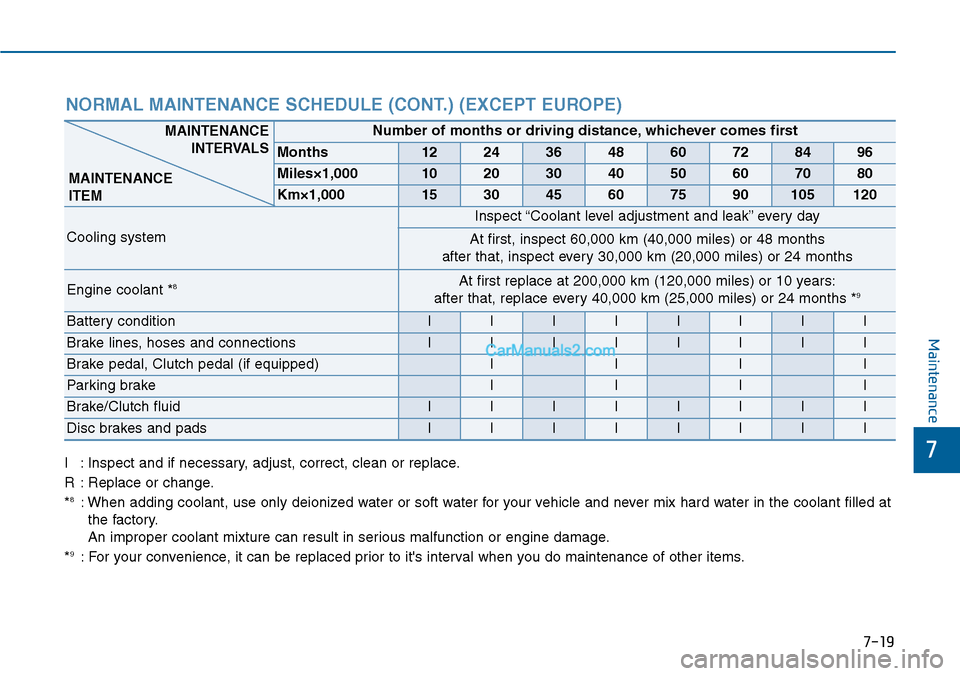
NORMAL MAINTENANCE SCHEDULE (CONT.) (EXCEPT EUROPE)
I:Inspect and if necessary, adjust, correct, clean or replace.
R:Replace or change.
*8:When adding coolant, use only deionized water or soft water for your vehicle and never mix hard water in the coolant filled at
the factory.
An improper coolant mixture can result in serious malfunction or engine damage.
*9:For your convenience, it can be replaced prior to it's interval when you do maintenance of other items.
Number of months or driving distance, whichever comes first
Months1224364860728496
Miles×1,0001020304050607080
Km×1,000153045607590105120
Cooling system
Inspect “Coolant level adjustment and leak” every day
At first, inspect 60,000 km (40,000 miles) or 48 months
after that, inspect every 30,000 km (20,000 miles) or 24 months
Engine coolant *8At first replace at 200,000 km (120,000 miles) or 10 years:
after that, replace every 40,000 km (25,000 miles) or 24 months *9
Battery conditionIIIIIIII
Brake lines, hoses and connectionsIIIIIIII
Brake pedal, Clutch pedal (if equipped)IIII
Par king brakeIIII
Brake/Clutch fluidIIIIIIII
Disc brakes and padsIIIIIIII
MAINTENANCE
INTERVALS
MAINTENANCE
ITEM