2014 Hyundai Santa Fe lock
[x] Cancel search: lockPage 57 of 711
Safety features of your vehicle
32 3
Pre-tensioner seat belt
(if equipped)
Your vehicle is equipped with driver's
and front passenger's pre-tensioner
seat belts (retractor pretensioner and
EFD (Emergency Fastening Device)).
The pre-tensioner seat belts can be
activated, where the frontal collision
is severe enough, together with the
air bags.
When the vehicle stops suddenly, or
if the occupant tries to lean forward
too quickly, the seat belt retractor will
lock into position. In certain frontal
collisions, the pre-tensioner will acti-
vate and pull the seat belt into tighter
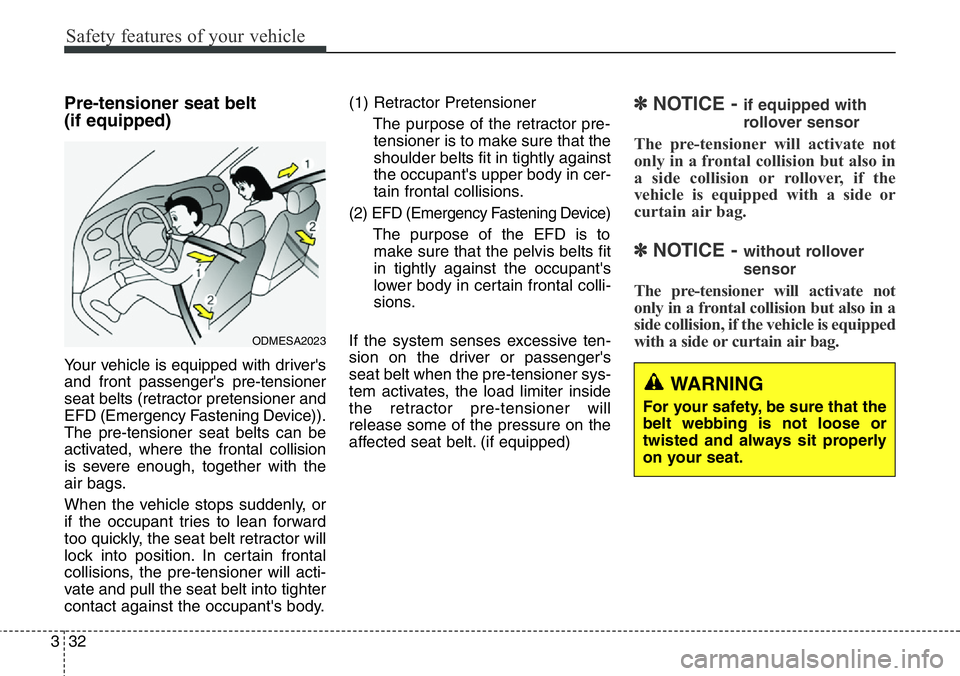
contact against the occupant's body.(1) Retractor Pretensioner
The purpose of the retractor pre-
tensioner is to make sure that the
shoulder belts fit in tightly against
the occupant's upper body in cer-
tain frontal collisions.
(2) EFD (Emergency Fastening Device)
The purpose of the EFD is to
make sure that the pelvis belts fit
in tightly against the occupant's
lower body in certain frontal colli-
sions.
If the system senses excessive ten-
sion on the driver or passenger's
seat belt when the pre-tensioner sys-
tem activates, the load limiter inside
the retractor pre-tensioner will
release some of the pressure on the
affected seat belt. (if equipped)
✽NOTICE - if equipped with
rollover sensor
The pre-tensioner will activate not
only in a frontal collision but also in
a side collision or rollover, if the
vehicle is equipped with a side or
curtain air bag.
✽NOTICE - without rollover
sensor
The pre-tensioner will activate not
only in a frontal collision but also in a
side collision, if the vehicle is equipped
with a side or curtain air bag.
ODMESA2023
WARNING
For your safety, be sure that the
belt webbing is not loose or
twisted and always sit properly
on your seat.
Page 65 of 711
Safety features of your vehicle
40 3
WARNING
To reduce a risk of serious or
fatal injuries:
• Children of all ages are safer
when restrained in the rear
seat. A child riding in the
front passenger seat can be
forcefully struck by an inflat-
ing air bag resulting in seri-
ous or fatal injuries.
• Always follow the instructions
for installation and use of the
child restraint maker.
• Always make sure the child
seat is secured properly in the
car and your child is securely
restrained in the child seat.
• Never hold a child in your
arms or lap when riding in a
vehicle. The violent forces cre-
ated during a crash will tear
the child from your arms and
throw the child against the
car’s interior.
(Continued)
(Continued)
• Never put a seat belt over
yourself and a child. During a
crash, the belt could press
deep into the child causing
serious internal injuries.
• Never leave children unat-
tended in a vehicle – not even
for a short time. The car can
heat up very quickly, resulting
in serious injuries to children
inside. Even very young chil-
dren may inadvertently cause
the vehicle to move, entangle
themselves in the windows, or
lock themselves or others
inside the vehicle.
• Never allow two children, or
any two persons, to use the
same seat belt.
• Children often squirm and
reposition themselves improp-
erly. Never let a child ride with
the shoulder belt under their
arm or behind their back.
Always properly position and
secure children in the rear
seat.
(Continued)(Continued)
• Never allow a child to stand-
up or kneel on the seat or
floorboard of a moving vehi-
cle. During a collision or sud-
den stop, the child can be vio-
lently thrown against the vehi-
cles interior, resulting in seri-
ous injury.
• Never use an infant carrier or
a child safety seat that
"hooks" over a seatback, it
may not provide adequate
security in an accident.
• Seat belts can become very
hot, especially when the car is
parked in direct sunlight.
Always check seat belt buck-
les before fastening them
over a child.
• After an accident, we recom-
mend that the system be
checked by an authorized
HYUNDAI dealer.
(Continued)
Page 68 of 711
343
Safety features of your vehicle
3. Buckle the seat belt and allow the
seat belt to take up any slack. After
installation of the child restraint
system, try to move it in all direc-
tions to be sure the child restraint
system is securely installed.
If you need to tighten the belt, pull
more webbing toward the retractor.
When you unbuckle the seat belt and
allow it to retract, the retractor will
automatically revert back to its nor-
mal seated passenger emergency
locking usage condition.
OEN036104
Child Seat Restraint Suitability For Seat Position using the Seat Belt
- For Europe
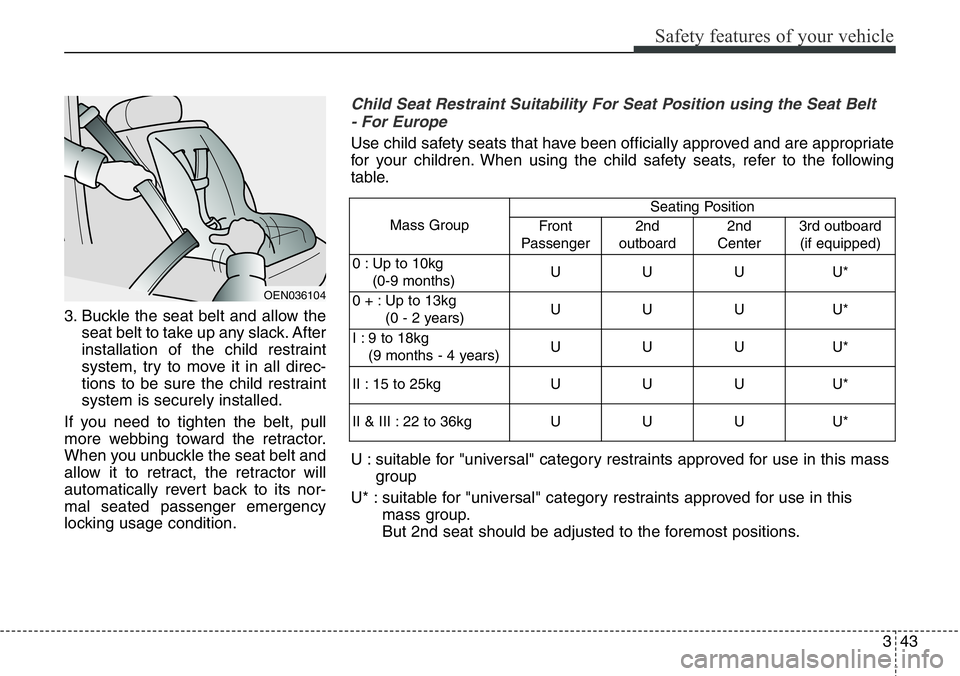
Use child safety seats that have been officially approved and are appropriate
for your children. When using the child safety seats, refer to the following
table.
U : suitable for "universal" category restraints approved for use in this mass
group
U* : suitable for "universal" category restraints approved for use in this
mass group.
But 2nd seat should be adjusted to the foremost positions.
Mass GroupSeating Position
Front
Passenger2nd
outboard2nd
Center3rd outboard
(if equipped)
0 : Up to 10kg
(0-9 months)UUU U*
0 + : Up to 13kg
(0 - 2 years)UUU U*
I : 9 to 18kg
(9 months - 4 years)UUU U*
II : 15 to 25kg U U U U*
II & III : 22 to 36kg U U U U*
Page 78 of 711
353
Safety features of your vehicle
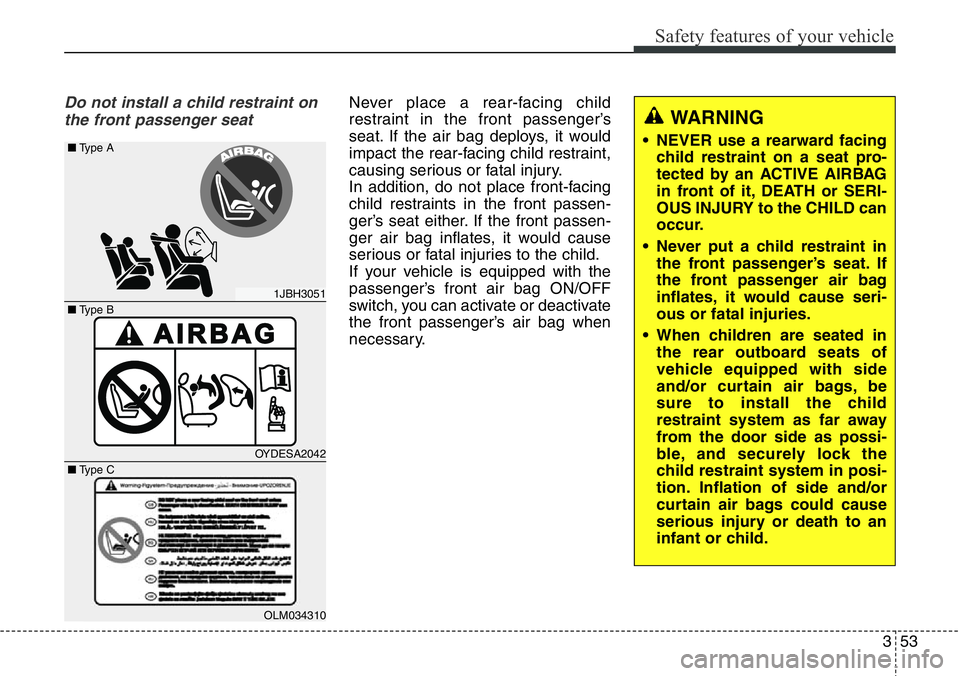
Do not install a child restraint on
the front passenger seatNever place a rear-facing child
restraint in the front passenger’s
seat. If the air bag deploys, it would
impact the rear-facing child restraint,
causing serious or fatal injury.
In addition, do not place front-facing
child restraints in the front passen-
ger’s seat either. If the front passen-
ger air bag inflates, it would cause
serious or fatal injuries to the child.
If your vehicle is equipped with the
passenger’s front air bag ON/OFF
switch, you can activate or deactivate
the front passenger’s air bag when
necessary.
WARNING
• NEVER use a rearward facing
child restraint on a seat pro-
tected by an ACTIVE AIRBAG
in front of it, DEATH or SERI-
OUS INJURY to the CHILD can
occur.
• Never put a child restraint in
the front passenger’s seat. If
the front passenger air bag
inflates, it would cause seri-
ous or fatal injuries.
• When children are seated in
the rear outboard seats of
vehicle equipped with side
and/or curtain air bags, be
sure to install the child
restraint system as far away
from the door side as possi-
ble, and securely lock the
child restraint system in posi-
tion. Inflation of side and/or
curtain air bags could cause
serious injury or death to an
infant or child.
1JBH3051
OYDESA2042
OLM034310
■Type B ■Type A
■Type C
Page 83 of 711
Safety features of your vehicle
58 3
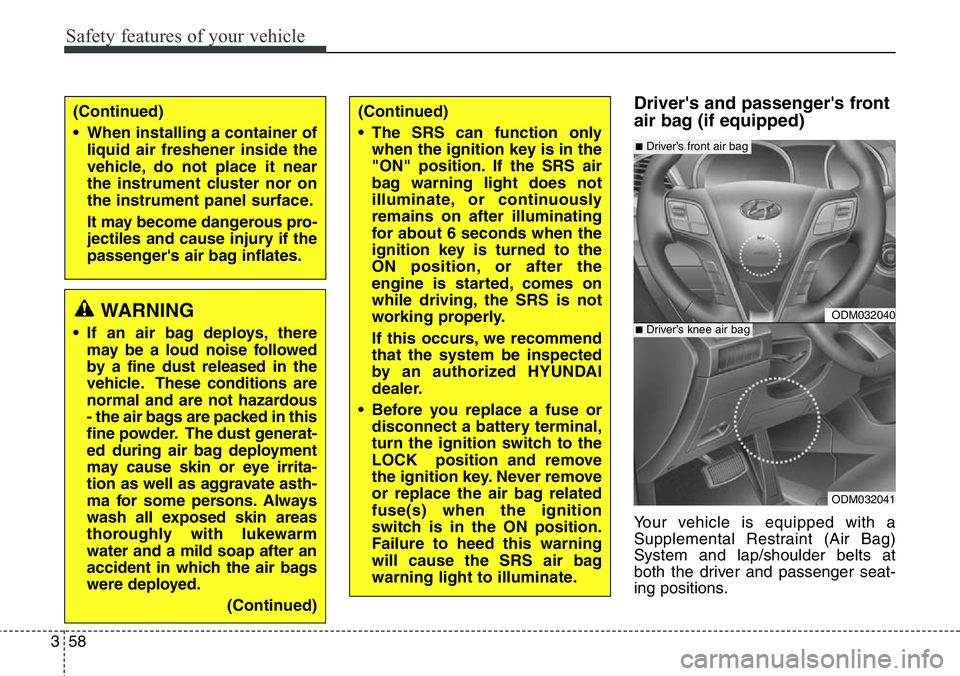
Driver's and passenger's front
air bag (if equipped)
Your vehicle is equipped with a
Supplemental Restraint (Air Bag)
System and lap/shoulder belts at
both the driver and passenger seat-
ing positions.
(Continued)
• The SRS can function only
when the ignition key is in the
"ON" position. If the SRS air
bag warning light does not
illuminate, or continuously
remains on after illuminating
for about 6 seconds when the
ignition key is turned to the
ON position, or after the
engine is started, comes on
while driving, the SRS is not
working properly.
If this occurs, we recommend
that the system be inspected
by an authorized HYUNDAI
dealer.
• Before you replace a fuse or
disconnect a battery terminal,
turn the ignition switch to the
LOCK position and remove
the ignition key. Never remove
or replace the air bag related
fuse(s) when the ignition
switch is in the ON position.
Failure to heed this warning
will cause the SRS air bag
warning light to illuminate.
ODM032040
ODM032041
■Driver’s front air bag
■Driver’s knee air bag
(Continued)
• When installing a container of
liquid air freshener inside the
vehicle, do not place it near
the instrument cluster nor on
the instrument panel surface.
It may become dangerous pro-
jectiles and cause injury if the
passenger's air bag inflates.
WARNING
• If an air bag deploys, there
may be a loud noise followed
by a fine dust released in the
vehicle. These conditions are
normal and are not hazardous
- the air bags are packed in this
fine powder. The dust generat-
ed during air bag deployment
may cause skin or eye irrita-
tion as well as aggravate asth-
ma for some persons. Always
wash all exposed skin areas
thoroughly with lukewarm
water and a mild soap after an
accident in which the air bags
were deployed.
(Continued)
Page 91 of 711
Safety features of your vehicle
66 3
They are designed to help protect
the heads of the front seat occupants
and the rear outboard seat occupants
in certain side impact collisions.
The curtain air bags are designed to
deploy during certain side impact col-
lisions, depending on the crash sever-
ity, angle, speed and point of impact.
The curtain air bags do not only
deploy on the side of the impact but
also on the opposite side.
✽NOTICE - if equipped with
rollover sensor
Also, both sides of the side impact
air bags and curtain air bags deploy
in certain rollover situations.
• The curtain air bags are not
designed to deploy in all side
impacts.
(Continued)
• Do not allow the passengers
to lean their heads or bodies
onto doors, put their arms on
the doors, stretch their arms
out of the window, or place
objects between the doors
and passengers when they are
seated on seats equipped with
side and/or curtain air bags.
• Never try to open or repair any
components of the side cur-
tain air bag system. We rec-
ommend that the system be
serviced by an authorized
HYUNDAI dealer.
Failure to follow the above men-
tioned instructions can result in
injury or death to the vehicle
occupants in an accident.WARNING
• In order for side impact and
curtain air bags to provide the
best protection, both front
seat occupants and both out-
board rear occupants should
sit in an upright position with
the seat belts properly fas-
tened.
Importantly, children should
sit in a proper child restraint
system in the rear seat.
• When children are seated in
the rear outboard seats, they
must be seated in the proper
child restraint system.
Make sure to put the child
restraint system as far away
from the door side as possible,
and secure the child restraint
system in a locked position.
(Continued)
Page 102 of 711
Features of your vehicle
Keys . . . . . . . . . . . . . . . . . . . . . . . . . . . . . . . . . . . . . . 4-5
• Record your key number . . . . . . . . . . . . . . . . . . . . . . . 4-5
• Key operations . . . . . . . . . . . . . . . . . . . . . . . . . . . . . . . . 4-5
• Immobilizer system . . . . . . . . . . . . . . . . . . . . . . . . . . . . 4-6
Remote keyless entry . . . . . . . . . . . . . . . . . . . . . . . . 4-8
• System operation . . . . . . . . . . . . . . . . . . . . . . . . . . . . . . 4-8
• Transmitter precautions . . . . . . . . . . . . . . . . . . . . . . . 4-10
• Battery replacement . . . . . . . . . . . . . . . . . . . . . . . . . . 4-11
Smart key . . . . . . . . . . . . . . . . . . . . . . . . . . . . . . . . 4-13
• Smart key function . . . . . . . . . . . . . . . . . . . . . . . . . . . 4-13
• Smart key precautions . . . . . . . . . . . . . . . . . . . . . . . . 4-14
• Door lock/unlock in an emergency situation . . . . . . 4-15
Theft-alarm system . . . . . . . . . . . . . . . . . . . . . . . . 4-16
• Armed stage . . . . . . . . . . . . . . . . . . . . . . . . . . . . . . . . . 4-16
• Theft-alarm stage . . . . . . . . . . . . . . . . . . . . . . . . . . . . 4-18
• Disarmed stage. . . . . . . . . . . . . . . . . . . . . . . . . . . . . . . 4-18
Door locks . . . . . . . . . . . . . . . . . . . . . . . . . . . . . . . . 4-19
• From outside . . . . . . . . . . . . . . . . . . . . . . . . . . . . . . . . 4-19
• From inside . . . . . . . . . . . . . . . . . . . . . . . . . . . . . . . . . 4-20
• Deadlocks . . . . . . . . . . . . . . . . . . . . . . . . . . . . . . . . . . . 4-22
• Door lock/unlock features. . . . . . . . . . . . . . . . . . . . . . 4-22
• Child-protector rear door lock . . . . . . . . . . . . . . . . . 4-23
Tailgate . . . . . . . . . . . . . . . . . . . . . . . . . . . . . . . . . . 4-24
• Opening the tailgate . . . . . . . . . . . . . . . . . . . . . . . . . . 4-24
• Closing the tailgate . . . . . . . . . . . . . . . . . . . . . . . . . . . 4-24• Emergency tailgate safety release . . . . . . . . . . . . . . . 4-25
Windows . . . . . . . . . . . . . . . . . . . . . . . . . . . . . . . . . 4-27
• Power windows . . . . . . . . . . . . . . . . . . . . . . . . . . . . . . 4-28
Hood. . . . . . . . . . . . . . . . . . . . . . . . . . . . . . . . . . . . . 4-32
• Opening the hood . . . . . . . . . . . . . . . . . . . . . . . . . . . . 4-32
• Closing the hood . . . . . . . . . . . . . . . . . . . . . . . . . . . . . 4-33
Fuel filler lid . . . . . . . . . . . . . . . . . . . . . . . . . . . . . . 4-34
• Opening the fuel filler lid . . . . . . . . . . . . . . . . . . . . . . 4-34
• Closing the fuel filler lid . . . . . . . . . . . . . . . . . . . . . . . 4-34
• Emergency fuel filler lid release. . . . . . . . . . . . . . . . . 4-36
Panorama sunroof . . . . . . . . . . . . . . . . . . . . . . . . . 4-37
• Sunroof open warning. . . . . . . . . . . . . . . . . . . . . . . . . 4-37
• Sunshade . . . . . . . . . . . . . . . . . . . . . . . . . . . . . . . . . . . 4-38
• Sliding the sunroof . . . . . . . . . . . . . . . . . . . . . . . . . . . 4-39
• Tilting the sunroof . . . . . . . . . . . . . . . . . . . . . . . . . . . . 4-39
• Closing the sunroof . . . . . . . . . . . . . . . . . . . . . . . . . . . 4-40
• Resetting the sunroof . . . . . . . . . . . . . . . . . . . . . . . . . 4-41
Steering wheel . . . . . . . . . . . . . . . . . . . . . . . . . . . . . 4-42
• Electronic power steering . . . . . . . . . . . . . . . . . . . . . . 4-42
• Power steering . . . . . . . . . . . . . . . . . . . . . . . . . . . . . . . 4-43
• Tilt & telescopic steering . . . . . . . . . . . . . . . . . . . . . . 4-43
• Heated steering wheel . . . . . . . . . . . . . . . . . . . . . . . . . 4-44
• Horn . . . . . . . . . . . . . . . . . . . . . . . . . . . . . . . . . . . . . . . 4-45
• Flex steering wheel . . . . . . . . . . . . . . . . . . . . . . . . . . . 4-45
4
Page 106 of 711
45
Features of your vehicle
Record your key number
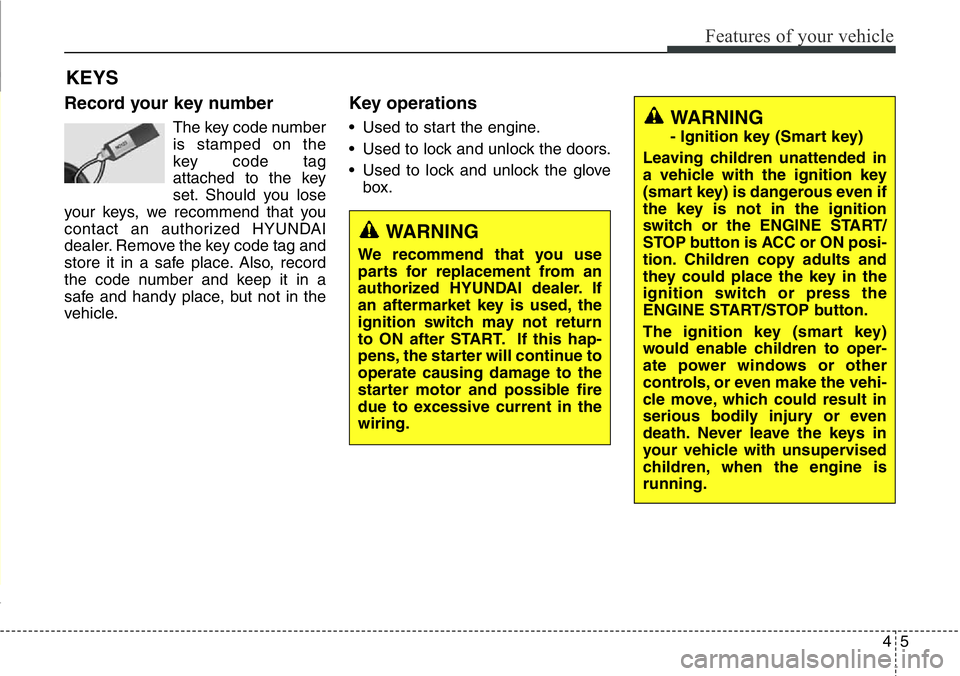
The key code number
is stamped on the
key code tag
attached to the key
set. Should you lose
your keys, we recommend that you
contact an authorized HYUNDAI
dealer. Remove the key code tag and
store it in a safe place. Also, record
the code number and keep it in a
safe and handy place, but not in the
vehicle.
Key operations
• Used to start the engine.
• Used to lock and unlock the doors.
• Used to lock and unlock the glove
box.
KEYS
WARNING
We recommend that you use
parts for replacement from an
authorized HYUNDAI dealer. If
an aftermarket key is used, the
ignition switch may not return
to ON after START. If this hap-
pens, the starter will continue to
operate causing damage to the
starter motor and possible fire
due to excessive current in the
wiring.
WARNING
- Ignition key (Smart key)
Leaving children unattended in
a vehicle with the ignition key
(smart key) is dangerous even if
the key is not in the ignition
switch or the ENGINE START/
STOP button is ACC or ON posi-
tion. Children copy adults and
they could place the key in the
ignition switch or press the
ENGINE START/STOP button.
The ignition key (smart key)
would enable children to oper-
ate power windows or other
controls, or even make the vehi-
cle move, which could result in
serious bodily injury or even
death. Never leave the keys in
your vehicle with unsupervised
children, when the engine is
running.