Page 564 of 711
What to do in an emergency
14 6
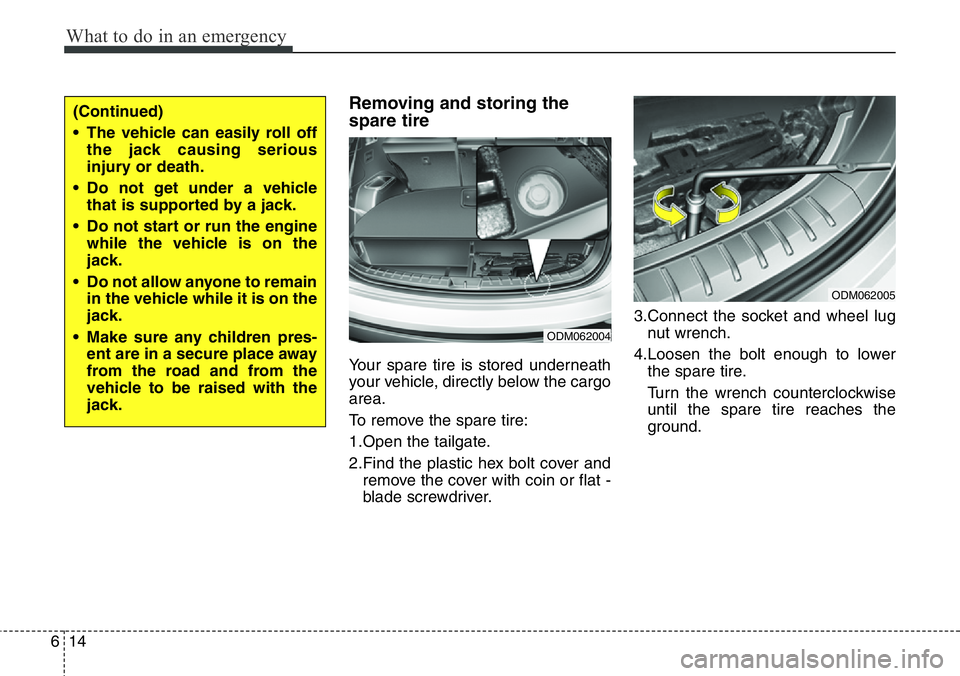
Removing and storing the
spare tire
Your spare tire is stored underneath
your vehicle, directly below the cargo
area.
To remove the spare tire:
1.Open the tailgate.
2.Find the plastic hex bolt cover and
remove the cover with coin or flat -
blade screwdriver.3.Connect the socket and wheel lug
nut wrench.
4.Loosen the bolt enough to lower
the spare tire.
Turn the wrench counterclockwise
until the spare tire reaches the
ground.
ODM062004
(Continued)
• The vehicle can easily roll off
the jack causing serious
injury or death.
• Do not get under a vehicle
that is supported by a jack.
• Do not start or run the engine
while the vehicle is on the
jack.
• Do not allow anyone to remain
in the vehicle while it is on the
jack.
• Make sure any children pres-
ent are in a secure place away
from the road and from the
vehicle to be raised with the
jack.
ODM062005
Page 572 of 711
What to do in an emergency
22 6
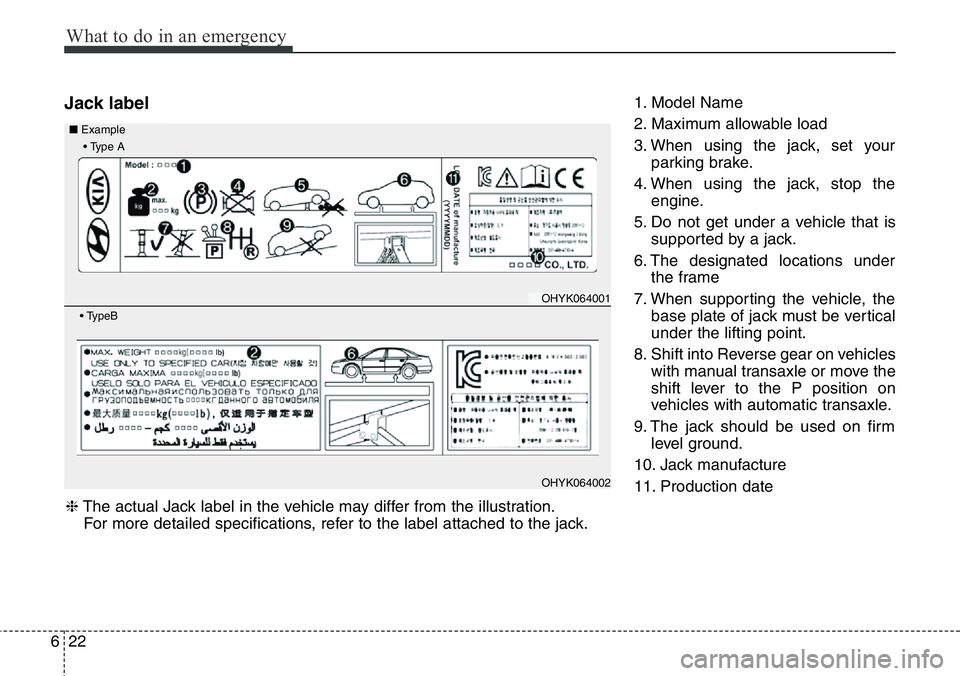
Jack label1. Model Name
2. Maximum allowable load
3. When using the jack, set your
parking brake.
4. When using the jack, stop the
engine.
5. Do not get under a vehicle that is
supported by a jack.
6. The designated locations under
the frame
7. When supporting the vehicle, the
base plate of jack must be vertical
under the lifting point.
8. Shift into Reverse gear on vehicles
with manual transaxle or move the
shift lever to the P position on
vehicles with automatic transaxle.
9. The jack should be used on firm
level ground.
10. Jack manufacture
11. Production date
OHYK064001
OHYK064002
• Type A
■Example
• TypeB
❈The actual Jack label in the vehicle may differ from the illustration.
For more detailed specifications, refer to the label attached to the jack.
Page 577 of 711
627
What to do in an emergency
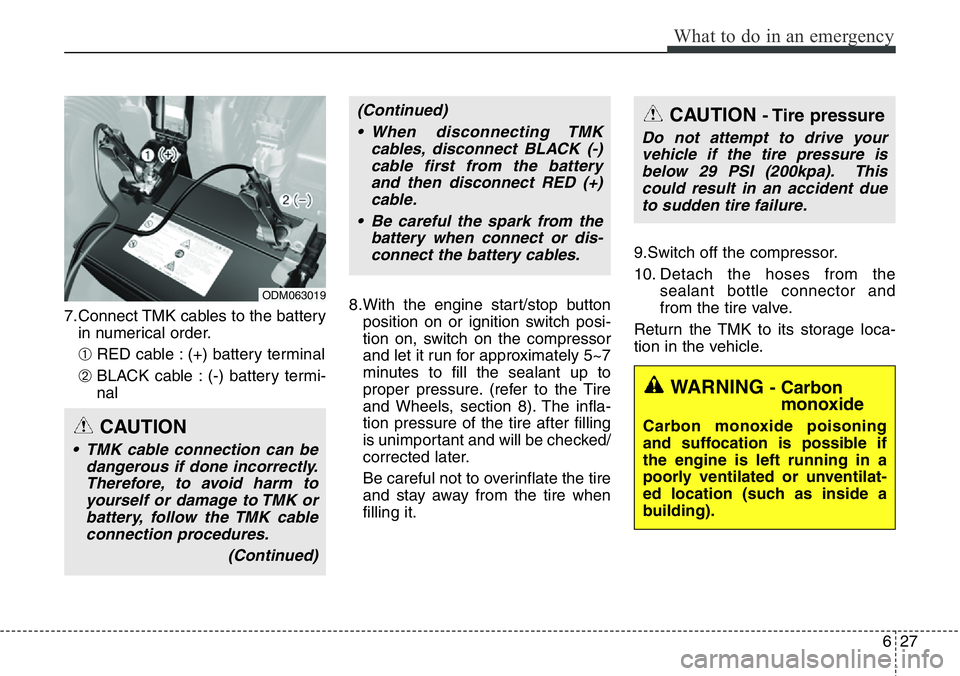
7.Connect TMK cables to the battery
in numerical order.
➀RED cable : (+) battery terminal
➁BLACK cable : (-) battery termi-
nal8.With the engine start/stop button
position on or ignition switch posi-
tion on, switch on the compressor
and let it run for approximately 5~7
minutes to fill the sealant up to
proper pressure. (refer to the Tire
and Wheels, section 8). The infla-
tion pressure of the tire after filling
is unimportant and will be checked/
corrected later.
Be careful not to overinflate the tire
and stay away from the tire when
filling it.9.Switch off the compressor.
10. Detach the hoses from the
sealant bottle connector and
from the tire valve.
Return the TMK to its storage loca-
tion in the vehicle.
CAUTION - Tire pressure
Do not attempt to drive your
vehicle if the tire pressure is
below 29 PSI (200kpa). This
could result in an accident due
to sudden tire failure.
CAUTION
• TMK cable connection can be
dangerous if done incorrectly.
Therefore, to avoid harm to
yourself or damage to TMK or
battery, follow the TMK cable
connection procedures.
(Continued)
ODM063019
WARNING - Carbon
monoxide
Carbon monoxide poisoning
and suffocation is possible if
the engine is left running in a
poorly ventilated or unventilat-
ed location (such as inside a
building).
(Continued)
• When disconnecting TMK
cables, disconnect BLACK (-)
cable first from the battery
and then disconnect RED (+)
cable.
• Be careful the spark from the
battery when connect or dis-
connect the battery cables.
Page 579 of 711
629
What to do in an emergency
Notes on the safe use of the
Tire Mobility Kit
• Park your car at the side of the
road so that you can work with the
TMK away from moving traffic.
Place your warning triangle in a
prominent place to make passing
vehicles aware of your location.
• To be sure your vehicle will not
move, even when you're on fairly
level ground, always set your park-
ing brake.
• Only use the TMK for sealing/infla-
tion passenger car tires. Do not
use on motorcycles, bicycles or
any other type of tires.
• Do not remove any foreign objects-
such as nails or screws -that have
penetrated the tire.
• Before using the TMK, read the
precautionary advice printed on
the sealant bottle!
• Provided the car is outdoors, leave
the engine running. Otherwise
operating the compressor may
eventually drain the car battery.• Never leave the TMK unattended
while it is being used.
• Do not leave the compressor run-
ning for more than 10 min. at a time
or it may overheat.
• Do not use the TMK if the ambient
temperature is below -30°C (-
22°F).
• When both the tire and wheel are
damaged, do not use Tire Mobility
Kit for your safety.
Technical Data
System voltage: DC 15 V
Working voltage: DC 10 - 15 V
Amperage rating: max. 20 A
Suitable for use at temperatures:
-30 ~ +70°C (-22 ~ +158°F)
Max. working pressure:
6 bar (87 psi)
Size
Compressor: 220 x 130 x 80 mm
(8.7 x 5.1 x 3.1 in.)
Sealant bottle:165 x 85.5 ø mm
(6.5 x 3.4 ø in.)
Compressor weight:
1.8 kg (3.97 lbs)
Sealant volume:
620 ml (37.8 cu. in.)
❈Sealant and spare parts can be
obtained and replaced at an
authorized vehicle or tire dealer.
Empty sealant bottles may be dis-
posed of at home. Liquid residue
from the sealant should be dis-
posed of by your vehicle or tire
dealer or in accordance with local
waste disposal regulations.
Page 586 of 711
Maintenance
7
Engine compartment . . . . . . . . . . . . . . . . . . . . . . . . 7-3
Maintenance services . . . . . . . . . . . . . . . . . . . . . . . . 7-5
• Owner’s responsibility . . . . . . . . . . . . . . . . . . . . . . . . . 7-5
• Owner maintenance precautions . . . . . . . . . . . . . . . . . 7-5
• Engine compartment precautions (Diesel engine) . . . 7-7
Owner maintenance . . . . . . . . . . . . . . . . . . . . . . . . . 7-8
• Owner maintenance schedule. . . . . . . . . . . . . . . . . . . . 7-8
Scheduled maintenance service. . . . . . . . . . . . . . . 7-10
• For europe, Except Russia . . . . . . . . . . . . . . . . . . . . . 7-11
• Except europe, For Russia . . . . . . . . . . . . . . . . . . . . . 7-22
Explanation of scheduled maintenance items . . . 7-34
Engine oil. . . . . . . . . . . . . . . . . . . . . . . . . . . . . . . . . 7-38
• Checking the engine oil level . . . . . . . . . . . . . . . . . . . 7-38
• Changing the engine oil and filter . . . . . . . . . . . . . . . 7-39
Engine coolant . . . . . . . . . . . . . . . . . . . . . . . . . . . . 7-40
• Checking the coolant level . . . . . . . . . . . . . . . . . . . . . 7-40
• Changing the coolant . . . . . . . . . . . . . . . . . . . . . . . . . 7-42
Brake/clutch fluid . . . . . . . . . . . . . . . . . . . . . . . . . . 7-43
• Checking the brake/clutch fluid level . . . . . . . . . . . . 7-43
Power steering fluid . . . . . . . . . . . . . . . . . . . . . . . . 7-44
• Checking the power steering fluid level . . . . . . . . . 7-44
• Checking the power steering hose . . . . . . . . . . . . . . . 7-44
Washer fluid . . . . . . . . . . . . . . . . . . . . . . . . . . . . . . 7-45
• Checking the washer fluid level . . . . . . . . . . . . . . . . . 7-45
Parking brake . . . . . . . . . . . . . . . . . . . . . . . . . . . . . 7-46
• Checking the parking brake. . . . . . . . . . . . . . . . . . . . 7-46
Fuel filter (for Diesel) . . . . . . . . . . . . . . . . . . . . . . . 7-47
• Draining water from fuel filter . . . . . . . . . . . . . . . . . 7-47
Air cleaner. . . . . . . . . . . . . . . . . . . . . . . . . . . . . . . . 7-48
• Filter replacement . . . . . . . . . . . . . . . . . . . . . . . . . . . . 7-48
Climate control air filter . . . . . . . . . . . . . . . . . . . . 7-50
• Filter inspection . . . . . . . . . . . . . . . . . . . . . . . . . . . . . . 7-50
• Filter replacement . . . . . . . . . . . . . . . . . . . . . . . . . . . . 7-50
Wiper blades . . . . . . . . . . . . . . . . . . . . . . . . . . . . . . 7-52
• Blade inspection . . . . . . . . . . . . . . . . . . . . . . . . . . . . . . 7-52
• Blade replacement . . . . . . . . . . . . . . . . . . . . . . . . . . . . 7-52
Battery . . . . . . . . . . . . . . . . . . . . . . . . . . . . . . . . . . . 7-55
• For best battery service . . . . . . . . . . . . . . . . . . . . . . . 7-55
• Battery capacity label . . . . . . . . . . . . . . . . . . . . . . . . . 7-56
• Battery recharging . . . . . . . . . . . . . . . . . . . . . . . . . . . 7-57
• Reset items . . . . . . . . . . . . . . . . . . . . . . . . . . . . . . . . . . 7-58
Tires and wheels . . . . . . . . . . . . . . . . . . . . . . . . . . . 7-58
• Tire care . . . . . . . . . . . . . . . . . . . . . . . . . . . . . . . . . . . . 7-58
• Recommended cold tire inflation pressures . . . . . . . 7-58
• Checking tire inflation pressure. . . . . . . . . . . . . . . . . 7-60
• Tire rotation . . . . . . . . . . . . . . . . . . . . . . . . . . . . . . . . . 7-61
• Wheel alignment and tire balance . . . . . . . . . . . . . . . 7-62
• Tire replacement . . . . . . . . . . . . . . . . . . . . . . . . . . . . . 7-62
• Wheel replacement . . . . . . . . . . . . . . . . . . . . . . . . . . . 7-64
Page 588 of 711
73
Maintenance
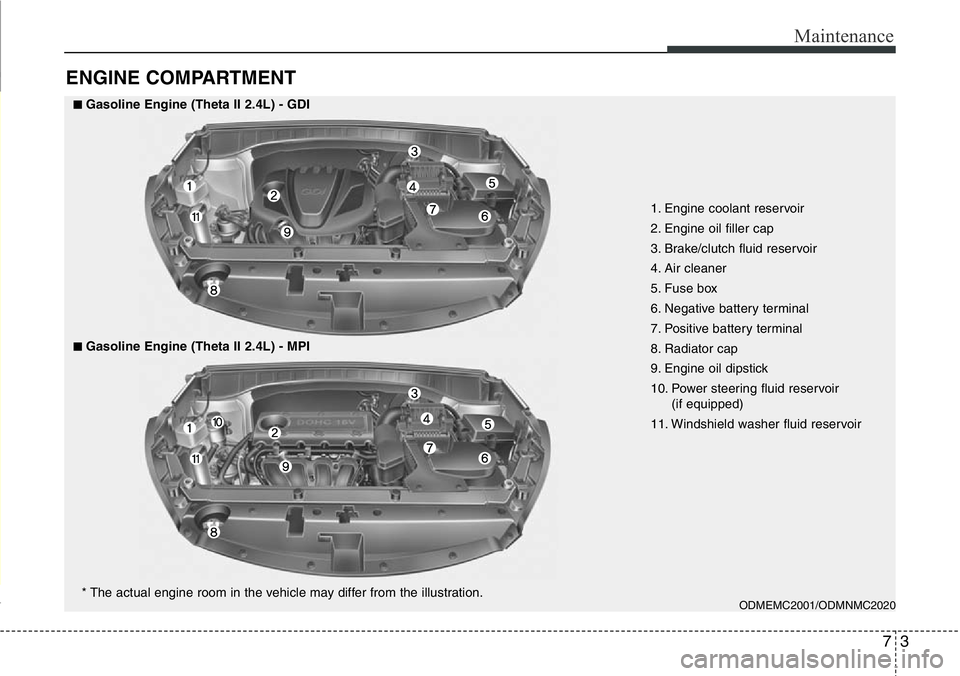
ENGINE COMPARTMENT
1. Engine coolant reservoir
2. Engine oil filler cap
3. Brake/clutch fluid reservoir
4. Air cleaner
5. Fuse box
6. Negative battery terminal
7. Positive battery terminal
8. Radiator cap
9. Engine oil dipstick
10. Power steering fluid reservoir
(if equipped)
11. Windshield washer fluid reservoir
ODMEMC2001/ODMNMC2020
■Gasoline Engine (Theta II 2.4L) - GDI
* The actual engine room in the vehicle may differ from the illustration.
■■Gasoline Engine (Theta II 2.4L) - MPI
Page 589 of 711
Maintenance
4 7
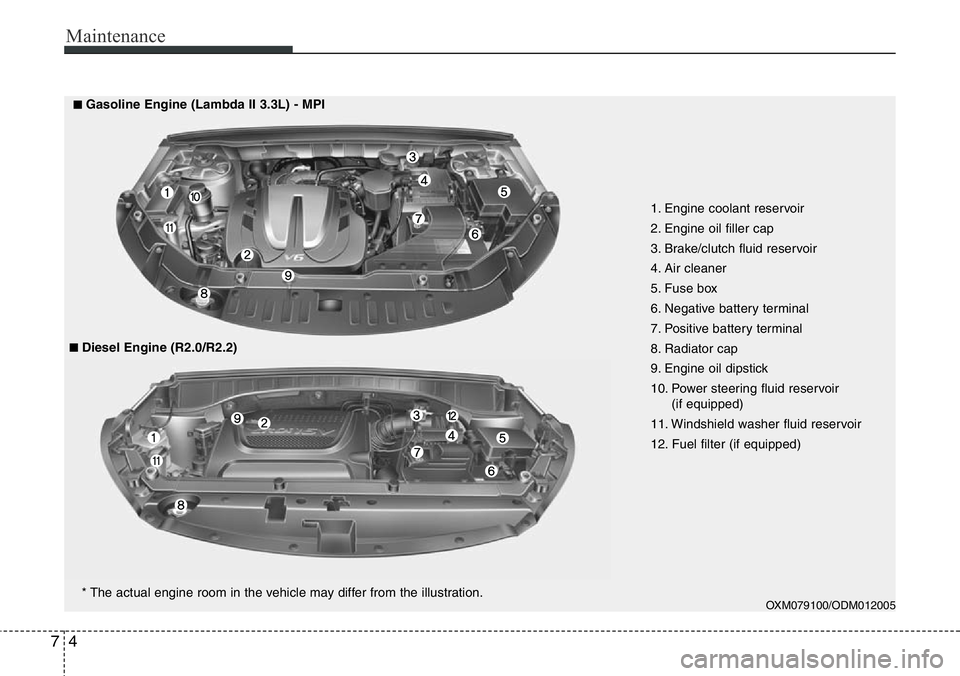
1. Engine coolant reservoir
2. Engine oil filler cap
3. Brake/clutch fluid reservoir
4. Air cleaner
5. Fuse box
6. Negative battery terminal
7. Positive battery terminal
8. Radiator cap
9. Engine oil dipstick
10. Power steering fluid reservoir
(if equipped)
11. Windshield washer fluid reservoir
12. Fuel filter (if equipped)
OXM079100/ODM012005
■Diesel Engine (R2.0/R2.2)
* The actual engine room in the vehicle may differ from the illustration.
■■Gasoline Engine (Lambda II 3.3L) - MPI
Page 591 of 711
Maintenance
6 7
WARNING -
Maintenance work
• Performing maintenance work
on a vehicle can be danger-
ous. You can be seriously
injured while performing some
maintenance procedures. If
you lack sufficient knowledge
and experience or the proper
tools and equipment to do the
work, we recommend that the
system be servied by an
authorized HYUNDAI dealer.
• Working under the hood with
the engine running is danger-
ous. It becomes even more
dangerous when you wear
jewelry or loose clothing.
(Continued)
(Continued)
These can become entangled
in moving parts and result in
injury. Therefore, if you must
run the engine while working
under the hood, make certain
that you remove all jewelry
(especially rings, bracelets,
watches, and necklaces) and
all neckties, scarves, and sim-
ilar loose clothing before get-
ting near the engine or cool-
ing fans.CAUTION
• Do not put heavy objects or
apply excessive force on top
of the engine cover (if
equipped) or fuel related
parts.
• When you inspect the fuel
system (fuel lines and fuel
injection devices), we recom-
mend that you contact an
authorized HYUNDAI dealer.
• Do not drive long time with the
engine cover (if equipped)
removed.
• When checking the engine
room, do not go near fire.
Fuel, washer fluid, etc. are
flammable oils that may cause
fire.
• Before touching the battery,
ignition cables and electrical
wiring, you should disconnect
the battery "-" terminal. You
may get an electric shock
from the electric current.
(Continued)